Watch This U-2 Spy Plane Make A Crazy Landing Without Its Flaps Or Speed Brakes观看这架U-2侦察机在没有襟翼和减速板的情况下完成一次惊险着陆
U-2s are notoriously challenging to land under the best conditions. A loss of key mechanical systems would make doing so even more complicated.
新闻视频
By Joseph Trevithick
Published Feb 12, 2020 7:17 PM EST
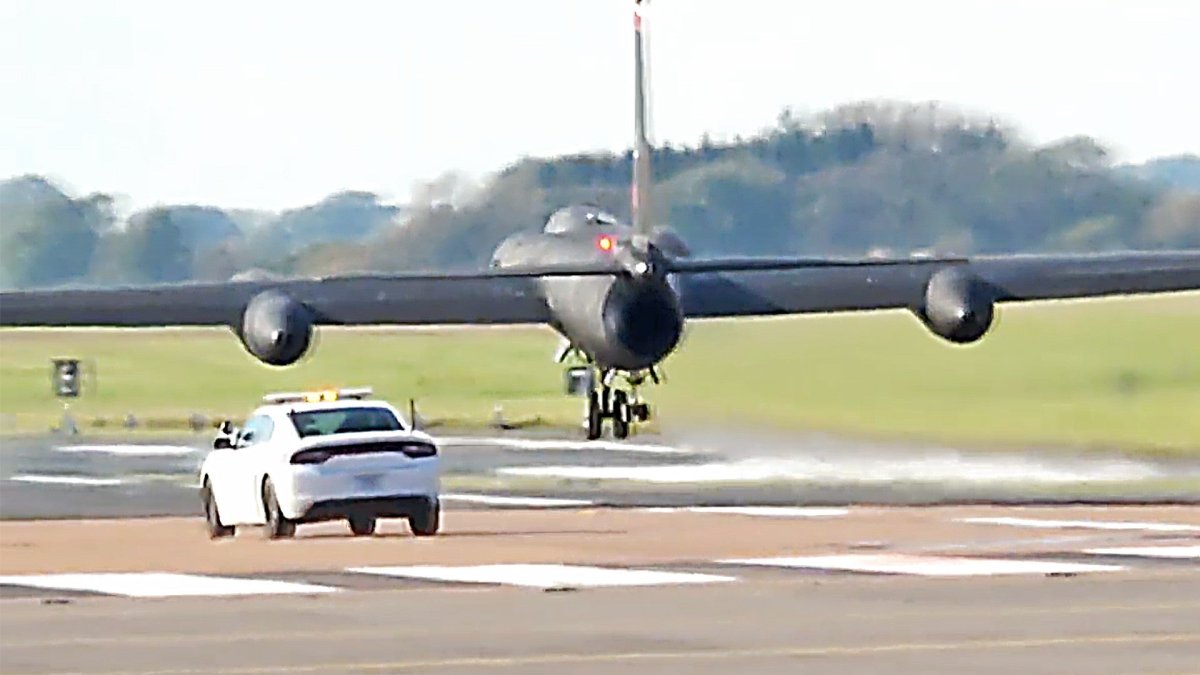
A video has appeared online showing a U.S. Air Force U-2S Dragon Lady spy plane landing at RAF Fairford in the United Kingdom without the help of its flaps or speed brakes. The same clip also shows another U-2S touching down normally from the exact same perspective, offering an interesting comparison of the two landing profiles.
Twitter user and plane spotter @Saint1Mil recently captured both U-2Ss landing at RAF Fairford and shared the footage online. The U-2S Dragon Lady spy plane is notoriously difficult to land under the best conditions, in large part due to the copious amount of lift its wings produce to its landing gear configuration, with only a pair of wheels in the center fuselage and smaller pair of wheels under the tail. The U.S. Air Force notably utilizes pilots driving chase cars on the ground to help get the aircraft down on the ground safely after each mission.
The first U-2S lands as normal with its flaps and speed-brakes deployed. It touches down relatively quickly with the chase car racing behind it. On an unrelated note, the chase car seen in the following video appears to be one of two white Dodge Chargers that the Air Force airlifted to the United Kingdom to support Dragon Lady operations last year at the cost of hundreds of thousands of dollars, something you can read about in this past War Zone story .
The second Dragon Lady comes in with its flaps still retracted and the speed brakes closed. As one of the commenters on @Saint1Mil’s Tweet noted, this landing had to be at a higher speed and much flatter to make up for the lack of ability to slow down without a dangerous loss of lift and stability. You can hear what appears to be the pilot actually increasing the throttle for a moment as the plane flies over the camera.
The more typical pitching up, or flaring, right before landing that is visible in the first U-2S landing, would have made it difficult, if not impossible to land under these conditions. As it is, you can see the second Dragon Lady have an exceptionally hard time actually sticking the landing and staying on the ground. The full landing run is notably longer overall.
All of this is very understandable given the aircraft’s overall design. Even the wings on the original U-2s, which were shorter than those on the present U-2S models, were exceptionally efficient and the type’s first flight, on Aug. 1, 1955, at Area 51, was accidental . The plane was only supposed to conduct a high-speed taxi test, but it left the ground after Lockheed test pilot Tony LeVier tried out the ailerons with the aircraft traveling at around 70 knots.
“I had no intentions whatsoever of flying. I immediately started back toward the ground, but had difficulty determining my height because the lakebed had no markings to judge distance or height,” LeVier subsequently said, according to a now-declassified CIA history of the U-2 program. “I made contact with the ground in a left bank of approximately 10 degrees.”
“The U-2 bounced back into the air, but LeVier was able to bring it back down for a second landing,” the previously secret history added. “He then applied the brakes with little effect, and the aircraft rolled for a long distance before coming to a stop.”
All told, with the U-2 already so finicky to land, to begin with, it’s not hard to see why the Air Force continues to train pilots on how to get the plane back down on the ground safely if an emergency keeps them from being able to extend the Dragon Lady’s flaps.
Contact the author: joe@thedrive.com
Comments couldn’t be loaded. Please refresh the page.
作者:约瑟夫·特雷维西克
发布于美国东部时间2020年2月12日晚上7:17。
一段视频近日在网上流传,显示一架美国空军U-2S“龙夫人”侦察机在英国费尔福德皇家空军基地降落时,未使用襟翼或减速板。同一段视频还从同一视角展示了另一架U-2S正常着陆的画面,从而为两种不同的着陆方式提供了有趣的对比。
推特用户兼飞机观察员@Saint1Mil近日拍摄到两架U-2S侦察机在英国皇家空军费尔福德基地降落的画面,并分享到了网上。U-2S“龙夫人”侦察机即使在最佳条件下也以难以着陆而闻名,这主要是因为其机翼产生的强大升力使其起落架结构复杂——机身中部只有一对轮子,尾部下方还有一对较小的轮子。值得一提的是,美国空军会在每次任务结束后安排飞行员驾驶引导车在地面协助飞机安全着陆。
第一架U-2S侦察机正常着陆,襟翼和减速板均已展开。它着陆速度相对较快,尾随车紧随其后。顺便一提,以下视频中出现的尾随车似乎是去年空军空运至英国支援“龙夫人”行动的两辆白色道奇Charger之一,耗资数十万美元,详情请见此前《战区》报道。
第二架“龙夫人”飞机降落时襟翼仍处于收起状态,减速板也处于关闭状态。正如@Saint1Mil推文下的一位评论者所指出的,由于无法在不损失升力和稳定性的情况下减速,这次着陆必须以更高的速度和更平缓的姿态进行。当飞机飞过镜头时,你可以听到飞行员似乎短暂地加大了油门。
第一架U-2S着陆时,机身在着陆前出现了更常见的抬头或拉平动作,这在当时的条件下会使着陆变得困难,甚至不可能。实际上,我们可以看到第二架“龙夫人”着陆时异常艰难,难以保持稳定。整个着陆滑跑距离也明显更长。
考虑到该飞机的整体设计,这一切都很容易理解。即使是最初的U-2飞机,其机翼比现在的U-2S型要短,但效率却异常高。该机型的首飞于1955年8月1日在51区进行,纯属意外。当时飞机原本只是计划进行高速滑行测试,但在洛克希德公司试飞员托尼·勒维尔(Tony LeVier)以大约70节的速度试飞副翼后,飞机意外离地。
据现已解密的中央情报局U-2项目历史记载,勒维尔后来表示:“我根本没有飞行的意图。我立即开始向地面坠落,但由于湖底没有任何标记可以判断距离或高度,我很难确定自己的高度。我以大约10度的左倾角触地。”
“U-2侦察机弹回空中,但勒维尔设法将其再次降落,”此前保密的历史资料补充道。“随后他踩下刹车,但效果甚微,飞机滑行了很长一段距离后才停了下来。”
总而言之,U-2 本身着陆就非常棘手,因此不难理解为什么空军要继续训练飞行员,让他们在紧急情况下无法展开“龙夫人”的襟翼时,如何安全地将飞机降落到地面上。
联系作者:joe@thedrive.com
评论加载失败,请刷新页面。