The AGM-122 “Sidearm” Came To Be From A Novel Missile Recycling SchemeAGM-122“侧臂”导弹源于一种新型导弹回收方案
And we could use something like it now more than ever.
Updated Jul 5, 2020 7:09 PM EDT
The AGM-122 “Sidearm” anti-radiation missile (ARM) is one of the more obscure operational missile systems within the annals of air combat history, but how it came to be was pretty creative and we probably could use something very similar to it today.
The history of the legendary Sidewinder air-to-air missile reads like alphabet soup, with dozens of variants carrying different letter designations, all of which were designed, tested, and in many cases deployed operationally over the last six decades. These have included a surface-to-air variant, the MIM-72, that equipped the M48 Chaparral short-range mobile air defense system, the air-to-ground AGM-87 Focus, and even a variant intended to defend submarines trying to hide from the prying eyes and ears of maritime patrol aircraft and anti-submarine warfare helicopters. But the AGM-122 version of the Sidewinder is maybe the most novel, and its genesis is actually a tail of two Sidewinder types, the other being the short-lived AIM-9C.
In the late 1970s, it was becoming clear that the Pentagon needed a light-weight anti-radiation missile capable of being deployed on attack helicopters—namely the upcoming AH-64 Apache and battle tested AH-1 Cobra. These helicopters could find themselves operating near or being threatened by enemy radar guided air defenses. Because of its size, the missile could also theoretically be deployed aboard attack jets that provide close air support in the place of short-range air-to-air missiles.
Adapting the hugely popular AIM-9 Sidewinder’s basic design for this requirement made the most sense as doing so would save on development and production costs, and ease aircraft integration. But building new AGM-122 “Sidearm” derivatives of the Sidewinder was not to be. Instead the program came up with a novel idea to reutilize an existing defunct Sidewinder variant to satisfy its lightweight anti-radiation missile requirements.
The AIM-9C Sidewinder, sometimes referred to as the “radar Sidewinder,” was built specifically for the F-8 Crusader in the early 1960s. The missile was the same as the AIM-9D in many ways, but instead of an infrared seeker it utilized a semi-active radar homing (SARH) seeker that could engage targets “painted” by the F-8’s radar. The main advantage of using SARH over infrared guidance was that the missiles could be used to make head-on “face shots” on enemy aircraft, something the Sidewinders of that era could not do. Instead they would require the F-8 to maneuver to the rear aspect of its target in order for the infrared seeker to acquire the enemy aircraft’s hot exhaust. Radar guided Sidewinders could also be more easily employed in all weather environments and at night.
An F-8 carrying AIM-9Cs., USN
About 1,000 AIM-9Cs were built but the concept was short lived due to limitations of the F-8’s radar and fire control system. As a result, large stocks of the missiles existed two decades later, long after the F-8 had ceased fighter operations, and at a time when the AGM-122 program was coming to fruition. The Sidearm conversion basically saw the fitment of a wide-band passive electromagnetic radiation homing seeker in place of the AIM-9C’s existing narrow-band SARH seeker, as well as overhauling the missiles other components, and the fitting of a new fuse section and updated rocket motor used by the AIM-9L/M.
Think of it as a ingenious missile recycling program of sorts.
The general configuration was tested at NAWS China Lake in 1981 and was deemed a success. By that time the Army had lost interest in the program, but the USMC pushed on in an initiative to deploy the lightweight anti-radiation missile on their AV8 Harriers, A-4 Skyhawks and AH-1 Cobra attack helicopters.
AGM-122 about to blow apart that radar emitter while testing a NAWS China Lake range., USN
A contract to convert the remaining AIM-9C stocks to the AGM-122A configuration was won by Motorola in 1984 and the conversions began in 1986. By 1990, the last of roughly 700 AIM-9Cs became AGM-122As.
The missile could lock on to a wide variety of enemy radar systems and chase them down even if they are on the move, albeit at relatively close ranges of around nine miles on paper, but often far shorter ranges in reality since the weapon was to be fired from low altitudes. Anti-aircraft artillery and short-range air defense systems (SHORADS), such as point defense SAM emplacements and mobile vehicle mounted anti-air systems were the missile’s primary targets, but it could also be used to attack enemy vessels that were emitting threatening radar energy. It was an incredibly simple but effective weapon.
A AV-8A Harrier at NAWS China Lake equipped with a AGM-122 Sidearm. , USN
Once fired, the missile was programmed to enact a “pop-up” maneuver so that it could make a diving terminal attack on the emitter being targeting. Although it lacked the standoff range, speed or advanced processing power of AGM-88 High-Speed Anti-Radiation Missile (HARM), it was still relevant. The one caveat being that the aircraft carrying it would have to get comparatively “down and dirty” with the threat in order to kill it.
Also it should be noted that the Sidearm was intended to destroy the radar emitter—the antenna basically—and not the armored vehicle or the surrounding infrastructure it is mounted on. In other words, it’s a suppression of enemy air defenses weapon intended to exact a “mission kill” on an enemy air defense system, not obliterate it and its controllers entirely. The same continuous rod fragmentation warhead was used in the AGM-122 as the AIM-9C, which gave it limited destructive ability, but a high probability of causing a fatal impact on the emitter itself.
In the end, the Sidearm was primary fielded by the USMC on its Cobra attack helicopters and AV8 Harrier jump-jets. Over the years the missiles were slowly fired off or went out of service as their expiration dates were reached. A much more capable and reprogrammable successor was planned to be built from scratch, dubbed the AGM-122B, after all the AIM-9Cs were converted, but funding from the services for this extension of the program never materialized.
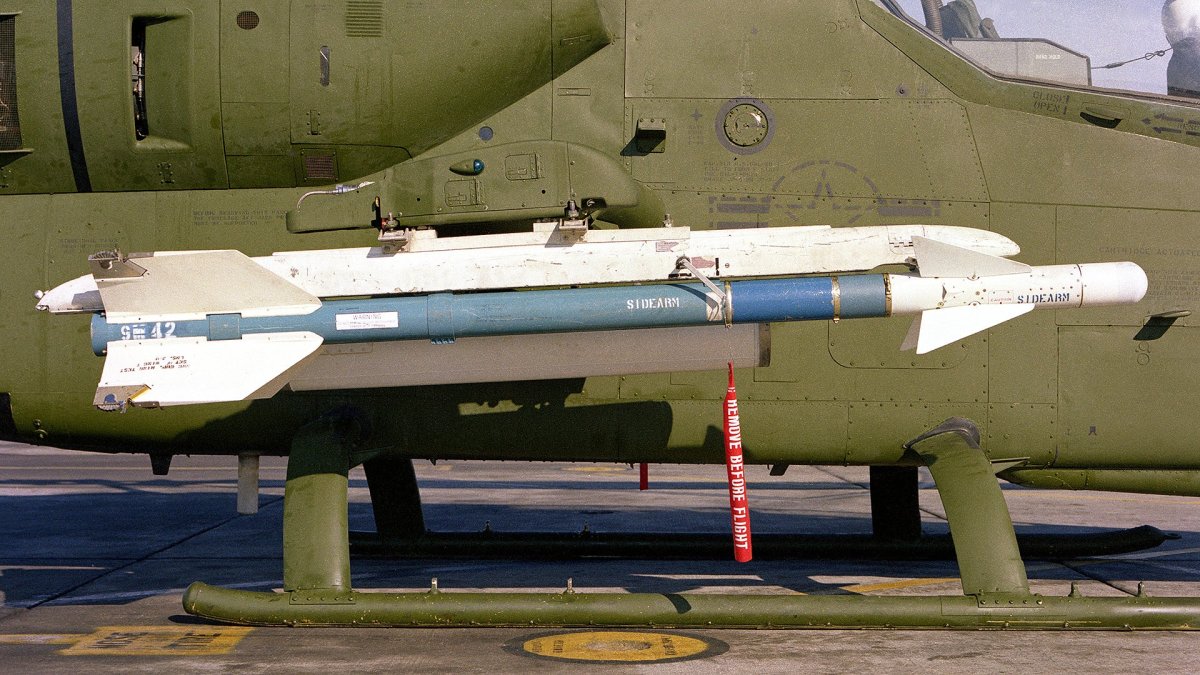
A AGM-122 mounted on a Cobra during testing in 1981. , USN
The Sidearm story is a relevant one not just because it showed how repurposing an existing platform can be a viable proposition and economically beneficial, but also that a light-weight ARM is really more relevant today than it was 30 years ago.
Today’s modern ground-based air defense systems are increasingly mobile and lethal. Systems like Russia’s Pantsir S1 , 2k22 Tungusta and Tor short-range mobile air defense systems, and many others from other countries, both friendly and not so friendly, have proliferated around the globe dramatically. These systems are hard to pinpoint and destroy using conventional suppression and destruction of enemy air defenses (SEAD/DEAD) tactics and can “pop up” virtually anywhere.
Advanced helicopters with capable radar warning and homing receivers may be able to detect the presence of these systems, after which they can try to avoid or attack them, but having the option to suppress them without having to mount a traditional strike on them would be beneficial. An updated version of the Sidearm, that can pop-up from low-level and detect, and then home in on and destroy an enemy emitter, without putting the helicopter at direct risk, could be a very useful tool on the anti-access battlefields of tomorrow. The USAF’s A-10 Warthog fleet, which is supposed to serve at least to 2030 now, could also benefit from such a weapon, as could a light attack turboprop aircraft should the USAF actually field one once and for all.
Basing such a design on the newest version of the Sidewinder, the AIM-9X, would make a lot of sense, and would offer enhanced kinematic performance over the AGM-122, but one short-range missile already has the capability to home-in on emissions from enemy radars—that being the small but highly agile RIM-116 Rolling Airframe Missile (RAM).
This missile is used as the primary point-defense weapon for US Navy and many NATO ships. Like the AGM-122, it uses components of the Sidewinder for its basic platform, but has a dual-mode seeker that rapidly homes in on enemy missile radar emissions as well as incorporating the infrared seeker from a FIM-92 Stinger man-portable air defense system (MANPADS) . It uses both these systems to reliably lock onto and engage incoming enemy anti-ship cruise missiles, some of which can crest the horizon at supersonic speeds.
RIM-116 being test fired. , AP
A simplified version of this missile omitting the infrared seeker and with specialized autopilot programing could give American helicopters and low-flying attack aircraft the rapid-reaction enemy air defenses killing capability they need. Not just that, but they could likely be programmed to sniff out and kill other emissions, such as radio signals and data-link emissions. If the infrared seeker was left on, they could be able to work as a dual-role missile, able to smash enemy radar emitters and take out other helicopters and low flying aircraft, as well as drones, at short ranges.
The AT-6 is one of the aircraft the USAF is eyeing as a possible light attack and surveillance aircraft., Beechcraft
So in some ways, the AGM-122 can be seen as almost as a proof of concept program, a forerunner to a much more capable, but also relatively off-the-shelf missile that can be adapted for similar and expanded uses. Think of it as the Sidearm II. But it all comes down to there being a will in the services to back such a project. At this time there doesn’t seem to be, which seems odd. Heavy reliance on electronic warfare and enhances situational awareness may be to blame for this. But now that the A-10 will be around for a long time to come, and a fleet of light air support aircraft may begin doing the duty of fighter aircraft for lower intensity conflicts, not to mention the growing threat of drones, maybe the Sidearm concept’s time has finally come.
Contact the author: Tyler@thedrive.com
Comments couldn’t be loaded. Please refresh the page.
更新于美国东部时间2020年7月5日晚上7:09
AGM-122“侧臂”反辐射导弹(ARM)是空战史上较为鲜为人知的作战导弹系统之一,但它的研发过程却颇具创意,我们今天或许可以使用与之非常相似的东西。
传奇的“响尾蛇”空空导弹的历史可谓错综复杂,数十种型号各异,均以不同的字母命名,所有这些型号都在过去六十年间经过设计、测试,并在许多情况下投入实战部署。其中包括装备M48“响尾蛇”近程机动防空系统的地对空型号MIM-72,空对地型号AGM-87“焦点”,甚至还有一种旨在保护潜艇免受海上巡逻机和反潜直升机侦察的型号。但AGM-122型“响尾蛇”或许是最具创新性的,它的起源实际上是两种“响尾蛇”导弹的融合,另一种是昙花一现的AIM-9C。
20世纪70年代末,五角大楼越来越意识到需要一种轻型反辐射导弹,能够部署在攻击直升机上——特别是即将服役的AH-64“阿帕奇”和久经沙场的AH-1“眼镜蛇”。这些直升机可能会在敌方雷达制导防空系统附近作战,甚至受到其威胁。由于其体积小巧,理论上这种导弹也可以部署在攻击机上,以替代短程空空导弹提供近距离空中支援。
鉴于AIM-9“响尾蛇”导弹广受欢迎,对其进行基本设计改造以满足这一需求是最合理的选择,因为这样做可以节省研发和生产成本,并简化飞机集成。然而,研制新型AGM-122“侧臂”导弹(即“响尾蛇”的衍生型号)的计划最终未能实现。取而代之的是,该项目提出了一种新颖的方案:重新利用一种已停产的“响尾蛇”导弹型号,以满足其轻型反辐射导弹的需求。
AIM-9C“响尾蛇”导弹,有时也被称为“雷达响尾蛇”,是20世纪60年代初专为F-8“十字军战士”战斗机研制的。该导弹在许多方面与AIM-9D相同,但它没有采用红外导引头,而是使用了半主动雷达制导(SARH)导引头,可以攻击由F-8雷达“标记”的目标。使用SARH制导相比红外制导的主要优势在于,该导弹可以对敌机进行正面攻击,而当时的“响尾蛇”导弹则无法做到这一点。使用红外制导的“响尾蛇”导弹需要F-8战斗机机动到目标后方,以便红外导引头能够捕获敌机的高温尾焰。此外,雷达制导的“响尾蛇”导弹在各种天气条件和夜间作战也更加便捷。
一架携带AIM-9C导弹的F-8战斗机,美国海军
AIM-9C导弹大约生产了1000枚,但由于F-8战斗机的雷达和火控系统存在局限性,该导弹项目很快便告终止。结果,在F-8战斗机退役二十年后,以及AGM-122导弹项目即将完成之际,仍然有大量的AIM-9C导弹库存。“侧臂”(Sidearm)改装方案主要包括:用宽带被动电磁辐射(PEMR)导引头替换AIM-9C原有的窄带半主动雷达制导(SARH)导引头,并对导弹的其他部件进行改造,同时安装AIM-9L/M使用的新型引信段和升级后的火箭发动机。
你可以把它想象成一种巧妙的导弹回收计划。
该导弹的总体配置于1981年在中国湖海军航空武器站进行了测试,并被认为取得了成功。当时陆军已经对该项目失去了兴趣,但海军陆战队继续推进一项计划,将这种轻型反辐射导弹部署到其AV8“鹞”式战斗机、A-4“天鹰”攻击机和AH-1“眼镜蛇”攻击直升机上。
AGM-122导弹在测试中国湖海军航空武器站靶场时,险些炸毁雷达发射器。(美国海军)
摩托罗拉公司于 1984 年赢得了将剩余的 AIM-9C 库存转换为 AGM-122A 配置的合同,转换工作于 1986 年开始。到 1990 年,大约 700 枚 AIM-9C 中的最后一批都变成了 AGM-122A。
这种导弹能够锁定多种敌方雷达系统,即使目标正在移动也能将其追踪。理论上的有效射程约为9英里,但实际射程往往更短,因为该武器通常从低空发射。防空炮兵和短程防空系统(SHORADS),例如点防御防空导弹阵地和车载防空系统,是该导弹的主要目标,但它也可用于攻击发出威胁性雷达信号的敌方舰艇。这是一种极其简单却又十分有效的武器。
一架装备有AGM-122“侧卫”导弹的AV-8A“鹞”式战斗机,停放在中国湖海军航空站。
导弹发射后,会按照预设程序进行“弹出”机动,以便对目标辐射源进行俯冲末端攻击。虽然它缺乏AGM-88高速反辐射导弹(HARM)的远程射程、速度和先进的处理能力,但仍然具有一定的实用价值。唯一的不足之处在于,携带该导弹的飞机必须采取相对“近距离”的攻击手段才能将其摧毁。
此外,需要指出的是,“侧卫”导弹旨在摧毁雷达发射器(即天线),而非装甲车辆或其周围的基础设施。换句话说,它是一种压制敌方防空系统的武器,旨在对敌方防空系统执行“任务摧毁”,而非彻底摧毁该系统及其控制人员。AGM-122 导弹与 AIM-9C 导弹一样,均采用连续棒状破片战斗部,这使其破坏力有限,但对雷达发射器本身造成致命打击的概率很高。
最终,AIM-9“侧卫”导弹主要装备于美国海军陆战队的“眼镜蛇”攻击直升机和AV-8“鹞”式垂直起降战斗机上。多年来,随着导弹寿命的到期,它们逐渐被淘汰或退役。在所有AIM-9C导弹完成改装后,军方计划从零开始研发一款性能更强、可重新编程的后继导弹,代号AGM-122B,但军方最终未能为该项目的延期提供资金。
1981年,一枚AGM-122导弹安装在眼镜蛇战斗机上进行测试。(美国海军)
Sidearm 的故事之所以具有现实意义,不仅在于它表明重新利用现有平台可以是一个可行的方案,并且在经济上是有利的,还在于它表明轻量级 ARM 在今天比 30 年前更具现实意义。
当今的现代地面防空系统机动性越来越强,杀伤力也越来越大。例如俄罗斯的“铠甲S1”、“通古斯塔2K22”和“道尔”等短程机动防空系统,以及其他许多国家(包括友好国家和非友好国家)的同类系统,已在全球范围内迅速扩散。这些系统难以通过传统的压制和摧毁敌方防空系统(SEAD/DEAD)战术进行精确定位和摧毁,几乎可以在任何地方“突然出现”。
配备先进雷达告警和归航接收器的直升机或许能够探测到这些系统的存在,之后可以尝试规避或攻击它们。但如果能够在不发动传统攻击的情况下压制这些系统,将会更有益处。升级版的“侧卫武器”(Sidearm)可以从低空突入,探测并追踪摧毁敌方发射源,而无需将直升机置于直接危险之中,这在未来的反介入/区域拒止战场上可能成为一种非常有效的工具。美国空军的A-10“疣猪”攻击机机队(目前预计至少服役到2030年)以及轻型攻击涡轮螺旋桨飞机(如果美国空军最终全面部署此类飞机)都将受益于这种武器。
以最新版本的响尾蛇导弹 AIM-9X 为基础进行这样的设计是很有道理的,并且与 AGM-122 相比,它将提供更强的运动性能,但有一种短程导弹已经能够追踪敌方雷达的辐射——那就是体积小但机动性极强的 RIM-116 滚体导弹 (RAM)。
这种导弹是美国海军和许多北约舰艇的主要近程防御武器。与AGM-122导弹一样,它以“响尾蛇”导弹的部件为基础平台,但配备了双模导引头,能够快速追踪敌方导弹的雷达信号,并集成了FIM-92“毒刺”便携式防空导弹系统(MANPADS)的红外导引头。它利用这两种系统可靠地锁定并拦截来袭的敌方反舰巡航导弹,其中一些导弹能够以超音速飞越地平线。
RIM-116正在进行试射。(美联社)
这种导弹的简化版本,如果去掉红外导引头并配备专门的自动驾驶程序,就能赋予美国直升机和低空攻击机所需的快速反应能力,摧毁敌方防空系统。不仅如此,它们还可以被编程来探测并摧毁其他辐射源,例如无线电信号和数据链辐射。如果保留红外导引头,它们就能作为双用途导弹使用,既能摧毁敌方雷达发射器,又能近距离击落其他直升机、低空飞行器以及无人机。
AT-6是美国空军正在考虑的轻型攻击和侦察机候选机型之一。比奇飞机公司
因此,从某种程度上说,AGM-122几乎可以被视为一个概念验证项目,是性能更强、相对现成的导弹的先驱,后者可以进行改装以用于类似甚至更广泛的用途。可以把它想象成“侧卫”导弹的升级版。但关键在于军方是否有意愿支持这样的项目。目前看来,军方似乎并没有这种意愿,这令人费解。过度依赖电子战和增强态势感知能力可能是造成这种情况的原因。但鉴于A-10攻击机将在未来很长一段时间内服役,轻型空中支援飞机可能会开始承担战斗机在低强度冲突中的任务,更不用说无人机的威胁日益增长,或许“侧卫”导弹的概念终于迎来了发展的时机。
联系作者:Tyler@thedrive.com
评论加载失败,请刷新页面。