Shahed-136 Clone Found By Florida Fisherman, Eglin AFB Admits It Lost A Drone佛罗里达州渔民发现一架Shahed-136克隆无人机,埃格林空军基地承认丢失了一架无人机
The drone hauled in off Florida appears to be of the same family as those used by the U.S. military to strike Iran.
By Howard Altman , Tyler Rogoway
Published Sep 20, 2026 4:09 PM EDT
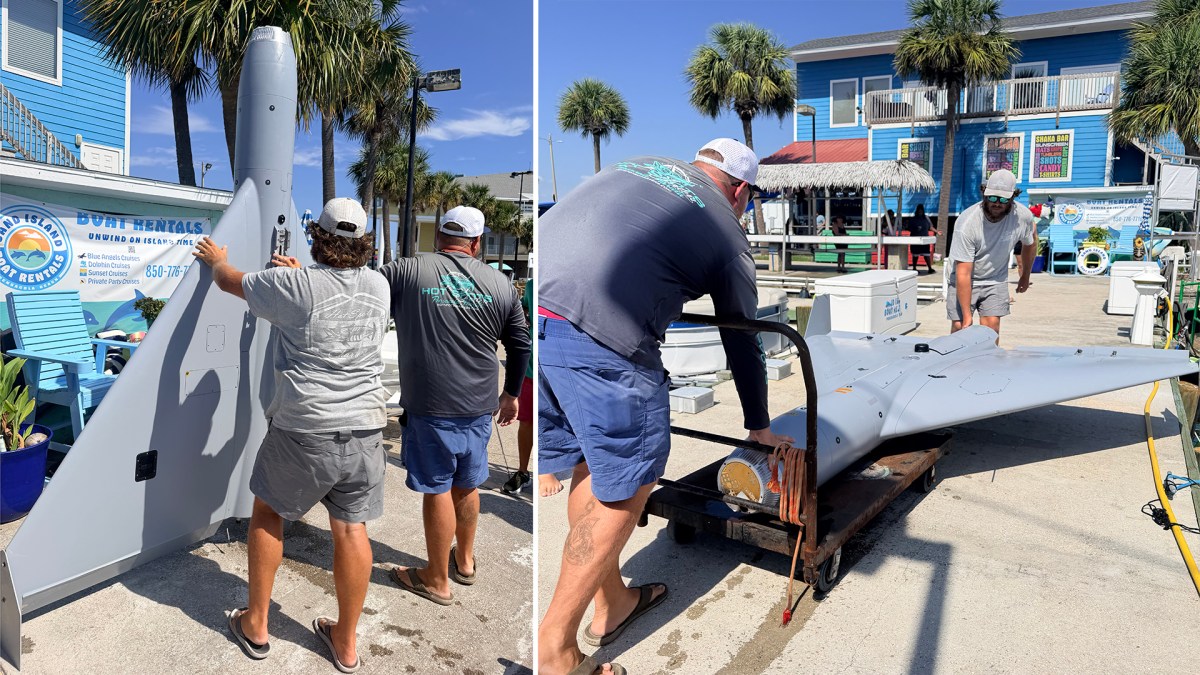
A Florida fishing charter boat made a very unusual catch Saturday while operating near Eglin Air Force Base . Located in the western end of the Florida Panhandle, Eglin is home of the U.S. Air Force weapons test wing. Hot Spots Charters pulled a delta-wing aerial drone out of the water during an excursion, according local charter captain Charlie Green. The recovered drone closely resembles a clone of the Iranian Shahed-136 one-way attack weapon, specifically the U.S. military’s Low-Cost Uncrewed Combat Attack System (LUCAS) that took center stage during its first combat use in Operation Epic Fury. The target version of that drone is built by SpecktreWorks and is designated the FLM-136. It was originally designed for mimicking one-way attack munitions, specifically the Shahed-136, which it was reverse engineered from, for testing and training before it was weaponized into LUCAS.
An Eglin AFB spokesperson told us the installation recently lost a drone, but would not confirm it was the same one found by Hot Spots Charters.
“I can confirm that we were doing a test and the test article went down,” the spokesperson told us, declining to provide further details about what kind of drone, when it was lost or the location it went down. They referred us to the Pentagon, which could not immediately provide any additional details.
“The drone was found by local charter Capt. Daniel Arsenault with Hot Spots Charters,” said Green, who is also an aviation photographer whose work can be found at Aquatic Charlie on social media . “He saw the object at a distance and went over to check it out. When he did, he pulled a good size mahi-mahi out from underneath it, complementing his already stocked cooler full of fish from that morning charter. His passengers helped him haul it aboard.”
The drone found by Hot Spots Charters. (Charlie Green)
“Arsenault and his charter company did all the due diligence possible to notify local agencies of the recovery- and was eventually collected by one of them,” Green added. He did not know which agency.
Images taken of the drone shared with us by Green show that it did not have the engine, propeller or the nose cone/seeker intact. Losing these kind of components is common for impacts into water.
While the Eglin spokesperson offered scant details, the host unit at the installation is the 96th Test Wing, which is the “test and evaluation center for Air Force air-delivered weapons, navigation and guidance systems, command and control systems, and Air Force Special Operations Command systems,” according to the wing’s homepage . It oversees the massive Eglin Gulf Test Range, which “provides approximately 120,000 square miles of overwater airspace, covering the eastern third of the Gulf of Mexico from the Florida panhandle to the Florida Keys. The land range covers 724 square miles and contains 70 specific test and training areas, including an approved depleted uranium test range and the only qualified air-to-ground supersonic range east of the Mississippi River.”
Eglin Test Range. (Eglin Air Force Base)
As noted in the opening of this article, the LUCAS drone was used for the first time in combat during the opening day of the Operation Epic Fury war on Iran on Feb. 28.
“Costing approximately $35,000 per platform, LUCAS is a low-cost, scalable system that provides cutting-edge capabilities at a fraction of the cost of traditional long-range U.S. systems that can deliver similar effects,” Navy Capt. Tim Hawkins, a CENTCOM spokesperson, told TWZ when the command stood up Task Force Scorpion Strike (TFSS), the military’s first one-way attack drone unit, back in December. “The drone system has an extensive range and the ability to operate beyond line of sight, providing significant capability across CENTCOM’s vast operating area.”
“LUCAS drones deployed by CENTCOM have an extensive range and are designed to operate autonomously,” CENTCOM added in a press release. “They can be launched with different mechanisms to include catapults, rocket-assisted takeoff, and mobile ground and vehicle systems.”
TFSS falls under the auspices of U.S. Special Operations Command Central (SOCCENT), which oversees U.S. special operations activities across the Middle East.
A LUCAS drone. (NAVCENT/C5F/U.S. Army Spc. Kayla McGuire) NAVCENT/C5F/U.S. Army Spc. Kayla Mc Guire
A LUCAS drone. (Courtesy photo/Naval Air Warfare Center Weapons Division)
While we aren’t sure if the drone found by Hot Spots Charters is the one lost by Eglin, it wouldn’t be the first time something like this has happened in Florida. For example, in 2021, beachcombers in Florida’s Palm Beach County found a U.S. Air Force BQM-167A high-performance target drone that washed ashore.
BREAKING: Military drone washes up on beach at Ocean Ridge Hammock Park https://t.co/JXMYTAdXcP pic.twitter.com/rHW5Dyv94p — WPTV (@WPTV) March 19, 2021
BREAKING: Military drone washes up on beach at Ocean Ridge Hammock Park https://t.co/JXMYTAdXcP pic.twitter.com/rHW5Dyv94p
Indeed, the Air Force has a handful of 120-foot boats, the only vessels in its service, to help recover drones after they are shot down during live-fire exercises , or otherwise need to be recovered from these waters. The boats are operated by a contracted crew from Florida Offshore and retrieve around 100 of the drones each year.
The FLM-136’s origins as a target drone are highly relevant here. Counter-unmanned aerial system (C-UAS) capabilities are being hotly pursued on all fronts across the U.S. military as the threat from them has ballooned. During the war in Ukraine and multiple engagements with Iran, including Operation Epic Fury, one-way attack drones have proven to be a massive threat that is heavily influencing how wars are fought. As far as Eglin AFB goes, maybe the most high-profile C-UAS development as of late that has emerged from there has been arming USAF fighters with FALCO APKWS laser-guided rockets to shoot down exactly the same kind of threat that the FLM-136 is meant to emulate. This program began in 2019, which TWZ was first to report on, but was finally rushed into service years later as the standoff with Iran went hot. Now there are many other programs aimed at dealing with these same threats, including a more capable “fire and forget” air-to-air APKWS .
A 2019 test of air-to-air APKWS laser-guided rockets occurred off Eglin AFB. (USAF)
LUCAS development is continuing at a high-pace, with its ability to swarm cooperatively with other LUCAS drones — a feature we reported as central to the LUCAS vision when the existence of the program was disclosed — being worked on now. You can read more about this here . These systems need sanitized airspace for development activities, and the vast ranges over the gulf are some of the best in the country for it.
So, it’s not surprising to see an FLM-136 floating in the waters off Eglin AFB. Even in the war with Iran, there were multiple losses of LUCAS drones where they were found intact. These weapons are produced to be risked in large numbers, and some failing, for whatever reason, is just part of the calculus.
Locals in Iraq appear to have recovered a crashed and almost entirely intact Low-Cost Unmanned Combat Attack System (LUCAS), an American copy of the Iranian Shahed-136 Attack Drone, which is confirmed to have been used recently by Task Force Scorpion Strike during U.S. attacks on… pic.twitter.com/SEqO6627en — OSINTdefender (@sentdefender) March 2, 2026
Locals in Iraq appear to have recovered a crashed and almost entirely intact Low-Cost Unmanned Combat Attack System (LUCAS), an American copy of the Iranian Shahed-136 Attack Drone, which is confirmed to have been used recently by Task Force Scorpion Strike during U.S. attacks on… pic.twitter.com/SEqO6627en
We will update this story with any additional details we can find about this drone. Though we don’t yet know for sure where it came from, one thing is for certain, the folks on the Hot Spots Charters boat that found it will always have a good tale about the one that didn’t get away.
Contact the author: howard@twz.com
Comments couldn’t be loaded. Please refresh the page.
作者:霍华德·奥特曼、泰勒·罗戈威
发布于美国东部时间2026年9月20日下午4:09
周六,一艘佛罗里达州的包船在埃格林空军基地附近作业时,意外捕获了一架非常罕见的无人机。埃格林空军基地位于佛罗里达州狭长地带的西端,是美国空军武器测试联队的所在地。据当地包船船长查理·格林称,Hot Spots Charters公司在一次出海垂钓活动中,从水中打捞出一架三角翼无人机。这架无人机与伊朗的“沙赫德-136”单向攻击武器非常相似,尤其是与美国军方的低成本无人作战攻击系统(LUCAS)极为相似。LUCAS在“史诗狂怒行动”中首次投入实战,并发挥了关键作用。这架无人机的目标版本由SpecktreWorks公司制造,型号为FLM-136。它最初的设计目的是模拟单向攻击弹药,特别是“沙赫德-136”单向攻击弹药(FLM-136正是基于“沙赫德-136”单向攻击弹药逆向工程而来),用于测试和训练,之后才被改装成LUCAS。
埃格林空军基地的一位发言人告诉我们,该基地最近丢失了一架无人机,但他不愿证实这架无人机是否是 Hot Spots Charters 找到的那架。
发言人告诉我们:“我可以确认我们当时正在进行测试,测试无人机坠毁了。”但他拒绝透露更多关于无人机型号、坠毁时间或坠毁地点等细节,并建议我们联系五角大楼,但五角大楼方面未能立即提供更多信息。
“这架无人机是当地包船公司Hot Spots Charters的船长丹尼尔·阿森诺特发现的,”格林说道,他同时也是一名航空摄影师,作品可以在社交媒体账号Aquatic Charlie上找到。“他远远地看到了这个物体,便走过去查看。结果,他从无人机下面拉出了一条体型不错的鲯鳅,这让他原本就装满鱼的冷藏箱更加丰盛,这些鱼都是他当天早上包船出海时捕获的。他的乘客们帮他把鱼拖上了船。”
Hot Spots Charters公司发现的无人机。(查理·格林摄)
格林补充说:“阿尔塞诺和他的包机公司尽一切可能通知了当地机构飞机失事的情况,最终由其中一家机构负责追回了飞机残骸。”但他不知道是哪家机构。
格林分享给我们的无人机照片显示,它的发动机、螺旋桨和锥形头/导引头均已损毁。坠入水中后,这些部件的丢失很常见。
埃格林空军基地发言人并未透露太多细节,但据该基地官网介绍,驻扎在该基地的单位是第96测试联队,该联队是“空军空投武器、导航制导系统、指挥控制系统以及空军特种作战司令部系统的测试和评估中心”。它负责管理规模庞大的埃格林湾试验场,该试验场“提供约12万平方英里的海上空域,覆盖墨西哥湾东部三分之一的区域,从佛罗里达狭长地带延伸至佛罗里达群岛。陆地靶场占地724平方英里,包含70个专用测试和训练区域,其中包括一个经批准的贫铀弹试验场和密西西比河以东唯一合格的空对地超音速靶场。”
埃格林试验场。(埃格林空军基地)
正如本文开头所述,LUCAS 无人机于 2 月 28 日在对伊朗发动的“史诗狂怒行动”战争的第一天首次投入实战。
“LUCAS系统每个平台造价约为3.5万美元,是一款低成本、可扩展的系统,能够以远低于传统远程美军系统的成本提供尖端能力,而这些系统也能达到类似的效果。”美国中央司令部发言人、海军上校蒂姆·霍金斯在去年12月中央司令部组建“蝎子打击特遣队”(TFSS)时告诉TWZ。TFSS是美军首个单向攻击无人机部队。“该无人机系统拥有广阔的作战范围和超视距作战能力,能够在中央司令部广阔的作战区域内提供强大的作战能力。”
美国中央司令部在一份新闻稿中补充道:“中央司令部部署的卢卡斯无人机航程远,设计为自主运行。它们可以通过不同的发射机制发射,包括弹射器、火箭助推起飞以及移动地面和车辆系统。”
TFSS隶属于美国特种作战司令部中央司令部(SOCCENT),该司令部负责监督美国在中东的特种作战活动。
一架卢卡斯无人机。(美国海军中央司令部/C5F/美国陆军下士凯拉·麦奎尔)
一架卢卡斯无人机。(图片由海军航空作战中心武器部提供)
虽然我们尚不确定Hot Spots Charters公司发现的无人机是否就是埃格林空军基地丢失的那架,但这并非佛罗里达州首次发生此类事件。例如,2021年,佛罗里达州棕榈滩县的沙滩拾荒者就发现了一架被冲上岸的美国空军BQM-167A高性能靶机。
突发:一架军用无人机被冲上海洋岭吊床公园的海滩 https://t.co/JXMYTAdXcP pic.twitter.com/rHW5Dyv94p — WPTV (@WPTV) 2021年3月19日
突发:一架军用无人机被冲上海洋岭吊床公园的海滩 https://t.co/JXMYTAdXcP pic.twitter.com/rHW5Dyv94p
事实上,美国空军拥有少量120英尺长的船只,这是其现役唯一的此类舰艇,专门用于在实弹演习中被击落或因其他原因需要从这些水域回收无人机。这些船只由佛罗里达近海公司的承包船员操作,每年大约回收100架无人机。
FLM-136作为靶机的起源与此密切相关。随着无人机威胁的日益加剧,美国军方正在各个领域大力发展反无人机系统(C-UAS)能力。在乌克兰战争和与伊朗的多次交战中,包括“史诗狂怒行动”,单向攻击无人机已被证明是巨大的威胁,并深刻影响着战争的进程。就埃格林空军基地而言,近期最引人注目的反无人机系统研发项目或许是为美国空军战斗机配备FALCO APKWS激光制导火箭,以击落与FLM-136旨在模拟的同类威胁。该项目于2019年启动(TWZ率先报道),但直到几年后与伊朗的对峙升级,才最终匆忙投入使用。现在还有许多其他计划旨在应对这些相同的威胁,包括更强大的“发射后不管”空对空 APKWS。
2019年,美国空军在埃格林空军基地附近海域进行了一次APKWS空对空激光制导火箭的测试。(美国空军)
LUCAS 的研发工作正在高速推进,目前正在着手开发其与其他 LUCAS 无人机协同飞行的功能——我们在 LUCAS 项目公布之初就曾报道过,这项功能是 LUCAS 愿景的核心。您可以在这里阅读更多相关信息。这些系统需要洁净的空域进行研发活动,而墨西哥湾上空广阔的空域是美国最适合此类活动的空域之一。
因此,在埃格林空军基地附近水域看到一架FLM-136无人机并不奇怪。即使在与伊朗的战争中,也曾多次损失卢卡斯无人机,但最终都完好无损地被发现。这些武器的生产目的就是为了大量使用,而部分无人机由于各种原因发生故障,也只是这种权衡的一部分。
伊拉克当地居民似乎找到了一架坠毁的低成本无人作战攻击系统(LUCAS),该无人机几乎完整无损。LUCAS是伊朗Shahed-136攻击无人机的美国仿制版,据证实,美军“蝎子打击”特遣队最近在对伊拉克的袭击中使用过它…… pic.twitter.com/SEqO6627en — OSINTdefender (@sentdefender) March 2, 2026
伊拉克当地居民似乎找到了一架坠毁的低成本无人作战攻击系统(LUCAS),该机几乎完整无损。LUCAS是伊朗Shahed-136攻击无人机的美国仿制版,据证实,美军“蝎子打击”特遣队最近在对伊拉克的袭击中使用过该无人机…… pic.twitter.com/SEqO6627en
我们会持续更新报道,提供关于这架无人机的更多细节。虽然我们目前还无法确定它的来源,但可以肯定的是,发现它的“热点包船公司”(Hot Spots Charters)的船员们,以后肯定会津津乐道地讲述这架“失控的无人机”的故事。
联系作者:howard@twz.com
评论加载失败,请刷新页面。