Why the Army needs a clean sheet modern combat vehicle为什么陆军需要一款全新设计的现代化作战车辆
American Rheinmetall’s Lynx XM30 is designed to replace the Bradley with built-in growth margin, open architecture and a two-person crew.
新闻视频
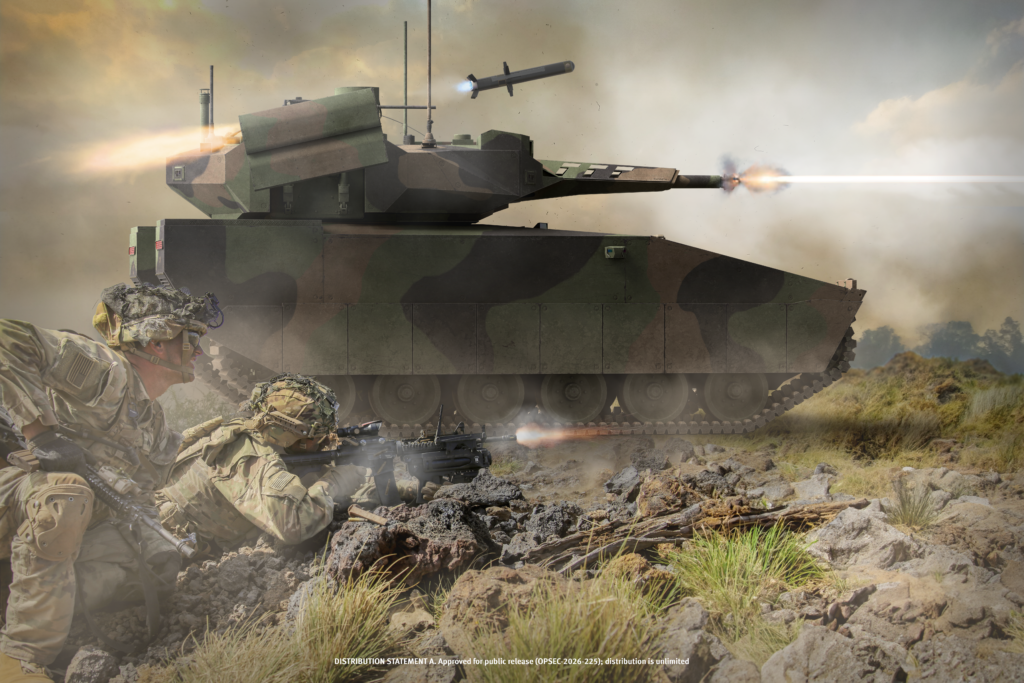
A photo illustration of American Rheinmetall’s Lynx XM30 in the Indo-Pacific region. (Photo illustration courtesy of American Rheinmetall.)
The Army’s decision to walk away from another Bradley upgrade wasn’t about firepower. It was about a platform that had reached the limits of its own architecture after four decades of service, and a requirement that anything built to replace it needed enough margin, in power, weight, and computing, to serve for 30 years or more without the same problem recurring.
American Rheinmetall’s answer is the Lynx XM30 , and the case for it rests on two questions: does the vehicle actually solve the problem the Army identified, and is the team behind it equipped to deliver on that solution? Jim Schirmer, senior vice president of programs at American Rheinmetall, spoke with Breaking Defense about both.
Breaking Defense: What are the key points that make the Lynx XM30 the best choice for the Army?
Schirmer: There are three areas that are important here in making this decision. Can you build it, can you grow it and can the crew fight in it?
Jim Schirmer, senior vice president of programs, American Rheinmetall.
We can build it. We’re building it right now. We’ve already begun delivering vehicles to the Army this year, and we’re building them in the production facilities where we’re planning to do the full-rate production should we win the contract.
Can you grow it? We’ve designed it for growth. The Army’s got a variety of tests that they’re going to be conducting to validate that, in fact, we delivered all the additional margin that we planned on.
Can the crew fight in it? We’ve put an enormous amount of effort into what the Army’s calling fightability, making sure that that two-man crew has the right tools, the right graphical user interfaces, and the data is presented in a manner that’s understandable so they can be fully effective and fight with that system as intended.
We took a lot of input from soldiers and we hired a bunch of retired master gunners to make sure that we had a user’s voice every day of the week as the engineers were designing the system.
That three-part test, build it, grow it, fight in it, is the architecture behind everything else American Rheinmetall did on this program. The first half of that test starts with a problem the Army had already run out of ways to solve.
A photo illustration of American Rheinmetall’s Lynx XM30 in an urban combat zone. (Photo illustration courtesy of American Rheinmetall.)
Why does the Army need a clean sheet combat vehicle rather than upgrading the Bradley again? What are the operational limitations that the Bradley has reached that’s driving all of this?
The Bradley’s been a great infantry fighting vehicle for a bit over 40 years at this point, and we’ve upgraded a number of times. But it’s out of margin for future growth, and it’s not really about firepower. This is more about electrical power and weight-carrying capacity, and at some point you just can’t continue to upgrade it.
If you’ve seen the power pack that goes into the Bradley, it takes up almost every square inch of space in that engine compartment. They can’t make it much bigger. The Army made the right call by deciding to start over with a clean sheet where they can build in some growth margin for the future.
Ultimately you have to generate the power armored vehicles need. It’s harder for the engine to cool itself because it has to live in an armored box to survive the environment. Cooling takes up a fair amount of space and all those things work to constrain your ability to grow and draw more power out of that power pack to provide electricity for whatever the Army might need.
How has the Lynx XM30 been designed to provide the capabilities that are needed not only today, but in the future?
That’s the centerpiece of the whole modernization program for XM30, because the Army’s going to have this in its inventory for 30 years, maybe longer. The Bradley has been here for more than 40 years, almost 50. Same for the Abrams. We have to design for a fight that might happen in the 2040s, and it’s impossible to predict what the Army’s going to need 20 years from now. But what we can do is provide extra margin in a couple of key areas to allow the Army to adapt to changes on the battlefield.
That starts with building some margin for weight. How do you do that? The chassis, the structure, the suspension have to be designed to carry more weight than the vehicle’s actually going to weigh when it’s produced. The powertrain, the engine and transmission are capable of meeting the minimum mobility requirements at a higher weight than the vehicle will weigh when we deliver it to the government.
If the Army wants to add a two-ton system that we can’t visualize today, you can add that weight to the vehicle, still meet the required mobility and not have to redesign your structure, upgrade your suspension system and then electrical power. There’s a significant amount of additional electrical power that’s generated by the system that is not consumed by all the subsystems that we have on the vehicle today.
Equally important is not just generating that electricity, but the ability to distribute it. The power distribution units and the architecture for electricity are available to provide that power throughout the vehicle. If we have to add, say, a counter-missile laser of some kind in the future that draws a lot of power, it goes on the turret.
Then lastly, we have spare computational power and we have empty card slots in several of our major compute boxes. We’re leaving that space in there for future upgrades that we can’t foresee today.
A video showing some of the capabilities of American Rheinmetall’s Lynx XM30. (Video courtesy of American Rheinmetall.)
What was the sort of incremental improvement we saw on ground vehicles years ago during Middle East operations?
If you look back at the early days of the Iraq war, for example, where Abrams and Bradley went into that fight, they both had spare margin for power and for weight, in particular. And it’s a good thing they did because we had to be reactive. We added the RPG cages, we added the CREW (Counter Radio-Controlled Improvised Explosive Device Electronic Warfare) system, which is electrical power to try to jam remote controlled IEDs.
A whole host of kits were developed over the course of that war against a threat that hadn’t been thought about in the 70s when they were designing the vehicle. Those efforts also consumed a lot of that spare power and weight margin. The thought is all right, we need to start over with a clean sheet and that’s going to give us running room for hopefully 30-plus years of adapting and evolving to the emerging environment.
How are you incorporating open architecture throughout the entire process?
One of the things the Army did differently here is they dictated a vehicle architecture standard, an open system standard. They called it GCIA (Ground Combat Systems’ Common Infrastructure Architecture). That allowed them to control the interfaces because they dictated how they wanted any of these interfaces to be laid out and how data had to be structured. By doing that, they maintain some control.
In the future, a qualified third party could come in and integrate a new subsystem onto the vehicle without necessarily coming through us, and that gives the Army a lot more optionality and will make it quicker for them to make modernization choices down the road.
If they implement an imaginary counter-missile laser 20 years from now, the company that produces that laser could find these interface standards because they’re open, they’re published and they could design to that, or they could come up with a wrapper that allows them to talk to that interface and make it work without the Army having to pay American Rheinmetall to do the integration work.
Margin and open architecture solve the Army’s capability problem on paper. Turning that into a vehicle a two-person crew can actually build, maintain, and fight in required a different kind of expertise, and it’s where American Rheinmetall’s team did its most distinctive work.
The American Rheinmetall Lynx XM30 traces its design heritage back to Rheinmetall’s Lynx. What remains from that platform and what is distinctly American Rheinmetall?
We inherited a design philosophy that had to do with modularity and how we space things around the vehicle. The Army had a very unique set of requirements, and we had a team of American engineers here in the US that designed the vehicle, inspired by the architecture that we inherited.
There is not much left of that original design other than the architectural philosophy. We have a very different set of requirements for how many soldiers it’s got to carry, the two-man crew, the weapon system is different, the protection requirements are different. It’s an American vehicle designed in the US specifically for the US Army.
What did your master gunner veterans identify to change during the design process? How did you incorporate their feedback?
A lot of that was actually how we lay information out on the screens. As they’re moving through a mission, how it was easiest for them to see the information displayed so it was quicker to understand how they wanted the controls to be laid out.
It’s things that you use a lot. You want them to be very easy to reach, things that you only use occasionally, they can be a little further away.
We ended up substantially reworking the software that laid out how those controls were put together and how the information was displayed on the screen. Luckily that was software, and software is never easy, but changing it on the front end of the program was a lot cheaper than doing that later.
The hatches are larger and we had them practice getting in and out of the vehicle with all their gear on, so we made some modifications to how the ramp was laid out to make that easier and safer.
We also learned quite a bit from the maintainers who were looking at how they would get to a piece of equipment if they had to do this maintenance task. How would they reload the missile? We had dummy missiles that were weighted, so they could try to put them in and out and had to make some adjustments there.
How are you supporting the two-person crew requirement that the Army implemented?
To begin with, we placed the two-man crew side by side, you could say inspired by aircraft design. Imagine a lot of pilot/copilot arrangements where they’re sitting side by side and this is going to make coordination easier between the two because they can talk to each other more easily than they can point.
There’s a common screen between the two of them. We’ve provided the same functionality at both crew stations, so you can fire the main weapon from the left or the right. You can drive the vehicle from the left or the right. They have complete redundancy in their controls, and so we’re going to let the Army decide how they want to distribute tasks between the two positions.
The Army’s priorities shaped every detail of the Lynx XM30—margin built into the chassis, soldier‑driven crew stations, and Army‑controlled interfaces. Discover how the right capability, built by the right team and ready right now, is redefining what’s possible.
Explore more about the Lynx XM30 and the team delivering it at wwww.teamlynx-xm30. com
这是一张美国莱茵金属公司Lynx XM30直升机在印度-太平洋地区的照片插图。(照片由美国莱茵金属公司提供。)
陆军决定放弃对布雷德利战车进行另一次升级,并非出于火力方面的考虑。而是因为该平台在服役四十年后已达到自身架构的极限,任何替代它的战车都必须在动力、重量和计算能力方面留有足够的余量,以确保其能够服役三十年以上而不会重蹈覆辙。
美国莱茵金属公司的答案是Lynx XM30,而支持这款车的关键在于两个问题:这款车是否真的能解决陆军提出的问题,以及其背后的团队是否具备交付解决方案的能力?美国莱茵金属公司项目高级副总裁吉姆·希尔默就这两个问题接受了《防务新闻》的采访。
突破防务:是什么关键因素使得 Lynx XM30 成为陆军的最佳选择?
希尔默:做出这个决定有三个重要方面:你能建造它吗?你能发展它吗?以及船员能在里面战斗吗?
吉姆·希尔默,美国莱茵金属公司项目高级副总裁。
我们可以造出来。我们现在就在造。今年我们已经开始向陆军交付车辆,而且我们正在生产这些车辆,如果我们赢得合同,我们将在这些生产设施中进行全面生产。
它能生长吗?我们设计时就考虑到了生长。陆军将进行一系列测试,以验证我们是否确实实现了所有预期的额外裕度。
这套系统能让操作人员有效作战吗?我们投入了大量精力来提升陆军所谓的“作战能力”,确保这两名操作人员拥有合适的工具、合适的图形用户界面,并且数据以易于理解的方式呈现,以便他们能够充分发挥效能,按照预期的方式使用该系统进行作战。
我们听取了许多士兵的意见,并聘请了一批退役的高级炮手,以确保在工程师设计系统时,每天都能听到用户的声音。
这项分为三个部分的测试——建造、发展、实战——构成了美国莱茵金属公司在该项目上所有其他工作的架构。测试的第一部分源于陆军已经束手无策的一个难题。
一张美国莱茵金属公司生产的Lynx XM30无人机在城市作战区域的实物照片。(照片由美国莱茵金属公司提供。)
为什么陆军需要一款全新的战车,而不是再次升级布雷德利战车?布雷德利战车究竟存在哪些作战局限性,才导致了这一切?
布雷德利步兵战车作为一款优秀的步兵战车,已经服役超过40年,我们也对其进行了多次升级。但它已经没有进一步发展的空间了,而且这并非火力方面的问题。这更多的是关于电力系统和载重能力的问题,而你不可能一直对其进行升级。
如果你见过布雷德利战车的动力装置,就会发现它几乎占据了发动机舱的每一寸空间。他们不可能再把它做得更大了。陆军决定从零开始重新设计,为未来预留一些发展空间,这是个正确的决定。
最终,你必须为动力装甲车辆提供所需的电力。由于发动机必须置于装甲箱内才能在恶劣环境下生存,因此冷却难度更大。冷却系统本身也占用大量空间,所有这些因素都会限制你从动力包中获取更多电力的能力,从而无法满足军队的各种电力需求。
Lynx XM30 的设计如何才能满足当今以及未来所需的各种功能?
这是XM30整个现代化计划的核心,因为陆军将在未来30年甚至更长时间里装备这种战车。布雷德利战车已经服役超过40年,接近50年了。艾布拉姆斯主战坦克也是如此。我们必须为2040年代可能发生的战争进行设计,而预测陆军20年后的需求是不可能的。但我们可以做的是在几个关键领域预留额外的余地,使陆军能够适应战场上的变化。
首先要预留一定的重量余量。如何做到这一点呢?底盘、车身结构和悬架的设计必须能够承受比车辆实际生产重量更大的重量。动力系统、发动机和变速箱也必须能够在比交付给政府的车辆重量更高的重量下满足最低机动性要求。
如果陆军想要加装一个我们目前无法想象的两吨重的系统,我们可以在不改变车辆结构、悬挂系统和电力系统的前提下,增加车辆的重量,同时仍然满足所需的机动性。该系统产生的额外电力并非车辆现有所有子系统所消耗的。
同样重要的是不仅要能发电,还要能分配电力。配电单元和电力架构足以满足整车的电力需求。如果将来我们需要加装某种耗电量巨大的反导弹激光器,它会被安装在炮塔上。
最后,我们还有一些剩余的计算能力,而且我们几个主要计算服务器的卡槽都是空的。我们预留这些空间是为了应对目前无法预见的未来升级。
一段视频展示了美国莱茵金属公司Lynx XM30的部分性能。(视频由美国莱茵金属公司提供。)
多年前在中东作战期间,我们在地面车辆方面看到了哪些渐进式改进?
例如,回顾伊拉克战争初期,艾布拉姆斯和布雷德利战车投入战斗时,它们在动力和重量方面都留有余量。这非常明智,因为我们不得不被动应对。我们加装了火箭筒防护笼,还加装了CREW(反遥控简易爆炸装置电子战)系统,该系统利用电力干扰遥控简易爆炸装置。
在那场战争期间,为了应对70年代设计车辆时未曾预料到的威胁,人们开发了一系列套件。这些努力也消耗了大量的剩余动力和重量余量。现在的想法是,好吧,我们需要从头开始,这样才能为我们留出足够的空间,以便在未来30多年里适应和发展,应对不断变化的环境。
你们是如何在整个过程中融入开放式架构的?
陆军在这里采取的不同做法之一是,他们制定了一套车辆架构标准,一个开放的系统标准。他们称之为GCIA(地面作战系统通用基础设施架构)。这使得他们能够控制接口,因为他们可以规定所有接口的布局方式以及数据的结构方式。通过这种方式,他们保持了一定的控制权。
未来,合格的第三方可以进入车辆,将新的子系统集成到车辆上,而无需通过我们,这将使陆军拥有更大的选择权,并使他们在未来更快地做出现代化选择。
如果20年后他们真的研制出一种假想的反导弹激光器,那么生产这种激光器的公司可以找到这些接口标准,因为它们是开放的、公开的,他们可以根据这些标准进行设计;或者他们可以想出一个封装程序,使他们能够与该接口通信并使其工作,而无需陆军支付美国莱茵金属公司进行集成工作。
理论上,裕量和开放式架构解决了陆军的能力问题。但要将其转化为两人乘员组能够实际建造、维护和作战的车辆,则需要另一种专业知识,而这正是美国莱茵金属公司团队最杰出的工作所在。
美国莱茵金属Lynx XM30的设计传承可以追溯到莱茵金属的Lynx系列。那么,Lynx平台保留了哪些元素,又有哪些元素体现了美国莱茵金属的独特风格呢?
我们继承了一种以模块化和车辆内部部件布局为核心的设计理念。陆军提出了一套非常独特的要求,而我们则在美国组建了一支美国工程师团队,他们以我们继承的架构为灵感,设计了这款车辆。
除了建筑理念之外,原设计几乎没有保留下来。我们对车辆的载兵量、双人乘员组、武器系统和防护要求都有着截然不同的要求。这是一款专为美国陆军设计的美国车辆。
在设计过程中,你们的资深炮手们提出了哪些需要改进的地方?你们是如何采纳他们的反馈意见的?
实际上,很多时候我们考虑的是如何将信息呈现在屏幕上。在他们执行任务的过程中,如何让他们最容易地看到显示的信息,从而更快地理解他们想要的操作布局。
经常使用的东西要放在触手可及的地方,而偶尔使用的东西可以放在稍远一些的地方。
我们最终对控制控件组合方式和信息在屏幕上显示方式的软件进行了大幅修改。幸运的是,这只是软件,而软件开发从来都不是一件容易的事,但提前修改程序比后期修改要便宜得多。
舱门更大了,我们让他们练习带着所有装备上下车,所以我们对坡道的布局进行了一些修改,使上下车更容易、更安全。
我们也从维护人员那里学到了很多东西,他们正在研究如果需要进行这项维护任务,他们该如何接近设备。他们该如何重新装填导弹?我们准备了一些加重的模拟导弹,让他们尝试装卸,并据此进行了一些调整。
您如何支持陆军实施的两人乘员组要求?
首先,我们让两名机组人员并排就座,可以说是受到了飞机设计的启发。想象一下,很多飞行员/副驾驶都是并排坐着,这样两人之间的协调会更加容易,因为他们可以更方便地交谈,而不是用手指指点。
两个操作台共用一个屏幕。我们在两个操作台都提供了相同的功能,因此无论从左侧还是右侧都可以发射主武器,也可以从左侧或右侧驾驶车辆。它们的控制系统完全冗余,所以我们将交由陆军决定如何在这两个位置之间分配任务。
陆军的优先事项贯穿了Lynx XM30的每一个细节——从底盘预留的裕量、单兵操控的乘员舱,到陆军控制的界面。了解一下,由合适的团队打造、随时可用的合适能力,是如何重新定义一切可能性的。
访问 www.teamlynx-xm30.com,了解更多关于 Lynx XM30 及其交付团队的信息。