Doing more with less: A Singaporean surgeon’s lessons from a hospital between two Sudans如何以更少的资源创造更多价值:一位新加坡外科医生从苏丹两国之间的一家医院汲取的经验教训
A Singaporean surgeon shares lessons from providing surgical care in a resource-limited hospital amid conflict between Sudan and South Sudan. Read more at straitstimes.com.
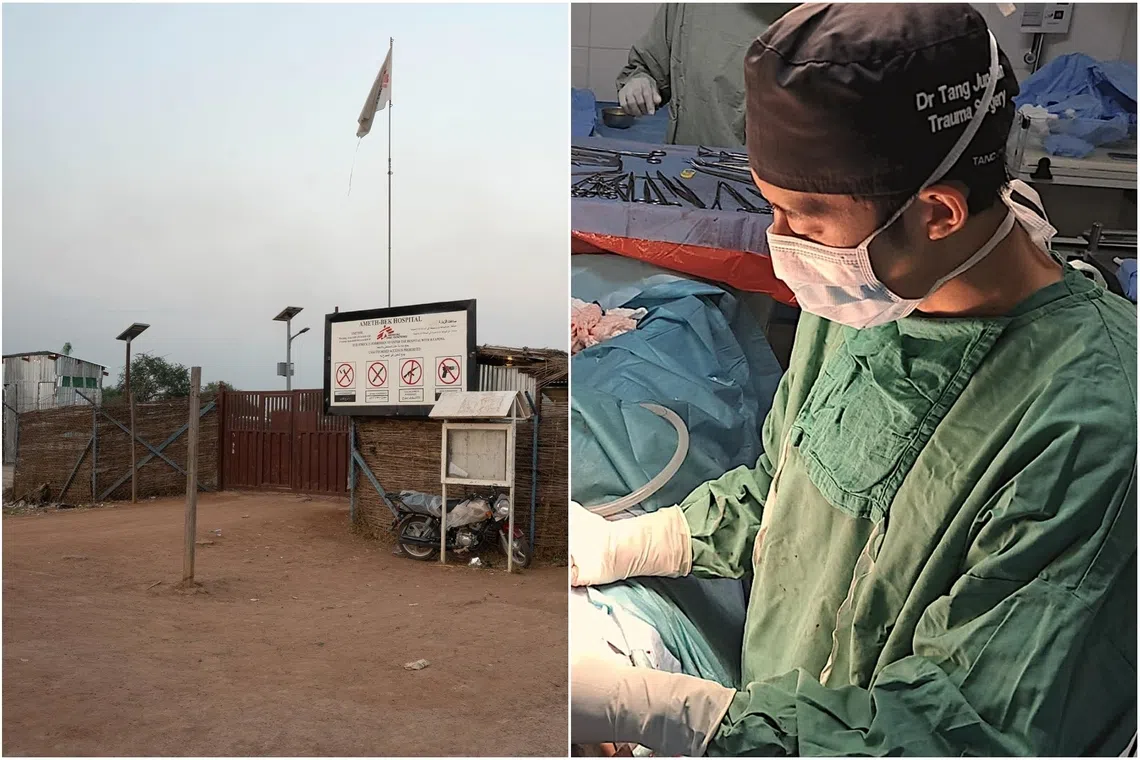
Tan Tock Seng Hospital specialist trauma surgeon Tang Jun Han performing diaphragm repair surgery at Ameth-Bek Hospital.
PHOTOS: COURTESY OF TANG JUN HAN
Published Sep 21, 2026, 05:00 AM
Updated Sep 21, 2026, 05:00 AM
SINGAPORE – The drive from Agok airstrip to Ameth-Bek Hospital cut through vast stretches of sandy ground and scrubland. Every so often, a truck would pass carrying young men – sometimes boys – armed with AK-47s.
It was an unremarkable sight to everyone but me, yet a stark reminder that the security situation could change quickly. Near the hospital, the presence of the United Nations Interim Security Force for Abyei peacekeepers brought some reassurance.
I was based at the Abyei Special Administrative Area, a disputed region between Sudan and South Sudan. Its communities have been shaped by years of tension, displacement and inter-communal violence. People fleeing the war in Sudan were still crossing the border during my assignment, while insecurity in South Sudan kept access to healthcare extremely fragile.
Ameth-Bek is a 91-bed secondary hospital and the only facility providing surgical care for a large surrounding region about 15 times the size of Singapore. It has an emergency room, operating theatre, surgical and inpatient wards, maternity services and a neonatal ward. With specialist referral difficult, it has to manage almost every and any case that comes through its doors.
I was one of two general surgeons in a project by Medecins Sans Frontieres, or Doctors Without Borders. Between April and June , the team performed 1,170 operations, with more than 20 cases on some days. We managed violence-related injuries, road traffic accidents, emergency abdominal surgery, obstetric emergencies, burns and common urgent surgical conditions such as hernias and infected wounds. The workload was heavy and varied, requiring constant adaptation with a small team and limited equipment and investigations.
A Doctors Without Borders vehicle at the entrance of Ameth-Bek Hospital in the Abyei region on the border of Sudan and South Sudan. PHOTO: COURTESY OF TANG JUN HAN
A Doctors Without Borders vehicle at the entrance of Ameth-Bek Hospital in the Abyei region on the border of Sudan and South Sudan.
PHOTO: COURTESY OF TANG JUN HAN
Few resources, more ingenuity
Trauma patients often arrived late at Ameth-Bek Hospital. Some had travelled long distances from Sudan after experiencing gunshots, drone attacks, explosions or other violent injuries, reaching us only after substantial blood loss, infection, pain and exhaustion had pushed their bodies close to their limits.
We also saw other consequences of delayed access to care. For example, children with burns who had initially been treated at home, sometimes with rabbit hair applied to the wounds as a local remedy. There was something almost disarming about it, until you remembered that families were doing what they could with what they had. Some patients had lived with severe open fractures for years, with bones jutting out.
In Singapore, we are used to the scoop-and-run pre-hospital system, extensive laboratory testing, CT scans, readily available blood products and intensive care unit (ICU) beds. In Abyei, none of these were possible.
We had to be deliberate about every blood test, asking whether the result would meaningfully change what we needed to do. Diagnosis often came down to a careful history, thorough physical examination, and close observation when non-operative management was chosen.
For much of the assignment, we had only one functioning diathermy pencil for a long operating list each day. It is a common instrument for cutting tissue and controlling bleeding that we barely think about having in operating theatres back home. In Abyei, replacement equipment and resupply could take time. We had to plan the use of the diathermy pencil around the day’s cases, preserving it for those cases where it would make the most significant difference.
The constraints changed not only how we operated, but also what a good outcome meant.
A major amputation or a stoma could be life-saving but have profound consequences once a patient returns to a community where prostheses, stoma bags and follow-up care might not be available. Damage control surgery, often taught as the answer for catastrophic trauma, is itself resource-intensive, requiring blood products, invasive monitoring and post-operative intensive care. We managed a high volume of serious trauma without an ICU and with limited blood products. Decisions had to account for what could safely be sustained after surgery as much as what could be achieved in the theatre.
That did not mean working without principles, but adapting them to what was available. We improvised a simple vacuum dressing to draw fluid from wounds, using gauze, a 50ml syringe and plungers from smaller syringes to create suction. For children with a foreign object in the ear or nose, we fashioned a small hook from the metal part of an intravenous cannula.
In extreme abdominal trauma, a Bogota bag – made by stitching a sterile fluid bag to the abdominal wall – provided temporary closure, protecting swollen organs while the patient was stabilised before a planned return to theatre.
In one case of a “frozen abdomen”, where severe scarring had fused the bowel and surrounding organs together, an endotracheal tube, normally used to secure the airway, was repurposed to drain intestinal contents until definitive surgery was possible.
In another case, we used a Cystofix catheter – normally used to drain urine from the bladder – to drain fluid from around the heart of a young child. Likely related to tuberculosis, the fluid had begun to squeeze the heart and stop it from filling properly, causing a life-threatening condition known as cardiac tamponade.
Such decisions were carefully considered, given the limited options for referral and further treatment.
One decision I vividly remember involved a young man with a gunshot wound in which the bullet had crossed the midline of his torso. He had arrived late from Sudan but looked surprisingly well – walking, eating and with normal vital signs. But the bullet trajectory concerned us, and we agreed to first check for injury to the diaphragm or abdomen before proceeding with wound debridement.
An emergency operation revealed a large tear in the diaphragm, with part of the stomach trapped through it and a ruptured segment of colon near the spleen. His deceptively good appearance had masked these serious injuries. He recovered over the following days and was soon well enough to return to Sudan .
Tan Tock Seng Hospital specialist trauma surgeon Tang Jun Han with German general surgeon Matthias Oppelt in Abyei. PHOTO: COURTESY OF TANG JUN HAN
Tan Tock Seng Hospital specialist trauma surgeon Tang Jun Han with German general surgeon Matthias Oppelt in Abyei.
The fight to save a leg
The case of a man with a snakebite has remained with me. He was from Sudan and had suffered a likely cytotoxic bite, causing severe swelling and progressive tissue destruction. By the time he reached us, his leg was infected and gangrenous, with haemorrhagic blisters. He was in septic shock and in great pain. The usual life-saving recommendation would have been an above-knee amputation, but he vehemently refused.
As we spoke, it became clear that losing his leg would mean losing not only his mobility, but also his ability to farm, tend cattle and provide for his family. We respected his decision, while being transparent about the risks. Over several weeks, we repeatedly debrided dead tissue from almost his entire leg and foot, dressing the wound with sugar. Gradually, and stubbornly, he improved, and we moved on to skin grafting.
On the day he was discharged, he walked out of the hospital on the leg he had refused to give up. If faced with a similar case again, I would still recommend amputation as a life-saving treatment. But his case reminded me that patients can be remarkably resilient, and that the “right” operation must also consider the life a patient hopes to return to.
Many of these decisions were not easy. I went there as a trauma surgeon, but had sought additional training in caesarean sections, external fixation and surgery in austere settings. In a single day, I might perform a trauma laparotomy or emergency caesarean, apply an external fixator to a fractured limb, remove a bead from a toddler’s nose, or debride non-viable brain tissue after a penetrating head injury.
The other hard part was seeing how much depended on resources. Some patients arrived too late, or needed blood products, ventilation or ICU care that we could not provide. Some might have survived in a better-resourced setting, but did not. In the end, you return each day and do the best you can with what you have, for the patient in front of you.
Tan Tock Seng Hospital specialist trauma surgeon Tang Jun Han with Japanese general surgeon Mikio Shiozawa in Abyei. PHOTO: COURTESY OF TANG JUN HAN
Tan Tock Seng Hospital specialist trauma surgeon Tang Jun Han with Japanese general surgeon Mikio Shiozawa in Abyei.
What changed for me?
This assignment taught me to appreciate the healthcare system in Singapore and the many things that support a patient’s journey long before and after a surgeon enters the operating theatre. In Abyei, I was reminded of how much safe care depends on the whole system working well.
It also brought me back to the basics of medicine – taking a careful history, examining a patient thoroughly, thinking through the anatomy and physiology, and reassessing rather than immediately relying on a scan or blood test. And, of course, how immensely useful bedside ultrasound can be in finding answers.
Yet, amid the stark differences in resources and environment, the fundamentals of good surgery did not change. The challenge was not to lower those standards, but to find safe and thoughtful ways to adapt and uphold them. What works well in one healthcare system may not be appropriate or sustainable in another.
My experience in Abyei has not changed the standards I hold for care in Singapore. Instead, it has made me more thoughtful about why we investigate, intervene or ask for a particular resource or test. It has also made me more conscious of the many people behind a patient’s recovery, especially our nursing and anaesthesia colleagues.
Coming home, I still often think about my patients and colleagues in Abyei. One very young patient with a complex abdominal condition underwent more than 30 operations. More than once, we considered whether it was time to shift the focus towards offering palliative care. But he was very young, and as long as we were seeing small signs of progress, we chose to persevere.
If I could tell colleagues and aspiring humanitarian surgeons one thing, it would be not to romanticise the work, but also not to be discouraged by that reality.
Prepare as thoroughly as you can, clinically and personally, because you owe that to your patients and the team who will work with you. No preparation can make a first assignment entirely predictable, but it will give you a safer place from which to adapt.
In difficult places, hope is not something you wait to feel. It is a choice made each day to keep showing up and doing the next right thing for the patient, even when the odds are poor. When a team is united by that purpose, it can give patients a chance they might otherwise never have had.
Tang Jun Han is a specialist trauma surgeon in the Department of General Surgery at Tan Tock Seng Hospital. He completed his speciality training in 2021 and was admitted as a Fellow of the Royal College of Surgeons of Edinburgh.
Tan Tock Seng Hospital
陈笃生医院创伤外科专家唐俊汉在阿梅特贝克医院进行膈肌修复手术。
照片由唐俊汉提供
发布于 2026 年 9 月 21 日上午 5:00
更新于2026年9月21日凌晨5:00
新加坡——从阿戈克机场到阿梅特贝克医院的路段,要穿过大片沙地和灌木丛。不时会有卡车经过,车上载着一些年轻人——有时甚至是男孩——他们手持AK-47步枪。
除了我以外,其他人对此都习以为常,但这却鲜明地提醒我们,安全局势可能瞬息万变。在医院附近,联合国阿卜耶伊临时安全部队维和人员的存在带来了一丝安心。
我驻扎在阿卜耶伊特别行政区,这是一个苏丹和南苏丹之间存在争议的地区。多年来,紧张局势、流离失所和部族间暴力事件深刻地影响着当地社区。在我任职期间,仍有逃离苏丹战乱的人们越过边境,而南苏丹的不安全局势也使得医疗服务极其匮乏。
阿梅特贝克医院是一家拥有91张床位的二级医院,也是周边广大地区(面积约为新加坡的15倍)唯一一家提供外科手术服务的医疗机构。医院设有急诊室、手术室、外科病房和住院病房、产科以及新生儿病房。由于专科转诊困难,医院几乎需要处理所有前来就诊的病例。
我曾是无国界医生组织(Medecins Sans Frontieres)一个项目中的两名普通外科医生之一。从四月到六月,我们团队共进行了1170例手术,有些日子甚至超过20例。我们处理的病例包括暴力伤害、交通事故、紧急腹部手术、产科急症、烧伤以及常见的紧急外科疾病,例如疝气和感染性伤口。工作量繁重且种类繁多,需要在人手有限、设备和检查手段匮乏的情况下不断调整应对。
一辆无国界医生组织的车辆停在苏丹和南苏丹边境阿卜耶伊地区的阿梅特贝克医院入口处。照片由唐俊汉提供
无国界医生组织的车辆停在苏丹和南苏丹边境阿卜耶伊地区的阿梅特贝克医院入口处。
照片:由唐俊汉提供
资源匮乏,但创造力十足
阿梅特贝克医院收治的创伤患者往往已经很晚了。有些患者在遭受枪击、无人机袭击、爆炸或其他暴力伤害后,从苏丹长途跋涉而来,到达医院时已是大量失血、感染、疼痛和精疲力竭,身体濒临极限。
我们也看到了延误治疗的其他后果。例如,一些烧伤儿童最初在家中接受治疗,有时甚至用兔毛敷在伤口上作为局部疗法。这种做法乍一看似乎有些无力,但当你意识到这些家庭只能用现有的资源尽力而为时,就会明白其中的道理。有些患者多年来一直忍受着严重的开放性骨折,骨头外露。
在新加坡,我们习惯了快速高效的院前急救系统、全面的实验室检测、CT扫描、充足的血液制品和重症监护病房(ICU)床位。但在阿卜耶伊,这一切都无法实现。
我们必须谨慎对待每一次血液检查,反复斟酌结果是否会对我们的治疗方案产生实质性影响。诊断往往取决于仔细的病史询问、全面的体格检查,以及在选择非手术治疗时密切的观察。
在执行任务的大部分时间里,我们每天要面对长长的手术清单,却只有一支能用的电凝笔。这是一种常用的组织切割和止血器械,但在我们家乡的手术室里,我们几乎想不到会有这种东西。在阿卜耶伊,更换设备和补给需要时间。我们必须根据当天的手术安排来计划电凝笔的使用,把它留给那些最需要它的时候。
这些限制不仅改变了我们的运作方式,也改变了我们对好结果的定义。
截肢或造口术虽然可以挽救生命,但一旦患者返回社区,可能面临假肢、造口袋和后续护理不足的困境,从而产生深远的影响。损伤控制手术常被视为应对灾难性创伤的良方,但其本身也需要耗费大量资源,包括输血、侵入性监测和术后重症监护。我们曾在没有重症监护室且输血资源有限的情况下,处理了大量严重创伤病例。因此,在决策时,必须同时考虑手术过程中能够达到的目标以及术后能够安全维持的治疗效果。
这并非意味着放弃原则,而是要根据现有条件灵活调整。我们用纱布、50毫升注射器和小型注射器的活塞,临时制作了一种简易的真空敷料来抽取伤口渗液。对于耳鼻异物患儿,我们用静脉输液管的金属部分制作了一个小钩子。
在严重的腹部创伤中,波哥大袋(通过将无菌液体袋缝合到腹壁上制成)可提供临时封闭,在患者病情稳定后,保护肿胀的器官,然后再计划返回手术室。
在一例“冻结腹部”病例中,严重的瘢痕将肠道和周围器官粘连在一起,通常用于确保气道通畅的气管插管被重新用于引流肠道内容物,直到可以进行最终手术为止。
在另一起病例中,我们使用了一根通常用于引流膀胱尿液的Cystofix导管,为一名幼童引流心脏周围的积液。这些积液可能与结核病有关,它们开始挤压心脏,使其无法正常充盈,从而引发了一种危及生命的疾病,即心包填塞。
鉴于转诊和后续治疗选择有限,这些决定都是经过慎重考虑的。
我至今仍清晰地记得,当时有个年轻人身中枪伤,子弹穿过了他的躯干中线。他从苏丹赶来时已是深夜,但看起来状态出奇的好——能走能吃,生命体征也正常。不过,子弹的轨迹让我们有些担忧,所以我们决定先检查他的膈肌或腹部是否受伤,然后再进行清创。
紧急手术发现他的膈肌有一道很大的撕裂口,部分胃组织被卡在撕裂处,脾脏附近的一段结肠也破裂了。他看似良好的外表掩盖了这些严重的伤势。接下来的几天里,他逐渐康复,很快就恢复到可以返回苏丹的程度。
陈笃生医院创伤外科医生唐俊汉与德国普通外科医生马蒂亚斯·奥佩尔特在阿卜耶伊。照片:唐俊瀚提供
陈笃生医院创伤外科专家唐俊汉与德国外科医生马蒂亚斯·奥佩尔特在阿卜耶伊。
保腿之战
我一直记得一个被蛇咬伤的案例。他来自苏丹,很可能是被毒性毒蛇咬伤,导致严重肿胀和组织逐渐坏死。他被送到我们这里时,腿已经感染坏疽,布满出血性水疱。他处于败血性休克状态,疼痛难忍。通常情况下,为了挽救他的生命,医生会建议进行膝上截肢,但他坚决拒绝了。
随着交谈的深入,我们逐渐明白,失去一条腿不仅意味着失去行动能力,也意味着失去耕作、放牧和养家糊口的能力。我们尊重他的决定,同时也坦诚地告知他其中的风险。在接下来的几周里,我们反复为他几乎整条腿和脚部进行清创,清除坏死组织,并用糖水包扎伤口。他的病情逐渐好转,我们开始进行植皮手术。
出院那天,他用自己坚持不放弃的那条腿走出了医院。如果再次遇到类似的情况,我仍然会建议截肢,认为这是挽救生命的有效治疗手段。但他的案例提醒我,患者可以展现出惊人的韧性,而且“正确”的手术方案也必须考虑到患者希望回归的生活。
这些决定很多都不容易。我当时是以创伤外科医生的身份去的,但为了更好地适应艰苦环境,我还接受了剖腹产、外固定和手术方面的额外培训。一天之内,我可能要做创伤性剖腹探查术或紧急剖腹产,给骨折的肢体安装外固定器,从幼儿的鼻子里取出珠子,或者在穿透性头部损伤后清创坏死的脑组织。
另一大难点在于,我们目睹了资源对治疗的依赖程度。有些病人来得太晚,或者需要输血、呼吸机或重症监护,而我们却无力提供。有些病人或许能在资源更充足的环境下活下来,但最终却没能幸免。最终,你每天只能回到病房,尽你所能,用你所拥有的一切,为眼前的病人做到最好。
陈笃生医院创伤外科专家唐俊汉与日本外科医生盐泽干雄在阿卜耶伊。照片由唐俊汉提供
陈笃生医院创伤外科专家唐俊汉与日本外科医生盐泽幹夫在阿卜耶伊。
我身上发生了什么变化?
这次任务让我更加体会到新加坡医疗体系的精妙之处,以及在外科医生进入手术室前后,为患者提供全方位支持的各个环节。在阿卜耶伊,我再次深刻体会到,安全的医疗服务离不开整个体系的良好运作。
这也让我重新审视了医学的基本原理——仔细询问病史、全面检查病人、深入思考人体解剖生理机制,以及重新评估病情而不是立即依赖扫描或血液检查结果。当然,还有床旁超声在寻找答案方面的巨大作用。
然而,尽管资源和环境存在巨大差异,但优秀外科手术的基本原则并未改变。挑战不在于降低这些标准,而在于找到安全周全的方法来调整和维护这些标准。在一个医疗体系中行之有效的方法,在另一个体系中可能并不适用或可持续。
我在阿卜耶的经历并没有改变我对新加坡医疗服务的标准。相反,它让我更加深入地思考我们为什么要进行调查、干预或申请特定的资源或检查。它也让我更加意识到患者康复背后有许多人的付出,尤其是我们的护理和麻醉同事。
回到家乡,我仍然常常想起我在阿卜耶伊的病人和同事们。一位非常年轻的病人患有复杂的腹部疾病,接受了超过30次手术。我们不止一次地考虑是否应该将治疗重点转向姑息治疗。但他年纪尚小,只要我们看到一丝丝的进步迹象,我们就决定坚持下去。
如果我能对同事和有志成为人道主义外科医生的朋友们说一句话,那就是不要美化这项工作,但也不要被现实吓倒。
尽可能做好充分的准备,包括临床和个人方面的准备,因为你对你的患者和与你共事的团队负有责任。任何准备都无法让第一份工作完全可控,但它能为你提供一个更安全的适应环境。
在困境中,希望并非等待感受,而是每天做出的选择:即使希望渺茫,也要坚持不懈地为患者做每一件事。当团队为了这个目标团结一致时,就能给予患者原本可能永远无法获得的希望。
唐俊翰是陈笃生医院普通外科的创伤外科专家。他于2021年完成专科培训,并被授予爱丁堡皇家外科医学院院士称号。
陈笃生医院