askST Jobs: My boss wants to be involved in everything I do. Am I being micromanaged?askST Jobs:我的老板想插手我做的每一件事。我是不是被过度管理了?
Learn how to recognise micromanagement, communicate effectively with your boss, and regain autonomy while maintaining a positive workplace relationship. Read more at straitstimes.com.
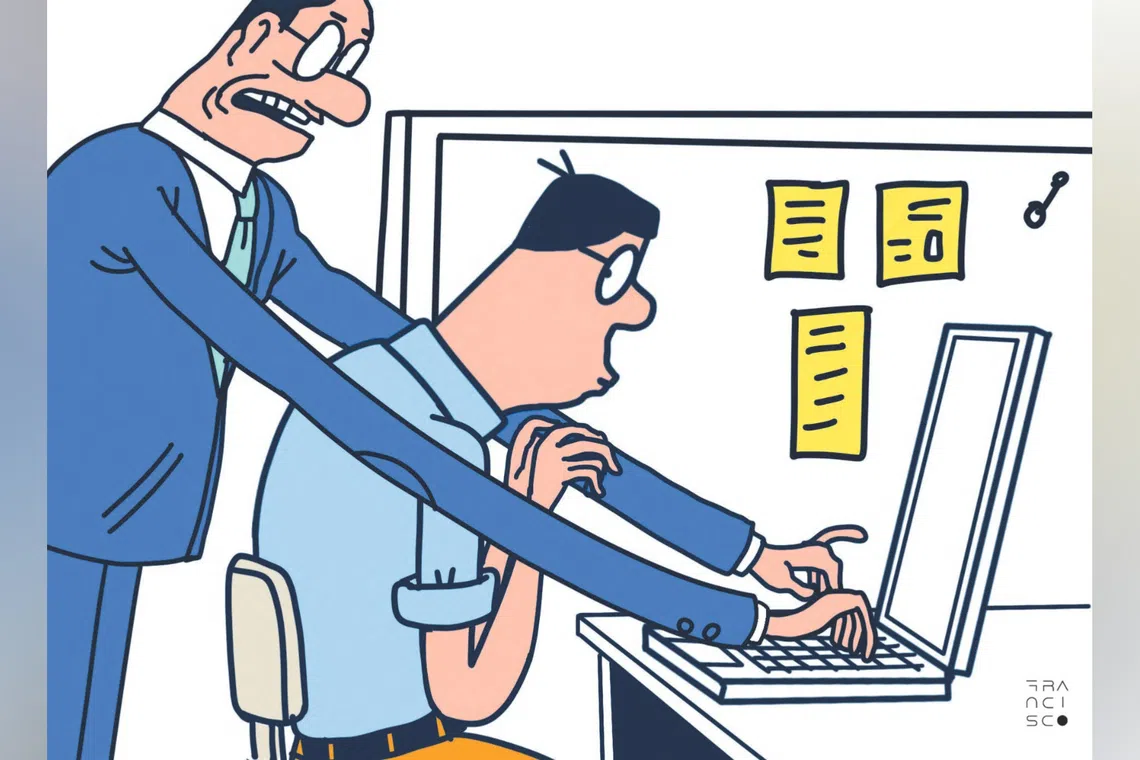
There is a difference between a boss who checks in on employees and one who constantly hovers like a “helicopter parent” over them.
ST ILLUSTRATION: MANNY FRANCISCO
Published Sep 21, 2026, 05:00 AM
Updated Sep 21, 2026, 05:41 AM
In this series, business correspondent Timothy Goh offers practical answers to candid questions on navigating workplace challenges and getting ahead in your career. Get more tips by signing up to The Straits Times’ Headstart newsletter .
How can I tell the difference between close supervision and micromanagement? Is it possible to ask for more autonomy without damaging my relationship with my manager?
Employees should look at what their boss is actually doing and how the behaviour is affecting them, said counselling psychologist Padma Jairam.
Some signs of micromanagement include having to provide excessive updates, needing a manager’s approval for even small and routine decisions, and having work repeatedly rewritten or heavily edited without a clear explanation.
Micromanagers may also focus excessively on how work is done rather than the outcome.
“Employees may also catch themselves overthinking routine decisions because they are preparing for someone to question them,” said Padma.
But close supervision does not necessarily mean a manager thinks an employee is incapable of doing his or her job.
“Often, it could be about your boss’ own anxiety or fears. They could be worried about being blindsided or getting blamed for a team member’s mistake,” she said.
“Such behaviour could stem from a manager’s own anxieties or previous unpleasant experiences.”
Although this does not justify micromanagement, understanding what may be driving the behaviour could help employees respond without becoming defensive.
Padma said employees who interpret their boss’ behaviour as a sign of their own incompetence may become more anxious and, consequently, could make careless errors, which could give the manager even more reason to micromanage.
“It’s a loop that worsens the situation for both the employee and the boss,” she said.
“Understanding the so-called hovering as perhaps your boss’ own stress response, rather than a verdict on you, makes it a lot easier to respond calmly instead of getting defensive.”
To regain some autonomy, employees could start by communicating proactively, such as providing a brief update before their manager asks for one.
This could reassure the manager that a project is under control while giving the employee more space to get the work done.
Employees should also clarify expectations at the beginning of a project, including what a successful outcome looks like and how frequently their manager expects updates.
Trust may also have to be built gradually, said Padma. Employees could demonstrate their reliability on smaller tasks before seeking greater autonomy over more significant pieces of work.
If a manager continues to demand more updates than necessary, employees could try negotiating rather than confronting them.
Employees should also “pick their battles”, as they may not need complete independence on every task.
“It is easier to accept more oversight on high-stakes projects while negotiating for more freedom on lower-risk ones,” Padma said.
However, better communication may not resolve every case of micromanagement.
“If the boss’ behaviour feels punitive and is ruining your sleep or your confidence, or if nothing changes, no matter what you try, then that may not be something you can fix with better communication,” she said.
In such situations, employees could consider approaching the human resources department, a mentor or a senior colleague whom they trust for help.
“Reaching out for help is not a sign of weakness but recognising that the problem is bigger than you,” said Padma.
“Micromanagement can be annoying, but the good news is that it usually does not last forever... Most bosses ease up once they trust the outcome, and most people get that trust back faster than they expect once they stop taking the scrutiny personally and start treating it as something to work through.”
David Leong, managing director of PeopleWorldwide Consulting, said employees should not immediately assume that close supervision means their manager is a micromanager.
“Before labelling a boss a micromanager, ask yourself an uncomfortable question: Is the manager controlling by nature and always like that, or has something happened that caused the manager to lose confidence in me? Have I failed in meeting my goals and key performance indicators?” he said.
Where trust has been affected, employees may be able to regain some autonomy by demonstrating that they can be relied upon to deliver their work. “Autonomy is rarely won through confrontation and assurances. It is usually earned through predictability and performance,” said Leong.
When managers know that an employee delivers what they promise, flags problems early and does not create unpleasant surprises, their perceived need to closely monitor the employee should gradually diminish, he said.
Leong also noted that prolonged micromanagement could eventually become counterproductive.
“The paradox of micromanagement is that managers use it to reduce risk, or so they think. But prolonged micromanagement can actually create another risk: Employees stop thinking for themselves or, worse, lose motivation to work,” Leong said.
Therefore, employees should ultimately be given sufficient room to perform their roles while remaining accountable for their work.
“A good boss provides a direction and shows the boundaries; a micromanager wants to hold the steering wheel and decide how, where and what,” added Leong.
“The objective is not management without accountability, but enough trust for employees to do the jobs they were hired to do.”
偶尔关心员工的老板和像“直升机父母”一样时刻盘旋在员工头顶的老板是有区别的。
插图:曼尼·弗朗西斯科
发布于 2026 年 9 月 21 日上午 5:00
更新于2026年9月21日 上午5:41
在本系列文章中,商业记者Timothy Goh将就如何应对职场挑战和如何在职业生涯中取得成功等坦诚问题,提供切实可行的解答。订阅《海峡时报》的“Headstart”新闻简报,获取更多实用技巧。
如何区分密切监督和微观管理?我能否在不损害与上司关系的前提下,要求获得更多自主权?
咨询心理学家帕德玛·贾伊拉姆表示,员工应该观察老板的实际行为以及这种行为对他们的影响。
微观管理的一些表现包括:需要提供过多的汇报,即使是微小的日常决定也需要经理批准,以及工作内容被反复重写或大幅修改而没有明确的解释。
微观管理者也可能过度关注工作方式而非结果。
帕德玛说:“员工们可能还会发现自己对一些日常决定想得太多,因为他们在为别人质疑这些决定做准备。”
但密切监督并不一定意味着经理认为员工无法胜任自己的工作。
“通常情况下,这可能与你的老板自身的焦虑或恐惧有关。他们可能担心措手不及,或者担心因为团队成员的错误而被责怪,”她说。
“这种行为可能源于管理者自身的焦虑或以往不愉快的经历。”
虽然这并不能为微观管理辩护,但了解这种行为背后的驱动因素可以帮助员工在不产生防御心理的情况下做出反应。
帕德玛表示,如果员工将老板的行为解读为自己能力不足的迹象,他们可能会变得更加焦虑,从而犯下粗心大意的错误,这反而会让经理更有理由进行微观管理。
“这是一个恶性循环,对员工和老板来说都是如此,情况只会越来越糟。”她说。
“把所谓的‘徘徊’理解为老板自身的一种压力反应,而不是对你的评判,就能更容易地冷静应对,而不是采取防御姿态。”
为了重新获得一些自主权,员工可以从主动沟通开始,例如在经理要求之前先提供简要的工作进展汇报。
这既能让管理者确信项目在掌控之中,又能给员工更多空间来完成工作。
员工还应在项目开始时明确预期目标,包括成功的结果是什么样子,以及他们的经理希望多久汇报一次项目进展。
帕德玛表示,信任也需要循序渐进地建立起来。员工可以先在较小的任务上展现自己的可靠性,然后再争取承担更重要的工作,获得更大的自主权。
如果经理不断要求提供不必要的汇报,员工可以尝试协商而不是对抗。
员工也应该“有所选择”,因为他们可能并不需要在每个任务上都完全独立。
帕德玛说:“对于高风险项目,人们更容易接受更多的监管,而对于低风险项目,人们则可以争取更多的自由。”
然而,更好的沟通可能无法解决所有微观管理的问题。
“如果老板的行为让你感觉像是在惩罚你,影响了你的睡眠和自信心,或者无论你尝试什么方法都无济于事,那么这可能不是通过更好的沟通就能解决的问题,”她说。
在这种情况下,员工可以考虑向人力资源部门、导师或他们信任的资深同事寻求帮助。
帕德玛说:“寻求帮助不是软弱的表现,而是认识到问题比你自身所能解决的要大。”
“微观管理固然令人恼火,但好消息是它通常不会永远持续下去……大多数老板一旦相信结果就会放松下来,而大多数人一旦不再把审查视为针对个人的攻击,而是把它当作需要解决的问题,就能比预期更快地重新获得信任。”
PeopleWorldwide Consulting 的董事总经理 David Leong 表示,员工不应立即认为密切监督意味着他们的经理是微观管理者。
他说:“在给老板贴上‘微观管理者’的标签之前,先问问自己一个不太舒服的问题:这位老板天生就喜欢控制别人,一直都是这样吗?还是发生了什么事导致他对我失去了信心?是不是我没能完成我的目标和关键绩效指标?”
当信任受到影响时,员工可以通过证明自己能够可靠地完成工作来重新获得一些自主权。“自主权很少能通过对抗和保证来赢得,它通常是通过可预测性和绩效来获得的,”梁先生说道。
他说,当管理者知道员工能够履行承诺、及早发现问题并且不会制造不愉快的意外时,他们密切监控员工的必要性就会逐渐降低。
梁先生还指出,长期的微观管理最终可能会适得其反。
梁先生说:“微观管理的悖论在于,管理者用它来降低风险,或者他们自认为如此。但长期的微观管理实际上会造成另一种风险:员工会停止独立思考,或者更糟的是,失去工作动力。”
因此,最终应该给予员工足够的空间来履行其职责,同时让他们对自己的工作负责。
梁补充道:“一位好的老板会指明方向并划定界限;而一位事无巨细的管理者则想掌控方向盘,决定如何做、在哪里做以及做什么。”
“我们的目标不是实行没有问责的管理,而是给予员工足够的信任,让他们能够做好自己被雇佣来做的工作。”