Over 33 million bottles and cans collected under beverage container return scheme; new sorting plant unveiled饮料容器回收计划已收集超过3300万个瓶罐;新的分拣厂正式启用。
The new 2,000 sq m facility sorts and processes collected containers before sending them to recyclers to be turned into new products.
The new 2,000 sq m facility sorts and processes collected containers before sending them to recyclers to be turned into new products.
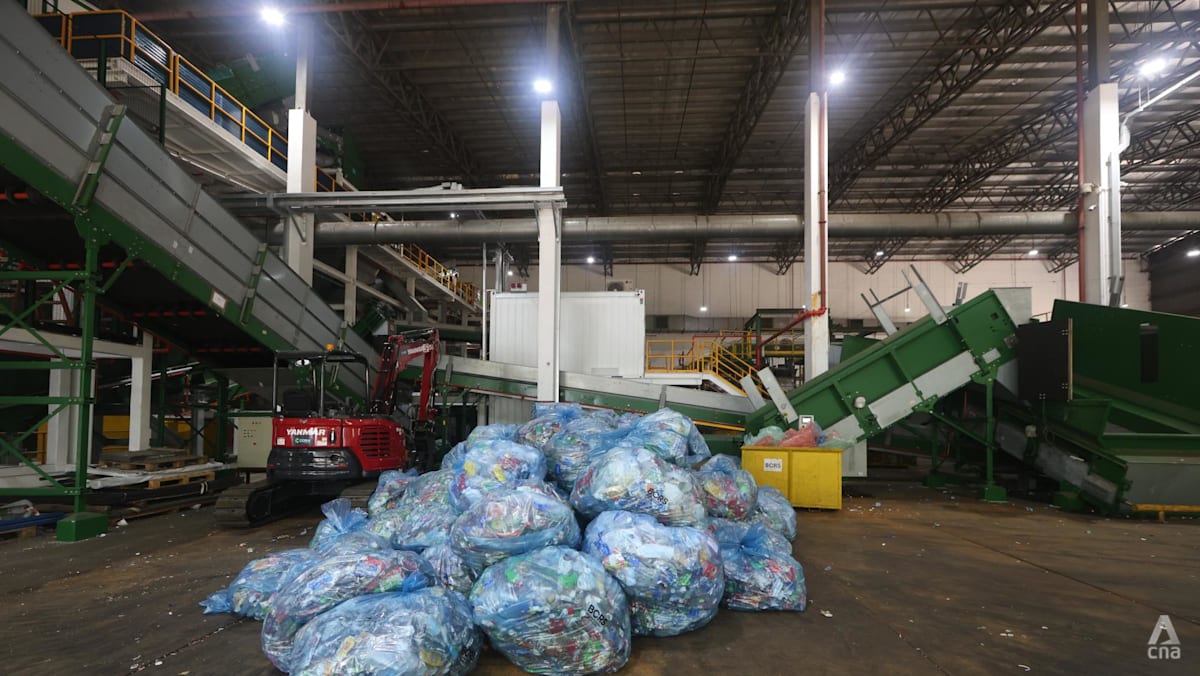
Bags of containers collected from the beverage container return scheme are transported to the counting and sorting facility at Cora Environment in Tuas, where they will be processed for recycling, on Sep 16, 2026. (Photo: CNA/Ooi Boon Keong)
This audio is generated by an AI tool.
SINGAPORE: Over 33 million drink containers have been returned via reverse vending machines, with 553 tonnes of material processed at a new counting and sorting facility in Tuas, as Singapore approaches the full rollout of the Beverage Container Return Scheme (BCRS) on Oct 1.
The total amounts recycled so far are accurate as of Sep 13, said scheme operator BCRS Ltd as it unveiled its centralised Tuas facility on Monday (Sep 21).
The operator did not state what this represents in terms of the proportion of eligible containers that were returned out of those sold, also known as the return rate.
About 55 per cent of the materials collected were plastic, while the remaining 45 per cent were metal.
CNA Games Guess Word Crack the word, one row at a time Buzzword Create words using the given letters Mini Sudoku Tiny puzzle, mighty brain teaser Mini Crossword Small grid, big challenge Word Search Spot as many words as you can Show More Show Less On Aug 5, the company disclosed that 5.5 million drink containers were returned, which meant that the number of containers returned grew by six times in less than two months. Ms Stephanie Yip, chief executive of BCRS Ltd, said it has taken an "extended ecosystem" to bring to life efforts to create a more circular economy, acknowledging that it will not be perfect from day one. "Our commitment is to run the scheme in a way that is fair, transparent and accountable. Whether it's our collection rates, showing you how we count and sort at our facility for recycling, we want to build your trust through transparency. Return Right is new for everyone, and we are just at the beginning," said Ms Yip. "There will be things to improve over time. We are committed to staying open, listening to feedback, and continuing to strengthen the system so it supports everyone involved as fairly as possible,” she said. Operational since August, the 2,000 sq m facility sorts and processes collected containers before sending them to recyclers to be turned into new products. The scheme, which launched on Apr 1, requires consumers to pay a refundable S$0.10 (US$0.07) deposit on eligible beverage containers — pre-packaged plastic or metal containers with volumes between 150ml and 3,000ml. Consumers can recoup their deposits by returning marked containers to one of about 1,300 Return Right reverse vending machines across Singapore, with another 200 machines slated to come online. The scheme is currently in a transition period, during which retailers are phasing out drinks without the deposit mark. From Oct 1, drinks without the deposit mark can no longer be sold. Metal and plastic beverage containers returned via reverse vending machines are handed over to Cora Environment, a waste management firm that operates the new facility and is in charge of the counting, sorting and baling of recycled materials for the scheme. Cora Environment was formerly known as Sembcorp Environment and SembWaste. Capable of handling 45 tonnes daily, which is equivalent to around 2 million containers, the solar-powered facility currently processes around 20 tonnes a day, with volumes expected to rise after the transition period. The system was designed by Nordic Recycling Systems, which has installed similar facilities in Norway. The firm also sourced the equipment, with installation in Tuas beginning in the first quarter of this year.
On Aug 5, the company disclosed that 5.5 million drink containers were returned, which meant that the number of containers returned grew by six times in less than two months.
Ms Stephanie Yip, chief executive of BCRS Ltd, said it has taken an "extended ecosystem" to bring to life efforts to create a more circular economy, acknowledging that it will not be perfect from day one.
"Our commitment is to run the scheme in a way that is fair, transparent and accountable. Whether it's our collection rates, showing you how we count and sort at our facility for recycling, we want to build your trust through transparency. Return Right is new for everyone, and we are just at the beginning," said Ms Yip.
"There will be things to improve over time. We are committed to staying open, listening to feedback, and continuing to strengthen the system so it supports everyone involved as fairly as possible,” she said.
Operational since August, the 2,000 sq m facility sorts and processes collected containers before sending them to recyclers to be turned into new products.
The scheme, which launched on Apr 1, requires consumers to pay a refundable S$0.10 (US$0.07) deposit on eligible beverage containers — pre-packaged plastic or metal containers with volumes between 150ml and 3,000ml.
Consumers can recoup their deposits by returning marked containers to one of about 1,300 Return Right reverse vending machines across Singapore, with another 200 machines slated to come online.
The scheme is currently in a transition period, during which retailers are phasing out drinks without the deposit mark. From Oct 1, drinks without the deposit mark can no longer be sold.
Metal and plastic beverage containers returned via reverse vending machines are handed over to Cora Environment, a waste management firm that operates the new facility and is in charge of the counting, sorting and baling of recycled materials for the scheme. Cora Environment was formerly known as Sembcorp Environment and SembWaste.
Capable of handling 45 tonnes daily, which is equivalent to around 2 million containers, the solar-powered facility currently processes around 20 tonnes a day, with volumes expected to rise after the transition period.
The system was designed by Nordic Recycling Systems, which has installed similar facilities in Norway. The firm also sourced the equipment, with installation in Tuas beginning in the first quarter of this year.
Bags of containers collected from Return Right reverse vending machines on Sep 16, 2026 at the start of the processing line at Cora Environment in Tuas, where they will be sorted according to material before being sent for recycling. (Photo: CNA/Ooi Boon Keong)
Containers collected from Return Right reverse vending machines across Singapore make their way onto a conveyor belt to be sorted by material at the beverage container return scheme counting and sorting facility at Cora Environment in Tuas, on Sep 16, 2026. (Photo: CNA/Ooi Boon Keong)
THE JOURNEY OF A CONTAINER
During a media tour of the facility, the operator showcased the automated sorting line that processed streams of containers, with robotic arms handling materials with minimal human intervention.
At this phase, the metal cans are to be sorted into separate bins for aluminium and steel, while plastics are sorted into bins for coloured and non-coloured polyethylene terephthalate (PET), high-density polyethylene (HDPE) and polypropylene (PP).
While there were steps further down the processing line to reduce odours, there were still smells from discarded drink containers when they first arrive at the facility.
Containers returned through reverse vending machines are handled by the three network point operators — RVM Systems, SG Recycle, and TOMRA — which consolidate the containers and convey them to the Cora facility.
Containers are packed in colour-coded plastic bags according to region, allowing them to be identified and counted more easily.
Overhead cameras identify and count the bags of collected containers, after which a pair of robotic arms helps to slice them open and shake loose containers into a screw bunker, at the counting and sorting facility operated by Cora Environment on Sep 16, 2026. (Photo: CNA/Ooi Boon Keong)
Overhead cameras log and count the bags by colour before conveyors feed them to robotic arms. The arms lift the bags onto platforms, where they are opened by slicing blades.
After the robotic arms shake the containers loose into a screw bunker below, it sends the emptied plastic bags on a separate route to be recycled.
In the screw bunker, leftover liquid in the containers are drained to reduce cross-contamination.
Further downstream, a ferrous magnet extracts steel cans and deposits them into a collection bin bound for metal recyclers.
The remaining containers are transported through enclosed pipes using an air conveying system, as opposed to open belts. Doing so helps to contain odours and reduces the dispersal of smaller particles throughout the premises. It also keeps the layout of the facility more compact.
The air conveying system transports beverage containers through enclosed pipes, helping to contain odours and minimise the dispersion of loose particles within the beverage container return scheme's counting and sorting facility at Cora Environment in Tuas on Sep 16, 2026. (Photo: CNA/Ooi Boon Keong)
Bottle caps and rings are separated from bottles as they pass through a rotating mechanism, and labels are detached from containers by utilising controlled air and its rotational speed.
A wind sifter then removes the labels, which are collected in bulk. Removing the labels creates a cleaner stream of recyclables and helps to increase overall yield.
Next, an eddy current separator uses electromagnetic induction to sort non-ferrous aluminium cans from plastic containers. It works by generating electrical currents that repel the aluminium cans away from plastics.
The aluminium cans are then compressed into dense blocks, also known as bales.
Aluminium cans separated from plastic beverage containers after passing through eddy current machines are conveyed to a baler, where they are compressed into bales (right), at the beverage container return scheme's counting and sorting facility on Sep 16, 2026. (Photo: CNA/Ooi Boon Keong)
The remaining plastic containers after steel cans and and aluminium cans were earlier removed from the stream of recyclables being processed at the beverage container return scheme's counting and sorting facility on Sep 16, 2026. (Photo: CNA/Ooi Boon Keong)
Aluminium cans are compressed into bales after being separated from containers made from other material at the beverage container return scheme counting and sorting facility in Tuas on Sep 16, 2026. (Photo: CNA/Ooi Boon Keong)
As for the remaining plastic containers, the journey through the facility is not yet over as they must be further sorted according to polymer type — PP, HDPE and PET.
Optical sensors paired with near-infrared technology identify each plastic type by how it reflects light and its colour, triggering targeted bursts of compressed air to shoot containers into designated bunkers.
Plastic containers travelling up a conveyor belt towards the first near-infrared plastic sorter at the counting and sorting facility for the beverage container return scheme on Sep 16, 2026. (Photo: CNA/Ooi Boon Keong)
Plastic sorters use near-infrared (NIR) technology and optical cameras to identify the different plastic containers, and pneumatic air jets then separate the containers into their respective bunkers at the beverage container return scheme counting and sort facility on Sep 16, 2026. (Photo: CNA/Ooi Boon Keong)
Finally, balers compress the sorted plastics into dense cubes, making them efficient to store and transport to recycling plants.
It takes about 30 minutes for a plastic bottle to travel through the system, from when it is first fed in until it is baled.
The facility generates daily operating reports detailing total bags processed, breaking down the data into important metrics, such as where the bags of containers are coming from.
Reporters were shown a Sep 7 example of such a report, which described how 1,423 bags were sorted at the facility, with 45 per cent of the bags coming from the central region, 40 per cent from west Singapore and 15 per cent from the eastern region.
As for where the bale of recyclable materials are bound for, scheme operator BCRS Ltd is working with a panel of "recycling off-takers" to close the loop.
Sorted plastics are compressed into bales at the counting and sorting facility operated by Cora Environment, on Sep 16, 2026. (Photo: CNA/Ooi Boon Keong)
Get our pick of top stories and thought-provoking articles in your inbox
Stay updated with notifications for breaking news and our best stories
Join our channel for the top reads for the day on your preferred chat app
这座占地 2000 平方米的新设施对收集到的容器进行分类和处理,然后将它们送到回收商那里制成新产品。
2026年9月16日,从饮料容器回收计划中收集的容器被运往位于大士的Cora Environment计数分拣中心,在那里进行回收处理。(图片:CNA/Ooi Boon Keong)
这段音频由人工智能工具生成。
新加坡:随着新加坡饮料容器回收计划(BCRS)于 10 月 1 日全面实施,已有超过 3300 万个饮料容器通过自动回收机被回收,553 吨材料在位于大士的新计数和分拣设施中得到处理。
回收计划运营商 BCRS Ltd 在周一(9 月 21 日)揭幕其位于大士的集中式回收设施时表示,截至 9 月 13 日,回收总量是准确的。
运营商没有说明这代表了已售出容器中退回的合格容器的比例(也称为退货率)。
收集到的材料中,约 55% 为塑料,其余 45% 为金属。
CNA游戏 猜词游戏 逐行破解单词 流行词游戏 用给定的字母组成单词 迷你数独 小谜题,脑力挑战 迷你填字游戏 小方格,大挑战 单词搜索 尽可能多地找出单词 显示更多 显示更少 8月5日,该公司披露已回收550万个饮料容器,这意味着在不到两个月的时间里,回收容器的数量增长了六倍。BCRS有限公司首席执行官叶女士表示,要实现更循环的经济模式,需要一个“更广泛的生态系统”,她也承认,这个模式不可能从一开始就完美无缺。“我们致力于以公平、透明和负责的方式运营这项计划。无论是我们的回收率,还是向您展示我们在回收设施中如何计数和分类,我们都希望通过透明度来建立您的信任。‘Return Right’对每个人来说都是全新的,我们才刚刚起步,”叶女士说道。 “随着时间的推移,肯定会有一些需要改进的地方。我们致力于保持开放的态度,认真听取反馈意见,并不断完善系统,使其尽可能公平地惠及所有相关方,”她说道。这座占地2000平方米的设施自8月投入运营以来,一直负责对收集到的容器进行分类和处理,然后再送往回收商处进行再加工,制成新产品。该计划于4月1日启动,要求消费者为符合条件的饮料容器支付0.10新元(约合0.07美元)的可退还押金——这些容器为容量在150毫升至3000毫升之间的预包装塑料或金属容器。消费者可以将贴有押金标记的容器退回新加坡各地约1300台“Return Right”自动回收机中的一台,以取回押金。另有200台回收机即将投入使用。该计划目前正处于过渡期,零售商正在逐步停止销售未贴押金标记的饮料。自10月1日起,未贴押金标记的饮料将不再销售。通过自动回收机回收的金属和塑料饮料容器将交给科拉环境公司(Cora Environment),这是一家废物管理公司,负责运营这座新设施,并负责对该计划中的可回收材料进行计数、分类和打包。科拉环境公司前身为胜科环境公司(Sembcorp Environment)和胜科废物处理公司(SembWaste)。这座太阳能供电的设施日处理能力为45吨,相当于约200万个容器。目前,该设施的日处理量约为20吨,预计过渡期结束后处理量将会增加。该系统由北欧回收系统公司(Nordic Recycling Systems)设计,该公司曾在挪威安装过类似的设施。该公司还负责采购设备,位于大士的安装工作已于今年第一季度开始。
8 月 5 日,该公司披露已退回 550 万个饮料容器,这意味着在不到两个月的时间里,退回的容器数量增长了六倍。
BCRS有限公司首席执行官Stephanie Yip女士表示,要实现更具循环性的经济,需要一个“更广泛的生态系统”,她也承认,这不会从一开始就完美无缺。
“我们承诺以公平、透明和负责的方式运营这项计划。无论是我们的回收率,还是向您展示我们在回收设施中如何计数和分类,我们都希望通过透明度来建立您的信任。‘Return Right’对每个人来说都是全新的,我们才刚刚起步,”叶女士说道。
“随着时间的推移,肯定会有一些需要改进的地方。我们致力于保持开放的态度,倾听反馈意见,并不断加强制度建设,使其尽可能公平地惠及所有相关人员,”她说道。
该占地 2000 平方米的设施自 8 月投入运营以来,对收集到的容器进行分类和处理,然后将其送往回收商,制成新产品。
该计划于 4 月 1 日启动,要求消费者对符合条件的饮料容器(容量在 150 毫升至 3000 毫升之间的预包装塑料或金属容器)支付 0.10 新元(0.07 美元)的可退还押金。
消费者可以通过将贴有标签的容器退回新加坡各地约 1300 台 Return Right 回收自动售货机之一来收回押金,另有 200 台机器计划投入使用。
该计划目前处于过渡期,零售商将逐步停止销售没有押金标识的饮品。自10月1日起,没有押金标识的饮品将不得再行销售。
通过自动回收机回收的金属和塑料饮料容器将交给科拉环境公司(Cora Environment),这是一家废物管理公司,负责运营该新设施,并负责对该计划中的可回收材料进行计数、分类和打包。科拉环境公司前身为胜科环境公司(Sembcorp Environment)和胜科废物处理公司(SembWaste)。
该太阳能发电设施每天可处理 45 吨货物,相当于约 200 万个集装箱,目前每天处理约 20 吨,预计过渡期结束后处理量将会增加。
该系统由北欧回收系统公司设计,该公司已在挪威安装了类似的设施。该公司还负责采购设备,并于今年第一季度开始在图阿斯进行安装。
2026年9月16日,从Return Right回收机收集的容器被装在袋子里,运到位于大士的Cora Environment处理线的起点。这些容器将在这里按材质分类,然后送去回收。(图片:CNA/Ooi Boon Keong)
2026年9月16日,在位于大士的Cora Environment饮料容器回收计划计数分拣中心,从新加坡各地的Return Right自动售货机收集的容器被送上传送带,按材质进行分拣。(图片:CNA/Ooi Boon Keong)
集装箱的旅程
在一次媒体参观活动中,运营方展示了自动化分拣线,该分拣线可以处理成串的容器,机械臂可以处理物料,最大限度地减少人为干预。
在这个阶段,金属罐要按铝罐和钢罐分别分类放入不同的箱子中,而塑料则要按有色和无色聚对苯二甲酸乙二醇酯(PET)、高密度聚乙烯(HDPE)和聚丙烯(PP)分别分类放入不同的箱子中。
虽然在后续的加工工序中采取了减少异味的措施,但废弃的饮料容器刚到达工厂时仍然会散发出异味。
通过逆向自动售货机退回的容器由三个网络点运营商——RVM Systems、SG Recycle 和 TOMRA——处理,它们将容器集中起来并运送到 Cora 设施。
容器按地区装入不同颜色的塑料袋中,以便更容易识别和计数。
2026年9月16日,在科拉环境公司运营的计数分拣中心,上方摄像头识别并计数收集到的容器袋,随后一对机械臂将袋子切开,并将散落的容器摇入螺旋式料仓。(图片:CNA/Ooi Boon Keong)
上方摄像头会按颜色记录并计数包装袋,然后传送带会将包装袋送到机械臂。机械臂会将包装袋提升到平台上,在那里由切割刀片打开包装袋。
机械臂将容器摇晃松动,落入下方的螺旋式料仓后,将空塑料袋送往另一条路线进行回收。
在螺旋输送机料仓中,容器中剩余的液体被排出,以减少交叉污染。
在下游更远处,一块铁磁铁会将钢罐吸出并放入一个运往金属回收商的收集箱中。
剩余的集装箱则通过封闭管道内的空气输送系统进行运输,而非使用开放式传送带。这样做有助于控制气味,减少细小颗粒在厂区内的扩散,同时也能使设施布局更加紧凑。
2026年9月16日,在位于大士的Cora Environment饮料容器回收计划计数分拣设施内,空气输送系统通过封闭管道输送饮料容器,有助于控制异味并最大限度地减少松散颗粒的扩散。(图片:CNA/Ooi Boon Keong)
瓶盖和瓶环在通过旋转机构时与瓶子分离,标签则利用可控空气及其旋转速度从容器上脱落。
然后,风力筛会将标签去除,这些标签会被集中收集。去除标签可以使可回收物更加清洁,并有助于提高整体回收率。
接下来,涡流分离器利用电磁感应原理将非铁质铝罐与塑料容器分离。它的工作原理是产生电流,使铝罐远离塑料。
然后将铝罐压缩成致密的块状物,也称为捆包。
2026年9月16日,在饮料容器回收计划的计数分拣中心,经过涡流分拣机从塑料饮料容器中分离出来的铝罐被输送到打包机,在那里被压缩成捆(右图)。(图片:CNA/Ooi Boon Keong)
2026年9月16日,在饮料容器回收计划的计数分拣设施中,钢罐和铝罐被回收后剩余的塑料容器从可回收物流中分离出来。(图片:CNA/Ooi Boon Keong)
2026年9月16日,在位于大士的饮料容器回收计划计数分拣中心,铝罐与其他材质的容器分离后被压缩成捆。(图片:CNA/Ooi Boon Keong)
至于剩下的塑料容器,它们在工厂的旅程还没有结束,因为它们必须根据聚合物类型(PP、HDPE 和 PET)进一步分类。
光学传感器与近红外技术相结合,通过塑料反射光线的方式和颜色来识别每种塑料类型,从而触发有针对性的压缩空气喷射,将容器射入指定的掩体中。
2026年9月16日,在饮料容器回收计划的计数分拣中心,塑料容器沿着传送带向上移动,前往第一台近红外塑料分拣机。(图片:CNA/Ooi Boon Keong)
2026年9月16日,在饮料容器回收计划的计数和分拣设施中,塑料分拣机利用近红外(NIR)技术和光学摄像头识别不同的塑料容器,然后通过气动喷气装置将容器分离到各自的料仓中。(图片:CNA/Ooi Boon Keong)
最后,打包机将分拣好的塑料压缩成致密的立方体,使其能够高效地储存和运输到回收厂。
一个塑料瓶从放入系统到被打包,大约需要 30 分钟才能完成整个流程。
该设施生成每日运营报告,详细列出处理的总袋数,并将数据分解为重要指标,例如袋装容器的来源。
记者们看到了一份 9 月 7 日的报告示例,该报告描述了该设施如何对 1423 个袋子进行分类,其中 45% 的袋子来自新加坡中部地区,40% 来自新加坡西部地区,15% 来自东部地区。
至于这些可回收材料包的最终去向,该计划的运营商 BCRS Ltd 正在与一个“回收承购商”小组合作,以实现闭环回收。
2026年9月16日,在科拉环境公司运营的计数分拣设施中,分拣好的塑料被压缩成捆。(图片:CNA/Ooi Boon Keong)
订阅我们的邮件,即可获取精选热点新闻和引人深思的文章。
订阅通知,第一时间获取突发新闻和精彩报道。
加入我们的频道,即可在您常用的聊天应用上获取当日热门文章。