What goes on inside the new sorting facility for used bottles and cans新的废瓶罐分拣中心内部究竟发生了什么?
The Straits Times journeys through the process of recycling used drink containers. Read more at straitstimes.com.
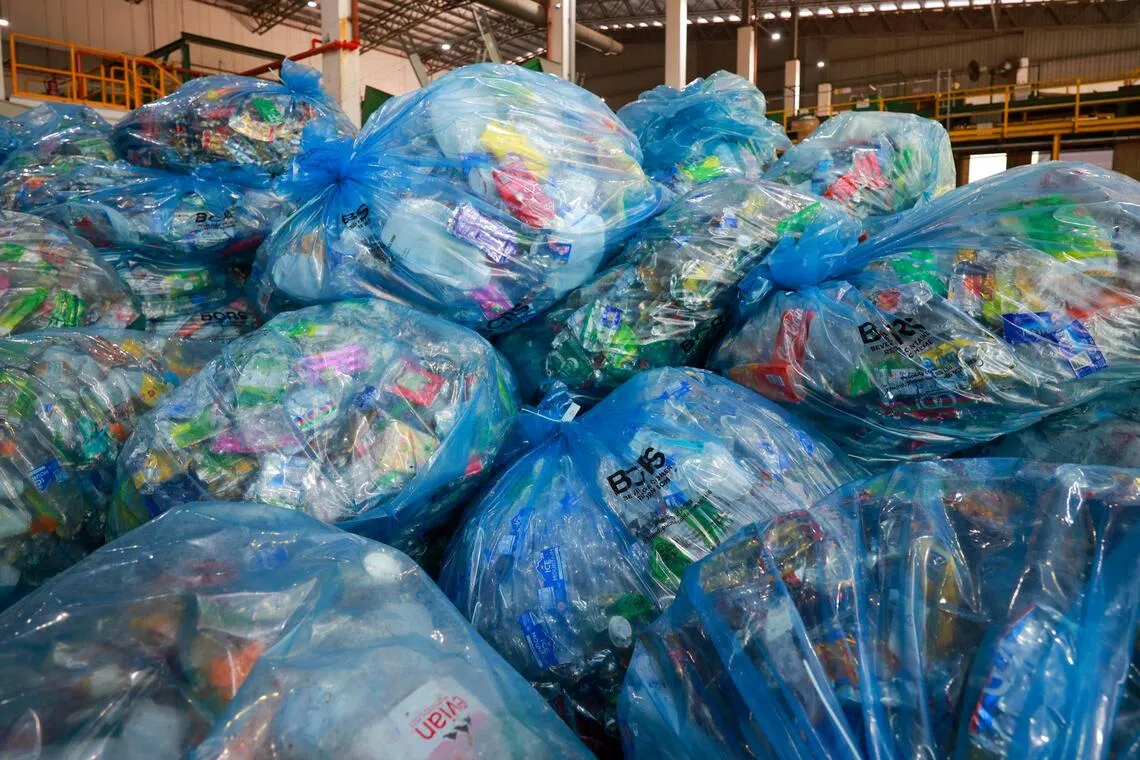
Bags of flattened cans and plastic bottles are piled at the new Counting and Sorting Facility in Tuas.
ST PHOTO: JASON QUAH
Published Sep 21, 2026, 04:05 PM
Updated Sep 21, 2026, 04:05 PM
The new Beverage Container Return Scheme’s Counting and Sorting Facility in Singapore processes over 1,200 bags daily from 1,300 reverse vending machines, using AI and robotics for efficient sorting.
The facility uses advanced technology like magnetic separators, eddy currents, and infrared rays to separate steel cans, aluminium cans, and various plastics, while also recycling plastic bags.
Innovative air-powered transport systems reduce the facility's footprint, control odours, and improve cleanliness, enhancing the overall recycling process for used drink containers.
SINGAPORE – The Beverage Container Return Scheme’s Counting and Sorting Facility was officially opened on Sept 21.
Operational since 2026, it receives cans and bottles from reverse vending machines across Singapore. The Straits Times journeys through the process of recycling used drink containers.
1) Collection and transport
A vehicle unloading bags of beverage containers at the Counting and Sorting Facility in Tuas Bay. ST PHOTO: JASON QUAH
A vehicle unloading bags of beverage containers at the Counting and Sorting Facility in Tuas Bay.
Empty bottles and cans are collected from around 1,300 reverse vending machines and transported to the Counting and Sorting Facility.
Each day, more than 1,200 bags are delivered to the facility.
Since April, members of the public have been returning their used cans and bottles - which are labelled with the deposit mark - at reverse vending machines islandwide. PHOTO: LIANHE ZAOBAO
Since April, members of the public have been returning their used cans and bottles - which are labelled with the deposit mark - at reverse vending machines islandwide.
PHOTO: LIANHE ZAOBAO
2) Robots empty bags
Robot arms pick up the bags, slice them open and empty the containers into a storage bin. The red bags come from reverse vending machines in the west of Singapore. ST PHOTO: JASON QUAH
Robot arms pick up the bags, slice them open and empty the containers into a storage bin. The red bags come from reverse vending machines in the west of Singapore.
AI-powered overhead cameras identify and count bags by colour , which indicates which region in Singapore the reverse vending machines come from.
Robot arms pick up the bags, slice them open and empty the containers into a storage bin called a screw bunker.
The plastic bags are also recycled.
3) Draining excess liquid
The containers are further compressed inside the screw bunker
Residual liquid is collected at the bottom and drained out through an outlet, reducing contamination risk.
4) Separating steel cans
Steel cans being sorted out through magnets. ST PHOTO: JASON QUAH
Steel cans being sorted out through magnets.
A magnetic separator removes steel cans from the mix.
5) Air-propelled transport
The air conveying system transports beverage containers through enclosed pipes. ST PHOTO: JASON QUAH
The air conveying system transports beverage containers through enclosed pipes.
The remaining plastic bottles and aluminium cans are propelled through pipes to a separating drum and wind sifter, which removes their labels.
The rotating drum screen filters out bottle caps and rings.
Using pipes instead of conveyor belts shrinks the facility’s overall footprint, contains odours, and minimises the dispersion of loose particles.
6) Separating aluminium cans
Processed materials are sold to recyclers by the bale. ST PHOTO: JASON QUAH
Processed materials are sold to recyclers by the bale.
Non-magnetic aluminium cans are separated from the remaining plastic containers by a machine using eddy currents to induce magnetism in the metal.
The recovered aluminium cans are compressed into bales and sold to recyclers.
7) Sorting the plastics
Plastic sorters use infrared technology and optical cameras to identify the specific types of plastic. ST PHOTO: JASON QUAH
Plastic sorters use infrared technology and optical cameras to identify the specific types of plastic.
The system sorts four types of plastics, including PET, coloured PET and HDPE (commonly used for milk and juice).
Infrared rays “read” the plastic containers to identify their specific material type.
Air jets shoot each bottle into its designated bin.
The sorted containers are baled and sent to recyclers.
Shabana Begum is a correspondent, with a focus on environment and science, at The Straits Times.
National Environment Agency
大士新建的计数和分拣中心堆放着成袋的压扁的易拉罐和塑料瓶。
《海峡时报》摄影:JASON QUAH
发布于 2026 年 9 月 21 日下午 4:05
更新于2026年9月21日下午4:05
新加坡新的饮料容器回收计划计数和分拣设施每天处理来自 1300 台自动售货机的 1200 多个袋子,利用人工智能和机器人进行高效分拣。
该设施采用磁选机、涡流分离器和红外线等先进技术来分离钢罐、铝罐和各种塑料,同时还能回收塑料袋。
创新的气动运输系统减少了设施的占地面积,控制了异味,提高了清洁度,从而增强了废旧饮料容器的整体回收过程。
新加坡——饮料容器回收计划的计数和分拣设施于9月21日正式启用。
该回收站自2026年运营以来,一直接收来自新加坡各地自动售货机的易拉罐和瓶子。《海峡时报》带您深入了解废旧饮料容器的回收过程。
1)收集和运输
一辆汽车正在大士湾的清点分拣中心卸下成袋的饮料容器。(海峡时报摄影:JASON QUAH)
一辆汽车正在大士湾的计数和分拣中心卸载成袋的饮料容器。
从大约 1300 台自动售货机收集空瓶和空罐,并运送到计数和分拣设施。
每天有超过 1200 袋垃圾被运送到该设施。
自四月起,市民已开始在全岛各地的自动回收机上退还带有押金标记的用过的易拉罐和瓶子。图片来源:联合早报
自四月以来,市民们一直在全岛各地的自动回收机上退还贴有押金标记的用过的罐子和瓶子。
图片来源:联合早报
2)机器人清空袋子
机械臂拾起这些袋子,切开后将里面的东西倒入储物箱。这些红色袋子来自新加坡西部的自动售货机。(海峡时报摄影:JASON QUAH)
机械臂拾起这些袋子,切开袋子,并将里面的东西倒入储物箱。这些红色袋子来自新加坡西部的自动回收机。
人工智能驱动的顶部摄像头通过颜色识别和计数袋子,从而指示新加坡的自动售货机来自哪个地区。
机械臂拿起袋子,切开袋子,将容器里的液体倒入一个叫做螺旋式储罐的储物箱中。
塑料袋也可以回收利用。
3)排出多余液体
这些容器在螺旋输送机内进一步压缩。
残留液体聚集在底部,并通过出口排出,从而降低污染风险。
4)分离钢罐
用磁铁分拣钢罐。(海峡时报摄影:JASON QUAH)
通过磁铁对钢罐进行分类。
磁性分离器将钢罐从混合物中分离出来。
5)空中推进运输
空气输送系统通过封闭管道输送饮料容器。(海峡时报照片:JASON QUAH)
空气输送系统通过封闭管道输送饮料容器。
剩余的塑料瓶和铝罐通过管道输送到分离滚筒和风选机,去除标签。
旋转滚筒筛可以过滤掉瓶盖和瓶环。
使用管道代替传送带可以缩小设施的整体占地面积,控制气味,并最大限度地减少松散颗粒的扩散。
6)分离铝罐
加工后的材料按捆出售给回收商。ST 摄影:JASON QUAH
加工后的材料按捆出售给回收商。
利用涡流在金属中感应磁性,将非磁性铝罐从剩余的塑料容器中分离出来。
回收的铝罐被压缩成捆,然后卖给回收商。
7)塑料分类
塑料分拣机利用红外技术和光学摄像头来识别塑料的具体类型。(海峡时报照片:JASON QUAH)
塑料分拣机利用红外技术和光学摄像头来识别塑料的具体类型。
该系统可对四种类型的塑料进行分类,包括 PET、彩色 PET 和 HDPE(常用于牛奶和果汁)。
红外线“读取”塑料容器,以识别其具体材料类型。
气流将每个瓶子喷射到指定的容器中。
分类后的容器被打包并送往回收商。
沙巴娜·贝古姆是《海峡时报》的记者,主要关注环境和科学领域。
国家环境局