New Tuas sorting facility collects 27.5 million bottles and cans for recycling in under 2 months位于大士的新分拣设施在不到两个月的时间内收集了2750万个瓶罐进行回收利用。
Discover how Singapore’s new Tuas facility uses AI and automation to sort 33 million bottles and cans for recycling under the Beverage Container Return Scheme. Read more at straitstimes.com.
新闻视频
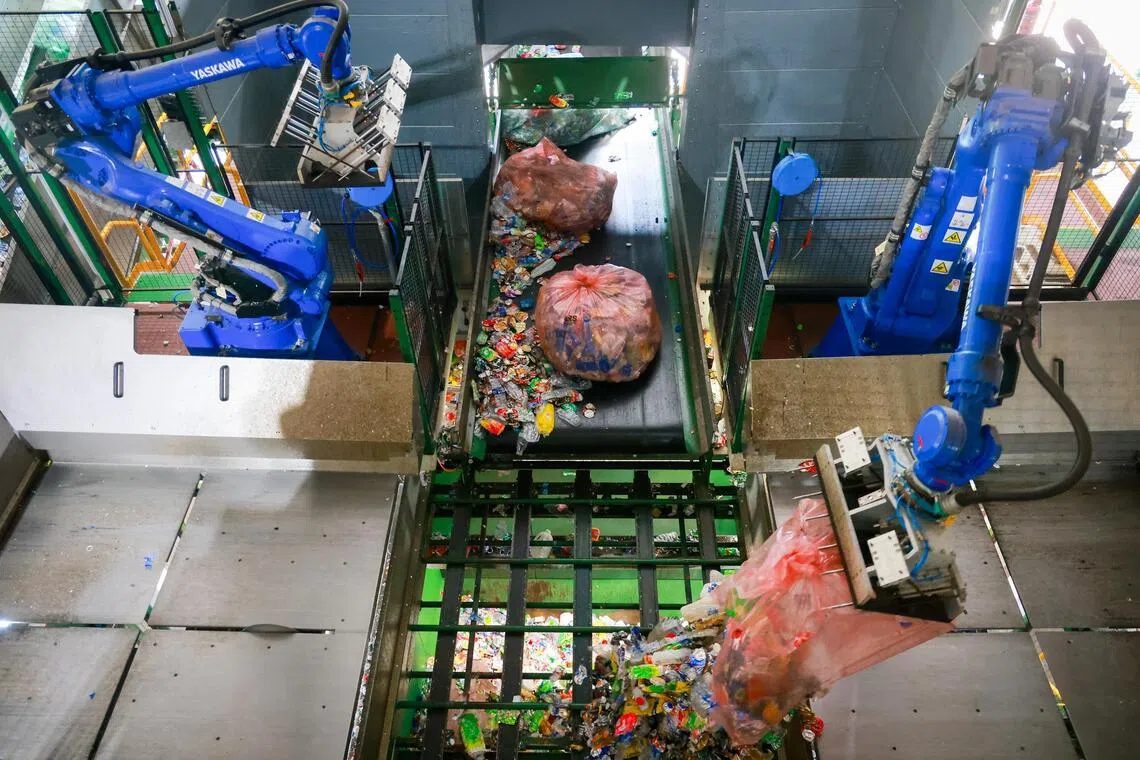
Robotic arms release the flattened bottles and cans into a heavy-duty storage bin, to kickstart the sorting process at the facility.
ST PHOTO: JASON QUAH
Published Sep 21, 2026, 04:00 PM
Updated Sep 21, 2026, 04:34 PM
The new BCRS Counting and Sorting Facility in Tuas uses automated technology to sort six types of materials from returned cans and bottles, improving recycling efficiency and reducing contamination.
Since April, the scheme collected around 33 million containers via 1,300 reverse vending machines, with users refunded 10 cents per container through digital payments.
BCRS aims to raise Singapore's low recycling rates, targeting 60% container return in one year and 80% within three years, recovering over 16,000 tonnes annually once fully operational.
SINGAPORE – These sorting machines in Tuas Bay do what many people in Singapore could do much better: sort and empty metal and plastic containers for recycling .
Every day, they take in around 1,200 large bags of flattened cans and bottles returned under the Beverage Container Return Scheme (BCRS) and send them on an industrial “roller coaster”.
Magnets separate some metal containers from the plastic ones, which are then sucked through pipes to another place where the labels are stripped.
The plastic containers are later further separated in four different types using infrared light.
Manual labour is not needed to sort the recyclables and discard around 40 per cent of contaminants, unlike other sorting facilities for the blue recycling bins.
The BCRS’ Counting and Sorting Facility at Tuas, which was officially launched on Sept 21, started operating in August.
Its operations could not have come at a better time as more labelled containers appear to be entering the market.
From the start of BCRS on April 1 to early August, 5.5 million containers were collected.
A vehicle unloading bags of used drink containers at the Counting and Sorting Facility pictured during a media preview on Sept 16. ST PHOTO: JASON QUAH
A vehicle unloading bags of used drink containers at the Counting and Sorting Facility pictured during a media preview on Sept 16.
Between August and Sept 13, the solar-powered facility by waste collector Cora Environment and the scheme’s operator BCRS Ltd has collected around 27.5 million used bottles and cans – five times more than before.
It is located within Cora Environment’s material recovery centre , which also sorts and processes recyclables collected from the blue bins like paper , cardboard and other plastics before sending them off to recyclers.
Under BCRS, customers pay an extra 10 cents for each drink and get the money back via EZ-Link or DBS PayLah! when they deposit the used containers into a reverse vending machine. There are around 1,300 reverse vending machines islandwide.
Once fully operational from October, the BCRS is expected to recover more than one billion beverage containers used each year, and recover over 16,000 tonnes of material annually. Since the scheme’s launch, around 553 tonnes have been recovered.
Recycled bottles at the Counting and Sorting Facility pictured on Sept 16, during a media preview. ST PHOTO: JASON QUAH
Recycled bottles at the Counting and Sorting Facility pictured on Sept 16, during a media preview.
Within the BCRS’ first year, the aim is to have 60 per cent of bottles and cans in the market returned for recycling. Within three years, the goal is to reach an 80 per cent return rate.
The scheme was launched to help raise Singapore’s household recycling rate, which reached an all-time low of 11 per cent in 2024 and 2025. Plastic recycling was at 4 per cent in 2025.
The blue bins, intended to collect a mix of recyclables, have been plagued with contamination rates of about 40 per cent since 2017. Segregating recyclables can improve their value, the authorities have said.
Using AI, robotic arms and infrared
The Tuas Bay facility, operational since August, is 2,000 sq m in size. ST PHOTO: JASON QUAH
The Tuas Bay facility, operational since August, is 2,000 sq m in size.
The 2,000 sq m Counting and Sorting Facility – roughly the size of two Olympic swimming pools – is the first in Singapore capable of sorting six material types on a single automated line. They include aluminium, steel and PET.
Fifty-five per cent of the materials collected so far are plastics, while the remaining 45 per cent are metal.
The bags are coloured red, blue and green, based on the regions they were collected from. Red bags come from reverse vending machines in the west. ST PHOTO: JASON QUAH
The bags are coloured red, blue and green, based on the regions they were collected from. Red bags come from reverse vending machines in the west.
While artificial intelligence and overhead cameras identify and count the bags containing crushed containers, robotic arms swing them onto slicers that break the bottom of the bags, before releasing the contents into a heavy-duty storage bin called a screw bunker.
C ontainers are further compressed inside this bin. Any residual liquid that collects at the bottom is drained out, reducing the risk of contaminating the materials.
When the public returns the used bottles and cans, they must be empty but do not need to be rinsed, although that is encouraged. The facility thus has a metallic and licorice-like odour.
Once the screw bunker releases the materials, it enters a “roller coaster” of pipes and conveyor belts to sort each material and bundle them up before sending them off to recyclers. Using the air-propelled vertical pipes reduces the facility’s footprint and also minimises odour.
A magnetic separator attracts steel cans. The rest of the containers travel through the pipes to a separating drum and wind sifter, which remove labels on the container, further raising the materials’ purity. A rotating drum screen filters out bottle caps and rings.
An eddy current machine with rapidly changing magnetic fields then separates aluminium cans from the plastic containers.
Four types of plastic bottles remain: Clear PET, coloured PET like the Mountain Dew bottles, HDPE which holds milk and juice, and PP (polypropylene).
These are individually identified in a plastic sorter machine using infrared rays, before compressed air shoots each container into its designated bin.
The infrared plastic sorters help to sort the different types of plastic containers. ST PHOTO: JASON QUAH
The infrared plastic sorters help to sort the different types of plastic containers.
Sorted plastic and aluminium are compressed into bales and sold to recyclers. The revenue from recyclers are used to fund BCRS, alongside fees from drink producers and unredeemed 10 cent deposits.
BCRS Ltd told The Straits Times: “We are working with a panel of recyclers for the different materials. Due to commercial sensitivities, we will not be able to reveal the recyclers.”
Shabana Begum is a correspondent, with a focus on environment and science, at The Straits Times.
机械臂将压扁的瓶罐放入重型存储箱中,从而启动工厂的分类过程。
《海峡时报》摄影:JASON QUAH
发布于2026年9月21日下午4:00
更新于2026年9月21日下午4:34
位于大士的BCRS新计数和分拣设施采用自动化技术对回收的罐和瓶子中的六种材料进行分拣,提高了回收效率并减少了污染。
自 4 月以来,该计划通过 1300 台反向自动售货机回收了约 3300 万个容器,用户通过数字支付方式获得每个容器 10 美分的退款。
BCRS 旨在提高新加坡的低回收率,目标是在一年内实现 60% 的集装箱回收率,并在三年内实现 80% 的回收率,一旦全面运营,每年可回收超过 16,000 吨。
新加坡——大士湾的这些分拣机做着许多新加坡人本可以做得更好的事情:对金属和塑料容器进行分类和清空,以便回收利用。
他们每天接收约 1200 大袋根据饮料容器回收计划 (BCRS) 退回的压扁的罐子和瓶子,并将它们送到工业“过山车”上进行处理。
磁铁将一些金属容器与塑料容器分离,然后将塑料容器通过管道吸入另一个地方,在那里标签被剥离。
然后使用红外线将塑料容器进一步分离成四种不同类型的容器。
与其他蓝色回收箱分拣设施不同,这里无需人工劳动即可对可回收物进行分拣,并丢弃约 40% 的污染物。
BCRS位于大士的计数和分拣设施于9月21日正式启用,并于8月开始运营。
它的运营可谓恰逢其时,因为越来越多的贴标容器似乎正在进入市场。
从 4 月 1 日 BCRS 开始到 8 月初,共收集了 550 万个容器。
9月16日媒体预览期间,一辆汽车正在清点分拣中心卸载装满废弃饮料容器的袋子。(海峡时报摄影:JASON QUAH)
9 月 16 日媒体预览期间,一辆汽车在计数和分拣设施卸载装满用过的饮料容器的袋子。
从 8 月到 9 月 13 日,由废物收集公司 Cora Environment 和该计划的运营商 BCRS Ltd 运营的太阳能设施收集了约 2750 万个用过的瓶罐——是以前的五倍。
它位于 Cora Environment 的材料回收中心内,该中心还会对从蓝色垃圾桶中收集的可回收物(如纸张、纸板和其他塑料)进行分类和处理,然后再将它们送往回收商。
根据“饮料回收计划”(BCRS),顾客每购买一杯饮料需额外支付10分钱,并将用过的饮料容器投入回收机后,通过EZ-Link或DBS PayLah! 取回这笔钱。全岛约有1300台回收机。
自10月全面投入运营以来,饮料容器回收系统(BCRS)预计每年可回收超过10亿个饮料容器,并回收超过1.6万吨材料。自该计划启动以来,已回收约553吨材料。
9月16日,在媒体预览会上,回收瓶在计数分拣中心被清点和分拣出来。(海峡时报摄影:JASON QUAH)
9 月 16 日,在媒体预览会上,计数和分拣设施内的回收瓶子被拍摄下来。
在BCRS计划实施的第一年,目标是使市场上60%的瓶罐被回收利用。三年内,目标是达到80%的回收率。
该计划旨在帮助提高新加坡的家庭回收率,该回收率在 2024 年和 2025 年降至历史最低点 11%。2025 年塑料回收率仅为 4%。
用于收集各种可回收物的蓝色垃圾桶自 2017 年以来一直受到污染率高达 40% 左右的困扰。有关部门表示,对可回收物进行分类可以提高其价值。
利用人工智能、机械臂和红外线
位于大士湾的这家设施自8月起投入运营,占地2000平方米。(海峡时报照片:JASON QUAH)
位于大士湾的设施自八月起投入运营,面积为2000平方米。
这座占地2000平方米的计数分拣中心——面积大约相当于两个奥运会标准游泳池——是新加坡首个能够在一条自动化生产线上分拣六种不同材料类型的设施,其中包括铝、钢和PET。
迄今为止收集到的材料中,55%是塑料,其余45%是金属。
这些袋子根据其收集地的不同,分别染成红色、蓝色和绿色。红色袋子来自西部地区的自动回收机。ST 摄影:JASON QUAH
这些袋子根据其收集地的不同,分别被涂成红色、蓝色和绿色。红色的袋子来自西部地区的自动售货机。
人工智能和高架摄像头识别并计数装有压碎容器的袋子,机械臂将它们摆放到切片机上,切片机切开袋子底部,然后将内容物释放到称为螺旋式储罐的重型存储箱中。
容器在这个料箱内被进一步压缩。底部积聚的任何残留液体都会被排出,从而降低污染物料的风险。
公众归还用过的瓶罐时,必须是空的,但无需冲洗,不过我们鼓励这样做。因此,该设施会散发出一种金属和类似甘草的气味。
螺旋输送机卸下物料后,物料会进入由管道和传送带组成的“过山车”式通道,对每种物料进行分拣和捆扎,然后再送往回收商。使用气动垂直管道可以减少设施占地面积,并最大限度地减少异味。
磁选机吸附钢罐。其余容器通过管道进入分离滚筒和风选机,去除容器上的标签,进一步提高物料纯度。旋转滚筒筛过滤掉瓶盖和瓶环。
然后,利用快速变化的磁场涡流分离机将铝罐与塑料容器分离。
现存四种类型的塑料瓶:透明 PET、彩色 PET(如 Mountain Dew 瓶子)、HDPE(用于盛装牛奶和果汁)和 PP(聚丙烯)。
这些容器在塑料分拣机中通过红外线进行逐一识别,然后压缩空气将每个容器送入其指定的容器中。
红外线塑料分拣机有助于对不同类型的塑料容器进行分拣。(海峡时报照片:JASON QUAH)
红外线塑料分拣机有助于对不同类型的塑料容器进行分拣。
分类后的塑料和铝被压缩成捆,出售给回收商。回收商的收入,加上饮料生产商缴纳的费用和未兑现的10分押金,共同用于资助BCRS项目。
BCRS有限公司告诉《海峡时报》:“我们正在与一组回收商合作处理不同的材料。由于商业敏感性,我们无法透露这些回收商的身份。”
沙巴娜·贝古姆是《海峡时报》的记者,主要关注环境和科学领域。