28 trains and 14 countries: Singaporean makes 21,445km journey home from Scotland by rail28列火车,跨越14个国家:新加坡人乘坐火车从苏格兰返回家乡,全程21445公里。
Nicholas Chua embarked on a 46-day solo train journey across 14 countries from Scotland to Singapore, navigating new cultures and other unexpected challenges. Read more at straitstimes.com.
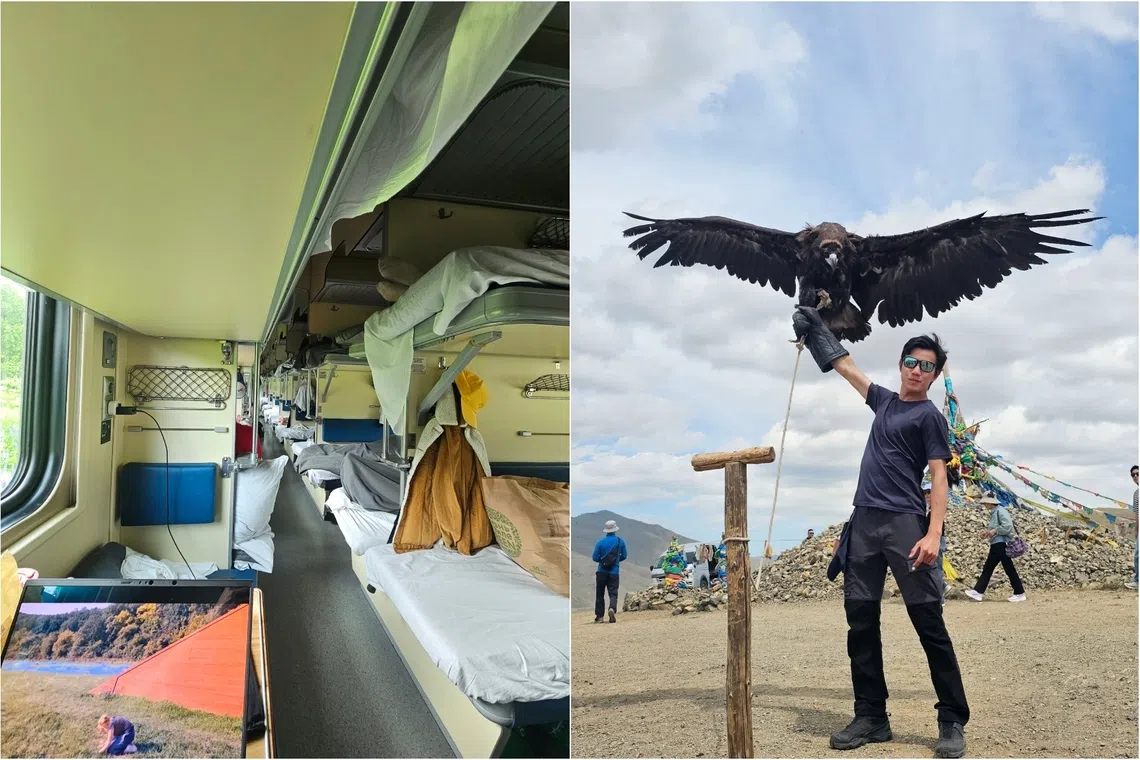
Nicholas Chua returned to Singapore from Scotland over a 46-day rail journey from May to July, crossing destinations like Mongolia and Russia.
PHOTOS: COURTESY OF NICHOLAS CHUA
Published Sep 21, 2026, 10:15 AM
Updated Sep 21, 2026, 05:23 PM
Nicholas Chua, a Singaporean student, travelled 21,445km home from Scotland by train.
He spent about $6,000 on the 46-day journey and experienced the 95-hour Trans-Siberian Railway ride in a noisy third-class cabin.
Chua values solo travel for self-discovery, plans more adventures post-university, and aims to climb peaks in Nepal with his mountaineering club later this year.
SINGAPORE – In June, Nicholas Chua found himself standing in a snaking queue at the land border between Estonia and Russia. He had been waiting for about 10 hours, unable to step away even for a quick toilet break or a meal.
He had taken a three-hour train ride from Estonia’s capital Tallinn to Narva, a border town on the country’s extreme eastern edge, hoping to cross into the Russian border town of Ivangorod on the same day.
Experienced travellers on the online forum Reddit had warned of long queues, as well as strangers approaching those waiting in line to offer a place closer to the front in exchange for payment.
Chua, 25, a third-year electrical engineering student at the National University of Singapore (NUS), experienced such an offer first-hand but declined it.
“I didn’t want to encourage them and be the guy who causes queue issues. It put those who were following the rules at a disadvantage. Some of them might have had to stay in line overnight,” he says.
The border crossing was just one leg of Chua’s 46-day rail journey home from Scotland, where he had completed a five-month exchange programme at The University of Edinburgh.
He started the trip on May 28. Rather than fly directly back to Singapore, he decided to take the long way home by train, which he believes will be difficult to replicate once he settles into the rhythm of adulting.
“Five months is the longest I’ve ever been away from home. By the end of the exchange programme, I really missed Singapore but decided to do this train trip because it felt meaningful to head home like this and explore the world along the way,” he says.
By June 6, he had travelled across the United Kingdom, Germany, Poland, Lithuania and Latvia, and finally had to make what he considered the most challenging land crossing of the entire route – between Estonia and Russia.
The two countries share a complex geopolitical relationship shaped by historical events and ongoing security considerations that influence border protocols.
Chua spent around 10 hours waiting in line to cross the border between the town of Narva in Estonia and Ivangorod in Russia. PHOTO: COURTESY OF NICHOLAS CHUA
Chua spent around 10 hours waiting in line to cross the border between the town of Narva in Estonia and Ivangorod in Russia.
PHOTO: COURTESY OF NICHOLAS CHUA
To make matters worse that day, a heavy downpour started midway through his wait, leaving his duffel bag and backpack soaked under what little shelter he had from his travel-size umbrella.
He finally cleared Customs at about 9.30pm, after queueing from 12.50pm that afternoon. But at the Russian border, he was detained for around 30 minutes, during which his photographs were taken and he was required to hand over his phone for inspection.
“They checked everything, from my albums to my chats. My privacy was gone,” he says. Despite the experience, he says he never felt he was truly in danger.
“I’m not Russian and I’m not from the European Union. I’m just this Singaporean guy who decided to cross this border. It made sense that they would question me. Most people would fly into Moscow instead of crossing the land border.”
It was with this same sense of curiosity and open-mindedness that he continued the 21,445km journey home by train, travelling through 14 countries.
The inspiration for his trip came from Spanish YouTuber Ramilla de Aventura, who posted a video on his experience taking the world’s longest train ride from Portugal to Singapore in June 2023 – roughly 18,755km long – which has chalked up more than 2.5 million views to date.
“I tried to follow the video as much as possible since it’s been trialled and tested. But I also had to use Google to check if some of the routes were still operational or if there were new routes available,” says Chua, who posted a map showing his route on TikTok after the trip.
Aside from using Google, he also turned to artificial intelligence chatbots Gemini and ChatGPT to narrow down the most suitable or alternative routes.
In total, he spent around $6,000 of savings from internships and national service on the entire journey, with most of his expenditure going to food and accommodation. He spent two to three days exploring each city before moving to the next one.
Chua remembers being fond of locomotives as a child, drawn by the sheer scale of the trains and their rhythmic sounds and movements. PHOTO: COURTESY OF NICHOLAS CHUA
Chua remembers being fond of locomotives as a child, drawn by the sheer scale of the trains and their rhythmic sounds and movements.
Although he tried to map out his itinerary in detail before setting off, much of the trip had to be booked on the fly. He would, for instance, buy his train tickets around three days before leaving a city and arrange his accommodation only afterwards.
“Sometimes, I’d plan far in advance and things wouldn’t work out, then money was wasted on booking the accommodation,” he says.
It was a lesson he learnt after unexpected train cancellations from London to Brussels in May – he forfeited the accommodation booked in Brussels and scrambled to stay at a friend’s place at the last minute.
Still, trains have always held a special place in Chua’s heart.
He remembers being fond of locomotives as a child, captivated by the sheer scale of the trains and the rhythmic sounds and movements. In 2024, he spent six months as an assistant engineer at public transport operator SMRT Corp as part of an internship.
Today, it is the reflective experience of travelling by train that continues to draw him.
Long train rides give people space and time to be more reflective, says Chua. PHOTO: COURTESY OF NICHOLAS CHUA
Long train rides give people space and time to be more reflective, says Chua.
“When you live in a city, there are so many people around that it can sometimes feel crowded and bothersome,” he says.
“On trains, you can just watch things go by and look at others living their lives. I sometimes have neither an internet connection nor any distractions, and have to be alone with my thoughts. There’s a lot of time for reflection.”
95 hours across Siberia
After crossing into Russia, he travelled from Ivangorod to St Petersburg and Moscow, visiting iconic landmarks such as the Church of the Saviour on Spilled Blood and the Red Square, where the Kremlin – a historic citadel that now serves as the official workplace and seat of the Russian government – stands.
The final stretch of the Russian leg, however, was the most gruelling.
Chua had planned to travel from Moscow to Ulan-Ude – the capital of Buryatia, a mountainous Russian republic in eastern Siberia – on a 95-hour train journey. It would be the longest train ride of his journey home.
Ulan-Ude was a stop on the Trans-Siberian Railway, the longest railway line in the world, which spans over 9,200km from Moscow in western Russia to Vladivostok in the east. Trains on the Trans-Siberian Railway typically have three cabin classes: first (spalny vagon), second (kupe) and third (platzkart).
The most expensive first class offers the most privacy, with two beds in a compartment with a lockable door. Second class has four beds – two upper and two lower bunks – in a compartment that also has a lockable door, at around half the cost of first class.
Third class, meanwhile, has an open-plan layout with no compartments or doors. Instead, rows of bunk beds accommodate more than 50 passengers.
Hoping for a more comfortable journey, Chua had intended to book second class. But a miscommunication when he bought his ticket in Moscow saw him walk straight into a third-class cabin.
“I only realised it when I boarded the train. It could get quite noisy and uncomfortable, which led to poor sleep,” he says.
Despite the blunder, the experience proved unexpectedly eye-opening.
Chua (second from left) spent his 95-hour train ride from Moscow to Ulan Ude chatting with other passengers, some of whom invited him for a drink and offered to share their snacks. PHOTO: COURTESY OF NICHOLAS CHUA
Chua (second from left) spent his 95-hour train ride from Moscow to Ulan Ude chatting with other passengers, some of whom invited him for a drink and offered to share their snacks.
“I ended up talking to people on the train, sometimes with translation apps like Google Translate. I found out that some of them were going home from work or visiting family and friends, while others were getting deployed for military exercises,” he says.
“I kept meeting different people because most passengers were just travelling between cities. They don’t usually take 95-hour train rides.”
The nearly four-day journey passed in a blur of changing faces and friendly conversations, quick meals in the dining car, a few downloaded movies and plenty of time spent staring out of the window at the vast expanse of Siberia.
“I think a trip shouldn’t be all smooth sailing. There should be certain challenging parts to it. Without a challenge, it doesn’t make things interesting,” Chua says.
On June 15, he reached Ulan-Ude and spent two days exploring the city, whose attractions include the Buddhist temple Rinpoche Bagsha Datsan on Bald Mountain and a 42,000kg statue of Russian politician Vladimir Lenin’s head.
From Ulan-Ude, he travelled to Mongolia’s capital Ulaanbaatar and then on to China, Hong Kong, Laos, Thailand and Malaysia before finally reaching Singapore on July 12. Among his favourite experiences during the trip was meeting friends along the way in places like Berlin, Beijing and Penang.
“Going on a solo trip for 46 days can get quite lonely. So, when I had the opportunity to be with my friends in a foreign country, it was really fun and memorable,” he says.
This was not Chua’s first solo trip and it is unlikely to be his last.
In September 2023, he trekked through Grand Teton National Park and Yellowstone National Park in Wyoming in the United States.
In November that year, he hiked up Mount Ollivier in New Zealand. And in 2025, he flew to Iceland and backpacked through geothermal valley Landmannalaugar and Hornstrandir, a remote nature reserve in the Westfjords.
Chua did a solo trip through Iceland in 2025, crossing large remote landscapes and navigating bad weather conditions. PHOTO: COURTESY OF NICHOLAS CHUA
Chua did a solo trip through Iceland in 2025, crossing large remote landscapes and navigating bad weather conditions.
Solo travelling, he says, brings out a different side of his personality – one he enjoys cultivating.
“When I’m alone in a foreign country where nobody knows me and I’m having a lot of fun, it makes me more talkative and more willing to approach strangers,” he says.
Some might describe this as an expression of wanderlust, but Chua is acutely aware that his current freedom is finite and that there are certain realities waiting for him after he graduates in 2028, including an increasingly competitive job market.
He says: “I know eventually I’ll have to find a job. I know trips like these won’t last forever. So, I’m really trying to make the best of my life while I’m in university, when I have so much freedom and so much free time.”
For now, he has another adventure on the horizon. In December, he plans to travel with 14 others from the NUS Mountaineering Club to Nepal, where they will attempt to scale one of three peaks – Naya Khang, Tsorku Peak or Scout Peak.
The group will travel from Kathmandu to Thulo Syabru village in the Langtang valley of Nepal, avoiding areas affected by the recent deadly floods. They plan to make the journey during the dry season, after the monsoon months from mid-June to early September, when conditions are safer for trekking.
Just a few years ago, Chua never imagined he would explore remote destinations on his own, let alone take 28 trains home from Scotland. Now, he no longer wants to leave his travels to another day and hopes to be able to do at least one adventurous trip a year.
“I’m happy with how far I’ve come. I’m no longer dreaming about things that I could do, but I’m actually doing things,” he says.
Sarah Stanley is a journalist at The Straits Times who covers travel, lifestyle and aviation.
蔡国强 (Nicholas Chua) 从苏格兰乘火车返回新加坡,从 5 月到 7 月,历时 46 天,途经蒙古和俄罗斯等地。
照片由尼古拉斯·蔡提供
发布于 2026 年 9 月 21 日上午 10:15
更新于2026年9月21日下午5:23
新加坡学生蔡尼古拉斯(Nicholas Chua)乘坐火车从苏格兰返回新加坡,全程21445公里。
他在为期 46 天的旅程中花费了约 6000 美元,并在嘈杂的三等车厢里体验了 95 小时的西伯利亚铁路之旅。
蔡先生重视独自旅行以发现自我,计划大学毕业后进行更多冒险,并打算今年晚些时候与登山俱乐部一起攀登尼泊尔的山峰。
新加坡——今年六月,尼古拉斯·蔡发现自己站在爱沙尼亚和俄罗斯陆路边境一条蜿蜒的队伍中。他已经等了大约十个小时,甚至连上个厕所或吃顿饭都做不到。
他从爱沙尼亚首都塔林乘坐三个小时的火车到达位于该国最东端的边境小镇纳尔瓦,希望当天就能进入俄罗斯边境小镇伊万哥罗德。
Reddit 论坛上的经验丰富的旅行者曾警告说,可能会出现排长队的情况,而且会有陌生人接近排队的人,提出付费后可以让他们排在队伍前面。
25岁的蔡某是新加坡国立大学(NUS)电气工程系三年级学生,他曾亲身经历过这样的机会,但他拒绝了。
“我不想鼓励他们这样做,也不想成为造成排队混乱的人。那样会让那些遵守规则的人处于不利地位。他们中的一些人可能不得不排队过夜,”他说。
过境只是蔡从苏格兰返回家乡的 46 天火车旅程中的一站。此前,他在爱丁堡大学完成了为期五个月的交换项目。
他于 5 月 28 日开始了这段旅程。他没有直接飞回新加坡,而是决定乘坐火车走远路回家,他认为一旦适应了成年人的生活节奏,就很难再体验这种旅行方式了。
“五个月是我离家时间最长的一次。交换项目结束时,我真的很想念新加坡,但我还是决定坐火车回家,因为我觉得这样回家很有意义,而且还能沿途探索世界,”他说。
到 6 月 6 日,他已经穿越了英国、德国、波兰、立陶宛和拉脱维亚,最后不得不进行他认为整个路线中最具挑战性的陆路穿越——从爱沙尼亚到俄罗斯。
两国地缘政治关系复杂,受到历史事件和持续安全因素的影响,这些因素也影响着边境协议。
蔡先生花了大约10个小时排队,才得以从爱沙尼亚纳尔瓦镇过境到俄罗斯伊万哥罗德镇。照片:由尼古拉斯·蔡先生提供
Chua花了大约10个小时排队等待通过爱沙尼亚纳尔瓦市和俄罗斯伊万哥罗德市之间的边境。
照片:由尼古拉斯·蔡提供
更糟糕的是,那天他等待的时候突然下起了瓢泼大雨,他的行李袋和背包在他仅有的旅行伞遮蔽下都被淋湿了。
他从当天下午12点50分开始排队,最终在晚上9点30分左右通过了海关。但在俄罗斯边境,他被扣留了大约30分钟,期间被拍照并被要求交出手机接受检查。
“他们检查了我的一切,从我的专辑到聊天记录。我的隐私荡然无存,”他说。尽管经历了这一切,他表示自己从未真正感到身处险境。
“我既不是俄罗斯人,也不是欧盟公民。我只是个决定越过边境的新加坡人。他们盘问我也是情理之中的事。大多数人都会选择飞到莫斯科,而不是走陆路边境。”
正是怀着这种好奇心和开放的心态,他继续乘坐火车,完成了 21445 公里的返乡之旅,途经 14 个国家。
他的旅行灵感来自西班牙 YouTuber Ramilla de Aventura,后者发布了一段视频,记录了他于 2023 年 6 月乘坐世界上最长的火车从葡萄牙到新加坡的经历——全程约 18,755 公里——该视频至今已获得超过 250 万次观看。
“我尽量按照视频里的路线走,因为这条路线已经过测试和验证。但我也得用谷歌地图查一下有些路线是否仍然有效,或者是否有新的路线可用,”蔡先生说道。旅行结束后,他还在TikTok上发布了一张地图,显示了他的路线。
除了使用谷歌之外,他还求助于人工智能聊天机器人 Gemini 和 ChatGPT,以缩小选择范围,找到最合适或替代路线。
他整个旅程总共花费了大约6000美元,这些钱是他实习和服兵役攒下的,其中大部分用于食宿。他每到一个城市都会停留两到三天,然后再前往下一个城市。
蔡先生回忆说,他小时候就很喜欢火车,被火车庞大的身躯、有节奏的声响和行驶的姿态所吸引。照片:由尼古拉斯·蔡先生提供
蔡先生回忆说,他小时候就很喜欢火车,被火车庞大的体量、有节奏的声音和运动所吸引。
尽管他出发前尽力详细规划了行程,但旅途中的许多事情还是需要临时安排。例如,他会在离开某个城市前三天左右购买火车票,之后再安排住宿。
“有时候,我提前很久就做了计划,但事情却没能如愿,结果预订住宿就浪费了钱,”他说。
这是他在五月份从伦敦到布鲁塞尔的火车意外取消后吸取的教训——他放弃了在布鲁塞尔预订的住宿,并在最后一刻匆忙找了一位朋友暂住。
不过,火车在蔡先生心中一直占据着特殊的地位。
他回忆起小时候就很喜欢火车,被火车庞大的身躯、有节奏的声响和行驶的姿态深深吸引。2024年,他曾在公共交通运营商SMRT公司实习六个月,担任助理工程师。
如今,乘坐火车旅行所带来的沉思体验依然吸引着他。
蔡先生说,长途火车旅行能让人们有时间和空间进行更多思考。照片:由尼古拉斯·蔡先生提供
蔡先生说,长途火车旅行能给人们提供空间和时间进行更多的反思。
他说:“住在城市里,周围人很多,有时会感到拥挤和烦躁。”
“在火车上,你可以看着窗外的风景,看看别人过着怎样的生活。有时候我既没有网络连接,也没有任何干扰,只能独自思考。我有很多时间反思。”
95小时穿越西伯利亚
进入俄罗斯后,他从伊万哥罗德前往圣彼得堡和莫斯科,参观了滴血救世主教堂和红场等标志性地标,克里姆林宫——这座历史悠久的城堡现在是俄罗斯政府的正式办公场所和所在地——就坐落在红场上。
然而,俄罗斯赛段的最后阶段最为艰苦。
蔡先生原计划从莫斯科乘火车前往乌兰乌德——布里亚特共和国的首府,布里亚特共和国是位于俄罗斯西伯利亚东部的一个多山共和国——全程需要95个小时。这将是他回家旅途中最长的一段火车旅程。
乌兰乌德是西伯利亚铁路上的一个站点,这条铁路是世界上最长的铁路线,全长超过9200公里,从俄罗斯西部的莫斯科延伸到东部的符拉迪沃斯托克。西伯利亚铁路上的列车通常分为三个等级:一等车厢(spalny vagon)、二等车厢(kupe)和三等车厢(platzkart)。
最贵的一等舱私密性最佳,设有两张床位,位于一个带锁的隔间内。二等舱设有四张床位——两张上铺和两张下铺——位于一个同样带锁的隔间内,价格约为一等舱的一半。
与此同时,三等车厢采用开放式布局,没有隔间或门。取而代之的是一排排上下铺,可容纳50多名乘客。
蔡先生原本希望旅途更舒适,打算预订二等车厢。但由于在莫斯科购票时沟通出现误会,他最终被安排进了三等车厢。
“我上火车后才意识到这一点。火车上会变得很吵闹,很不舒服,导致睡眠质量很差,”他说。
尽管出现了失误,但这次经历却出乎意料地令人大开眼界。
蔡先生(左二)在从莫斯科到乌兰乌德的95小时火车旅途中,与同行的乘客聊天,其中一些人邀请他喝饮料,并分享他们的零食。照片:由尼古拉斯·蔡先生提供
蔡(左二)在从莫斯科到乌兰乌德的95小时火车旅途中,与其他乘客聊天,其中一些人邀请他喝饮料,并表示愿意与他分享零食。
“我最后和火车上的人聊了起来,有时还会用谷歌翻译之类的翻译软件。我发现他们中有些人是下班回家或探望亲友,而另一些人则即将被派往参加军事演习,”他说。
“我不断遇到不同的人,因为大多数乘客只是在城市之间旅行。他们通常不会乘坐95个小时的火车。”
将近四天的旅程在不断变换的面孔和友好的交谈中飞逝而过,我们在餐车里匆匆吃了顿饭,看了几部下载的电影,并花了大量时间凝视窗外广袤的西伯利亚。
“我认为旅行不应该一帆风顺,应该有一些挑战性的部分。没有挑战,旅行就失去了趣味性。”蔡女士说道。
6月15日,他抵达乌兰乌德,花了两天时间游览这座城市,其景点包括秃山上的仁波切巴格沙达赞佛教寺庙和重达42000公斤的俄罗斯政治家弗拉基米尔·列宁头像。
他从乌兰乌德出发,前往蒙古首都乌兰巴托,然后途经中国、香港、老挝、泰国和马来西亚,最终于7月12日抵达新加坡。旅途中他最喜欢的经历之一是在柏林、北京和槟城等地与朋友们相聚。
“独自旅行46天可能会很孤独。所以,当我有机会和朋友们在国外一起旅行时,那段经历真的非常有趣,也令人难忘,”他说。
这并非蔡先生第一次独自旅行,而且很可能也不会是最后一次。
2023年9月,他徒步穿越了美国怀俄明州的大提顿国家公园和黄石国家公园。
同年11月,他徒步攀登了新西兰的奥利维尔山。2025年,他飞往冰岛,背着行囊穿越了地热山谷兰德曼纳劳卡和霍恩斯特兰迪尔——西峡湾地区一处偏远的自然保护区。
2025年,蔡先生独自一人穿越冰岛,跋涉于广袤偏远的地区,并克服了恶劣的天气条件。照片:由尼古拉斯·蔡先生提供
2025年,蔡独自一人穿越冰岛,穿越广袤偏远的地区,并克服了恶劣的天气条件。
他说,独自旅行能展现他性格中不同的一面——而他很享受培养这种性格。
他说:“当我在异国他乡独自一人,没有人认识我,而且玩得很开心的时候,我会变得更健谈,更愿意接近陌生人。”
有些人可能会把这描述为一种旅行癖的表达,但蔡非常清楚他目前的自由是有限的,2028 年毕业后,他将面临一些现实,包括竞争日益激烈的就业市场。
他说:“我知道我最终还是要找工作的。我也知道这样的旅行不会永远持续下去。所以,我真的想在大学期间好好享受生活,因为我拥有如此多的自由和空闲时间。”
目前,他还有另一项冒险计划。12月,他计划与新加坡国立大学登山俱乐部的其他14名成员前往尼泊尔,尝试攀登三座山峰中的一座——纳亚康峰、措尔库峰或童子军峰。
该团队将从加德满都前往尼泊尔朗塘山谷的图洛夏布鲁村,避开近期遭受致命洪灾的地区。他们计划在旱季,即6月中旬至9月初的雨季过后进行此次行程,届时徒步旅行条件更为安全。
几年前,蔡先生从未想过自己会独自探索偏远地区,更别提从苏格兰搭乘28趟火车回家了。如今,他不再想把旅行计划推迟到以后,希望每年至少能进行一次冒险之旅。
“我对自己的成就感到满意。我不再只是梦想着自己能做些什么,而是正在付诸行动,”他说。
Sarah Stanley 是《海峡时报》的一名记者,主要报道旅游、生活方式和航空方面的新闻。