SBF launches tool to help firms assess future readiness, address capability gapsSBF推出工具,帮助企业评估未来准备情况,弥补能力差距
SBF launches the Future Ready Business Index, a tool to help companies assess readiness, identify gaps and prioritise transformation across six key business dimensions. Read more at straitstimes.com.
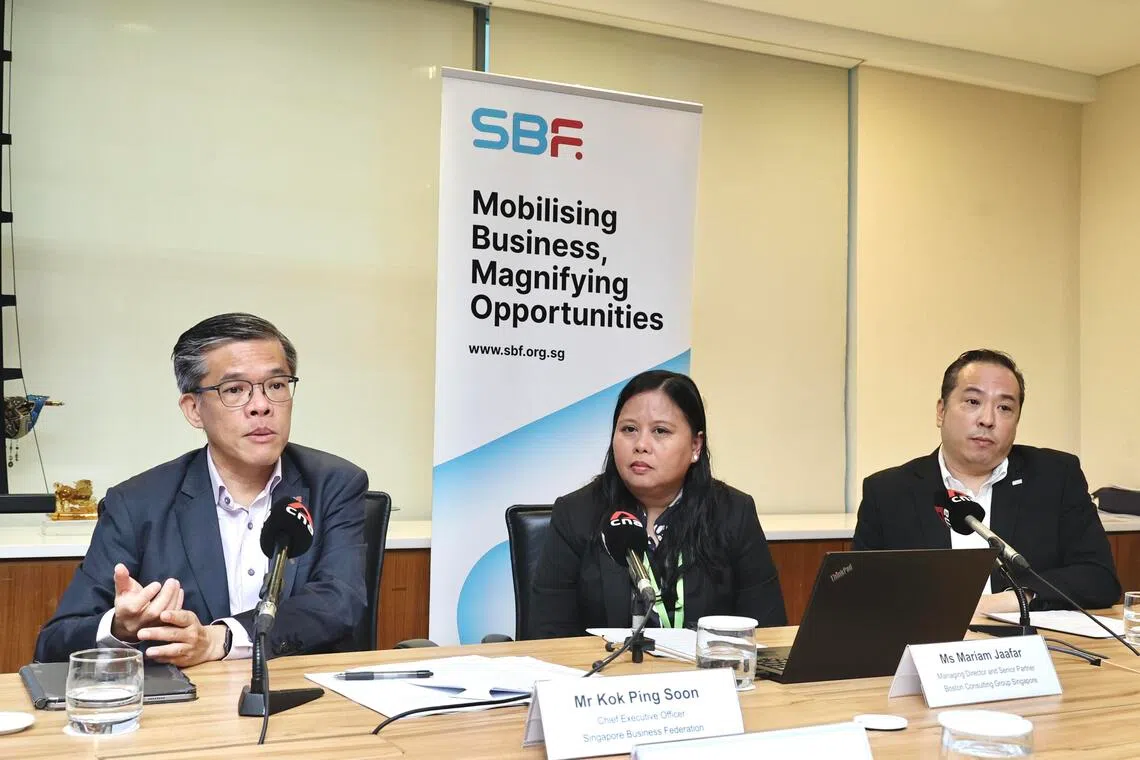
(From left) Singapore Business Federation chief executive officer Kok Ping Soon, Boston Consulting Group Singapore managing director and senior partner Mariam Jaafar and RSM Singapore head of advisory Terence Ang at the launch of the diagnostic tool.
PHOTO: LIANHE ZAOBAO
Published Sep 21, 2026, 03:45 PM
Updated Sep 21, 2026, 06:39 PM
The Singapore Business Federation (SBF) launched the Future Ready Business Index (FRBI) to help companies assess their readiness, identify gaps, and prioritise transformation across six key business dimensions.
Developed with BCG and partners, the FRBI measures maturity, not just activity, and guides firms to focus resources effectively while connecting them to relevant support programmes.
Over 100 companies have used the tool, showing strong willingness to transform, especially in skills and technology, with plans to expand usage and refine the tool for ongoing business needs.
SINGAPORE – The Singapore Business Federation (SBF) on Sept 21 launched a new holistic diagnostic tool to help companies assess their future readiness, identify capability gaps and prioritise transformation efforts.
The launch was officiated by Senior Minister of State for Trade and Industry Low Yen Ling at the inaugural Future Ready Business in Action 2026 event, as part of the wider Future Ready Business platform .
The Future Ready Business Index (FRBI), developed with Boston Consulting Group (BCG) and delivered in partnership with DBS, Enterprise Singapore and RSM Singapore, looks at 11 quantitative measures and 39 qualitative metrics with rubrics with specific descriptors for more objectivity.
It is a “business readiness check” that looks at six key dimensions, said SBF chief executive officer Kok Ping Soon.
The six key dimensions are:
Success driven, which looks at their business performance, including strategy and financial strength
Scaled globally, which considers their readiness for international growth
Smart-enabled, which looks at their use of technology, including their data infrastructure and cybersecurity preparedness
Skills empowered, which assesses their workforce planning and development
Sustainable-centric, which explores measures such as emissions tracking and preparation to seize green opportunities
Socially impactful, which looks at businesses’ purpose and governance
Mariam Jaafar, managing director and senior partner at BCG Singapore , noted that it uses a T-shaped model, which provides a broad assessment but also helps businesses understand which pillars require the most work.
It is a “first step” that gives the business community something it has not had before at scale, said Kok, highlighting three ways it differs from other diagnostic tools.
First, it gives businesses the full picture, rather than being focused on one aspect such as digitalisation or sustainability.
The six dimensions are interconnected, with capabilities working together as a whole, he said. For example, strong fundamentals are needed to support overseas growth, and sustainability can affect costs.
Second, the FRBI measures maturity, not just activity. It asks not just about adoption, but also how well capabilities are embedded and producing results.
Companies will be told whether they are nascent, emerging, progressing, or future ready and how to move forward.
Third, the tool turns diagnosis into action. By identifying the gaps that matter most, it helps businesses “focus their limited time and resources where they have the greatest impact”.
Advisers will direct companies to the relevant programmes, training, financing and specialist support from across the ecosystem.
Kok said: “More than 100 companies have actually completed the FRBI. We aim to double it by the end of this year to 200 and then reach collectively 500 companies by the end of next year.”
With more companies using the FBRI, the tool can also be refined over time to stay relevant to business needs and operating conditions, he said.
Mariam said that based on feedback from the pilot, the tool was tweaked to allow companies to delegate sections to team members with relevant expertise.
The trial also helped to cut the time needed to fill in the survey, as it was optimised to pull data from sources such as the Accounting and Corporate Regulatory Authority.
Of the 102 companies in the pilot programme, 70 were those with revenues of under $10 million.
By maturity level, about 80 per cent of respondents were in the nascent or merging stages, but 77 per cent aspire to be progressing or future ready by 2027.
This shows that companies are aware and willing to transform, but lack capability, Mariam said.
Kok also noted that this shows that companies are realistic, understanding that they may not reach the “final stage” immediately.
Mariam added that according to findings, companies with higher FRBI scores demonstrate better business outcomes. Progressing companies marked median revenue growth that was 5 percentage points higher than nascent ones, for example.
Currently, businesses are most prepared in the success-driven and skills-empowered dimensions, whereas sustainable-centric and socially impactful were clear laggards, she said.
Of the six aspects, the biggest differences between current and target states – the largest ambition gaps for pilot participants – were in smart-enabled and skills empowered.
SBF recommends that companies retake the FRBI every two years, providing time for improvements to take effect while establishing a meaningful benchmark for tracking progress .
The Future Ready Business platform includes complementary offerings from closed-room dialogues to behind-the-scenes company visits, with the aim of helping companies move from diagnoses to action. THE BUSINESS TIMES
(从左至右)新加坡商业联合会首席执行官郭炳顺、波士顿咨询集团新加坡董事总经理兼高级合伙人玛丽亚姆·贾法尔和 RSM 新加坡咨询主管 Terence Ang 在诊断工具发布会上。
图片来源:联合早报
发布于 2026 年 9 月 21 日下午 3:45
更新于2026年9月21日下午6:39
新加坡商业联合会 (SBF) 推出了未来就绪商业指数 (FRBI),旨在帮助企业评估自身准备情况,找出差距,并优先考虑六个关键业务维度的转型。
FRBI 由 BCG 和合作伙伴共同开发,它衡量的是成熟度,而不仅仅是活动,并指导企业有效地集中资源,同时将资源与相关的支持计划联系起来。
已有超过 100 家公司使用了该工具,表现出强烈的转型意愿,尤其是在技能和技术方面,并计划扩大使用范围,并根据持续的业务需求改进该工具。
新加坡——新加坡商业联合会(SBF)于9月21日推出了一款新的综合诊断工具,旨在帮助企业评估其未来准备情况、识别能力差距并优先考虑转型工作。
此次启动仪式由贸工部高级政务部长刘燕玲在首届“未来就绪商业行动 2026”活动上主持,该活动是更广泛的“未来就绪商业”平台的一部分。
未来就绪商业指数 (FRBI) 由波士顿咨询集团 (BCG) 开发,并与星展银行、新加坡企业发展局和 RSM 新加坡合作推出,它考察了 11 项定量指标和 39 项定性指标,并制定了带有具体描述符的评分标准,以提高客观性。
新加坡银行家协会 (SBF) 首席执行官郭平顺表示,这是一项“业务准备情况检查”,着眼于六个关键维度。
六个关键维度是:
以成功为导向,关注其业务绩效,包括战略和财务实力。
在全球范围内扩大规模,这考虑到了它们对国际增长的准备情况
智能化程度,指的是他们对技术的使用情况,包括他们的数据基础设施和网络安全准备情况。
技能赋能,评估其劳动力规划和发展
以可持续发展为中心,探讨诸如排放追踪和抓住绿色机遇等措施。
社会影响力方面,关注企业的宗旨和治理。
BCG新加坡董事总经理兼高级合伙人Mariam Jaafar指出,该公司采用T型模型,该模型不仅提供广泛的评估,还能帮助企业了解哪些支柱需要投入最多的工作。
Kok表示,这是“第一步”,它为商业界带来了以前从未大规模拥有过的东西,并重点介绍了它与其他诊断工具的三个不同之处。
首先,它为企业提供了全面的视角,而不是仅仅关注数字化或可持续性等某个方面。
他表示,这六个维度相互关联,各项能力协同运作,形成一个整体。例如,强大的基本面是支撑海外增长的必要条件,而可持续性会影响成本。
其次,FRBI衡量的是成熟度,而不仅仅是活动量。它不仅关注采用情况,还关注能力融入程度以及产生的效果。
公司将被告知自己处于初创阶段、新兴阶段、发展阶段还是未来准备阶段,以及如何向前发展。
第三,该工具能将诊断转化为行动。通过识别最重要的差距,它能帮助企业“将有限的时间和资源集中在最能产生影响的地方”。
顾问将指导企业获得来自整个生态系统的相关项目、培训、融资和专家支持。
Kok表示:“目前已有超过100家公司完成了FRBI项目。我们的目标是在今年年底前将这一数字翻一番,达到200家,然后在明年年底前达到500家。”
他表示,随着越来越多的公司使用 FBRI,该工具也可以随着时间的推移而不断完善,以保持与业务需求和运营条件的相关性。
Mariam表示,根据试点项目的反馈,该工具经过调整,允许公司将部分工作委派给具有相关专业知识的团队成员。
该试验还有助于缩短填写调查所需的时间,因为它经过优化,可以从会计和企业监管局等来源提取数据。
参与试点项目的 102 家公司中,有 70 家公司的收入低于 1000 万美元。
按成熟度划分,约 80% 的受访者处于萌芽或融合阶段,但 77% 的受访者希望到 2027 年能够取得进步或为未来做好准备。
玛丽亚姆表示,这表明企业已经意识到转型的必要性,并且愿意转型,但却缺乏转型能力。
Kok还指出,这表明企业是务实的,明白它们可能不会立即达到“最终阶段”。
玛丽亚姆补充说,根据调查结果,FRBI评分较高的公司业绩更佳。例如,发展迅速的公司营收增长率中位数比初创公司高出5个百分点。
她表示,目前企业在以成功为导向和以技能为赋能的维度上准备得最为充分,而以可持续发展为中心和社会影响方面则明显落后。
在六个方面中,当前状态与目标状态之间最大的差异——试点参与者最大的雄心差距——在于智能赋能和技能赋能。
SBF 建议公司每两年重新进行 FRBI 测试,以便有时间让改进措施生效,同时建立一个有意义的基准来跟踪进展。
“未来就绪型企业”平台提供一系列配套服务,包括闭门会谈和企业幕后参观,旨在帮助企业从诊断问题到采取行动。《商业时报》