With AI tool, SGH detects brain bleeding from CT scans within a few minutes借助人工智能工具,SGH可在几分钟内通过CT扫描检测出脑出血。
Singapore General Hospital deploys AI tool iScreen to analyse brain scans in minutes, improving detection and treatment of brain bleeding and reducing reporting times. Read more at straitstimes.com.
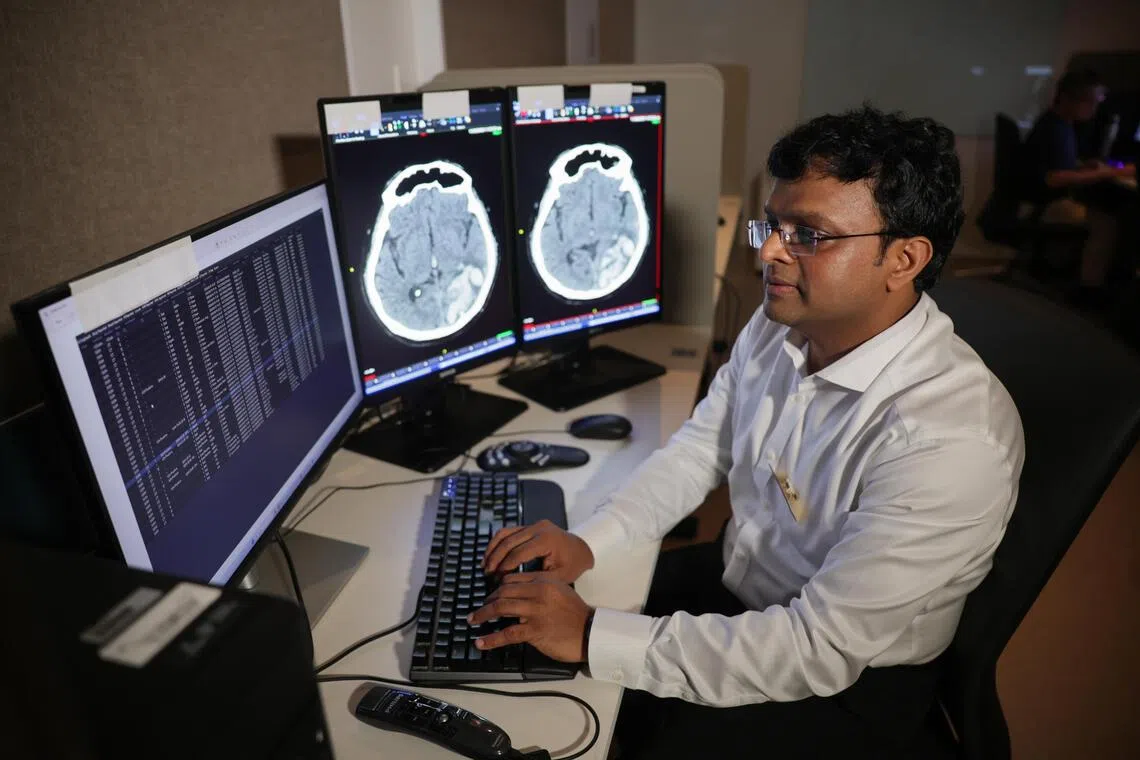
Analysis of CT brain scans had been made faster and easier with the use of AI, said senior consultant Sarat Kumar Sanamandra at the neuroradiology department of Singapore General Hospital and National Neuroscience Institute.
Published Sep 21, 2026, 09:10 PM
Updated Sep 21, 2026, 09:10 PM
Singapore General Hospital (SGH) has launched iScreen, an AI tool that analyses brain CT scans in about six minutes to detect intracranial bleeding faster than the usual 30 minutes to an hour.
iScreen alerts neuroradiologists and doctors instantly via SMS for quicker review and intervention, reducing reporting delays and improving patient outcomes in urgent brain bleed cases.
Developed with local startup Iota MedTech and integrated on the national AimSG platform, iScreen supports radiologists and is planned for wider adoption across Singapore public hospitals.
SINGAPORE – A new AI tool co-developed by Singapore General Hospital (SGH) can detect brain bleeding from scans in about six minutes, instead of the 30 minutes to an hour that radiologists at the hospital need for urgent cases.
The AI model named iScreen analyses the computed tomography (CT) scans and picks up white spots which signal bleeding in the brain, or locations of bleeding which might have more severe impact to the patient.
Acute cases may need surgery to stop the bleeding.
“Reduced reporting time can really make the difference between life and death, or between a full recovery and lasting disability,” said senior consultant Robert Chen, head of the neuroradiology department of SGH and National Neuroscience Institute (NNI@SGH).
Once the AI model flags a positive result, an SMS message will be sent to both the neuroradiologist and the attending doctor, said senior consultant Sarat Kumar Sanamandra from the same department.
This will nudge the neuroradiologist to prioritise reviewing the AI results of that patient, ahead of all other scans in the queue.
For cases assessed to be patients with haemorrhage , the radiologist will then report the case to the attending doctor.
SGH’s data on 3,475 CT brain scans in November and December 2025 showed that the sensitivity of iScreen is 93.1 per cent.
This means 6.9 per cent of the cases flagged as positive for bleeding turned out to be false positives.
The hospital’s data also showed that the proportion of bleeding cases that took more than an hour to be reported dropped from 14.6 per cent to 5 per cent with the use of iScreen.
Sarat emphasised the use of AI is meant to support its radiologists, rather than replace them. SGH has about 100 radiologists, of whom 21 are neuroradiologist.
SGH deals with thousands of CT scans each day, of which about 50 are head CT scans, and about 10 per cent of these show signs of bleeding.
There is no limit to the number of scans which iScreen can process concurrently.
Scans which were picked up as positive for bleeding in the brain, or intracranial haemorrhage (ICH), by the AI tool would be clearly marked as “ICH positive”, whereas other scans will not show a reading. ST PHOTO: GIN TAY
Scans which were picked up as positive for bleeding in the brain, or intracranial haemorrhage (ICH), by the AI tool would be clearly marked as “ICH positive”, whereas other scans will not show a reading.
Bleeding in the brain, also known as intracranial haemorrhage, can happen in those who suffer from strokes, or experience a rupture of an aneurysm (bulge in the blood vessel) and tumours.
Traumatic head injury can also lead to brain bleeding, especially for seniors or those on certain blood-thinning medications.
Such patients could start to bleed in the brain even with minor physical impact, such as the head knocking against the door or slipping.
(From left) Robert Chen, head and senior consultant with the neuroradiology department of Singapore General Hospital and National Neuroscience Institute (NNI@SGH) reviewing the AI results and CT scans of patients together with Sarat Kumar Sanamandra, senior consultant of the same department. ST PHOTO: GIN TAY
(From left) Robert Chen, head and senior consultant with the neuroradiology department of Singapore General Hospital and National Neuroscience Institute (NNI@SGH) reviewing the AI results and CT scans of patients together with Sarat Kumar Sanamandra, senior consultant of the same department.
Local start-up Iota MedTech began its collaboration with NNI and SGH since 2019 to develop the AI model.
Justin Ker, consultant with the NNI’s neurosurgery department, said the model stemmed from his trainee days when he looked into possible ways to scale the precious resources involved in brain surgeries to help more patients.
“Timely interventions to these cases will determine how long the patient will stay in intensive care, in the hospital, and when he or she can return to work”, Ker added.
For scans which had been detected as positive for bleeding by the AI model, the system will automatically send off an SMS message to both the radiologist and attending doctor to alert them. ST PHOTO: GIN TAY
For scans which had been detected as positive for bleeding by the AI model, the system will automatically send off an SMS message to both the radiologist and attending doctor to alert them.
Iota MedTech’s chief executive Benjamin Hong told The Straits Times that it will continue to work with SGH on developing other clinical usage for the AI model.
It is also currently in talks with other public hospitals to use iScreen.
The AI model utilised at Singapore General Hospital could potentially be used for other types of scans. ST PHOTO: GIN TAY
The AI model utilised at Singapore General Hospital could potentially be used for other types of scans.
The model can be easily implemented in more hospitals as it is deployed on the national AI medical imaging platform AimSG – AI-enabled medical imaging platform for Singapore public healthcare.
It is the first AI model for head CT scans on AimSG, which allows different hospitals to switch between AI models on the platform, without having to utilise or stick to specific hardware or software.
Several other hospitals and NHG Polyclinics are already using AI models on AimSG, for clinical uses such as chest X-ray and thyroid ultrasound scans.
The platform was co-developed by the national HealthTech agency Synapxe, together with all three public healthcare clusters.
Synapxe’s director for innovation capabilities enablement Henry Kang said that when AI in medical imaging was first introduced, there was indeed a lot of scepticism and clinicians needed some time to better understand how to work with AI.
“I think we are at the crossroad now.... getting comfortable in terms of the use of AI... once that reached a state of comfort, scaling up is just a matter of time”, added Kang.
SGH/Singapore General Hospital
AI/artificial intelligence
新加坡中央医院和国家神经科学研究所神经放射科高级顾问萨拉特·库马尔·萨纳曼德拉表示,人工智能的应用使得CT脑部扫描的分析变得更快、更容易。
发布于2026年9月21日晚上9:10
更新于2026年9月21日晚上9:10
新加坡中央医院 (SGH) 推出了 iScreen,这是一款人工智能工具,可在大约 6 分钟内分析脑部 CT 扫描,比通常的 30 分钟到 1 小时更快地检测出颅内出血。
iScreen 通过短信立即向神经放射科医生和医生发出警报,以便更快地进行审查和干预,从而减少报告延迟,改善紧急脑出血病例的患者预后。
iScreen 由本地初创公司 Iota MedTech 开发,并集成到国家 AimSG 平台上,可为放射科医生提供支持,并计划在新加坡公立医院更广泛地采用。
新加坡——新加坡中央医院 (SGH) 联合开发的一款新型人工智能工具,可以在大约六分钟内从扫描图像中检测出脑出血,而医院放射科医生在紧急情况下通常需要 30 分钟到 1 小时。
名为 iScreen 的人工智能模型分析计算机断层扫描 (CT) 图像,并识别出表明脑出血的白点,或可能对患者造成更严重影响的出血部位。
急性病例可能需要手术止血。
“缩短报告时间真的可以决定生死,或者决定能否完全康复还是终身残疾,”新加坡中央医院和国家神经科学研究所 (NNI@SGH) 神经放射科主任、高级顾问罗伯特·陈 (Robert Chen) 说。
该部门高级顾问萨拉特·库马尔·萨纳曼德拉表示,一旦人工智能模型发出阳性结果信号,就会向神经放射科医生和主治医生发送短信。
这将促使神经放射科医生优先查看该患者的 AI 结果,而不是排队等待其他扫描结果。
对于经评估确诊为出血的病例,放射科医生会将病例报告给主治医生。
新加坡中央医院 (SGH) 2025 年 11 月和 12 月对 3,475 例脑部 CT 扫描的数据显示,iScreen 的灵敏度为 93.1%。
这意味着,被标记为出血阳性的病例中有 6.9% 最终被证实是假阳性。
医院的数据还显示,使用 iScreen 后,出血病例报告时间超过一小时的比例从 14.6% 下降到 5%。
Sarat强调,人工智能的应用旨在辅助放射科医生,而非取代他们。新加坡中央医院约有100名放射科医生,其中21名是神经放射科医生。
新加坡中央医院每天处理数千例 CT 扫描,其中约 50 例为头部 CT 扫描,约 10% 的头部 CT 扫描显示出血迹象。
iScreen 可以同时处理的扫描数量没有限制。
人工智能工具检测到的脑出血(颅内出血,ICH)阳性扫描结果将被明确标记为“ICH阳性”,而其他扫描结果则不会显示任何读数。ST PHOTO:GIN TAY
人工智能工具检测到的脑出血(颅内出血)扫描结果将被明确标记为“ICH 阳性”,而其他扫描结果则不会显示读数。
脑出血,也称为颅内出血,可能发生在中风患者、动脉瘤(血管中的凸起)破裂患者以及肿瘤患者身上。
头部外伤也可能导致脑出血,尤其是对于老年人或服用某些血液稀释药物的人来说。
即使是轻微的物理冲击,例如头部撞到门或滑倒,也可能导致这类患者脑出血。
(从左至右)新加坡中央医院及国家神经科学研究所(NNI@SGH)神经放射科主任兼高级顾问罗伯特·陈(Robert Chen)与该科高级顾问萨拉特·库马尔·萨纳曼德拉(Sarat Kumar Sanamandra)一同查看患者的人工智能结果和CT扫描图像。(海峡时报摄影:金泰)
(从左至右)新加坡中央医院和国家神经科学研究所(NNI@SGH)神经放射科主任兼高级顾问罗伯特·陈与该科高级顾问萨拉特·库马尔·萨纳曼德拉一起查看患者的人工智能结果和CT扫描。
本地初创公司 Iota MedTech 自 2019 年起与 NNI 和 SGH 合作开发人工智能模型。
NNI神经外科部门顾问贾斯汀·克尔表示,该模型源于他接受培训期间,当时他研究了如何扩大脑外科手术中宝贵资源的规模,以帮助更多患者。
克尔补充说:“对这些病例及时采取干预措施将决定患者在重症监护室、医院待多久,以及何时可以重返工作岗位。”
对于人工智能模型检测出出血阳性的扫描结果,系统会自动向放射科医生和主治医生发送短信提醒。ST PHOTO:GIN TAY
对于人工智能模型检测到有出血的扫描结果,系统会自动向放射科医生和主治医生发送短信提醒。
Iota MedTech 首席执行官 Benjamin Hong 告诉《海峡时报》,该公司将继续与新加坡中央医院合作,开发人工智能模型的其他临床用途。
目前,该公司还在与其他公立医院洽谈使用 iScreen 系统。
新加坡中央医院使用的AI模型未来或可用于其他类型的扫描。海峡时报照片:金泰
新加坡中央医院使用的AI模型未来或许可以用于其他类型的扫描。
该模型可以很容易地在更多医院实施,因为它部署在国家人工智能医学影像平台 AimSG 上——AimSG 是新加坡公共医疗保健的人工智能医学影像平台。
这是 AimSG 平台上首个用于头部 CT 扫描的 AI 模型,它允许不同的医院在该平台上切换 AI 模型,而无需使用或坚持使用特定的硬件或软件。
其他几家医院和NHG综合诊所已经在AimSG上使用人工智能模型,用于胸部X光和甲状腺超声扫描等临床用途。
该平台由国家医疗科技机构 Synapxe 与所有三个公共医疗集群共同开发。
Synapxe 创新能力赋能总监 Henry Kang 表示,当人工智能首次应用于医学影像时,确实存在很多怀疑,临床医生需要一些时间来更好地了解如何使用人工智能。
康补充道:“我认为我们现在正处于十字路口……在人工智能的使用方面逐渐适应……一旦达到适应状态,规模化只是时间问题。”
新加坡中央医院
人工智能