General Atomics FQ-42A Vengeance CCA Now Flying Together With USAF Fighters通用原子公司FQ-42A复仇CCA现已与美国空军战斗机一同飞行
CCAs are participating in ever-more realistic demonstrations, including with crewed counterparts, as actual teaming trials are on the horizon.
新闻视频
By Joseph Trevithick
Published Sep 21, 2026 1:30 PM EDT
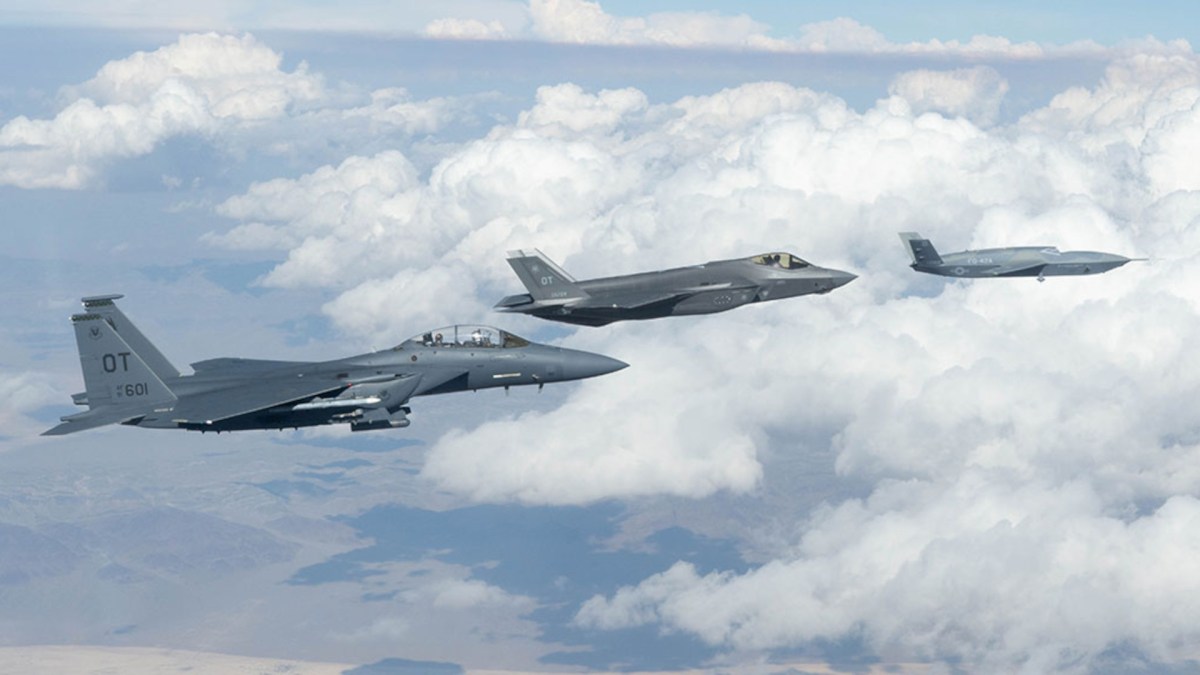
General Atomics has given us the first look at its FQ-42 Vengeance Collaborative Combat Aircraft (CCA) drone flying in formation with crewed fighters. The U.S. Air Force is continuing to expand crewed-uncrewed teaming and other testing of the FQ-42, as well as Anduril’s FQ-44 Fury , as it aims to start fielding both types around the end of the decade .
The newly released picture from General Atomics’ Aeronautical Systems, Inc. division (GA-ASI), seen at the top of this story, shows an FQ-42 in flight together with an F-35A Joint Strike Fighter and an F-15E Strike Eagle . The company has also disclosed the delivery of another Vengeance drone to the Air Force, this time to service’s main drone operations hub at Creech Air Force Base in Nevada.
“The FQ-42 that arrived at Creech will continue regular test and evaluation operations with the Air Force aimed at experimentation with the new aircraft,” according to a press release GA-ASI put out today. “Previous efforts with Vengeance and other GA-ASI jets, including [the] XQ-67A Off-Board Sensing Station and MQ-20 Avenger – have found the trio of combat jets flying in various scenarios that push the boundaries of combat aviation. GA-ASI’s jets have flown semi-autonomously and autonomously with various AI pilots and under collaborative control of human fighter pilots operating F-22 Raptor and F-35 Lightning II jets.”
From top to bottom, General Atomics MQ-20 Avenger, XQ-67 OBSS, and YFQ-42 drones. GA-ASI
GA-ASI has previously confirmed that the XQ-67A, an earlier experimental drone TWZ was first to report on , served as a prototype for the development of the FQ-42 . The Air Force’s F-22s also look set to be the first operational airborne controllers for USAF CCAs.
As mentioned, the Air Force is steadily working to broaden the scale and scope of testing involving the FQ-42 and FQ-44 to include more and more operationally relevant scenarios. Both types are set to make their first appearance at a large-force employment (LFE) exercise in December, offering a valuable new opportunity for deeper and more realistic integration with crewed fighters.
The Air Force otherwise continues to lay the groundwork for future CCA operations, including through a major round of testing at Creech in July, which TWZ was first to report on . The service is heavily focused now just on figuring out how the drones will be deployed, launched, recovered, supported, and otherwise operated on a day-to-day basis. A dedicated test squadron called the Experimental Operations Unit (EOU), established at Nellis Air Force Base in Nevada, has been leading those efforts .
Work is also underway to demonstrate tactical capabilities, such as the FQ-44 launching an AIM-120 Advanced Medium-Range Air-to-Air Missile (AMRAAM) for the first time earlier this year.
New test footage: first missile shot from YFQ-44A. YFQ-44A executed an end-to-end, beyond-line-of-sight strike against a simulated target. The test, executed out of @EdwardsAFB , represents an important step in turning CCA into an operational capability. pic.twitter.com/70cRIs6uXJ — Anduril Industries (@anduriltech) July 15, 2026
New test footage: first missile shot from YFQ-44A. YFQ-44A executed an end-to-end, beyond-line-of-sight strike against a simulated target. The test, executed out of @EdwardsAFB , represents an important step in turning CCA into an operational capability. pic.twitter.com/70cRIs6uXJ
“We’re on path right now to do our air-to-air shot coming up here in the near future,” Mike Shortsleeve, Vice President for Strategy Business Development at GA-ASI, told TWZ ‘s Jamie Hunter on the floor of the Air & Space Forces Association’s (AFA) 2026 Air, Space & Cyber Conference last week.
Last week, GA-ASI separately announced a new demonstration of semi-autonomous air-to-air combat capability involving crewed F-5AT Advanced Tiger jets belonging to private adversary air contractor Tactical Air Support, Inc. and an unspecified “CCA test aircraft.” The company did use a picture of an Avenger drone to illustrate the press release . The F-5s and the CCA surrogate were equipped with infrared search-and-track sensors (IRST) during the testing.
The stock picture of an Avenger drone that General Atomics used to illustrate its press release last week. General Atomics
“The live exercise proved that a CCA and a manned fighter can collaborate to fuse sensor data from AMS-GRA-compliant sensors to track, engage, and eliminate an airborne target while using a Beyond Line of Sight (BLOS) data link to accomplish seamless coordination between the two aircraft,” according to the GA-ASI release.
“The demonstration utilized BLOS communication between the CCA and the airborne F-5, enabling the Advanced Tiger to send data about targets from an AMS-GRA-compatible system. These commands were relayed to the CCA’s TacACE [Tactical Autonomy Ecosystem software] system,” the release added. “This flight showed that many companies’ platforms can interoperate using the plug-and-play government reference architectures ecosystem. The U.S. Air Force isn’t locked into using a single vendor or system.”
GA-ASI has previously demonstrated the ability of MQ-20s flying with podded IRSTs to detect and track aerial targets semi-automatically . Generally speaking, IRSTs look set to be an important sensor for future CCAs, and are particularly relevant in the air-to-air role. As we have written in the past :
IRSTs are especially valuable for helping spot stealthy targets with features designed to reduce their radar cross-sections since they detect and track infrared emissions. By extension, IRSTs are also immune to radio frequency electronic warfare jamming. As passive sensors, they do not emit their own signals that could alert a target to the fact they are being tracked, either. IRSTs can still be used to cue or otherwise be linked to other sensors, including active electronically-scanned array radars. Fusing data from multiple sources can provide higher fidelity tracks of multiple targets, as well as improved situational awareness overall.
An Avenger drone with a podded IRST sensor under its wing. General Atomics
Air-to-air combat is expected to be the primary mission set, at least initially, for Air Force CCAs. At the same time, an air-to-ground role for the FQ-42 and FQ-44, and/or other future CCA-type drones the Air Force might acquire, is emerging on the horizon . Anduril has already fit-checked a variety of air-to-ground ordnance on Fury .
As it stands now, the Air Force is looking to hoping to have its first operational CCAs in service toward the end of the decade. The service is also presently aiming to have a total fleet of at least 500 CCAs of all types by 2032 .
“If we can’t be ready, then certainly you’re not going to have the forces that you need and the numbers that you need going forward. This signifies that mass is certainly important again, but also autonomy is just as important,” General Atomics’ Shortsleeve told us last week in talking about the Air Force’s CCA fleet size target. “So the ability to have these autonomous systems, whether they’re bringing in additional weapons, sensing capability, whatever it is, all of those working in a collaborative environment, whether it’s manned, unmanned teaming, or unmanned and unmanned capabilities, that right there is what’s going to help the warfighter in the future.”
“And when we say autonomy, it’s not just strictly this is going to go off and do its own thing. It’s going to be directed,” he added. “Whether it’s on the ground, in the air, [it] makes no difference to the system itself. It’s going to work hand-in-hand [with humans]. So that human-machine teaming, that’s what they’re really focusing on. There is figuring out how to best use this capability in the advancement of actually having to employ it in [the] real world.”
Though just flying in formation is very different from collaboration with a high degree of autonomy, the new picture of the FQ-42 together with the F-35A and the F-15E is a window into the future teamed operations the Air Force is hoping to build.
Contact the author: joe@twz.com
Comments couldn’t be loaded. Please refresh the page.
作者:约瑟夫·特雷维西克
发布于美国东部时间2026年9月21日下午1:30
通用原子公司首次公开展示了其FQ-42“复仇”协同作战无人机(CCA)与有人驾驶战斗机编队飞行的画面。美国空军正在持续扩大有人驾驶与无人驾驶联合作战的规模,并继续测试FQ-42以及安杜里尔公司的FQ-44“狂怒”无人机,目标是在本十年末开始部署这两种机型。
本文顶部图片所示为通用原子公司航空系统分部(GA-ASI)最新发布的一张照片,照片中一架FQ-42无人机与一架F-35A联合攻击战斗机和一架F-15E攻击鹰战斗机一同飞行。该公司还透露,已向美国空军交付另一架“复仇者”无人机,此次交付的无人机将部署在位于内华达州克里奇空军基地的空军主要无人机作战中心。
通用原子航空系统公司(GA-ASI)今天发布的新闻稿称:“抵达克里奇空军基地的FQ-42将继续与美国空军进行常规测试和评估行动,旨在对这款新型飞机进行试验。”新闻稿还指出:“此前,GA-ASI已与复仇者(Vengeance)和其他几款战机,包括XQ-67A机外传感站和MQ-20复仇者(Avenger)无人机开展合作,这三款战机已在各种场景下飞行,突破了作战航空的极限。GA-ASI的战机已在人工智能飞行员的辅助下进行半自主和自主飞行,并在驾驶F-22猛禽(Raptor)和F-35闪电II(Lightning II)战斗机的飞行员的协同控制下进行了飞行。”
从上到下依次为:通用原子公司MQ-20“复仇者”无人机、XQ-67 OBSS无人机和YFQ-42无人机。通用原子航空系统公司
通用航空系统公司(GA-ASI)此前已证实,TWZ率先报道的早期实验型无人机XQ-67A,是FQ-42无人机研发的原型机。此外,美国空军的F-22战斗机也有望成为美国空军空中指挥控制(CCA)的首批作战型空中指挥控制机。
如前所述,空军正稳步扩大FQ-42和FQ-44的测试规模和范围,使其涵盖更多与作战相关的场景。这两款战机都将于12月首次亮相大规模联合作战演习(LFE),这将为它们与有人驾驶战斗机进行更深入、更真实的协同作战提供宝贵的新契机。
空军仍在继续为未来的CCA行动奠定基础,包括7月份在克里奇空军基地进行的大规模测试,TWZ率先报道了此事。目前,空军的重点是研究如何部署、发射、回收、维护无人机以及日常操作这些无人机。一支名为“实验行动部队”(EOU)的专门测试中队一直在领导这些工作,该中队设立于内华达州的内利斯空军基地。
目前也在进行战术能力展示工作,例如今年早些时候,FQ-44 首次发射了 AIM-120 先进中程空对空导弹 (AMRAAM)。
最新测试视频:YFQ-44A导弹首次发射。YFQ-44A对模拟目标进行了端到端、超视距打击。此次测试在爱德华兹空军基地进行,标志着CCA向作战能力转型迈出了重要一步。pic.twitter.com/70cRIs6uXJ — Anduril Industries (@anduriltech) July 15, 2026
最新测试视频:YFQ-44A导弹首次发射。YFQ-44A对模拟目标进行了端到端、超视距打击。此次测试在爱德华兹空军基地进行,标志着CCA向作战能力转型迈出了重要一步。pic.twitter.com/70cRIs6uXJ
“我们目前正按计划推进空对空导弹的研发,预计不久的将来就能在这里进行测试,”通用航空航天公司 (GA-ASI) 战略业务发展副总裁迈克·肖特斯利夫上周在空军与航天部队协会 (AFA) 2026 年航空航天网络大会上告诉 TWZ 的杰米·亨特。
上周,通用航空系统公司(GA-ASI)另行宣布了一项新的半自主空战能力演示,演示中使用了私人假想敌空中承包商战术空中支援公司(Tactical Air Support, Inc.)的F-5AT“先进虎”战斗机和一架未指明的“CCA测试飞机”。该公司在新闻稿中使用了一张“复仇者”无人机的图片作为配图。测试期间,F-5战斗机和CCA测试飞机均配备了红外搜索跟踪传感器(IRST)。
这是通用原子公司上周在其新闻稿中使用的一张复仇者无人机的库存图片。通用原子公司
根据通用航空系统公司(GA-ASI)发布的消息,“实战演习证明,CCA(空中作战飞机)和有人驾驶战斗机可以协同工作,融合来自符合AMS-GRA标准的传感器的传感器数据,以跟踪、攻击和摧毁空中目标,同时使用超视距(BLOS)数据链实现两架飞机之间的无缝协调。”
新闻稿补充道:“此次演示利用了CCA与机载F-5战斗机之间的超视距(BLOS)通信,使‘先进虎’战斗机能够通过兼容AMS-GRA的系统发送目标数据。这些指令被转发至CCA的TacACE(战术自主生态系统软件)系统。此次飞行表明,众多公司的平台可以利用即插即用的政府参考架构生态系统进行互操作。美国空军并非只能使用单一供应商或系统。”
通用航空系统公司(GA-ASI)此前已演示了搭载红外搜索跟踪吊舱的MQ-20无人机能够半自动地探测和跟踪空中目标。总的来说,红外搜索跟踪系统有望成为未来空中作战飞机的重要传感器,尤其在空对空作战中发挥着重要作用。正如我们过去所写:
红外搜索跟踪系统(IRST)尤其适用于发现那些采用旨在降低雷达反射截面的隐身目标,因为它们能够探测并跟踪红外辐射。因此,IRST 也不受射频电子战干扰的影响。作为被动传感器,它们不会发射自身信号,从而避免暴露自身正被跟踪的事实。IRST 还可以用于引导其他传感器,或与其他传感器(包括有源相控阵雷达)进行联动。融合来自多个数据源的数据可以更精确地跟踪多个目标,并全面提升态势感知能力。
一架复仇者无人机,机翼下方装有吊舱式红外搜索跟踪系统(IRST)传感器。通用原子公司
至少在初期,空对空作战预计将是空军CCA无人机的主要任务。与此同时,FQ-42和FQ-44,以及空军未来可能采购的其他CCA型无人机,执行空对地作战任务的可能性也逐渐显现。Anduril公司已经对“狂怒”无人机上的多种空对地弹药进行了适配性测试。
目前,美国空军希望在本十年末实现首批作战型CCA投入使用。空军目前的目标是到2032年拥有至少500架各类CCA飞机。
“如果我们无法做好准备,那么未来肯定无法拥有所需的兵力和数量。这表明,规模固然重要,但自主性也同样重要,”通用原子公司的肖特斯利夫上周在谈到空军的CCA机队规模目标时告诉我们。“因此,拥有这些自主系统的能力,无论是运送额外的武器、提供传感能力,还是其他任何功能,所有这些系统在协作环境中运行的能力,无论是有人驾驶和无人驾驶的协同作战,还是无人驾驶能力的独立作战,这才是未来真正能够帮助作战人员的关键所在。”
“我们所说的自主性,并非仅仅指它自行其是,而是需要人为引导,”他补充道。“无论是在地面还是空中,对系统本身而言都无关紧要。它将与人类协同工作。因此,人机协作才是他们真正关注的重点。他们正在研究如何才能最好地利用这项能力,并将其应用于实际应用中。”
虽然编队飞行与高度自主的协作截然不同,但 FQ-42 与 F-35A 和 F-15E 并肩作战的新景象,展现了空军希望构建的未来联合作战模式。
联系作者:joe@twz.com
评论加载失败,请刷新页面。