Mid-market gyms feel the heat in Singapore's 'golden age' of fitness在新加坡健身业的“黄金时代”,中档健身房感受到了压力。
Even as more Singaporeans exercise regularly, big box gyms are losing ground to boutique studios and budget 24-hour chains.
Even as more Singaporeans exercise regularly, big box gyms are losing ground to boutique studios and budget 24-hour chains.
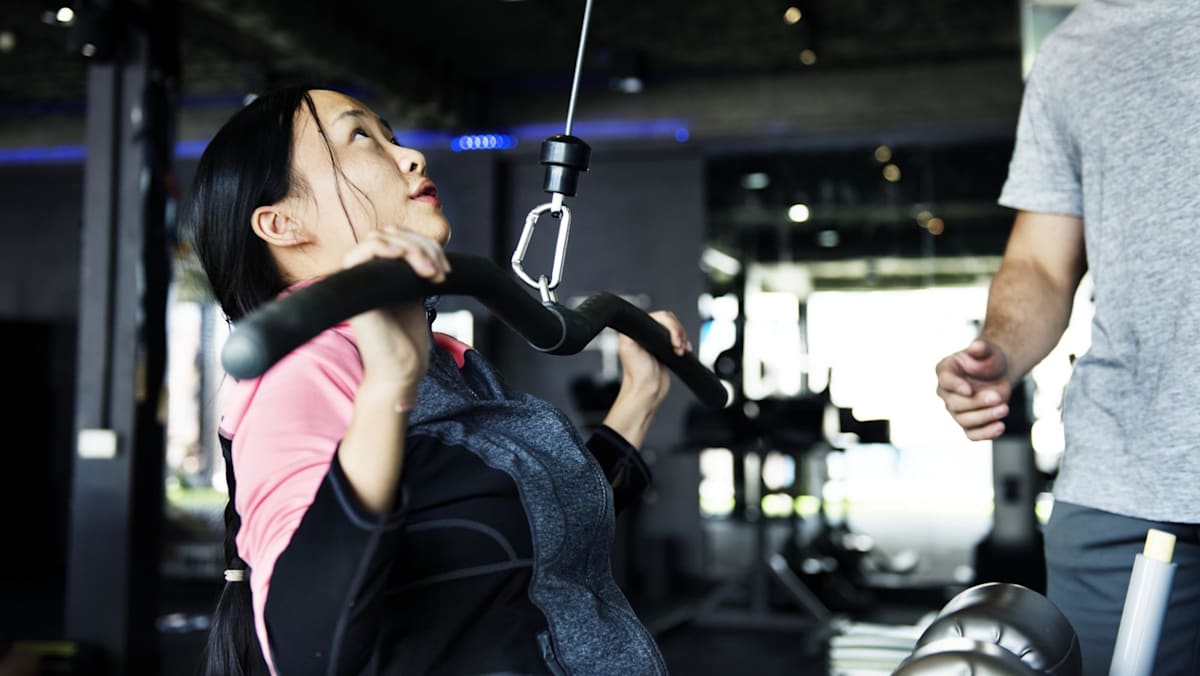
A woman exercising in a gym. (File photo: iStock)
This audio is generated by an AI tool.
SINGAPORE: When personal trainer Sharon H started taking clients in April, she offered them the option of training in ActiveSG gyms, their own homes or her flat, which has a dedicated exercise space.
The 29-year-old told CNA she wanted to fill the “gap in the market” for clients who prefer more privacy and convenience, as the fitness scene is “saturated” with big box gyms.
About half of her 10 to 15 active clients work out at her flat. The rest train with her in ActiveSG gyms or their homes.
Hindrances like queues for machines at ActiveSG gyms and limited equipment in condominium gyms are counterbalanced by greater affordability and convenient locations.
When the trainer herself started exercising regularly around 2018, she followed videos on YouTube. She still primarily works out at home.
CNA Games Guess Word Crack the word, one row at a time Buzzword Create words using the given letters Mini Sudoku Tiny puzzle, mighty brain teaser Mini Crossword Small grid, big challenge Word Search Spot as many words as you can Show More Show Less This mix of home workouts and shared facilities exemplifies the "increasingly fierce" competition cited in True Fitness and True Yoga's abrupt closure of all their studios in Singapore earlier this month. Parent company Kontafarma cited "unprecedented" challenges: the growing popularity of boutique studios, more residential gyms reducing the need for external memberships and the rise of online training options. But taking a wider view complicates this explanation. “We are in what the industry calls the ‘golden age of fitness and wellness’. There has never been greater awareness (of) the importance of exercise,” said Mr Sean Tan, co-founder and president of the non-profit Singapore Fitness Alliance. More people in Singapore are keeping active. Sport SG data showed that 76 per cent of residents exercised at least once a week last year, a figure that has risen almost every year since before COVID-19, when it stood at 66 per cent in 2019. With the market growing, fitness studio owners pushed back against the idea that industry-wide headwinds were what ailed True Fitness and True Yoga. “If a free gym downstairs is enough to make someone switch, it raises the question of what else that gym is offering beyond access to equipment,” said Mr Samuel Gallo, co-founder of Surge Strength & Results. “The market itself has never been bigger,” he said. “Demand is not the problem. Being nothing in particular is the problem. Not the cheapest, not the best, so people drift out of the middle.”
This mix of home workouts and shared facilities exemplifies the "increasingly fierce" competition cited in True Fitness and True Yoga's abrupt closure of all their studios in Singapore earlier this month.
Parent company Kontafarma cited "unprecedented" challenges: the growing popularity of boutique studios, more residential gyms reducing the need for external memberships and the rise of online training options.
But taking a wider view complicates this explanation.
“We are in what the industry calls the ‘golden age of fitness and wellness’. There has never been greater awareness (of) the importance of exercise,” said Mr Sean Tan, co-founder and president of the non-profit Singapore Fitness Alliance.
More people in Singapore are keeping active. Sport SG data showed that 76 per cent of residents exercised at least once a week last year, a figure that has risen almost every year since before COVID-19, when it stood at 66 per cent in 2019.
With the market growing, fitness studio owners pushed back against the idea that industry-wide headwinds were what ailed True Fitness and True Yoga.
“If a free gym downstairs is enough to make someone switch, it raises the question of what else that gym is offering beyond access to equipment,” said Mr Samuel Gallo, co-founder of Surge Strength & Results.
“The market itself has never been bigger,” he said. “Demand is not the problem. Being nothing in particular is the problem. Not the cheapest, not the best, so people drift out of the middle.”
Conventional big box gyms like True Fitness sit in the middle of the market, between boutique gyms offering specialised or premium experiences on one end, and low-cost 24-hour gyms with convenient heartland locations on the other.
Big box gyms tend to be upwards of 15,000 sq ft and offer all kinds of training under one roof, from treadmills and elliptical machines for cardio, to pin-loaded machines for strength training, said Mr Tan.
These gyms usually provide personal training and have studios for group classes, recovery facilities like saunas or cold plunge baths, as well as showers, changing rooms and even swimming pools, he said.
True Fitness’ TFX club in Millennia Walk was the epitome of this – at more than 41,000 sq ft, it was the largest gym in Singapore before it closed.
“Large gyms carry significant fixed costs in rent, equipment, staffing, utilities and maintenance, so profitability becomes a challenge when utilisation falls,” Mr Tan said of this business model.
“Operating costs remain high, while consumers have more alternatives these days and can switch providers with ease, making membership revenue less predictable.”
In contrast, boutique gyms with smaller footprints of 1,000 to 2,500 sq ft are less costly to set up. They usually offer only a single modality, such as pilates or indoor cycling, and may not have showers or toilets.
At boutique gym Surge Strength & Results, "the coaches are the product", says Surge Strength & Results co-founder Samuel Gallo.
Such gyms that offer specialised training and small- to mid-sized studios with premium wellness services are more resilient, said Mr Damien Lee, senior lecturer in sport and wellness management at Nanyang Polytechnic.
This is because they offer unique expertise, personalisation, a strong sense of community and measurable fitness outcomes, he said.
The other growing segment comprises lower-budget, 24-hour franchises like Anytime Fitness, Snap Fitness and 24/7 Fitness. Sized around 4,000 to 6,000 sq ft, they may offer personal trainers and group classes.
It costs much less to rent and outfit these smaller gyms, which are also able to open closer to where their members live. They save even more by not providing showers or toilets, the most expensive part of a gym's built facilities, said Mr Tan.
“Their lean operating model allows them to compete effectively on convenience and affordability without the overhead burden that weighs on larger operators,” added Mr Lee.
In short, consumers are now gravitating towards either value and convenience, or specialised training and premium experiences, he said.
"Operators in the middle could face greater challenges in setting themselves apart from their competitors.”
“BOUTIQUE” DOES NOT JUST MEAN SMALL
Even then, just being "small versions of the same commercial gym" does not cut it for a boutique fitness studio, according to Mr Gallo.
Boutique studio operators emphasised the service layer they build on top of gym hardware. This usually involves fitness or wellness experts who work closely with clients and keep them accountable to their goals.
Surge goes all in on one-to-one personal training, with no group classes or gym memberships. It has three locations, but Mr Gallo said the company’s biggest investment is its people, because “the coaches are the product”.
“Last year alone we invested over S$50,000 in our team’s education. This year we plan to do the same,” he said.
Fitness studio UFIT, which has four locations, similarly eschews a pay-per-use or gym membership model, but for a different approach – a wider take on wellness that it calls a “circle of care”.
It has about 700 active clients who attend personal training or group fitness classes, and can also tap on the services of a physiotherapist, podiatrist or nutritionist as needed.
“We work more with clients who are paying for expertise and accountability, not just access to equipment and facilities,” said founder and COO Dean Ahmad.
UFIT works with clients who are paying for "expertise and accountability, not just access to equipment and facilities", says gym founder and COO Dean Ahmad. (Photo: UFIT)
In stark contrast to the recent gym closures, Mr Ahmad said 2026 has been UFIT’s best year of business in the past five years. Event-based competitions and marathons are helping to drive people into gyms, but he also credited a focus on client retention by delivering measurable outcomes.
Mr Ahmad added that ActiveSG and condominium gyms are a form of "healthy market segmentation" and not a threat to boutique studios.
“They have absorbed a real slice of that demand, but it’s a very specific slice of that demographic that are price sensitive or that are convenience-based users, who are never going to pay for coaching or they’re not interested in that coaching model in the first place.”
CHANGING EXERCISE HABITS
Differentiation through service is also increasingly necessary because the way people exercise in Singapore has changed.
“Today’s consumers are far less likely to anchor their fitness routines around a single gym membership,” said Nanyang Polytechnic’s Mr Lee.
“Instead, they mix and match across different formats: using the condo gym, running outdoors, attending pilates classes, joining colleagues for pickleball, following free digital fitness programmes, or even travelling regionally for Hyrox competitions with their training communities.
“Fitness spending has become more fragmented, more flexible, and increasingly driven by experience, community and measurable outcomes.”
It is a challenge noted by Amore Fitness, which has been in business for more than 40 years. The homegrown chain runs women-only fitness studios and spas in nine locations around Singapore.
“Fitness is no longer just about choosing between one gym and another. Consumers can choose from 24-hour gyms, boutique studios, pilates, specialised training, outdoor activities and digital programmes, and many move between them,” said director Lim Kian Leong.
As women look for “more choice and more ways to fit fitness into their lives”, Amore has responded by introducing new brands for beauty, rest and recovery treatments, reformer pilates, and strength and functional training.
“Women don’t all want the same thing from fitness, and what they need can change over time. We want to give them the choice to find what works for them, while staying within a community they know,” he said.
Amore’s physical footprint reflects these ongoing shifts. It closed outlets at Jurong Point in 2023 and Seletar Mall in 2024, only to open at the CPF Jurong building in 2024 and Punggol Coast Mall in 2025.
Mr Lim said this was “part of running a physical fitness business in a changing market”, adding that the goal is not to have more locations, but the right ones.
“We regularly review our locations based on factors such as demand in the neighbourhood, rental rates and operating costs, as well as changes to the properties themselves,” he said.
“At the same time, we look at where we can serve members better, whether that means being closer to where they live and work, having a more accessible location or offering a space that better suits the way they want to exercise.”
Internal competition aside, the fitness industry is not immune to the same cost factor squeezing other local businesses regardless of sector – rent.
High rents are the single biggest challenge that gyms face, according to Singapore Fitness Alliance's Mr Tan. Margins in the fitness industry are traditionally thin at 15 to 25 per cent, with rents taking up 15 to 20 per cent of revenues.
“If rents now go up to 30 to 40 per cent of revenues, and other costs like manpower and utilities also go up, what is there for the businesses to take home?”
He traced this situation to more commercial properties being owned by real estate investment trusts, or REITs, where he said landlords must show year-on-year increases in rental yields.
“Rarely can you now find instances where your unit is owned by an individual with whom you can have reasonable discussions on rents. Rental negotiations are often cold and without emotion,” he said.
Many leases also have a gross turnover component, where rent is tied to sales. “If the landlord sees that you are doing well, you can almost surely expect a significant increase in your rent at the next lease renewal,” he added.
And the costs can stack up quickly. Operating expenses come up to about S$40,000 a month at Unstoppable Fitness, a roughly 4,000 sq ft bodybuilding gym in Shenton Way.
“Beyond rent, there are utilities, business loans, manpower, cleaning, laundry, equipment maintenance and repairs, software, marketing and many other recurring expenses,” founder and owner Luke Yeo said.
About S$1.2 million has been invested into building and operating the gym since it opened in 2022.
Independent gyms like Unstoppable Fitness compete not just on prices, but on "equipment, design, convenience, amenities, technology, community, branding and the overall experience" says founder Luke Yeo. (Photo: Unstoppable Fitness)
To Mr Yeo, the amount of capital being pumped into the fitness industry by well-funded gym operators is a major change that is intensifying competition.
A premium commercial gym machine can easily cost around S$15,000 to S$20,000, not including taxes, transport and installation costs, said Mr Yeo, adding that he is seeing more of such equipment in local gyms.
Gym operators are also spending heavily on renovation and amenities because customer expectations have changed, he said.
Differences between two pieces of gym equipment may be hard to spot, but what clients do see immediately are a gym’s size and appearance, showers and changing rooms and overall environment, he said.
“An independent operator isn’t competing only on membership price anymore. You’re competing on equipment, design, convenience, amenities, technology, community, branding and the overall experience."
Mr Yeo pointed to branding and visibility as his pain points.
“A trainer with more experience does not automatically get more clients, and a gym with better equipment does not automatically get more members. People first need to know you exist, understand what you offer and trust your brand.”
But the bodybuilder, whose own training journey began in ActiveSG facilities, leans into the rivalry.
“I don’t necessarily think competition is a bad thing. It forces every operator, including us, to continuously improve and give customers a reason to choose us.”
Our chief editor shares analysis and picks of the week's biggest news every Saturday.
A single handpicked story that we think you shouldn't miss. Just one a day.
Get our pick of top stories and thought-provoking articles in your inbox
Stay updated with notifications for breaking news and our best stories
Join our channel for the top reads for the day on your preferred chat app
尽管越来越多的新加坡人开始定期锻炼,但大型连锁健身房正在被精品工作室和价格实惠的24小时连锁健身房抢占市场份额。
一名女子在健身房锻炼。(图片来源:iStock)
这段音频由人工智能工具生成。
新加坡:私人教练 Sharon H 于 4 月份开始接受客户时,她为客户提供在 ActiveSG 健身房、自己家中或她自己的公寓(公寓内设有专门的健身空间)进行训练的选择。
这位 29 岁的女士告诉 CNA,她想填补“市场空白”,满足那些更喜欢隐私和便利的客户的需求,因为健身行业已经被大型连锁健身房“饱和”了。
她大约有10到15名活跃客户,其中一半在她家锻炼。其余的客户则在ActiveSG健身房或她自己家中与她一起训练。
ActiveSG 健身房器械排队和公寓健身房器材有限等不利因素,可以通过更实惠的价格和便利的地理位置来弥补。
这位教练本人大约在2018年开始规律锻炼,当时她是在YouTube上看视频学习的。她现在仍然主要在家锻炼。
CNA游戏猜词游戏:逐行破解单词;流行词游戏:用给定的字母组成单词;迷你数独:小巧的谜题,强大的脑力挑战;迷你填字游戏:小网格,大挑战;单词搜索:尽可能多地找出单词。显示更多 显示更少 这种居家锻炼和共享健身设施相结合的方式,体现了True Fitness和True Yoga在本月初突然关闭其在新加坡所有工作室时所提到的“日益激烈”的竞争。其母公司Kontafarma指出,面临“前所未有”的挑战:精品工作室的日益普及、更多住宅健身房减少了对外部会员资格的需求以及在线训练选择的兴起。但从更广阔的角度来看,这种解释就变得复杂了。“我们正处于业内所谓的‘健身和健康黄金时代’。人们对运动重要性的认识从未如此之高,”非营利组织新加坡健身联盟的联合创始人兼主席Sean Tan先生表示。越来越多的新加坡人正在保持活跃的生活方式。新加坡体育理事会(Sport SG)的数据显示,去年有76%的居民每周至少锻炼一次,这一比例自新冠疫情爆发前(2019年为66%)以来几乎逐年上升。随着市场的增长,健身工作室的经营者们反驳了“行业整体逆风才是True Fitness和True Yoga困境的根源”的说法。“如果楼下有免费健身房就能吸引顾客,那么问题就来了:除了器材之外,这家健身房还能提供什么?”Surge Strength & Results的联合创始人Samuel Gallo先生说道。“市场规模从未如此之大,”他补充道,“需求不是问题,问题在于缺乏特色。既不是最便宜的,也不是最好的,所以人们最终会选择其他类型的健身房。”
这种家庭锻炼和共享设施相结合的模式,体现了 True Fitness 和 True Yoga 在本月初突然关闭其在新加坡所有工作室时所提到的“日益激烈的”竞争。
母公司 Kontafarma 指出,他们面临着“前所未有”的挑战:精品工作室日益普及,更多住宅健身房减少了对外部会员资格的需求,以及在线培训选择的兴起。
但从更广阔的角度来看,这种解释就变得复杂了。
“我们正处于业内所谓的‘健身和健康黄金时代’。人们对运动重要性的认识从未如此之高,”非营利组织新加坡健身联盟的联合创始人兼主席陈先生说道。
新加坡越来越多的人开始积极运动。新加坡体育理事会的数据显示,去年有76%的居民每周至少锻炼一次,这一比例自新冠疫情爆发前(2019年为66%)以来几乎每年都在上升。
随着市场的发展,健身工作室的老板们反驳了这样一种观点:整个行业的逆风才是 True Fitness 和 True Yoga 遭遇困境的原因。
“如果楼下的免费健身房足以让人们改变主意,那么问题就来了,除了使用器材之外,这家健身房还能提供什么呢?” Surge Strength & Results 的联合创始人 Samuel Gallo 先生说道。
他说:“市场规模从未如此之大。需求不是问题,问题在于产品缺乏特色。既不是最便宜的,也不是最好的,所以人们逐渐远离中间市场。”
像 True Fitness 这样的传统大型连锁健身房处于市场中间位置,一端是提供专业或高端体验的精品健身房,另一端是位于市中心、价格低廉的 24 小时健身房。
谭先生说,大型健身房的面积通常超过 15,000 平方英尺,在一个屋檐下提供各种训练,从跑步机和椭圆机等有氧运动器材,到插销式力量训练器材,应有尽有。
他说,这些健身房通常提供私人教练服务,并设有团体课程教室、桑拿浴室或冷水浴等恢复设施,以及淋浴间、更衣室甚至游泳池。
True Fitness 位于 Millennia Walk 的 TFX 俱乐部就是个典型的例子——面积超过 41,000 平方英尺,在关闭之前是新加坡最大的健身房。
“大型健身房在租金、设备、人员配备、水电费和维护等方面都有很高的固定成本,因此当利用率下降时,盈利能力就会面临挑战,”谭先生在谈到这种商业模式时说道。
“运营成本依然居高不下,而如今消费者有了更多选择,可以轻松更换服务提供商,这使得会员收入更难以预测。”
相比之下,面积在1000到2500平方英尺之间的精品健身房,开设成本较低。它们通常只提供单一的健身项目,例如普拉提或室内自行车,而且可能没有淋浴或卫生间。
Surge Strength & Results 精品健身房的联合创始人 Samuel Gallo 表示:“教练就是产品。”
南洋理工学院体育与健康管理高级讲师李达明先生表示,提供专业训练和中小型工作室以及优质健康服务的健身房更具韧性。
他说,这是因为他们提供独特的专业知识、个性化服务、强烈的社区意识和可衡量的健身成果。
另一个增长迅速的细分市场是预算较低的24小时连锁健身房,例如Anytime Fitness、Snap Fitness和24/7 Fitness。这些健身房面积约为4000至6000平方英尺,可能提供私人教练和团体课程。
谭先生表示,这些小型健身房的租金和设备租赁成本要低得多,而且它们还能开在离会员居住地更近的地方。由于不提供淋浴和厕所等设施,这些小型健身房还能节省更多成本,而这些恰恰是健身房设施中最昂贵的部分。
李先生补充道:“他们精简的运营模式使他们能够在便利性和价格优势方面有效竞争,而无需承担大型运营商所面临的运营成本负担。”
他表示,简而言之,消费者现在要么追求性价比和便利性,要么追求专业培训和高端体验。
“处于中间位置的运营商在与竞争对手区分开来方面可能会面临更大的挑战。”
“精品店”并不一定意味着小。
加洛先生认为,即便如此,仅仅成为“同一家商业健身房的小型版本”对于精品健身工作室来说也是不够的。
精品健身工作室运营商强调他们在健身器材之上构建的服务层。这通常包括健身或健康专家,他们与客户密切合作,并督促客户实现目标。
Surge专注于一对一私人训练,不提供团体课程或健身房会员卡。它目前有三家分店,但Gallo先生表示,公司最大的投资在于员工,因为“教练就是产品”。
“仅去年一年,我们就投入了超过5万新元用于团队成员的教育。今年我们计划也这样做,”他说道。
健身工作室 UFIT 拥有四家分店,同样摒弃了按次付费或健身房会员模式,而是采取了一种不同的方法——一种更广泛的健康理念,它称之为“关怀圈”。
它拥有约 700 名活跃客户,他们参加私人训练或团体健身课程,还可以根据需要获得理疗师、足科医生或营养师的服务。
“我们更多地与那些为专业知识和责任感付费的客户合作,而不仅仅是为设备和设施的使用权付费,”创始人兼首席运营官迪恩·艾哈迈德说。
UFIT健身房创始人兼首席运营官迪恩·艾哈迈德表示,UFIT的客户付费购买的是“专业知识和责任感,而不仅仅是器材和设施的使用权”。(图片:UFIT)
与近期健身房纷纷倒闭的情况形成鲜明对比的是,艾哈迈德先生表示,2026年是UFIT过去五年中业绩最好的一年。他认为,举办各种赛事和马拉松活动有助于吸引人们走进健身房,但同时也归功于公司注重通过提供可衡量的成果来提高客户留存率。
艾哈迈德先生补充说,ActiveSG 和公寓健身房是一种“健康的市场细分”,不会对精品工作室构成威胁。
“他们确实吸收了一部分需求,但这部分需求非常具体,属于对价格敏感或注重便利性的特定人群,这些人永远不会为教练服务付费,或者他们一开始就对这种教练模式不感兴趣。”
改变运动习惯
由于新加坡人的锻炼方式发生了变化,通过服务实现差异化也变得越来越必要。
南洋理工学院的李先生表示:“如今的消费者不太可能再像以前那样,将健身计划完全建立在单一的健身房会员资格之上。”
“相反,他们会将不同的运动形式混合搭配:使用公寓健身房、户外跑步、参加普拉提课程、与同事一起打匹克球、参加免费的数字健身计划,甚至与他们的训练社区一起前往地区参加Hyrox比赛。
“健身支出变得更加分散、更加灵活,并且越来越受到体验、社群和可衡量结果的驱动。”
这是Amore Fitness也面临的挑战,这家拥有40多年历史的本土连锁企业在新加坡各地经营着九家仅限女性使用的健身工作室和水疗中心。
“健身不再只是在不同的健身房之间做选择。消费者可以选择24小时健身房、精品工作室、普拉提、专业训练、户外活动和数字课程,许多人还会在它们之间转换,”董事林建良说道。
随着女性寻求“更多选择和更多将健身融入生活的方式”,Amore 也顺应潮流,推出了美容、休息和恢复护理、普拉提器械以及力量和功能训练等新品牌。
他说:“女性对健身的需求并不完全相同,而且随着时间的推移,她们的需求也会发生变化。我们希望让她们能够自主选择适合自己的健身方式,同时又能留在她们熟悉的社群中。”
爱茉莉的实体店布局也反映了这些持续的变化。它在2023年关闭了裕廊坊的门店,2024年关闭了实里达购物中心的门店,但随后又分别于2024年和2025年在中央公积金局裕廊大厦和榜鹅海岸购物中心开设了新店。
林先生表示,这是“在不断变化的市场中经营健身业务的一部分”,并补充说,他们的目标不是拥有更多的门店,而是拥有合适的门店。
他说:“我们会定期根据周边需求、租金水平、运营成本以及房产本身的变化等因素来审查我们的选址。”
“与此同时,我们也在思考如何更好地为会员服务,无论是靠近他们居住和工作地点,还是提供更便利的地点,或是提供更符合他们锻炼方式的空间。”
撇开内部竞争不谈,健身行业也无法免受其他行业本地企业面临的相同成本因素的影响——租金。
新加坡健身联盟的陈先生表示,高昂的租金是健身房面临的最大挑战。健身行业的利润率历来很低,只有15%到25%,而租金就占了收入的15%到20%。
“如果租金上涨到收入的 30% 到 40%,再加上人力和水电等其他成本也上涨,企业还能剩下多少钱呢?”
他将这种情况归咎于越来越多的商业地产由房地产投资信托基金(REITs)所有,他表示,在这种情况下,房东必须证明租金收益率逐年增长。
他说:“现在很难找到房东是个人,而且你可以和他/她就租金进行合理协商的情况了。租房谈判往往冷冰冰的,没有任何感情色彩。”
许多租赁合同还包含营业额分成条款,即租金与销售额挂钩。“如果房东看到你的生意兴隆,那么在下次续租时,你的租金几乎肯定会大幅上涨,”他补充道。
而且成本会迅速累积。位于珊顿道的Unstoppable Fitness是一家面积约4000平方英尺的健美健身房,其运营费用每月高达约4万新元。
“除了租金之外,还有水电费、商业贷款、人力、清洁费、洗衣费、设备维护和维修费、软件费、营销费以及许多其他经常性支出,”创始人兼所有者卢克·叶奥 (Luke Yeo) 说。
自 2022 年开业以来,该健身房的建设和运营已投资约 120 万新元。
创始人卢克·叶表示,像Unstoppable Fitness这样的独立健身房,竞争不仅仅体现在价格上,更体现在“器材、设计、便利性、配套设施、技术、社群、品牌以及整体体验”上。(图片:Unstoppable Fitness)
在叶先生看来,资金雄厚的健身房运营商向健身行业投入的大量资金,是一个重大变化,加剧了竞争。
杨先生表示,一台高档商用健身器材的价格很容易达到 15,000 至 20,000 新元,还不包括税费、运输和安装费用。他还补充说,他看到本地健身房里这类器材越来越多。
他还表示,由于顾客的期望发生了变化,健身房经营者也在翻新和设施方面投入巨资。
他说,两件健身器材之间的区别可能很难发现,但顾客能立即看到的是健身房的规模和外观、淋浴间和更衣室以及整体环境。
“独立运营商之间的竞争不再仅仅局限于会员价格。他们还要在设备、设计、便利性、配套设施、技术、社区、品牌和整体体验等方面展开竞争。”
叶先生指出,品牌建设和知名度是他面临的痛点。
“经验丰富的教练并不一定能自动获得更多客户,拥有更好器材的健身房也不一定能自动获得更多会员。人们首先需要知道你的存在,了解你提供的服务,并信任你的品牌。”
但这位健美运动员,他的训练生涯也是从 ActiveSG 的设施开始的,却乐于接受这种竞争。
“我并不认为竞争一定是一件坏事。它迫使包括我们在内的所有运营商不断改进,并给客户一个选择我们的理由。”
我们的主编每周六都会分享对本周重大新闻的分析和精选。
每天一篇,我们精心挑选一篇您不容错过的精彩故事。
订阅我们的邮件,即可获取精选热点新闻和引人深思的文章。
订阅通知,第一时间获取突发新闻和精彩报道。
加入我们的频道,即可在您常用的聊天应用上获取当日热门文章。