Japanese torpedo sends US ship to the ocean floor during Valiant Shield exercise在“勇敢之盾”演习中,日本鱼雷将一艘美国军舰击沉海底。
The USS Juneau was sent to the ocean floor during a multinational SINKEX exercise.
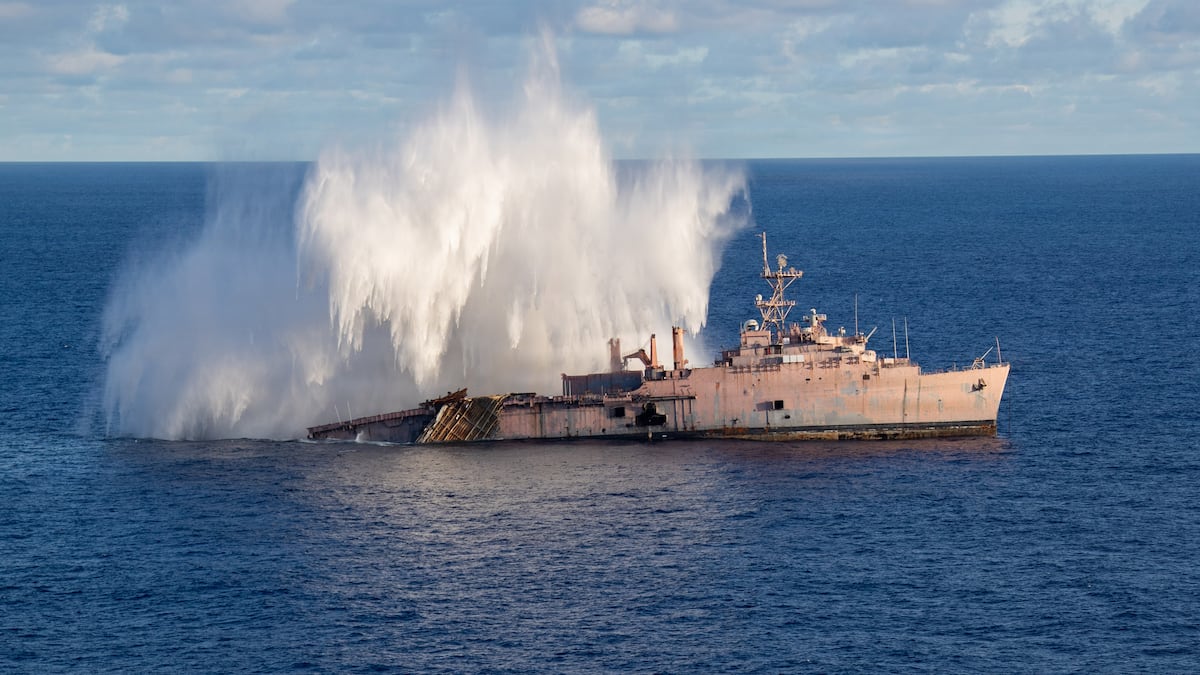
The U.S. Navy’s decommissioned Austin-class amphibious transport dock ship USS Juneau (LPD-10) was sent to the ocean floor during the ongoing Valiant Shield exercise taking place from June 22 to July 1.
Sunk more than 200 nautical miles off the coast in the Mariana Islands Range Complex, the death knell to the Juneau came from a torpedo strike from a Japan Maritime Self-Defense Force submarine.
“This SINKEX provided an outstanding opportunity for our joint team to integrate capabilities across domains, honing the lethal precision and coordination essential for high-end maritime operations in the Pacific theater,” said Rear Adm. Eric Anduze , commander of Carrier Strike Group 5 and Task Force 70.
Valiant Shield involving the U.S., Japan, Australia, Canada and New Zealand is a biennial field training that builds real-world proficiency in sustaining joint forces through detecting, locating, tracking and engaging units at sea, in the air, in space, on land and in cyberspace, according to the Navy .
The SINKEX of the USS Juneau comes nearly 84 years after the first USS Juneau, CL-52, was infamously sunk by a Japanese torpedo during the Guadalcanal campaign in November of 1942. Upon contact with the torpedo from Japanese submarine I-26, the Juneau exploded and sank within minutes. Only 10 crew members survived the attack — and among those lost were the five Sullivan brothers . As a result of their loss, according to Naval History and Heritage Command, the U.S. Navy barred close relatives from serving onboard the same ship.
Juneau (LPD-10) entered service in 1969, seeing action in the Vietnam War and Operation Desert Storm. It was decommissioned in 2008 and was moored in Naval Sea Systems Command Inactive Ships On-Site Maintenance Office at Pearl Harbor before being used by the U.S. and its allies as a means to gain proficiency and confidences in their weapons systems that can not be duplicated in simulations.
According to the Navy , prior to the sinking of any vessel for participation in a SINKEX, each vessel is put through a rigorous cleaning process, “including the removal of all liquid polychlorinated biphenyls (PCBs) from transformers and large capacitors, small capacitors to the greatest extent practical, and all trash, floatable materials, mercury or fluorocarbon-containing materials, and readily detachable solid PCB items. Petroleum is also cleaned from tanks, piping, and reservoirs.”
In addition, a Navy environmental, safety and health manager and a quality assurance supervisor are on hand to inspect the environmental remediation conducted.
Claire Barrett is an editor and military history correspondent for Military Times. She is also a World War II researcher with an unparalleled affinity for Sir Winston Churchill and Michigan football.
美国海军退役的奥斯汀级两栖船坞运输舰“朱诺”号(LPD-10)在6月22日至7月1日举行的“勇敢之盾”演习期间被送往海底。
“朱诺”号沉没于马里亚纳群岛靶场群海岸 200 多海里处,其丧命的导火索是日本海上自卫队潜艇发射的鱼雷。
“这次沉没演习为我们的联合团队提供了一个绝佳的机会,让他们能够跨领域整合能力,磨练在太平洋战区进行高端海上行动所必需的致命精确性和协调性,”第5航母打击群和第70特遣部队指挥官埃里克·安杜泽少将说。
据美国海军称,“英勇之盾”演习是一项每两年举行一次的实地训练,由美国、日本、澳大利亚、加拿大和新西兰参与,旨在通过在海上、空中、太空、陆地和网络空间探测、定位、跟踪和打击单位,来培养维持联合部队作战能力的实战技能。
“朱诺”号巡洋舰的沉没事件发生在首艘“朱诺”号巡洋舰(CL-52)沉没近84年后。1942年11月,在瓜达尔卡纳尔岛战役中,“朱诺”号被日本鱼雷击沉,震惊世界。当时,“朱诺”号与日本潜艇伊-26发射的鱼雷接触后爆炸,并在几分钟内沉没。仅有10名船员幸存,其中包括苏利文五兄弟。据美国海军历史与遗产司令部记载,由于他们的牺牲,美国海军禁止近亲在同一艘军舰上服役。
“朱诺”号(LPD-10)于1969年服役,曾参与越南战争和沙漠风暴行动。该舰于2008年退役,停泊在珍珠港海军海上系统司令部非现役舰艇现场维护办公室,之后被美国及其盟国用作武器系统实战训练的平台,以增强其武器系统的熟练度和作战信心,而这些训练和信心是无法通过模拟实现的。
据海军方面称,在任何舰艇沉入水中参与沉船演习之前,每艘舰艇都要经过严格的清洁程序,“包括清除变压器和大型电容器中的所有液态多氯联苯(PCBs),尽可能清除小型电容器中的所有液态多氯联苯,以及所有垃圾、漂浮物、含汞或含氟碳化合物的材料和易于拆卸的固体多氯联苯部件。此外,还要清除油箱、管道和储罐中的石油残留。”
此外,海军环境、安全和健康经理以及质量保证主管也在现场,对进行的环境修复工作进行检查。
克莱尔·巴雷特是《军事时报》的编辑和军事历史记者。她也是一位二战研究员,对温斯顿·丘吉尔爵士和密歇根大学橄榄球队有着无与伦比的热爱。