Chinese Next-Generation Submarine Developments Spotted In New Satellite Imagery最新卫星图像揭示中国新一代潜艇研发进展
A Chinese submarine now taking shape at Bohai Shipyard has a number of significant features and offers new insights into China's undersea ambitions.
By Joseph Trevithick , Thomas Newdick
Published Sep 21, 2026 8:29 PM EDT
Satellite image ©2026 Vantor
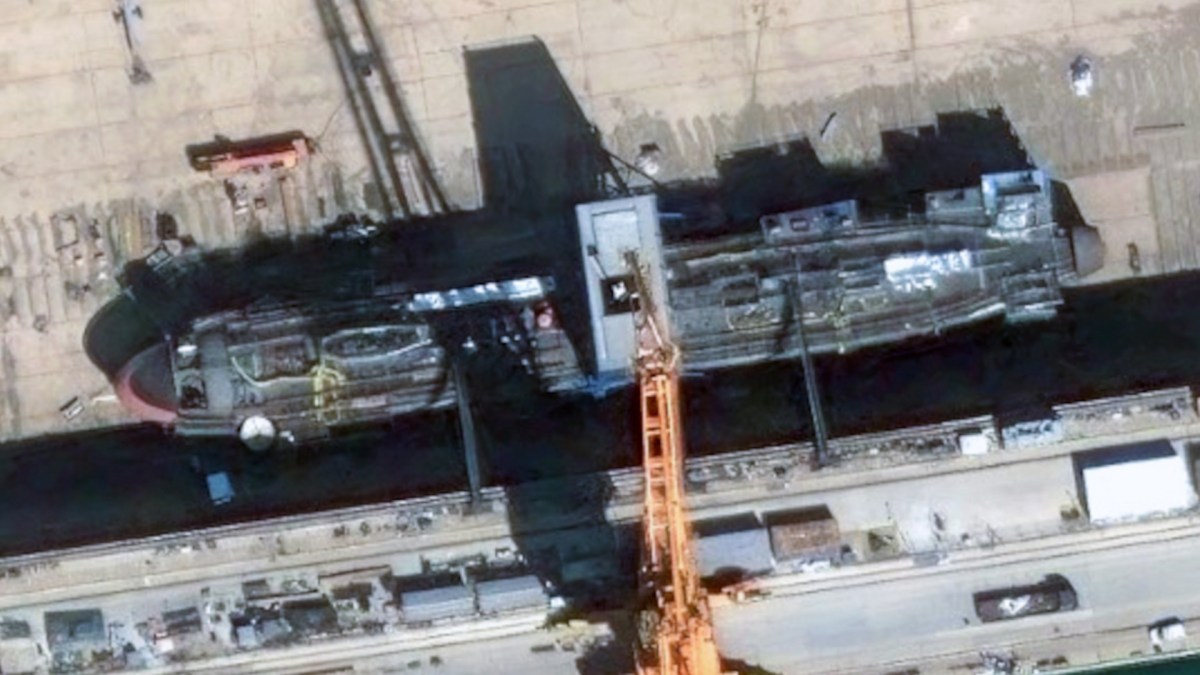
Recent satellite imagery of a shipyard in northeastern China offers interesting new insights into the country’s next-generation submarine developments . The images notably show a pumpjet propulsor and other features worth examining on an example of what is generally described as a new class of nuclear-powered attack submarine, or SSN.
TWZ has obtained a new image taken on September 18 of the submarine in question, which is being built at the Bohai Shipyard in Huludao, from Vantor. Janes reported on this submarine earlier today, based on a separate Vantor image from September 1. The outlet also described the boat as a Type 095, something we will come back to later on.
A wider view of the new Chinese submarine under construction at the Bohai Shipyard in Huludao on September 18, 2026. Satellite image ©2026 Vantor
As mentioned, the pumpjet propulsor immediately stands out in both images. This is also understood to be a feature on the Type 093B nuclear-powered attack submarine, a significantly improved variation on that earlier design, which first emerged in the early 2020s. Compared to traditional exposed propellers and more basic shrouded types, pumpjets offer benefits for quieter operation and efficiencies, especially at higher submerged speeds.
The recent imagery also highlights the submarine’s X-shaped stern plane arrangement. This is not found on the Type 093B, which is considered to be something a bridge between that class and the next-generation design. Broadly speaking, an X-shaped configuration offers advantages when it comes to enhanced maneuverability, efficiency, and safety, which can be particularly useful in littoral environments. It can also provide benefits when it comes to acoustic signature reductions across significant parts of the submarine’s operating envelope compared to the cruciform stern planes.
Another Chinese submarine design that emerged in 2024, currently referred to as the Type 041 or Zhou class , and that is understood to feature a hybrid nuclear/conventional propulsion system, also has an X-shaped stern configuration. The first known example of the Type 041 came to light after it appeared to have sunk in a shipyard .
Crane barges seen surrounding the first known Type 041 submarine after it apparently sank at China’s Wuchang Shipyard in 2024. PHOTO © 2024 PLANET LABS INC. ALL RIGHTS RESERVED. REPRINTED BY PERMISSION
An X-shaped stern arrangement also looks to be a feature on yet another new class of submarine that appeared at the JN (Jiangnan) Shipyard in Shanghai earlier this year. Initial reports also suggested that the design lacked a traditional sail . However, it has been confirmed that it has a sail, but that is very small proportionally to the overall size of the boat. Truncated sails can offer performance and other advantages, but there are trade-offs.
The image of the submarine that Janes obtained also notably shows an open rectangular-shaped section aft of the sail. The September 18 image that we received from Vantor shows a structure placed over that section of that submarine, obscuring ongoing work on that part of the boat. The Type 095 is widely expected to feature some type of vertical launch system (VLS) array able to accommodate a variety of anti-ship and land-attack cruise missiles, as well as potentially hypersonic types . The Type 095 is also sometimes referred to as a guided missile submarine, or SSGN, as a result. The open area seen in the September 1 shot could be where the VLS array is set to be fitted. It might also provide access to the reactor compartment or another area of the submarine.
The clearest photos we have on the Type 095 SSN! As we can see, there is one confirmed chamber than could physically fit about 18-24 VLS Cells. There is a big chance that more than one VLS Chamber exists, with an estimate VLS count from 24-48+ VLS pic.twitter.com/0ZJ8gsl4su — PLA Military Updates🇨🇳 (@PLA_MilitaryUpd) September 21, 2026
The clearest photos we have on the Type 095 SSN! As we can see, there is one confirmed chamber than could physically fit about 18-24 VLS Cells. There is a big chance that more than one VLS Chamber exists, with an estimate VLS count from 24-48+ VLS pic.twitter.com/0ZJ8gsl4su
Interestingly, the September 18 image also shows what look to be at least two relatively large circular openings, side-by-side, at the bow end of the submarine in front of the sail, the purpose of which is not immediately clear. There is a possibility these could also be for vertically launching munitions or other payloads. As a point of comparison, U.S. Virginia class nuclear attack submarines, starting with the Block III version, have two large-diameter Virginia Payload Tubes (VPT), one in front of the other, in the bow in front of their sails. At the same time, the openings on the submarine in Huludao also appear to be in a position that is very close to where the submarine’s main sonar array would be installed, and they could be tied to that aspect of the design, too.
A close-up look at the bow end of the submarine under construction in Huludao as seen in the September 18, 2026, image. Satellite image ©2026 Vantor
The Block III Virginia class submarine USS John Warner seen at its commissioning ceremony with one of its two Virginia Payload Tubes open. USN
“I think its too early to be sure about the VLS configuration from publicly available imagery. I realize people assume the large rectangular space halfway behind the sail is the VLS, but I am not sure this is the case and I’d caution to jump to conclusions. The space could also be related to work on the reactor compartment,” Alex Luck, a naval analyst who closely tracks submarine and Chinese navy developments, told TWZ . “With Type 093B, the VLS after launch was initially covered with a tarp, and then the installed launchers were readily visible quite quickly during the fitting-out process. The work process may change with these newer boats, but the different appearance during launch and fitting out needs to be considered in that regard.”
“I do expect Type 095 to have a VLS of some sort, but I am not sure as of yet what the configuration would look like, or where exactly it is located,” he added.
The bigger outstanding question may be exactly what type of submarine is currently being built now at the Bohai Shipyard. Based on a review of additional imagery from Planet Labs’ archive, the boat appears to be around 394 feet (120 meters) long. When the first example of what was assessed to be a Type 095 emerged in Huludao in February , it was estimated to have a length of roughly 361 feet (110 meters). The ‘small sail’ design that broke cover earlier this year in Shanghai is also estimated to be some 394 feet/120 meters long based on available imagery, but also looks to be narrower than the boat presumed to be a Type 095 in February.
“One significant question is the nature and difference between the boat launched by Bohai in February, and the two newer hulls launched in late May/early June both by Bohai and at Jiangnan in Shanghai,” Luck, the naval analyst, also told TWZ . “Specifically, we do not quite know whether they are for different operational roles, or rather a two step development for one final configuration of a new SSN. I think the latter is at least plausible.”
“A related question then is what boat we are looking at now with the new imagery, i.e. the February boat or the newer hull Bohai had launched,” he continued. “Without exact and reliable measurements that question for now is unresolved in the public discourse. For now we need more, and more detailed imagery, including of the different boats together, to clarify these aspects.”
“This [September 1] image reinforces my impression that the boat launched in February may have been a one off not including the full spec featured on the notional 095A launched by Bohai and Jiangnan in late May. We’ve already seen both versions side by side in Bohai,” Luck also wrote on X after Janes ‘ published its report.
This image reinforces my impression that the boat launched in February may have been a one off not including the full spec featured on the notional 095A launched by Bohai and Jiangnan in late May. We've already seen both versions side by side in Bohai. https://t.co/wBMkB1gmSQ — Alex Luck (@AlexLuck9) September 21, 2026
This image reinforces my impression that the boat launched in February may have been a one off not including the full spec featured on the notional 095A launched by Bohai and Jiangnan in late May. We've already seen both versions side by side in Bohai. https://t.co/wBMkB1gmSQ
Regardless, the emergence in recent years of so many new, more modern submarines, and across what appear to be several distinct classes, is significant. It is no secret that China’s People’s Liberation Army Navy (PLAN) is working to significantly expand the size and capabilities of its submarine force with a clear eye toward extending operations further and further out in the Pacific, at least. In the past, U.S. officials have publicly said the overall quality of newer Chinese submarines has been getting closer in parity to American designs.
“The PLA Navy is executing a significant strategic shift from diesel-electric to all-nuclear construction, representing a fundamental departure from historical construction patterns,” U.S. Navy Rear Adm. Mike Brookes, head of the Office of Naval Intelligence, wrote in prepared remarks ahead of a hearing before members of the U.S.-China Economic and Security Review Commission in March.
In particular, the Type 095, as well as the new Type 096 nuclear-powered ballistic missile submarine, “represent next-generation platforms expected to enter service during the late 2020s through 2030s,” Brookes also wrote at that time. “These submarines will incorporate substantial advancements in nuclear reactor design, sensor performance, weapons integration, and noise quieting technologies.”
Submarine modernization efforts are just one aspect of a larger effort by the PLAN to expand its capabilities above and below the waves. Chinese shipyards have also been producing ever-more capable aircraft carriers , amphibious assault ships , destroyers , frigates , and more in recent years, as well. The pace of China’s construction of new surface ships and submarines has also been growing, creating a particularly significant and still-widening disparity in this regard with the U.S. Navy. This is something that has become increasingly concerning , as TWZ routinely highlights .
Work in Huludao, as well as shipyards elsewhere in China, is certainly already revealing interesting new insights into China’s next-generation submarine efforts.
Contact the author: joe@twz.com
Comments couldn’t be loaded. Please refresh the page.
作者:约瑟夫·特雷维希克、托马斯·纽迪克
发布于美国东部时间2026年9月21日晚上8:29
卫星图像 ©2026 Vantor
最近,中国东北某造船厂的卫星图像为我们了解该国下一代潜艇的研发提供了新的视角。这些图像尤其清晰地显示了一台泵喷式推进器以及其他值得关注的特征,这些特征出现在一艘通常被称为新型核动力攻击潜艇(SSN)的样艇上。
TWZ从Vantor公司获得了一张拍摄于9月18日的潜艇新照片,该潜艇正在葫芦岛渤海造船厂建造。简氏防务周刊今天早些时候也报道了这艘潜艇,报道依据的是Vantor公司9月1日提供的另一张照片。简氏防务周刊还称该潜艇为095型,这一点我们稍后会再谈。
2026年9月18日,在葫芦岛渤海造船厂建造的中国新型潜艇全景图。卫星图像 ©2026 Vantor
如前所述,两张图片中泵喷推进器都格外引人注目。据悉,这也是093B型核动力攻击潜艇的特色之一,该潜艇是早期设计的显著改进型,最早于2020年代初问世。与传统的外露式螺旋桨和更简单的封闭式螺旋桨相比,泵喷推进器具有运行噪音更低、效率更高等优势,尤其是在水下高速航行时。
最近曝光的图像还突显了该潜艇的X形尾翼布局。这种布局在093B型潜艇上并不存在,093B型被认为是该级潜艇与下一代设计之间的过渡型号。总的来说,X形布局在提升机动性、效率和安全性方面具有优势,这在近岸环境中尤为重要。与十字形尾翼相比,X形尾翼还能在潜艇的大部分作战范围内显著降低声学特征。
另一款于2024年亮相的中国潜艇设计,目前被称为041型或周级,据了解采用核动力/常规动力混合推进系统,也采用了X形尾部设计。已知的首艘041型潜艇是在一艘似乎沉没于造船厂后才被发现的。
2024年,中国武昌造船厂发生一起疑似041型潜艇沉没事故,图中可见起重驳船围绕着这艘已知的首艘041型潜艇。照片© 2024 PLANET LABS INC. 保留所有权利。经许可转载。
今年早些时候,上海江南造船厂展出的另一款新型潜艇也采用了X形尾部布局。最初的报道还指出,该设计没有传统的指挥塔。然而,现在已经证实它确实配备了指挥塔,但相对于潜艇的整体尺寸而言,其尺寸非常小。截短的指挥塔虽然可以提升性能和其他方面的优势,但也存在一些不足。
简氏防务周刊获得的潜艇照片还特别显示了指挥塔后方一个敞开的矩形区域。我们从Vantor公司收到的9月18日照片显示,该区域上方覆盖着一个结构,遮挡了正在进行的艇体作业。095型潜艇普遍预计会配备某种垂直发射系统(VLS)阵列,能够搭载多种反舰和对陆攻击巡航导弹,甚至可能包括高超音速导弹。因此,095型潜艇有时也被称为导弹潜艇(SSGN)。9月1日照片中看到的开放区域可能就是垂直发射系统阵列的安装位置。它也可能通往反应堆舱或其他艇体区域。
我们获得了095型核潜艇最清晰的照片!如图所示,确认存在一个舱室,其物理尺寸可容纳约18-24个垂直发射系统单元。很有可能存在不止一个垂直发射系统舱室,估计垂直发射系统单元数量在24-48个以上。pic.twitter.com/0ZJ8gsl4su — PLA Military Updates🇨🇳 (@PLA_MilitaryUpd) September 21, 2026
我们目前掌握的095型核潜艇最清晰的照片!如图所示,有一个已确认的舱室,其物理尺寸可容纳约18-24个垂直发射系统单元。很有可能存在不止一个垂直发射系统舱室,估计垂直发射系统单元数量在24-48个以上。pic.twitter.com/0ZJ8gsl4su
有趣的是,9月18日拍摄的图像还显示,潜艇艇首指挥塔前方并排至少有两个相对较大的圆形开口,其用途尚不明确。这些开口有可能用于垂直发射弹药或其他有效载荷。作为对比,美国弗吉尼亚级核动力攻击潜艇(从Block III型开始)在艇首指挥塔前方设有两根大直径的弗吉尼亚有效载荷发射管(VPT),前后排列。同时,葫芦岛潜艇上的这些开口位置似乎也非常靠近潜艇主声呐阵列的安装位置,它们也可能与该设计有关。
2026年9月18日拍摄的图像显示,在葫芦岛建造的潜艇的船首部分近距离特写。卫星图像©2026 Vantor
弗吉尼亚级Block III型潜艇“约翰·华纳”号在服役仪式上,其两个弗吉尼亚级有效载荷发射管中的一个打开。美国海军
“我认为现在仅凭公开图片就断定垂直发射系统(VLS)的配置还为时尚早。我知道大家普遍认为指挥塔后方中间的那个大矩形区域就是VLS,但我并不确定,建议大家不要妄下结论。这个区域也可能与反应堆舱的施工有关,”密切关注潜艇和中国海军发展的海军分析师亚历克斯·拉克(Alex Luck)告诉TWZ。“093B型潜艇下水后,VLS最初是用篷布遮盖的,但在舾装过程中,安装好的发射器很快就能清晰可见。这些新型潜艇的施工流程可能会有所不同,但下水和舾装过程中不同的外观需要从这个角度来考虑。”
“我预计 095 型战舰会配备某种垂直发射系统,但我目前还不确定其配置会是什么样子,或者它具体位于哪里,”他补充道。
更大的悬而未决的问题或许是渤海造船厂目前正在建造的究竟是哪种类型的潜艇。根据Planet Labs档案库中的其他图像分析,这艘潜艇的长度似乎约为394英尺(120米)。今年2月,在葫芦岛首次亮相的疑似095型潜艇,其长度估计约为361英尺(110米)。今年早些时候在上海亮相的“小帆”设计,根据现有图像估计长度也约为394英尺/120米,但看起来比2月份疑似095型潜艇要窄一些。
“一个重要的问题是渤海造船厂2月份下水的那艘潜艇与5月底/6月初渤海造船厂和上海江南造船厂分别下水的两艘新艇之间的性质和区别,”海军分析师拉克告诉TWZ。“具体来说,我们尚不清楚它们是否用于不同的作战任务,或者它们是否是为最终形成一种新型核潜艇配置而分两步研发的成果。我认为后一种可能性至少是存在的。”
“那么,一个相关的问题是,我们现在看到的这些新图像究竟是哪艘船,是二月份的那艘,还是渤海公司新推出的那艘?”他继续说道,“在没有精确可靠的测量数据之前,这个问题目前在公众讨论中仍未得到解答。我们现在需要更多、更详细的图像,包括不同船只的合影,来澄清这些问题。”
“这张(9月1日)照片进一步印证了我的印象,即2月份下水的那艘船可能只是个特例,并不包含渤海和江南在5月底下水的095A型概念船的全部规格。我们已经在渤海见过这两个版本并排停泊了,”拉克在简氏防务周刊发表报道后也在X网站上写道。
这张图片更加印证了我的印象,即二月份下水的那艘船可能只是个特例,并不包含渤海和江南在五月下旬联合推出的095A概念船的全部配置。我们已经在渤海见过这两个版本的船并排停泊了。https://t.co/wBMkB1gmSQ — Alex Luck (@AlexLuck9) September 21, 2026
这张图片更加印证了我的想法,即二月份下水的那艘船可能只是个特例,并不具备渤海和江南在五月下旬联合推出的095A概念船的全部规格。我们已经在渤海见过这两个版本并排停泊的景象了。https://t.co/wBMkB1gmSQ
无论如何,近年来大量新型现代化潜艇的出现,以及它们似乎涵盖多个不同类别,都意义重大。众所周知,中国人民解放军海军(PLAN)正致力于大幅提升其潜艇部队的规模和能力,其目标显然是将行动范围进一步扩展到太平洋等更远的海域。此前,美国官员曾公开表示,中国新型潜艇的整体质量已越来越接近美国同类潜艇。
“解放军海军正在执行从柴电建造向全核建造的重大战略转变,这代表着与历史建造模式的根本性背离,”美国海军少将、海军情报办公室主任迈克·布鲁克斯在3月份出席美中经济与安全审查委员会听证会之前发表的准备好的讲话中写道。
布鲁克斯当时还写道,特别是095型潜艇以及新型096型核动力弹道导弹潜艇,“代表了预计将于2020年代末至2030年代服役的下一代平台”。“这些潜艇将融合核反应堆设计、传感器性能、武器集成和噪声抑制技术方面的重大进步。”
潜艇现代化只是中国海军提升水面和水下作战能力整体战略的一个方面。近年来,中国造船厂也在不断建造性能更强的航空母舰、两栖攻击舰、驱逐舰、护卫舰等舰艇。中国建造新型水面舰艇和潜艇的速度也在不断加快,这使得中国与美国海军之间的差距日益显著,并且还在不断扩大。正如TWZ经常强调的那样,这种情况已变得越来越令人担忧。
葫芦岛以及中国其他地方的造船厂的工作,无疑已经揭示了中国下一代潜艇研发工作的一些有趣的新见解。
联系作者:joe@twz.com
评论加载失败,请刷新页面。