Ukraine is launching strike-drones from everything – including Black Sea robo-boats乌克兰正从各种载体上发射攻击型无人机——包括黑海的无人艇。
The Pentagon is studying the lesson as it shifts focus toward a possible conflict with China.
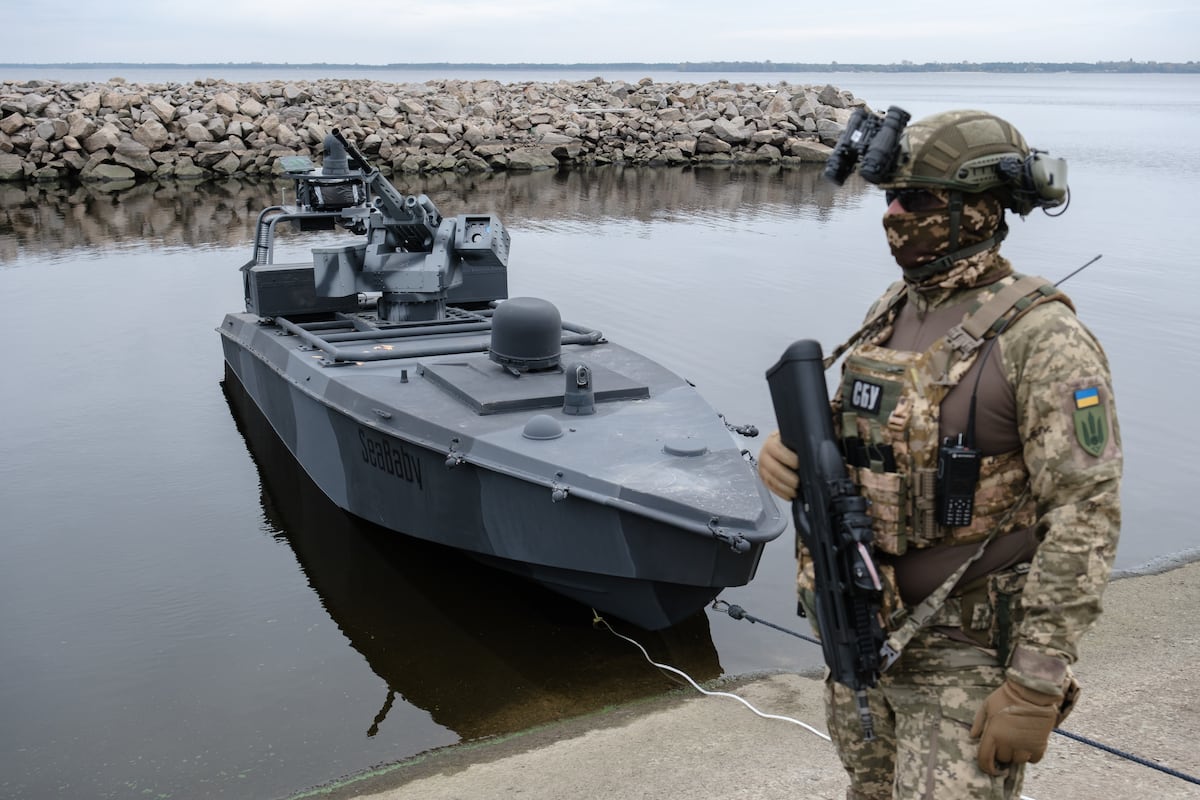
KYIV, Ukraine — Ukraine has turned its signature naval drone – the little boat that drove Russia’s fleet out of the western Black Sea – into a launch platform for first-person-view attack drones, putting Kyiv’s strike reach beyond the coast.
The Sea Baby, a strike boat built and operated by Ukraine’s Security Service, or SBU, can now carry six to eight FPV drones in side compartments that open during an attack, alongside thermobaric Shmel rockets, according to Russian accounts of the boats operating around the Kinburn Spit, roughly 40 miles east of Odesa, shared by Forbes .
Ukrainian officials count on the autonomous vessels’ ability to move closer toward Russian military positions than land-based launchers could, with the SBU assuming a range of 930 miles (1,500 kilometers) on a 4,400-pound (2,000-kilogram) payload. Some of the drones in the cargo hold are guided by fiber-optic cable, leaving them immune to the radio jamming that downs ordinary FPVs, according to Forbes .
Ukraine has turned nearly everything it fields into an FPV launcher. Sea drones carrying fiber-optic FPVs struck the Russian ports of Tuapse and Novorossiysk in September. Several companies have rigged ground robots to fire the same drones, and both sides have flown balloons carrying them .
“The SBU became the first in the world to pioneer this new kind of naval warfare,” Brig. Gen. Ivan Lukashevych said at an unveiling of the Sea Baby’s latest generation in October 2025, “and we continue to advance it.”
Ukraine fields two distinct naval drone families.
The Sea Baby is developed and operated by the SBU, Ukraine’s domestic security service. The Magura – built by Uforce for the GUR, Ukraine’s military intelligence directorate – is a separate system with its own lineage and export path.
The Sea Baby is primarily remote-piloted from a mobile ground station but carries AI-assisted targeting and navigation systems that allow it to operate autonomously when communications are jammed or degraded – a design imperative born from Russia’s intense electronic warfare environment over the Black Sea.
American forces have begun using the boats themselves.
U.S. special forces sank a target ship with a Ukrainian Magura at the Balikatan 2026 exercise off the Philippines on June 24, the first use of the technology in the Indo-Pacific.
The interest is not one-off. A cheap, expendable boat that can carry a cluster of attack drones to within striking range is exactly the kind of weapon the United States is looking for as it prepares for a possible war with China across the Pacific’s vast distances.
“Magura’s successes on the Ukrainian-Russian front confirm their value for use in the Indo-Pacific region,” Oleg Roginsky, chief executive of Uforce, the London-based startup that makes the Magura, told Bloomberg last week.
Uforce is in talks with Indo-Pacific buyers and weighing at least two production sites in the region, Roginsky said. Ukraine barred weapons exports in 2022 to keep its arms at the front, and only began opening that market in 2025.
Ukrainian naval drones have sunk or damaged roughly a dozen Russian warships since 2022 and forced the Black Sea Fleet to pull its main operations back to Novorossiysk, the U.S. Naval Institute reported in September.
Each boat costs a few hundred thousand dollars, below the price of a single modern torpedo.
The Pentagon is studying the lesson as it shifts focus toward a possible conflict with China.
The U.S. Navy expects to field thousands of small uncrewed surface vessels across the Indo-Pacific by 2030, Capt. Garrett Miller, who leads its Surface Development Group One, said at a Navy symposium on April 20, as reported by USNI News .
In a report last July, the Center for Strategic and International Studies urged the U.S. military to copy Kyiv’s acquisition methods, arguing that “unlike theoretical models or peacetime pilots, Ukraine’s innovations in defense acquisition are battlefield tested.”
And Ukraine has continued to innovate. Its Sub Sea Baby underwater drone struck an Improved Kilo-class submarine at its pier in Novorossiysk on Dec. 15, the first time an unmanned underwater vehicle has hit a submarine in port, the SBU said.
Russia denied any damage, but satellite imagery taken the following day showed a 9-meter crater in the pier, the submarine visibly lower in the water, and the vessel, later identified as the B-271 Kolpino, unmoved at its berth more than a month later. Ukrainian and independent analysts assessed it as a mission kill.
NATO is already training with Kyiv’s tactics, too.
Ukraine’s navy led a NATO red team and beat the alliance’s blue force in all five scenarios at the REPMUS naval-drone exercise in Portugal in September, the first time it had run the opposing force.
Katie Livingstone is the Ukraine correspondent for Defense News and Military Times. Based in Kyiv, she has covered Russia's full-scale invasion since its first days. She is a former Fulbright fellow whose award-winning work has appeared in outlets across Europe and the U.S.
乌克兰基辅——乌克兰已将其标志性的海军无人机——将俄罗斯舰队赶出黑海西部的小型无人机——改造成第一人称视角攻击无人机的发射平台,使基辅的打击范围超越了海岸线。
据《福布斯》报道,俄罗斯方面称,乌克兰安全局(SBU)建造和运营的“海宝贝”号攻击艇,现在可以携带六到八架FPV无人机,这些无人机安装在攻击时打开的侧舱内,同时还可以携带温压火箭“什梅尔”。这些船只在金伯恩沙嘴附近活动,位于敖德萨以东约40英里处。
乌克兰官员指望这些自主无人机能够比陆基发射器更接近俄罗斯军事阵地,据乌克兰国家安全局(SBU)称,其有效载荷为2000公斤(4400磅),航程可达1500公里(930英里)。据《福布斯》报道,货舱内的一些无人机由光纤电缆引导,因此不受普通FPV无人机常见的无线电干扰影响。
乌克兰几乎将其部署的所有武器都改装成了FPV(第一人称视角)发射器。9月份,携带光纤FPV的海上无人机袭击了俄罗斯的图阿普谢港和新罗西斯克港。多家公司已改装地面机器人来发射同样的无人机,双方都曾使用气球携带这些无人机进行飞行。
“SBU成为世界上第一个开创这种新型海军作战方式的舰艇,”伊万·卢卡舍维奇准将在2025年10月举行的“海之子”最新一代舰艇揭幕仪式上说,“我们将继续推进这项技术的发展。”
乌克兰拥有两种截然不同的海军无人机系列。
“海宝贝”(Sea Baby)系统由乌克兰国家安全局(SBU)研发和运营。“马古拉”(Magura)系统则是由乌克兰联合部队(Uforce)为乌克兰军事情报局(GUR)建造的独立系统,拥有其自身的研发历程和出口途径。
“海之子”主要通过移动地面站进行远程操控,但配备了人工智能辅助目标定位和导航系统,使其能够在通信受到干扰或劣化时自主运行——这一设计要求源于俄罗斯在黑海上的激烈电子战环境。
美军已经开始使用这些船只。
6 月 24 日,在菲律宾附近举行的“肩并肩 2026”联合军演中,美国特种部队使用乌克兰“马古拉”导弹击沉了一艘靶船,这是该技术在印太地区的首次应用。
这种兴趣并非偶然。美国正在寻找一种廉价、可消耗的舰艇,能够将一群攻击型无人机运送到打击范围之内,这正是美国在为可能与中国在太平洋彼岸爆发的战争做准备时所需要的武器。
“Magura 在乌克兰-俄罗斯战线上的成功证实了其在印太地区的使用价值,”总部位于伦敦的初创公司 Uforce 的首席执行官 Oleg Roginsky 上周告诉彭博社。Uforce 正是 Magura 的制造商。
罗金斯基表示,Uforce正在与印太地区的买家进行谈判,并考虑在该地区至少设立两个生产基地。乌克兰为了保持其武器前沿地位,于2022年禁止武器出口,并于2025年开始逐步开放武器市场。
据美国海军学会9月份报道,自2022年以来,乌克兰海军无人机击沉或损坏了大约十几艘俄罗斯军舰,迫使黑海舰队将其主要行动撤回新罗西斯克。
每艘船造价几十万美元,低于一枚现代鱼雷的价格。
五角大楼正在研究这一教训,并将注意力转向可能发生的与中国的冲突。
据美国海军学会新闻报道,美国海军第一水面舰艇发展大队队长加勒特·米勒上校在4月20日举行的海军研讨会上表示,美国海军预计到2030年将在印太地区部署数千艘小型无人水面舰艇。
去年七月,战略与国际研究中心在一份报告中敦促美国军方效仿基辅的采购方法,认为“与理论模型或和平时期的试点项目不同,乌克兰在国防采购方面的创新已经过战场检验”。
乌克兰一直在不断创新。乌克兰国家安全局称,12月15日,其“海底宝贝”(Sub Sea Baby)水下无人潜航器在诺沃罗西斯克码头击中了一艘改进型基洛级潜艇,这是无人水下航行器首次在港口内击中潜艇。
俄罗斯否认造成任何损失,但次日拍摄的卫星图像显示,码头上出现了一个9米深的弹坑,潜艇明显下沉,而这艘后来被确认为B-271“科尔皮诺”号的潜艇,在一个多月后仍静静地停泊在泊位上。乌克兰和独立分析人士均认为这是一次任务失败。
北约也已经开始采用基辅的战术进行训练。
9 月在葡萄牙举行的 REPMUS 海军无人机演习中,乌克兰海军率领北约红队,在所有五个场景中击败了北约蓝队。这是乌克兰海军首次担任对抗部队。
凯蒂·利文斯通是《防务新闻》和《军事时报》的乌克兰特派记者。她常驻基辅,自俄罗斯全面入侵乌克兰之初便开始报道此事。她曾是富布赖特学者,其获奖作品发表于欧洲和美国的多家媒体。