New $60m marine science institute launched to help Singapore, region with ocean challenges耗资6000万美元新建的海洋科学研究所成立,旨在帮助新加坡及周边地区应对海洋挑战。
Singapore launches $60m National Institute of Marine and Ocean Sciences to tackle regional ocean challenges and support sustainable marine ecosystem management. Read more at straitstimes.com.
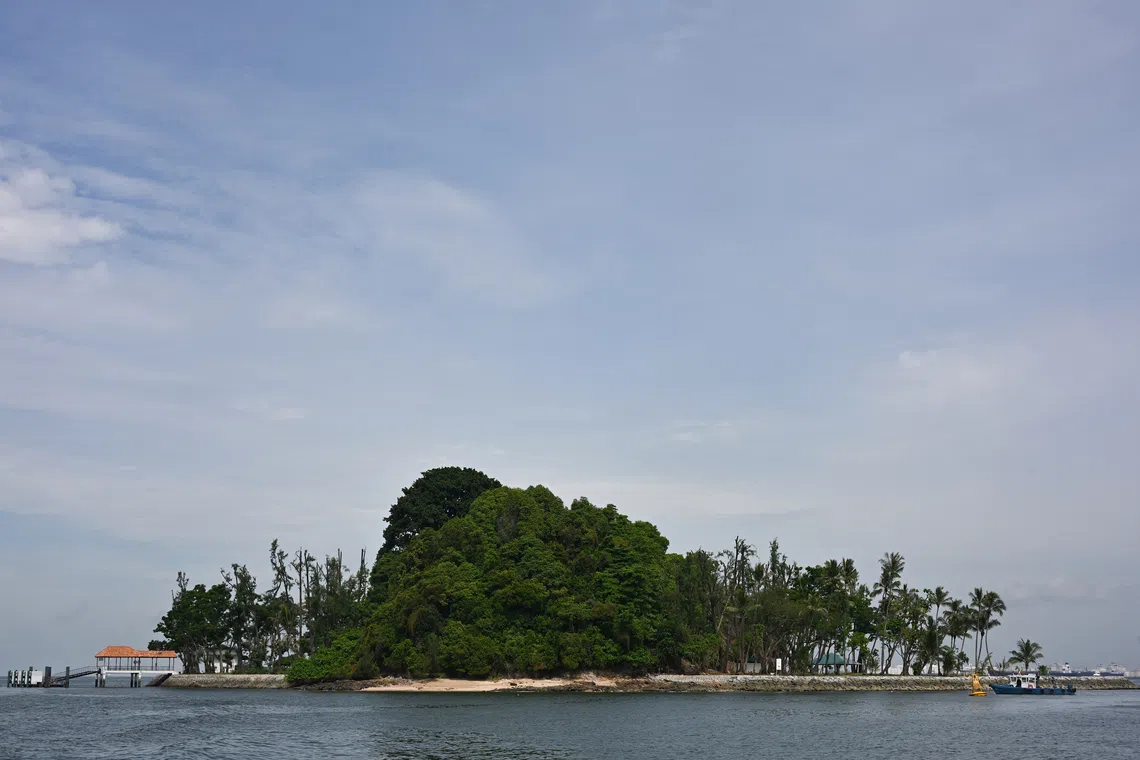
The launch of the new institute comes as several changes are expected in Singapore’s sea spaces.
ST PHOTO: LIM YAOHUI
Published Sep 22, 2026, 01:00 PM
Updated Sep 22, 2026, 01:00 PM
SINGAPORE - A landmark national research initiative on marine science was officially launched on Sept 22, with a remit to help Singapore and the broader South-east Asian region deal with challenges ranging from coastal development to climate change.
The $60 million National Institute of Marine and Ocean Sciences, dubbed NIMOS, is established by National Parks Board (NParks) with the National University of Singapore (NUS).
The previous two marine science research programmes were five-year programmes funded to the tune of $25 million each. Both programmes were also more focused on applying science to domestic challenges, such as identifying sustainable engineering measures and solutions to create new marine habitats.
The launch event at the NUS University Hall Auditorium was attended by Minister for National Development Chee Hong Tat, as well as some 150 researchers, university representatives and government officials.
NIMOS director Huang Danwei, a coral biologist, said the launch of the new institute comes as several changes are expected in Singapore’s sea spaces. Regionally, too, the waters of South-east Asia are under stress from coastal development and climate change.
In Singapore, he pointed to the recently announced plans for a new western island as an example of how partnership between scientists and government agencies will be paramount for securing a sustainable sea space for Singapore.
Prime Minister Lawrence Wong had in August announced plans to merge several Southern islands to reclaim a new western island for industry, energy and defence needs.
At the same time, Singapore will soon also welcome its second marine park at the nearby Lazarus-South Kusu reef. The second marine park was first announced in May 2024, but has not been officially gazetted.
Said Huang: “As a small, highly urbanised island nation at the centre of one of the world’s most intensively used marine regions, Singapore can serve as a living laboratory for the future of tropical coastal environments.
“Our goal is therefore larger than understanding Singapore’s seas. It is to develop the science and tools for sustaining marine ecosystems alongside economic development—solutions that Singapore can demonstrate locally and contribute to a rapidly changing South-east Asia.”
He noted that coastal cities in South-east Asia are expanding and becoming more urbanised, taking the path that Singapore took years earlier.
Huang added that Singapore has played a prominent role in the High Seas Treaty , a hard-fought global deal that aims to protect the marine life of two-thirds of the ocean.
NIMOS will start by operating as a virtual institute while longer-term facilities are being developed, NUS said in a statement.
Its permanent home on the NUS campus is expected to include wet science laboratory facilities and collaborative office space for project teams.
Huang said the institute will not compete for limited funding and resources through competitive grant calls.
Instead, research teams will be assembled to take on projects co-developed by principal investigators, NIMOS and NParks.
Outlining the objectives of NIMOS for the years ahead, Huang said the institute will develop tools to enable marine ecosystems to withstand multiple stressors while continuing to provide the essential services Singapore relies on, among other things.
Ecosystems provide natural benefits like improving water quality and supporting populations of marine life.
This includes understanding which organisms and processes are critical for maintaining ecosystem functions, and whether ecosystems are performing the functions society depends on.
Over the next decade, NUS and the institute will also offer a total of 22 post doctoral research scholarships supporting the growth of local expertise and projects.
Addressing guests, Chee said the institute will help Singapore “make good decisions supported by science”.
On western island, he noted that it is important for the Republic to plan ahead for its future strategic national needs, even as it recognises that the area is rich in biodiversity.
Said Chee: “I think members of the marine research and conservation community would agree with me that this is something that we need to do our best, to preserve as much as possible to minimise the impact as far as we can.”
He said the institute’s work can deepen Singapore’s understanding of the marine environment, assess the choices and trade-offs, and help make informed decisions about how its limited marine space is used.
NIMOS’ approach will help the Republic better understand the cumulative effects of climate change, human activity and other pressures on our marine environment over time,” he added.
He pointed out that the waters around Singapore have always been important to its development as a nation.
“How we understand, protect and manage them will become even more important in the decades ahead, as the demands on our limited marine space continue to grow,” said Chee.
“Our investments in marine science today are therefore investments in Singapore’s future. The better we understand our marine environment, the better equipped we will be to make sound decisions.”
新研究所的成立正值新加坡海域预计将发生多项变化之际。
ST 照片:林耀辉
发布于2026年9月22日下午1点
更新于2026年9月22日下午1点
新加坡——一项具有里程碑意义的国家海洋科学研究计划于9月22日正式启动,其宗旨是帮助新加坡和更广泛的东南亚地区应对从沿海开发到气候变化等一系列挑战。
耗资 6000 万美元的国家海洋与海洋科学研究所(简称 NIMOS)由国家公园局 (NParks) 与新加坡国立大学 (NUS) 共同建立。
前两个海洋科学研究项目均为五年期项目,每个项目经费达2500万美元。这两个项目也更侧重于将科学应用于国内挑战,例如确定可持续的工程措施和解决方案,以创造新的海洋栖息地。
在新加坡国立大学大学礼堂举行的发布会上,国家发展部长徐芳达以及约150名研究人员、大学代表和政府官员出席了活动。
NIMOS主任、珊瑚生物学家黄丹伟表示,新研究所的成立正值新加坡海域预计将发生多项变化之际。同时,东南亚海域也正面临着沿海开发和气候变化带来的压力。
在新加坡,他指出最近宣布的西部新岛计划就是一个例子,说明科学家和政府机构之间的合作对于确保新加坡拥有可持续的海洋空间至关重要。
总理黄循财曾在8月宣布计划合并几个南部岛屿,以填海造陆,形成一个新的西部岛屿,满足工业、能源和国防需求。
与此同时,新加坡即将迎来其第二个海洋公园,位于附近的拉扎勒斯-南龟屿礁。第二个海洋公园最初于2024年5月宣布,但尚未正式公布。
黄先生说:“新加坡是一个高度城市化的小型岛国,位于世界上海洋利用最密集的地区之一的中心,可以作为热带沿海环境未来的活实验室。”
“因此,我们的目标不仅仅是了解新加坡的海洋。而是要发展科学技术和工具,以在经济发展的同时维持海洋生态系统的可持续发展——这些解决方案新加坡可以在本地进行示范,并为快速变化的东南亚做出贡献。”
他指出,东南亚沿海城市正在扩张并变得更加城市化,走上了新加坡多年前走过的道路。
黄补充说,新加坡在《公海条约》中发挥了重要作用,这是一项来之不易的全球协议,旨在保护三分之二海洋的海洋生物。
新加坡国立大学在一份声明中表示,NIMOS 将首先以虚拟研究所的形式运营,同时开发更长期的设施。
其位于新加坡国立大学校园内的永久校址预计将包括湿科学实验室设施和项目团队的协作办公空间。
黄表示,该研究所不会通过竞争性拨款申请来争夺有限的资金和资源。
相反,研究团队将组建起来,承担由首席研究员、NIMOS 和 NParks 共同开发的项目。
黄在概述NIMOS未来几年的目标时表示,该研究所将开发工具,使海洋生态系统能够抵御多种压力,同时继续提供新加坡赖以生存的基本服务。
生态系统提供改善水质和支持海洋生物种群等自然益处。
这包括了解哪些生物和过程对于维持生态系统功能至关重要,以及生态系统是否正在履行社会赖以生存的功能。
在接下来的十年里,新加坡国立大学和该研究所还将提供总共 22 个博士后研究奖学金,以支持本地专业人才和项目的发展。
Chee在致辞中表示,该研究所将帮助新加坡“做出以科学为依据的正确决策”。
他指出,在西部岛屿上,共和国必须提前规划其未来的国家战略需求,同时也要认识到该地区生物多样性丰富。
Chee说:“我认为海洋研究和保护界的成员会同意我的观点,我们需要尽最大努力去保护尽可能多的资源,以尽可能减少影响。”
他表示,该研究所的工作可以加深新加坡对海洋环境的了解,评估各种选择和权衡利弊,并帮助就如何利用其有限的海洋空间做出明智的决定。
“NIMOS 的方法将帮助共和国更好地了解气候变化、人类活动和其他压力对我们海洋环境的长期累积影响,”他补充道。
他指出,新加坡周边水域对新加坡作为一个国家的发展一直至关重要。
“随着我们有限的海洋空间需求不断增长,未来几十年我们如何了解、保护和管理海洋将变得更加重要,” Chee 说。
“因此,我们今天对海洋科学的投资就是对新加坡未来的投资。我们越了解海洋环境,就越能做出明智的决策。”