Behold the Pioneering A-6C Intruder With its Massive Ventral Sensor Pod瞧瞧这架开创先河的A-6C入侵者攻击机,它配备了巨大的腹部传感器吊舱。
The Intruder came in many flavors, but the rare A-6C was perhaps the most interesting.
Updated Jul 3, 2020 3:38 AM EDT
Few aircraft have captured my imagination like the Grumman A-6 Intruder, and the aircraft’s history is sprinkled with awesome obscurities, thrust vectoring nozzles being one of them . Over the decades, the type was adapted into a tanker (KA-6D), and suppression of enemy air defenses aircraft (A-6B), and, most famously, into the an outstanding electronic warfare platform (EA-6A and EA-6B), the latter of which still serves the USMC today . But lots of other sub-variants were built, and maybe the most intriguing is the A-6C.
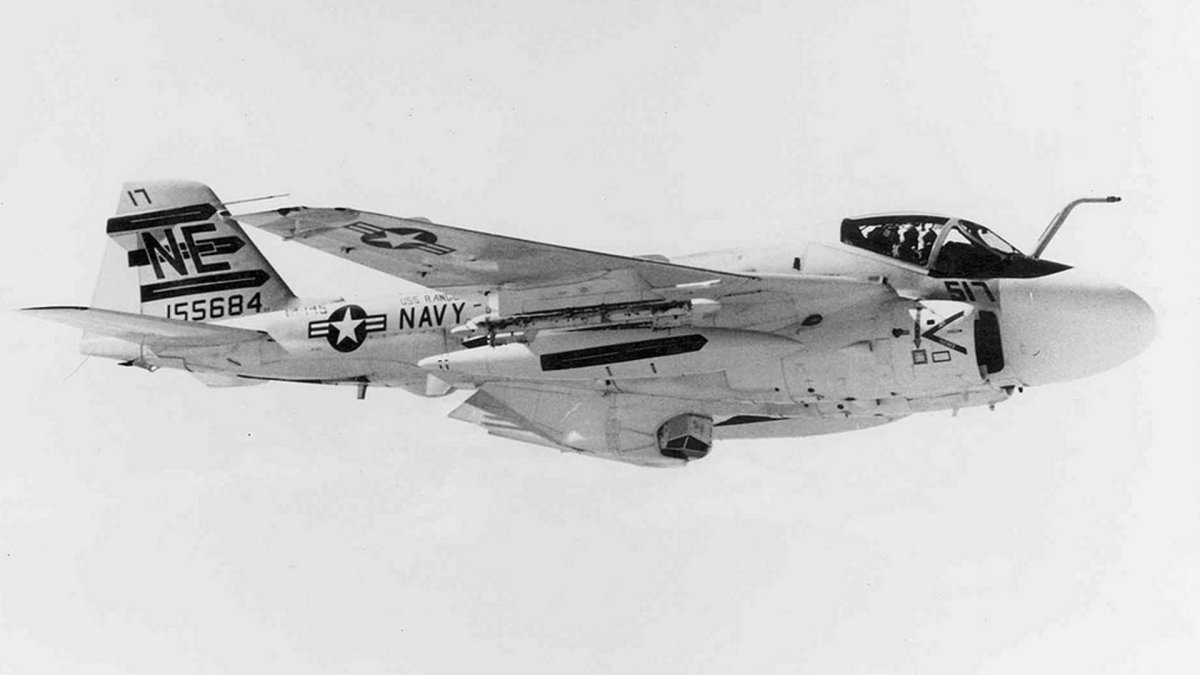
Only a dozen A-6Cs were fielded, all of which were converted from A-6As starting in 1968 with their combat debut occurring in 1970. Their role was to specifically go after targets along the Ho Chi Minh Trail , North Vietnam’s key logistical route that cut in and out along the Vietnam-Laos border. Even under mass bombardment, breaking the trail had been nearly impossible, so the Pentagon looked towards high technology to affect the situation. One such application was the A-6C with its massive and somewhat futuristic TRIM pod attached to its belly.
A-6C’s TRIM pod. , …
The name stood for Trails, Roads, Interdiction, Multi-Sensor, an adequate description for the pod’s mission and configuration. Inside the big fairing were low-light and infrared cameras that allowed A-6C crews to navigate visually and to identify targets such as people vehicles along the trail at night. The optics were a far cry from the FLIR systems and targeting pods found on virtually every American tactical military aircraft today, or even those found domestically on police and news helicopters, but at the time the technology was cutting-edge. The two systems were mounted side-by-side behind flat panes of glass in a rotating turret located at the front of the pod. The low-light TV camera offered a wider field of view than the more narrow field of view offered by the infrared camera.
The components of the A-6C TRIM pod., …
In addition to the A-6C’s optical sensors, the Black Crow engine ignition-detection system was also fitted. This system was effective in any weather and even while targets were concealed visually under thick jungle canopy. It detected the microwave emissions from a vehicle’s spark plugs firing and gave targeting coordinates for the host aircraft to fire on. The first AC-130 gunships also used the system over the Ho Chi Minh Trail successfully. In addition to the TRIM pod and Black Crow, the charlie model of the A-6 also saw major upgrades to its navigational and fire control radars and other avionics systems.
The unique lines of the A-6C., …
Although the concept behind the A-6C held great promise, the technology was lacking, and the big pod imposed a severe performance tax on the Intruder. This included substantially limiting the amount of ordnance the jet could bring back to the boat if no targets were found during nighttime hunting missions, as well as increased fuel burn throughout the aircraft’s flight envelope.
A-6E TRAMs loaded with bombs in the early 1980s. You can see the TRAM turret on the bottom of the Intruder’s nose. , USN
Just one A-6C was lost in a mishap, and many of the surviving examples ended up being converted over to the Intruder’s ultimate operational configuration following the end of the war. Even though the A-6C was not a huge success, it paved the way for this final A-6 variant, as the A-6E TRAM (Target Recognition and Attack Multi-sensor) would feature much more evolved and miniaturized infrared systems. These were housed in a small turret under the A-6E’s nose that contained a FLIR, laser designator and spot tracker, and a computer that tied the system into the A-6E’s integrated avionics suite. Many of the lessons learned in the A-6C program were taken into account when developing the A-6E TRAM.
A-6E TRAM loaded with laser guided bombs during Desert Storm., USN
A-6Es would see service in Libya and in especially in Iraq, where they pummeled targets with laser-guided bombs. Although the A-6E TRAM was an amazing all-weather war-fighting machine, no version of “Flying Frying Pan” could compare charismatically with the pioneering, rare, and futuristic looking A-6C. It was another short-lived but unique highlight in what was a very diverse time for naval aviation.
Contact the author: Tyler@thedrive.com
Comments couldn’t be loaded. Please refresh the page.
更新于美国东部时间2020年7月3日凌晨3:38
很少有飞机能像格鲁曼A-6“入侵者”那样让我着迷,而这款飞机的历史也充满了令人惊叹的冷门技术,推力矢量喷管便是其中之一。几十年来,该机型被改装成加油机(KA-6D)、压制敌方防空系统的飞机(A-6B),以及最著名的电子战平台(EA-6A和EA-6B),后者至今仍在为美国海军陆战队服役。此外,还有许多其他子型号,其中最引人入胜的或许要数A-6C了。
仅有十几架A-6C投入使用,全部由A-6A改装而来,改装始于1968年,并于1970年首次投入实战。它们的任务是专门打击胡志明小道沿线的目标。胡志明小道是北越的关键后勤通道,贯穿越老边境。即使在大规模轰炸下,切断这条小道也几乎不可能,因此五角大楼寻求高科技手段来改变局势。A-6C便是其中一种应用,其腹部挂载着体积庞大且颇具未来感的TRIM吊舱。
A-6C的配平吊舱,……
这个名称代表“小径、道路、拦截、多传感器”,恰如其分地描述了吊舱的任务和配置。大型整流罩内装有低照度和红外摄像机,使A-6C机组人员能够在夜间进行目视导航并识别小径上的人员和车辆等目标。其光学系统与如今几乎所有美国战术军用飞机,甚至国内警用和新闻直升机上配备的前视红外系统和目标指示吊舱相比,都相去甚远,但在当时,这项技术堪称尖端。这两个系统并排安装在吊舱前部旋转炮塔内的平板玻璃后面。低照度电视摄像机的视野比红外摄像机更宽广。
A-6C TRIM吊舱的组成部分,……
除了A-6C的光学传感器外,它还配备了“黑鸦”发动机点火探测系统。该系统在任何天气条件下都有效,即使目标被茂密的丛林树冠遮蔽也能正常工作。它能探测到车辆火花塞点火产生的微波辐射,并为母机提供目标坐标以供攻击。首批AC-130炮艇机也成功地在胡志明小道上空使用了该系统。除了TRIM吊舱和“黑鸦”系统外,A-6的“查理”型(Charlie)还对其导航雷达、火控雷达和其他航空电子系统进行了重大升级。
A-6C独特的线条……
尽管A-6C的设计理念前景广阔,但当时的技术还不够成熟,而且其庞大的吊舱严重影响了“入侵者”战机的性能。这包括大幅限制战机在夜间搜索任务中若未发现目标时可携带的弹药量,以及增加战机在整个飞行包线内的燃油消耗。
20世纪80年代初,A-6E TRAM攻击机装载着炸弹。你可以看到“入侵者”攻击机机头下方的TRAM炮塔。(美国海军)
仅有一架A-6C因事故损失,而幸存的许多A-6C在战后被改装成“入侵者”的最终作战配置。尽管A-6C并非大获成功,但它为最终的A-6衍生型号A-6E TRAM(目标识别与攻击多传感器)铺平了道路,因为A-6E TRAM将配备更先进、更小型化的红外系统。这些系统安装在A-6E机头下方的一个小型炮塔内,炮塔内包含前视红外(FLIR)、激光指示器、目标跟踪器以及一台将该系统与A-6E集成航空电子设备连接起来的计算机。A-6C项目中汲取的许多经验教训在A-6E TRAM的研发过程中都得到了充分考虑。
在“沙漠风暴”行动期间,美国海军的A-6E TRAM攻击机装载着激光制导炸弹。
A-6E攻击机曾在利比亚服役,尤其是在伊拉克,它们用激光制导炸弹猛烈轰炸目标。尽管A-6E TRAM是一款出色的全天候作战机器,但任何型号的“飞行煎锅”都无法在魅力上与开创先河、稀有且外形极具未来感的A-6C相媲美。在海军航空兵发展日新月异的时代,A-6C是又一个短暂却独特的亮点。
联系作者:Tyler@thedrive.com
评论加载失败,请刷新页面。