2 defense tech companies sue US Navy after losing out on MUSV program两家国防科技公司在MUSV项目竞标中落败后起诉美国海军
Two defense tech companies sued the U.S. government, alleging they were unfairly excluded from the Navy's Medium Unmanned Surface Vessel program.
Two defense technology companies filed lawsuits in federal court Tuesday after being excluded from the U.S. Navy’s newest unmanned surface vessel acquisition program .
Blue Water Autonomy and Saildrone allege they were kicked out of contention for the Navy’s Medium Unmanned Surface Vessel Family of Systems program after the Navy failed to comply with its own requirements, among other errors.
Blue Water Autonomy said the decision was based on “overly restrictive evaluation criteria, a misreading of Blue Water’s proposal, and irrational conclusions that are inconsistent with the [Request for Prototype Proposals] and statutory requirements,” according to a complaint filed in the U.S. Court of Federal Claims.
A significant portion of both companies’ legal documents were redacted, and the specifics of what the Navy found lacking in each of their MUSV proposals was not immediately clear.
The Navy said it could not comment on pending litigation.
The service launched the MUSV program and opened solicitations for the new class of boat on March 26, after canceling the Modular Attack Surface Craft program.
The latter, announced on July 28, 2025, solicited the development of USVs that were capable of carrying large containerized payloads that could accommodate a similar weight to the Navy’s anti-ballistic missile system, the Mark 70 Mod 1 Payload Delivery System.
The MASC program was dedicated to a specific mission and specific ask from the fleet, whereas the MUSV program addresses a larger batch of requirements and mission types.
This was the reasoning behind the shuttering of the MASC program, according to Rebecca Gassler, portfolio acquisition executive for the U.S. Navy’s robotic and autonomous systems.
The MUSV solicitation, which ended on April 17, analyzed a company’s business plan, manufacturing plan, test plan and technical design.
Chosen companies and their MUSVs were then instructed to prepare for an on-water test with a surrogate vessel that would be conducted at the end of the fiscal year.
Blue Water Autonomy was initially chosen by the Navy to participate in the Modular Attack Surface Craft program before the MUSV program was rolled out.
The company was already underway in developing its Liberty vessel for the MASC program when it ended, having sunk money into production.
But before Blue Water Autonomy could participate in the on-water test with a surrogate vessel to demonstrate its viability as a partner for future MUSVs, they say they were barred from continuing in the MUSV program competition.
The Navy announced on June 1 that it had selected seven companies to participate in at-sea testing.
Those companies included Sea Machines, Leidos, Saronic Technologies, Galliano Marine Services, PacMar Technologies, Birdon and Huntington Ingalls Industries.
Blue Water Autonomy was not on the list.
The company said the Navy’s decision to remove it from consideration for the MUSV request for prototype proposal was “capricious” and not “in accordance with statute or regulation.”
The complaint asked that the Navy halt the testing and funding for the MUSV program until “prejudicial errors” were remedied and Blue Water Autonomy was allowed reentry into the program in an effort to win the bid for the MUSV contract.
Saildrone was also excluded from participating in the program after initially taking part.
The company argues that it was more than deserving of being in the mix for the MUSV program, as it operates the world’s largest fleet of contractor-owned, contractor-operator USVs which have completed upwards of 2.5 million nautical miles since 2012, according to a complaint filed in the U.S. Court of Federal Claims.
“Our fully compliant MUSV submission to the US Navy should have qualified for advancing to the next round, in which we would participate in sea trials and develop a prototype at our own cost,” a Saildrone spokesperson said. “We support the Navy’s mission and believe there has been a misunderstanding in the evaluation of our bid.”
Saildrone has deployed more than 70 vessels across the globe, including for the Navy and U.S. Coast Guard, the complaint said.
The company said it learned it was disqualified from continuing to compete in the MUSV program from a news article and was offered no explanation in an email follow-up with the U.S. government as to why it wasn’t given an opportunity to continue.
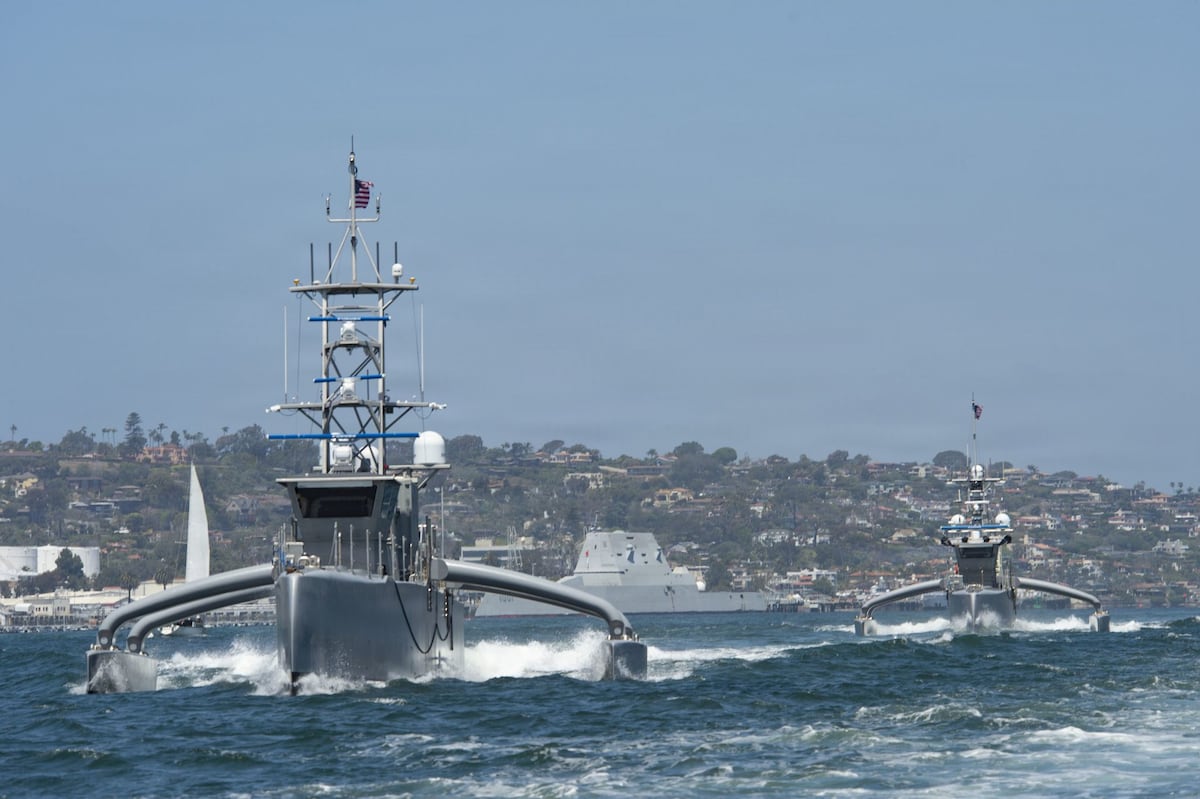
Sea Hunter and Seahawk were the first autonomous MUSVs operated by the U.S. Navy. (Navy)
Eventually, Saildrone says they were provided a “fundamentally flawed evaluation.”
“Because advancement to the on-water test event imposes no material financial obligation on the government, reevaluating Saildrone’s proposal consistent with the solicitation and advancing Saildrone furthers the public interest at no meaningful cost,” the complaint said.
Saildrone asked to be reinstated in the competition and allowed to compete in the on-water test.
The fiscal 2027 Navy budget calls for the procurement 63 unmanned vessels .
President Donald Trump’s One Big Beautiful Bill Act contains $2.1 billion for medium unmanned surface vessels, a Navy official told Military Times in March.
Riley Ceder is a Navy reporter at Military Times, where he covers issues directly affecting service members and their families, as well as breaking news.
两家国防科技公司周二向联邦法院提起诉讼,称其被排除在美国海军最新的无人水面舰艇采购计划之外。
Blue Water Autonomy 和 Saildrone 声称,由于海军未能遵守其自身的要求,以及其他一些错误,导致他们被踢出了海军中型无人水面舰艇系统系列项目的竞争。
据向美国联邦索赔法院提交的诉状称,Blue Water Autonomy 表示,该决定是基于“过于严格的评估标准、对 Blue Water 提案的误读以及与[原型提案征集]和法定要求不符的非理性结论”。
两家公司的法律文件很大一部分都被删减了,海军认为两家公司的 MUSV 提案具体缺少哪些内容尚不清楚。
海军方面表示,无法对正在进行的诉讼发表评论。
在取消模块化攻击水面艇项目后,该军种于 3 月 26 日启动了 MUSV 项目,并开始招标新型舰艇。
后者于 2025 年 7 月 28 日宣布,旨在开发能够携带大型集装箱式有效载荷的无人水面艇,其重量可与海军的反弹道导弹系统 Mark 70 Mod 1 有效载荷投放系统相媲美。
MASC 计划致力于满足舰队的特定任务和特定需求,而 MUSV 计划则针对更大范围的需求和任务类型。
据美国海军机器人和自主系统项目采购主管丽贝卡·加斯勒 (Rebecca Gassler) 称,这就是 MASC 项目关闭的原因。
MUSV 招标于 4 月 17 日结束,该招标分析了公司的商业计划、制造计划、测试计划和技术设计。
随后,选定的公司及其多用途船舶被指示准备在财政年度末使用替代船舶进行水上测试。
在 MUSV 项目推出之前,海军最初选择 Blue Water Autonomy 参与模块化攻击水面艇 (MUSV) 项目。
该公司在 MASC 计划结束后,就已经开始开发其 Liberty 号舰艇,并已投入资金进行生产。
但蓝水自主公司表示,在他们能够使用替代船只参与水上测试,以证明其作为未来 MUSV 合作伙伴的可行性之前,他们就被禁止继续参加 MUSV 项目竞争。
海军于6月1日宣布,已选定七家公司参与海上测试。
这些公司包括 Sea Machines、Leidos、Saronic Technologies、Galliano Marine Services、PacMar Technologies、Birdon 和 Huntington Ingalls Industries。
Blue Water Autonomy公司不在名单上。
该公司表示,海军决定将其从 MUSV 原型提案的考虑范围中移除是“反复无常的”,并且“不符合法规或条例”。
该投诉要求海军暂停 MUSV 项目的测试和资金,直到“有偏见的错误”得到纠正,并允许 Blue Water Autonomy 重新加入该项目,以赢得 MUSV 合同的竞标。
Saildrone 最初参与了该计划,但后来也被排除在外。
该公司辩称,它完全有资格参与 MUSV 项目,因为它运营着世界上最大的承包商所有、承包商运营的无人水面艇 (USV) 船队,根据向美国联邦索赔法院提交的诉状,自 2012 年以来,这些 USV 已完成了超过 250 万海里的航行。
“我们向美国海军提交的完全符合要求的MUSV方案本应符合进入下一轮的资格,届时我们将参与海上试验并自费开发原型机,”Saildrone公司的一位发言人表示。“我们支持海军的任务,并认为对我们投标方案的评估存在误解。”
诉状称,Saildrone 已在全球范围内部署了 70 多艘船只,其中包括为美国海军和海岸警卫队提供的船只。
该公司表示,他们是从一篇新闻报道中得知自己被取消了继续参加 MUSV 项目的资格,并且在随后通过电子邮件向美国政府询问为何没有得到继续参赛的机会时,没有得到任何解释。
“海猎者”和“海鹰”是美国海军首批自主式多用途水下航行器(MUSV)。(海军)
Saildrone 最终表示,他们收到的评估报告“存在根本性缺陷”。
投诉称:“由于推进水上测试活动不会给政府带来任何实质性的财政负担,因此,根据招标要求重新评估 Saildrone 的提案并推进 Saildrone 的计划,既有利于公共利益,又不会造成任何实质性的成本。”
Saildrone 请求恢复参赛资格,并允许其参加水上测试。
2027 财年海军预算要求采购 63 艘无人舰艇。
一位海军官员在 3 月份告诉《军事时报》,唐纳德·特朗普总统的《一项宏伟的法案》包含 21 亿美元用于中型无人水面舰艇。
Riley Ceder 是《军事时报》的海军记者,他负责报道直接影响军人及其家属的问题以及突发新闻。