US allows Ukraine to fire deeper into Russia ahead of Kursk battle美国允许乌克兰在库尔斯克战役前向俄罗斯境内更深处开火
The move marks the latest reversal from the White House on what weapons it’s sending and how freely Ukraine can use them.
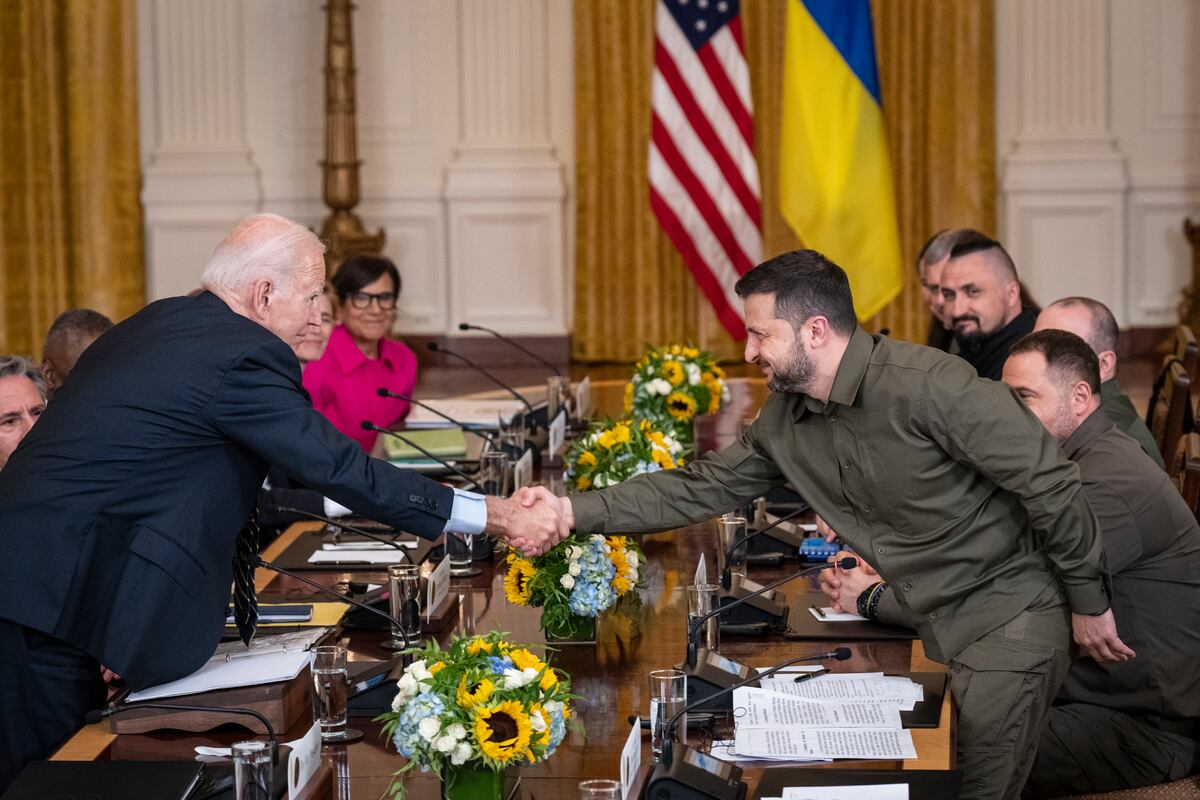
MANILA, Philippines — After months of debate, the U.S. will allow Ukraine to fire long-range American weapons into Russia.
President Joe Biden recently gave permission to use the Army Tactical Missile System, with a 180-mile range. Ukraine has sought such authority since the Biden administration first allowed Kyiv to fire American-provided weapons into Russia this May.
Despite Ukraine’s entreaties, the U.S. resisted the choice until now – arguing it would be an escalation with little battlefield value.
This marks the latest reversal from the White House on what weapons it’s sending and how freely Ukraine can use them. The pattern has repeated throughout the war for equipment like F-16 fighters, long-range missiles and tanks.
The change in course is not a sign that the U.S. thinks the long range missiles will be more useful than before. Instead it’s a tit-for-tat response to North Korea sending more than 10,000 troops to fight alongside Russia in the border region of Kursk, where Ukrainian forces took a swathe of territory earlier this fall.
The North Korean troops haven’t seen much fighting yet, Secretary of Defense Lloyd Austin told reporters this week, but he expects them to enter combat soon.
Russia has so far waited to begin a counteroffensive around Kursk, putting other parts of the front line first. As it suffers enormous casualties – as high as 1,250 per day, U.S. officials have said – the North Korean troops will help Russia maintain its positions without needing another draft.
That said, because of their different languages and lack of experience fighting alongside Russia – far from an ally for the last 30 years – Austin doubted the North Korean forces will be very effective.
Ukraine has not yet used ATACMS to fire deep into Russia, an American defense official said.
For now, the revised policy will focus only on the Kursk region, though Ukraine has asked for permission to fire anywhere the missiles can reach. The U.S. may grant such authority if Russia continues to escalate.
To wit, the initial choice to let Ukraine fire American weapons into Russia came after Moscow began a spring offensive on Kharkiv, Ukraine’s second-largest city and one that sits close to the border. The White House argued then that restricting the fires created an arbitrary haven for Russian forces, who could station equipment just out of reach.
Just where that permission applied was convoluted at first, with the Pentagon saying it was only meant for the Kharkiv region and the White House expanding it soon after.
Speaking with reporters at NATO headquarters in Brussels, a senior U.S. defense official doubted even the embargo on long-range strike would last, referencing the no-no-yes pattern throughout the war.
“Never say never,” the official said.
Notwithstanding, the U.S. stood firm for months. Eventually, it settled on three public arguments to make its case.
America’s stocks of the missiles are low – so much so that it didn’t send them to Ukraine for much of the war. At the same time, the Pentagon has argued that Ukraine was building its own long-range weapons, mostly drones, that worked just as well.
Ukraine has used these to hit Russian oil refineries and ammunition depots, causing major damage in the latter case.
After the policy change in May, Russia also moved many of its planes beyond the 180-mile range, expecting the U.S. to eventually relent. That means Ukraine won’t be able to stop barrages of glide bombs – essentially imprecise weapons tweaked to be more accurate – that have pounded their cities for more than a year.
A congressional aide told Defense News the new permission could still help Ukraine target some important military sites, such as ammunition depots.
But with ATACMS in such short supply, the U.S. also hasn’t said whether the policy change also extends to long range weapons provided by Britain and France. Both countries have said Ukraine should be able to fire these missiles wherever it wants, but they rely on American parts and data to target military sites, giving Washington a veto.
Noah Robertson is the Pentagon reporter at Defense News. He previously covered national security for the Christian Science Monitor. He holds a bachelor’s degree in English and government from the College of William & Mary in his hometown of Williamsburg, Virginia.
菲律宾马尼拉——经过数月的辩论,美国将允许乌克兰向俄罗斯发射美国远程武器。
拜登总统近日批准乌克兰使用射程180英里的陆军战术导弹系统。自拜登政府今年5月首次允许基辅向俄罗斯境内发射美国提供的武器以来,乌克兰一直在寻求获得此类授权。
尽管乌克兰一再恳求,但美国直到现在才做出这一选择——理由是这将导致局势升级,而战场上的价值却很小。
这标志着白宫在向乌克兰提供哪些武器以及允许乌克兰多大程度上自由使用这些武器的问题上,再次出现政策逆转。在整个战争期间,这种模式在F-16战斗机、远程导弹和坦克等装备的交付上反复出现。
这一政策转变并非表明美国认为远程导弹将比以往更有用。相反,这是对朝鲜向俄罗斯派遣超过1万名士兵前往库尔斯克边境地区作战的回应。今年秋季早些时候,乌克兰军队在该地区占领了大片领土。
美国国防部长劳埃德·奥斯汀本周告诉记者,朝鲜军队目前还没有经历太多战斗,但他预计他们很快就会投入战斗。
俄罗斯迄今为止尚未在库尔斯克附近发起反攻,而是优先处理其他战线的战事。由于伤亡惨重——据美国官员称,每天伤亡高达1250人——朝鲜军队将帮助俄罗斯维持阵地,而无需再次征兵。
尽管如此,由于语言不同,而且缺乏与俄罗斯并肩作战的经验——俄罗斯在过去 30 年里远非盟友——奥斯汀怀疑朝鲜军队的作战效能不会很高。
一位美国国防官员表示,乌克兰尚未使用ATACMS导弹深入俄罗斯境内进行射击。
目前,修订后的政策将仅限于库尔斯克地区,尽管乌克兰已请求允许向导弹射程范围内的任何地方发射导弹。如果俄罗斯继续升级冲突,美国可能会授予乌克兰此类授权。
具体而言,允许乌克兰向俄罗斯境内发射美制武器的最初决定,是在莫斯科对乌克兰第二大城市哈尔科夫(该市靠近俄俄边境)发动春季攻势之后做出的。当时白宫辩称,限制此类射击会为俄罗斯军队创造一个任意的避风港,使他们能够将装备部署在乌克兰无法触及的范围内。
该许可的适用范围起初很复杂,五角大楼表示它仅适用于哈尔科夫地区,而白宫随后不久就扩大了其适用范围。
一位美国高级国防官员在布鲁塞尔北约总部接受记者采访时表示,他甚至怀疑对远程打击的禁运能否持续下去,并提到了整个战争期间反复无常的“不-不-是”模式。
“永远不要说不可能,”这位官员说道。
尽管如此,美国立场依然坚定了数月之久。最终,它提出了三项公开论点来阐述自己的立场。
美国的导弹库存量很低——低到战争的大部分时间里都没有向乌克兰运送导弹。与此同时,五角大楼辩称,乌克兰正在研制自己的远程武器,主要是无人机,其效果同样出色。
乌克兰曾利用这些武器袭击俄罗斯的炼油厂和弹药库,其中对弹药库造成了重大损失。
5月份政策调整后,俄罗斯也将许多战机部署到180英里航程之外,预期美国最终会妥协。这意味着乌克兰将无法阻止滑翔炸弹的轰炸——这种武器本质上是精度不高的武器,经过改进后变得更加精准——这种轰炸已经持续一年多,持续袭击乌克兰的城市。
一位国会助理告诉《防务新闻》,新的许可仍然可以帮助乌克兰打击一些重要的军事目标,例如弹药库。
但由于ATACMS导弹供应如此短缺,美国尚未表明这项政策调整是否也适用于英国和法国提供的远程武器。英法两国都表示,乌克兰应该能够随意发射这些导弹,但它们依赖美国提供的零部件和数据来瞄准军事目标,这使得华盛顿拥有否决权。
诺亚·罗伯逊是《防务新闻》的五角大楼记者。他此前曾为《基督教科学箴言报》报道国家安全新闻。他拥有弗吉尼亚州威廉斯堡威廉与玛丽学院的英语和政治学学士学位。