Vandenberg AFB’s Space Shuttle Processing Facility Now Has A Very Mysterious Mission范登堡空军基地的航天飞机处理设施现在肩负着一项非常神秘的任务。
The base's old Orbiter Processing Facility offers high security and isolation, as well as ease of operations and access to vast sanitized airspace.
新闻视频
Updated Dec 1, 2019 6:48 AM EST
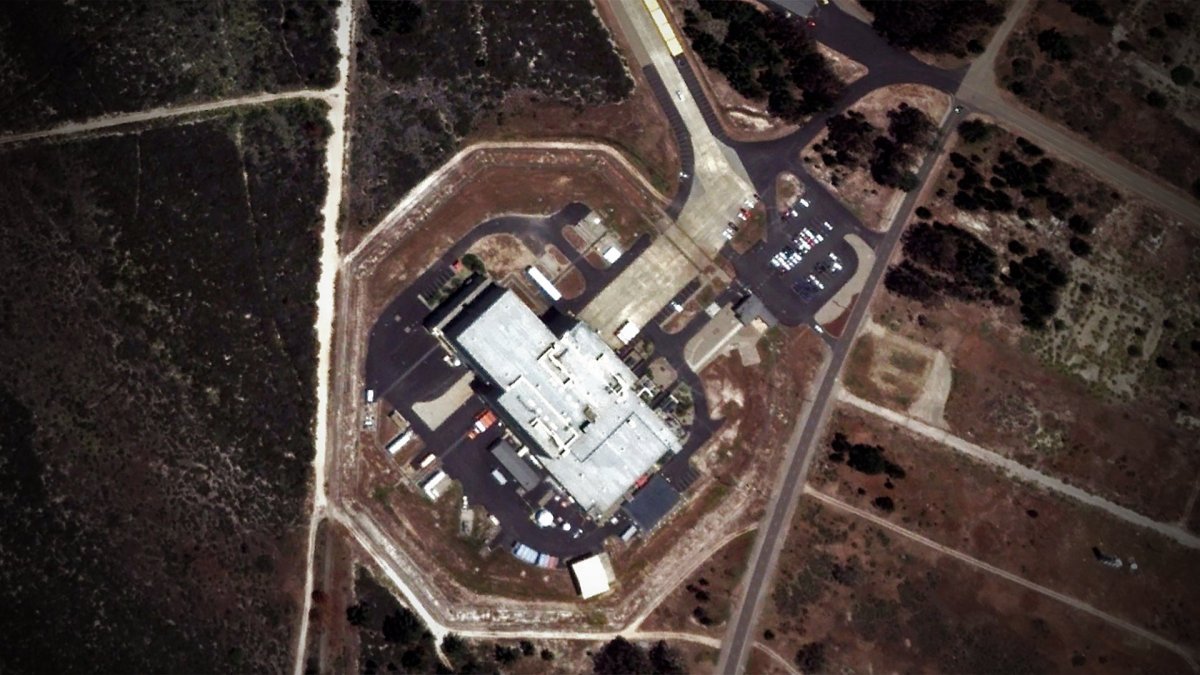
Nestled to the south of Vandenberg Air Force Base’s massive 15,000-foot runway and connected to it by a long, private taxiway sits a peculiar facility encased inside two layers of security fencing, with its entrance from the taxiway only accessible via a pair of sliding gates. At first glance, its appearance is reminiscent of a high-security prison, but this facility is meant to keep people out, not keep them in. But the origins of this highly peculiar installation are far higher-profile in nature than whatever its mission is now.
Years ago, I wrote a feature on Vandenberg Air Force Base’s Space Launch Complex Six (SLC-6) very colorful, but not widely known past . It was built to launch the Air Force’s own Space Shuttle and was a far cry from the expansive Apollo-inherited infrastructure NASA’s Space Shuttles operated from at Kennedy Space Center in Florida. Instead, SLC-6 was a remarkably compact facility tucked between the California coastline and the Santa Ynez mountain range. To put it simply, it looked like something right out of a James Bond movie, not reality.
SLC-6 with Enterprise mocked-up on the pad. , DoD
Part of the infrastructure needed for the USAF’s Space Shuttle program beyond SLC-6 was an Orbiter Processing Facility (OPF). A critical piece of the Shuttle’s operation, the OPF was a highly customized hangar facility designed to regenerate the Orbiter after each mission. Originally, this was supposed to include a fairly abbreviated process, allowing for continuous access to orbit on the cheap, but as the Shuttle program progressed, this operations model—and the business case that supported it—dematerialized, with the Orbiters having to go through a months-long and very expensive process of rehabilitation after each use.
Regardless, the USAF needed its own OPF at Vandenberg for independent operations. From what we can tell, the base’s OPF was built in a very logical place, just south of the runway that would recover the Shuttle after most missions and where the Shuttle Carrier Aircraft would ferry the Orbiter to when landings at another runway were necessary. With a long private taxiway accessing the end of Vandenberg’s runway, the Orbiter could be towed back to the OPF with ease, where it would be turned around for the next mission. It would then be towed to SLC-6, located 10 miles to the south, for mating with its fuel tank, boosters, and payload before launch.
The thing is, none of this ever happened. By the mid-1980s, the Space Shuttle was already proving to be a far more resource-intensive capability than what was originally envisioned. Once the Challenger blew up during ascent, the Air Force canned its Space Shuttle dreams and moved to invest in other ways to access space as it needed, some of which may have been quite experimental and exotic in nature.
In the years that followed, SLC-6 was repurposed, although without success, until it found the right fit in the mid-2000s, as I described when I wrote about SLC-6 in 2015 :
After the cancellation of the Defense Department’s arm of the Shuttle Program, SLC-6 was used by multiple defense contractors with varying results ( see a full launch list here ). By the early 2000s, a legend that the complex was badly cursed had grown to massive proportions, as so many billions of dollars had been poured into the installation, under the guise of a whole slew of programs, with very little to show for it in the end. Finally, in the mid-2000s, Boeing took over the facility and re-utilized much of the Shuttle’s infrastructure for their Delta IV rocket program . The first Delta IV Medium rocket was triumphantly launched from the long-beleaguered complex in 2006. Since then, the once doomed SLC-6 has performed extremely well launching large payloads into space, most of which contain America’s most high-tech and secretive space-based spying technologies. This is somewhat of an ironic reprieve for the site as it had unsuccessfully been envisioned as facilitating just that mission for close to half a century.
After the cancellation of the Defense Department’s arm of the Shuttle Program, SLC-6 was used by multiple defense contractors with varying results ( see a full launch list here ). By the early 2000s, a legend that the complex was badly cursed had grown to massive proportions, as so many billions of dollars had been poured into the installation, under the guise of a whole slew of programs, with very little to show for it in the end.
Finally, in the mid-2000s, Boeing took over the facility and re-utilized much of the Shuttle’s infrastructure for their Delta IV rocket program . The first Delta IV Medium rocket was triumphantly launched from the long-beleaguered complex in 2006. Since then, the once doomed SLC-6 has performed extremely well launching large payloads into space, most of which contain America’s most high-tech and secretive space-based spying technologies. This is somewhat of an ironic reprieve for the site as it had unsuccessfully been envisioned as facilitating just that mission for close to half a century.
While we know all about the history of SLC-6 and how it eventually found success after decades of uncertainty, the Orbiter Processing Facility at Vandenberg is something of an information black hole. I wanted to follow-up on my popular SLC-6 story with a feature about the geographically separated OPF’s own history and what it is up to now, but there was little to no information of any about it. This seemed very odd for something of such historic significance and that is quite large and elaborate and situated on a fairly high-profile Air Force installation.
There is nothing secretive about the OPFs at Kennedy Space Center, which has three of them arranged near the gigantic Vehicle Assembly Building. After the Space Shuttle program was shuttered, those facilities have been given a whole new life. Two are leased by Boeing to support the USAF’s X-37B miniature spaceplane program. The other is also leased by Boeing, but is used for their CST-100 Starliner capsule program . Yet when it comes to Vandenberg’s OPF, the tenant is completely unknown. In fact, it seems as if it was never disclosed in the decades that followed the abortive military Space Shuttle program.
OPFs at Kennedy Space Center., NASA
Check out just how elaborate, large, and advanced the OPFs are:
Vandenberg AFB seems to be quite open when it comes to its various tenants and uses for its launch facilities. There are multiple rocket assembly buildings scattered all around the base used for a number of customers and programs, but nothing as expansive as the OPF. With this in mind, I reached out to the base’s public affairs shop in hopes of getting a simple answer as to what the facility is used for today, or at least about its history following the collapse of the Pentagon’s Shuttle Program. It turns out, they are not willing to share any information about the facility or really even comment on its existence.
So, this leaves us with an odd mystery of sorts. Secret hangar facilities working on undisclosed projects are usually the domain of remote locales, like those in the expansive deserts of the American Southwest. But really, there is no other facility that comes to mind that is better suited with operating an incredibly advanced and clandestine aircraft that needs a lot of space to operate in.
First off, the facility is located deep within an already highly secure facility. This offers high security, but also far better accessibility compared to the remote options in the Nevada desert and elsewhere. Second, the OPF is basically the most ‘Cadillac’ of hangars ever constructed, capable of fully renovating a Space Shuttle with all its exotic materials and workshop needs. Vandenberg’s OPF is even larger than those at Kennedy Space Center. In addition, it was already built and paid for by the USAF for a program that never actually materialized.
Third, it has incredible accessibility to one of the longest runways in the United States. Whatever lives inside that hangar can taxi—or be towed—from its ultra-secure roost, out directly to the end of the runway and launch without even having to use the airfield’s shared aprons and taxiways. It can do the same in reverse for recovery. If the aircraft in question can be transported by airlifter in a disassembled state, moving it to and from its loading area on the base would also be an extremely secure and private affair.
Finally, and most importantly, Vandenberg AFB sits on the California Coast adjacent to where vast military range facilities are located. Literally, the airspace off Vandenberg is part of gargantuan range complex that extends over the Channel Islands and far out into the Pacific and down along the Baja Peninsula. This is where the Navy and the Air Force do some of their most extensive and sensitive testing, including live missile shoots and highly integrated war games.
Combined, these ranges absolutely dwarf those that exist over land, including the expansive Nellis Test and Training Range that occupies a huge chunk of Southern Nevada. In fact, from what we understand, quite a bit of testing of secretive aircraft based in the deserts of the western U.S. occurs over these over-water ranges. Being able to access them without flying over the population in itself is also a huge plus.
The huge range complexes that extend out from the California Coast. , Globalsecurity.org
We also know that Vandenberg AFB does have a test function for secretive aircraft, in particular, unmanned ones. The RQ-170 program has a detachment there and the bat-winged drones fly from the base’s runways fairly regularly. We also know they use the airfield’s main ramp and hangar for their operations, not the expansive OPF.
It’s hard to stress how unique this arrangement is. Although people often think secret aircraft can be shoved in any hangar on any base, that simply is not the case. Few facilities have the ability to offer high-security and isolation, while also ease of operations and access to vast sanitized airspace like what we see at Vandenberg.
So, what lives inside the historic OPF today? We have no idea, but logic points to a number of possibilities and one’s imagination can pretty much run down the rabbit hole from there. Something capable of high speed, that would require the base’s long runway and the huge range complex that sits adjacent to it makes a lot of sense. Sonic booms, deep rumblings in the sky, and strange contrails have been present off the SoCal coast dating back to the late 1980s. In fact, those reports continue to this very day .
It’s also worth noting that the D-21/M-21 combo , a parasite drone-mothership system that is part of the A-12 Oxcart/SR-71 Blackbird family of aircraft, was tested in secrecy over this range complex as over-land alternatives were far too restrictive and problematic.
The utility of high-speed platforms has made a drastic resurgence as of late, with the Pentagon investing billions into hypersonic capabilities of many flavors . One of these is the much talked about ‘SR-72’ hypersonic unmanned strike and reconnaissance aircraft that Lockheed is working on. As I have posited in detail , it seems as if the corporate chatter we are hearing about this craft is a reflection of the past, not the present. Lockheed’s competition is also interested in getting a taste of the USAF’s high-speed reusable aircraft buck. Regardless of who owns it, the OPF would be perfectly suited to such a machine or a technology demonstrator progenitor to it.
Lockheed’s notional SR-72 design., Youtube Screencap
A reusable spacecraft launched from a larger mothership that sorties from a different location, but recovers at Vandenberg is another possibility. It’s also a concept which we have delved into deeply in the past and one the USAF was interested following the collapse of the Shuttle Program. The OPF’s main bay is roughly 150 feet across as measured on Google Earth, so it’s not a like a massive aircraft could occupy the facility, but something the size of the Space Shuttle certainly isn’t small either. On the other hand, a smaller two-stage-to-orbit space-launch system capable of putting small payloads in orbit could also possibly call the OPF home.
A facility used to support a small force of experimental, autonomous, and highly networked unmanned combat air vehicle (UCAV) drones would also be beneficial as they could use the vast range spaces to put their capabilities to the test. The OPF’s shadowy status would certainly fit with the equally puzzling status of any kind of USAF UCAV program. You can read more about this strange reality here .
There are other, far more exotic possibilities to ponder as well, even if just for one’s imagination’s sake, one of which was actually present in the region during a notorious series of events that occurred off the Baja Coast back in 2004.
On the other hand, maybe the OPF has a far more mundane purpose. But if that’s the case, why not offer some details about it, especially considering the facility’s historic significance?
With the Space Shuttle program in America’s rear-view mirror now, its story will only become more fascinating, and a large part of it doesn’t have to do with NASA, it has to do with the Pentagon. Hopefully, we will find out what happened to Vandenberg’s abortive Orbiter Processing Facility and how it ended up influencing the future of aerospace technology sooner rather than later.
Contact the author: Tyler@thedrive.com
Comments couldn’t be loaded. Please refresh the page.
更新于美国东部时间2019年12月1日上午6:48。
在范登堡空军基地长达15000英尺的跑道南侧,一条长长的私人滑行道与之相连,坐落着一座奇特的设施。它被两层安全围栏环绕,只能通过滑行道上的两扇滑动门进入。乍一看,它像一座高度戒备的监狱,但这座设施的目的是阻止人们进入,而不是将他们困在里面。然而,这座极其奇特的设施的起源远比它现在的用途更加引人注目。
多年前,我曾写过一篇关于范登堡空军基地六号航天发射场(SLC-6)的专题报道,讲述了它一段鲜为人知却又精彩纷呈的历史。该发射场是为了发射美国空军自己的航天飞机而建,与NASA在佛罗里达州肯尼迪航天中心运营的、规模庞大的、继承自阿波罗计划的航天飞机发射设施截然不同。SLC-6 规模小巧,隐匿于加利福尼亚海岸线和圣伊内兹山脉之间。简而言之,它看起来更像是詹姆斯·邦德电影里的场景,而非现实。
SLC-6发射台上已搭建好“企业”号火箭的模型。(美国国防部)
美国空军航天飞机项目在SLC-6发射台之后所需的基础设施之一是轨道飞行器处理设施(OPF)。作为航天飞机运行的关键组成部分,OPF是一个高度定制的机库设施,旨在每次任务后对轨道飞行器进行修复。最初,这套流程应该相当精简,从而能够以较低的成本持续进入轨道。但随着航天飞机项目的推进,这种运行模式及其背后的商业论证逐渐失效,轨道飞行器每次使用后都必须经历长达数月且极其昂贵的修复过程。
无论如何,美国空军需要在范登堡空军基地拥有自己的航天飞机回收设施(OPF),以便进行独立操作。据我们所知,该基地的OPF选址非常合理,位于跑道南侧,这条跑道在大多数任务结束后用于回收航天飞机,当需要在其他跑道着陆时,航天飞机运输机也会将航天飞机运送至此。由于有一条长长的专用滑行道直通范登堡跑道的尽头,航天飞机可以轻松地被拖回OPF,在那里进行转向,为下一次任务做准备。之后,航天飞机将被拖至位于南侧10英里处的SLC-6发射台,与燃料箱、助推器和有效载荷对接,准备发射。
事实上,这一切都从未发生过。到了20世纪80年代中期,航天飞机已被证明比最初设想的资源消耗要大得多。挑战者号在升空过程中爆炸后,空军放弃了航天飞机的计划,转而投资其他方式以满足太空探索的需求,其中一些方式可能相当具有实验性和奇特的性质。
在随后的几年里,SLC-6 被重新用于其他用途,但一直没有成功,直到 2000 年代中期才找到了合适的用途,正如我在 2015 年撰写关于 SLC-6 的文章时所描述的那样:
在国防部航天飞机项目被取消后,SLC-6发射台被多家国防承包商使用,但结果参差不齐(完整发射列表请点击此处)。到了21世纪初,关于该发射台被诅咒的传言甚嚣尘上,因为数十亿美元的资金被投入到这个设施中,名义上用于各种项目,最终却收效甚微。最终,在21世纪中期,波音公司接管了该设施,并将航天飞机的许多基础设施重新用于其德尔塔IV火箭项目。2006年,第一枚德尔塔IV中型火箭从这个长期饱受争议的发射台成功发射升空。自那以后,曾经被认为命运多舛的SLC-6发射台表现出色,成功将大量有效载荷送入太空,其中大多数都包含美国最先进的、高度机密的太空间谍技术。对于该遗址而言,这多少有些讽刺意味,因为近半个世纪以来,它一直被设想为促进这一使命,但却未能成功。
在国防部航天飞机项目部门取消后,SLC-6发射台被多家国防承包商使用,但结果参差不齐(完整发射列表请点击此处)。到了21世纪初,关于该发射台被诅咒的传言甚嚣尘上,因为数十亿美元的资金被投入到这个设施中,名义上用于各种项目,最终却收效甚微。
最终,在2000年代中期,波音公司接管了该设施,并将航天飞机的许多基础设施重新用于其德尔塔IV火箭项目。2006年,第一枚德尔塔IV中型火箭从这座长期饱受诟病的发射场成功发射升空。自那以后,这座曾经被认为注定失败的SLC-6发射台表现出色,成功将大量有效载荷送入太空,其中大多数都搭载了美国最先进的、高度机密的太空间谍技术。对于这座发射场而言,这多少有些讽刺意味,因为近半个世纪以来,它一直被设想用于执行这项任务,但最终未能成功。
虽然我们对SLC-6的历史以及它如何在经历了数十年的不确定性后最终取得成功了如指掌,但位于范登堡空军基地的轨道飞行器处理设施(OPF)却几乎是个信息黑洞。我原本想在之前那篇广受欢迎的SLC-6报道之后,再写一篇关于地理位置偏远的OPF的历史及其现状的专题文章,但却几乎找不到任何相关信息。对于这样一个具有如此重要历史意义、规模庞大、结构复杂,且坐落于如此重要的空军基地内的设施而言,这种情况实在令人费解。
肯尼迪航天中心的作战设施(OPF)并无任何秘密可言,其中三个就位于巨大的航天器组装大楼附近。航天飞机项目终止后,这些设施被赋予了全新的用途。其中两个由波音公司租赁,用于支持美国空军的X-37B微型航天飞机项目。另一个也由波音公司租赁,但用于其CST-100“星际客机”太空舱项目。然而,范登堡空军基地的作战设施的租户却完全是个谜。事实上,在航天飞机项目失败后的几十年里,它似乎从未被公开过。
美国宇航局肯尼迪航天中心的OPF。
看看最优潮流(OPF)有多么复杂、庞大和先进吧:
范登堡空军基地似乎对其发射设施的各种租户和用途相当开放。基地内散布着许多火箭组装厂,服务于众多客户和项目,但没有一个像发射场(OPF)那样规模庞大。鉴于此,我联系了基地的公共事务部门,希望能得到一个简单的答案,了解该设施目前的用途,或者至少了解一下五角大楼航天飞机项目终止后它的历史。结果发现,他们不愿透露任何关于该设施的信息,甚至不愿就其存在发表任何评论。
所以,这就给我们留下了一个有点奇怪的谜团。秘密机库设施通常用于进行未公开的项目,而且往往位于偏远地区,比如美国西南部广袤的沙漠地带。但实际上,我们很难想到还有什么地方比这里更适合操作这种极其先进且需要巨大空间才能运行的隐蔽飞机。
首先,该设施位于一个高度安全的基地深处。这不仅确保了高安全性,而且相比内华达沙漠或其他地方的偏远地点,其可达性也大大提高。其次,OPF堪称有史以来建造的最顶级的机库,能够使用所有特殊材料和满足各种维修需求,对航天飞机进行全面翻新。范登堡空军基地的OPF甚至比肯尼迪航天中心的同类设施还要大。此外,它当初是由美国空军为一项最终未能实现的计划而建造并支付费用的。
第三,它拥有得天独厚的优势,可便捷地使用美国最长的跑道之一。机库内的任何飞机都可以从其高度安全的停放处滑行(或被拖曳)至跑道尽头起飞,无需使用机场的公共停机坪和滑行道。回收飞机时,也可以反向操作。如果相关飞机能够以拆解状态通过运输机运输,那么将其运送至基地装载区以及从装载区运出的过程也将极其安全且私密。
最后,也是最重要的一点,范登堡空军基地位于加利福尼亚海岸,毗邻庞大的军事靶场设施。事实上,范登堡附近的空域是庞大靶场综合体的一部分,该综合体横跨海峡群岛,深入太平洋,并延伸至下加利福尼亚半岛。海军和空军在这里进行一些最广泛、最敏感的测试,包括实弹导弹射击和高度一体化的联合军事演习。
这些水上靶场的总规模远远超过陆地靶场,包括占据内华达州南部大片区域的内利斯试验训练靶场。事实上,据我们了解,美国西部沙漠地区许多秘密飞机的测试都是在这些水上靶场进行的。能够避开人口密集区直接进入这些靶场本身就是一个巨大的优势。
从加利福尼亚海岸延伸出去的庞大靶场群。,Globalsecurity.org
我们还知道,范登堡空军基地确实承担着秘密飞机,特别是无人机的测试任务。RQ-170项目在那里设有一个分遣队,这种蝙蝠翼无人机经常从基地的跑道上起飞。我们也知道,他们使用的是机场的主停机坪和机库进行测试,而不是规模庞大的作战训练场(OPF)。
这种安排的独特性怎么强调都不为过。虽然人们常常认为秘密飞机可以随便塞进任何基地的任何机库,但事实并非如此。很少有设施能够像范登堡空军基地那样,既提供高度安全和隔离,又能方便操作,还能进入广阔的洁净空域。
那么,如今这座历史悠久的OPF基地里究竟藏着什么呢?我们不得而知,但逻辑指向多种可能性,而人们的想象力也足以让人浮想联翩。某种能够高速飞行的飞行器,需要基地那条长长的跑道以及毗邻的大型靶场,这似乎合情合理。早在20世纪80年代末,南加州海岸就出现了音爆、低沉的隆隆声以及奇怪的凝结尾迹。事实上,直到今天,这些报道仍然层出不穷。
值得一提的是,D-21/M-21 组合体(一种寄生无人机母舰系统,属于 A-12 牛车/SR-71 黑鸟系列飞机)曾在这个靶场秘密进行测试,因为陆上替代方案限制太多且问题重重。
近年来,高速平台的实用性显著回升,五角大楼已投入数十亿美元用于研发各种类型的超音速能力。其中之一便是备受瞩目的洛克希德·马丁公司正在研发的“SR-72”超音速无人打击侦察机。正如我之前详细阐述的那样,我们目前听到的关于这款飞机的企业内部讨论似乎反映的是过去,而非现在。洛克希德的竞争对手也对美国空军的高速可重复使用飞机项目很感兴趣。无论最终归谁所有,OPF(作战平台)都非常适合此类飞机或其技术验证原型机。
洛克希德公司SR-72概念设计图,YouTube截图
另一种可能性是,从大型母舰发射的可重复使用航天器,从不同的地点起飞,最终在范登堡空军基地回收。我们过去曾深入研究过这一概念,美国空军在航天飞机计划终止后也对此很感兴趣。根据谷歌地球的测量,OPF 的主舱直径约为 150 英尺(约 46 米),因此它无法容纳大型飞机,但像航天飞机那样大小的物体也绝非小巧。另一方面,能够将小型有效载荷送入轨道的较小型两级入轨航天发射系统也可能以 OPF 为基地。
一个用于支持少量实验性、自主且高度联网的无人作战飞行器(UCAV)无人机的设施也将大有裨益,因为它们可以利用广阔的场地来测试自身性能。OPF 的神秘状态无疑与美国空军任何 UCAV 项目同样令人费解的现状相符。您可以在这里阅读更多关于这一奇特现实的信息。
还有其他一些更加奇特的可能性值得思考,即使只是为了满足想象力,其中一种可能性实际上在 2004 年下加利福尼亚海岸发生的一系列臭名昭著的事件中就存在。
另一方面,或许 OPF 的用途远比这平凡得多。但如果是这样,为什么不提供一些细节信息呢?尤其考虑到该设施的历史意义?
随着美国航天飞机计划的落幕,它的故事只会变得更加引人入胜,而其中很大一部分与美国宇航局无关,而是与五角大楼息息相关。希望我们能尽快了解范登堡航天中心那座夭折的轨道飞行器处理设施究竟发生了什么,以及它最终如何影响了航空航天技术的未来。
联系作者:Tyler@thedrive.com
评论加载失败,请刷新页面。