Another cannabis measure agreed by cabinet on Tuesday to rein in the out of control industry in Thailand泰国内阁周二通过了另一项大麻管制措施,旨在遏制该国失控的大麻产业。
Thailand moves to rein in cannabis as Cabinet backs medical-only sales and thousands of shops face expiring licences, while UK gangs recruit air travellers and… Read More ›
新闻视频
September 23, 2026 at 12:55 am
in Crime , Living , Media , Politics , Thailand
Thailand is moving to rein in its sprawling cannabis industry as the Cabinet backs sweeping new controls four years after decriminalisation. Thousands of shops now face licence expiry, medical-only sales and tougher inspections, while officials battle forged prescriptions used to bypass existing restrictions. At the same time, organised crime gangs are increasingly exploiting airline passengers to carry Thai cannabis into Britain. UK arrests rose again in 2025 and surged further during the first half of 2026. The scale was laid bare on Monday when four couriers were sentenced over a £13.8 million operation involving 460 kilogrammes of Thai cannabis packed into 22 suitcases in 2024. Against that backdrop, Tuesday’s Cabinet decision puts Thailand’s cannabis experiment at another decisive turning point, with tighter controls planned from farms and exports to prescriptions and the thousands of dispensaries still operating nationwide.
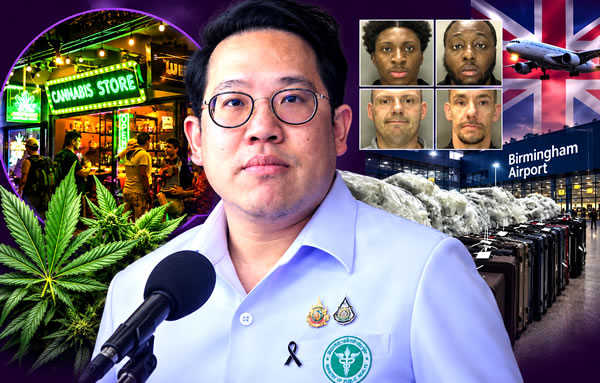
Public Health Minister Phatthana Phromphat unveils Thailand’s cannabis crackdown as shops face medical-only rules and UK gangs fuel rising smuggling. ( Source: Matichon )
Thailand’s Cabinet approved sweeping cannabis legislation on Tuesday, tightening controls over an industry transformed by decriminalisation four years ago. The proposed law reaches from cannabis farms through processing, distribution and final retail sales.
Crucially, it reinforces the government’s position that cannabis should be supplied for medical purposes, not recreational consumption. Yet thousands of cannabis shops remain open nationwide under older licences.
The Cabinet approved the draft Cannabis Control Act on September 22. It will now go before the House of Representatives for consideration. Therefore, the legislation is not yet law and must pass through Parliament. Public Health Minister Phatthana Phromphat announced the decision at Government House shortly before noon.
Tighter farm controls would trace cannabis from cultivation through processing, extraction and sale
At its core, the bill imposes tighter controls beginning at the cultivation stage. Small, medium and large cannabis farms would require registration. Their locations and production details would enter the regulatory system. As a result, officials could trace cannabis from cultivation through processing, extraction and eventual sale.
Beyond cultivation, the government wants stronger quality controls governing cannabis entering the commercial market. Extraction methods would also come under clearer regulation. Meanwhile, penalties would become clearer and heavier than those available under the existing framework. The legislation would create a dedicated national system covering almost every stage of the industry.
The bill marks another major shift for a market transformed by Thailand’s 2022 cannabis decriminalisation. Cannabis was removed from the country’s narcotics list that year. Anutin Charnvirakul championed the policy while serving as Public Health Minister. Four years later, Mr Anutin is Prime Minister and Interior Minister. His government has now approved substantially tighter controls over the industry that subsequently developed.
However, the proposed legislation does not simply return cannabis to Thailand’s narcotics list. Instead, it creates a dedicated legal framework centred on medical and health-related use. Research would remain permitted under conditions established by law. Commercial cultivation, production and sales would require licences under the proposed system.
Import and export licences join age limits, location bans and tighter restrictions on cannabis advertising
Likewise, importing and exporting cannabis would come under licensing controls. Licences would generally remain valid for three years. Furthermore, the legislation would establish a national cannabis committee chaired by the Public Health Minister. That committee would sit at the centre of the new regulatory structure.
The bill also restricts who can legally buy cannabis. Sales would be prohibited to anyone under 20. Pregnant women would also be barred from purchasing cannabis. Similarly, breastfeeding women would fall under the restriction. These measures would operate alongside tighter controls over where cannabis can be sold.
For example, sales would be prohibited at educational establishments, temples and dormitories. Public parks would also be covered. In addition, cannabis sales would be prohibited at zoos and amusement parks. The legislation therefore extends restrictions beyond individual customers into designated public locations.
Advertising faces another crackdown. Marketing cannabis flowers and resin would be prohibited. Promotion of cannabis smoking equipment would also be restricted. Moreover, unlicensed production, importing, exporting or selling could trigger criminal penalties under the proposed framework.
Expiring licences put thousands of cannabis shops on a path towards mandatory medical conversion
For existing dispensaries, however, the most immediate threat comes from expiring licences. More than 10,000 outlets and cultivation operations remain registered nationwide. Many dispensaries continue trading under three-year licences issued before the latest restrictions. Those licences are now steadily running out.
Some expire during 2026, while thousands more remain valid through 2027. The final group continues into 2028. Earlier ministry figures put the number of active registered cannabis shops at around 12,000. Consequently, the expiry programme potentially affects almost the entire established retail sector.
Approximately 5,000 to 6,000 licences were expected to expire during 2026. Another 4,000 to 5,000 were expected to end during 2027. Finally, around 1,000 remaining licences were expected to continue into 2028. The transition therefore unfolds over several years rather than through an immediate nationwide closure.
More significantly, businesses cannot simply expect to renew their existing retail operations unchanged. Shops seeking new licences must comply with the medical-use framework. Mr Phatthana said cannabis businesses would have to convert into medical facilities to continue. They would also need qualified medical practitioners.
Medical prescriptions and qualified practitioners become central as more than 10,000 sites are tracked
Under that model, cannabis could only be supplied through medical prescriptions. On Tuesday, Mr Phatthana again stressed that cannabis was intended for medical use. Existing shops can continue under older licences until those permits expire. Afterwards, businesses seeking renewal must satisfy the new requirements.
In practice, the government expects that process to sharply reduce cannabis outlet numbers. Earlier estimates suggested shop numbers could eventually fall from tens of thousands into thousands. Existing operators therefore face substantial changes to their business models. Conventional roadside cannabis dispensaries cannot simply continue unchanged after their licences expire.
Instead, continuing businesses would have to operate as recognised medical facilities. An authorised practitioner would need to be present. Additionally, cannabis supplied to patients would require properly issued medical prescriptions. Mr Phatthana said prescriptions would require signatures from authorised practitioners.
In parallel, the government is expanding its ability to track cannabis shops and cultivation sites. A digital system now records registered cannabis businesses and growing operations. By Tuesday morning, more than 10,000 locations had entered the system. Mr Phatthana said this covered more than 95% of relevant operations.
National database and inspections target illegal cannabis businesses as prescription abuse grows
That database gives officials a clearer map of the legal cannabis market. They can check whether individual shops and cultivation sites are registered. Consumers can also use the system to identify registered businesses. Accordingly, businesses missing from the database can be treated as potentially operating illegally.
At the enforcement level, inspection teams are being prepared for checks across Thailand. Tourist destinations will receive particular attention. Major urban centres will also face intensified inspections. The Department of Thai Traditional and Alternative Medicine will later provide further details about the programme.
Mr Phatthana said the government had sufficient personnel to conduct those inspections. Consequently, checks are expected to increase as more older licences expire. Tourist centres are particularly significant because cannabis shops remain highly visible there. Bangkok also retains a large cannabis retail presence.
Yet another problem is already confronting the medical framework. Thailand’s existing prescription system has been circumvented. Under earlier restrictions, cannabis flower sales became tied to medical prescriptions. Buyers were supposed to obtain those prescriptions from authorised practitioners.
Forged prescriptions expose weaknesses as officials warn cannabis shops and medical facilities of action
Purchases were capped at 30 grammes, regarded as a 30-day supply. Furthermore, patient information had to be recorded. Medical diagnoses and prescription information also had to enter the system. Those requirements were intended to establish a documented medical basis for each purchase.
Subsequently, telemedicine was permitted, allowing consultations to take place remotely. However, by June 2026, the Public Health Ministry was openly acknowledging abuses. Officials had discovered forged medical certificates and falsified Phor Thor 33 prescription forms. Some cannabis was therefore being obtained without genuine medical examinations.
Notably, officials reported prescription forms carrying practitioners’ signatures before patient information was completed. Other details could then be inserted afterwards. That practice allowed supposedly medical documentation to be completed without the normal examination process. It also gave regulators another enforcement problem.
In response, the Department of Thai Traditional and Alternative Medicine issued warnings over the practice. Officials said some prescriptions were effectively being supplied for recreational cannabis consumption. The department threatened legal proceedings against participating businesses and healthcare facilities. Individuals involved could also face criminal action.
Medical professionals face discipline as digital prescription checks tighten ahead of licence renewals
Medical professionals faced additional consequences. Doctors and other practitioners could also face professional disciplinary proceedings. Thus, enforcement began extending beyond cannabis shops into the medical system supporting sales. The discoveries exposed weaknesses inside the medical-only retail framework already being imposed.
The recreational cannabis trade did not simply disappear after medical restrictions arrived. Instead, officials discovered forged and improperly issued prescriptions being used to circumvent controls. The government has since moved towards stronger digital verification. Prescription codes can now be checked against medical practitioners and registered healthcare facilities.
Through those checks, duplicate prescription codes can be detected. Invalid prescriptions can also be flagged. Equally, mismatches involving practitioners or healthcare facilities can trigger scrutiny. These controls become increasingly important as thousands of existing shops approach their licence renewal deadlines.
Against this background, cannabis outlets remain highly visible across Thailand’s main tourism centres. The new legislation seeks to change the legal basis supporting that retail industry. Rather than maintaining a broad dispensary market, the government wants cannabis moved firmly into medical channels. Existing businesses therefore face rolling deadlines as their three-year licences expire.
Final cannabis licences expire through 2028 as a separate £13.8 million British prosecution advances
The process has already begun in 2026. It will continue throughout 2027. Ultimately, the remaining older licences are expected to expire during 2028. Shops then face either meeting medical requirements or ending operations under their existing model.
Separately, a major British prosecution has highlighted the international movement of cannabis from Thailand. The case concerns a huge shipment carried into Britain by airline passengers. Its latest development came one day before the Thai Cabinet approved the new legislation. However, there is no evidence the British prosecution prompted Tuesday’s decision.
The two developments emerged through entirely separate legal processes. Nevertheless, the British case involved an extraordinary quantity of cannabis leaving Thailand. On September 21, Britain’s National Crime Agency announced prison sentences for four couriers. The intercepted shipment carried an estimated British street value of £13.8 million.
Border Force officers stopped the operation at Birmingham Airport in August 2024. Investigators established that the couriers had travelled from Thailand. However, they did not fly directly into Birmingham. Instead, they travelled through Charles de Gaulle Airport in Paris before continuing to Britain.
British officers seize 460 kilogrammes of cannabis in 22 suitcases tracked through a single Apple account
Altogether, the operation involved 22 suitcases containing 460 kilogrammes of cannabis. That equals more than 1,000lb of the drug. The cannabis had been vacuum-packed before being placed inside the luggage. It was then concealed beneath thin layers of clothing.
Each courier carried two suitcases. Each case contained roughly 20 kilogrammes of cannabis. Indeed, the luggage was so heavy that excess baggage charges became necessary. Those charges were paid at Bangkok Airport before the group left Thailand.
Beyond the sheer weight, investigators found evidence of a coordinated tracking system. Eight suitcases contained Apple AirTags. Crucially, every device was linked to the same Apple ID account. Investigators could therefore connect several supposedly separate pieces of luggage to one digital account.
Investigators also recovered instructions sent to individual couriers. One courier was told a man would be waiting after arrival. The courier was ordered not to leave the airport until that man departed. Even collecting the suitcases immediately was considered unnecessary.
Instead, the courier was told to leave the luggage circulating if necessary. The bags could remain on the baggage carousel while the courier waited. The message even suggested going to the toilet rather than immediately collecting the cases.
Border Force operation at Birmingham Airport brings prison terms for four cannabis couriers from Thailand
By then, British Border Force officers were linking suspicious seizures involving passengers using connecting flights into Birmingham. Officers responded by fully staffing the airport’s nothing-to-declare customs channel. The intervention stopped the cannabis before the shipment left the airport.
Following the seizure, 11 people were charged over the importation operation. The charges covered carrying, removing, depositing, harbouring, keeping, concealing and dealing with Class B drugs. Prosecutors said those acts were intended to evade Britain’s prohibition on importing cannabis.
Four men have now received prison sentences at Birmingham Crown Court. Bradley Lloyd, 27, from Wythenshawe, Greater Manchester, received the longest term. He was jailed for four years. Lewis Ross, 35, from Bolton, Lancashire, received two years and eight months.
Nathan Vitorino, 26, from Welwyn Garden City, also received two years and eight months. Carsten Kyei, 21, from Newham, East London, received two years and six months. Kyei and Vitorino were convicted following a three-week trial.
During that trial, Ross and Lloyd changed their pleas to guilty. However, the prosecution is not finished. Seven more defendants remain awaiting sentence at Birmingham Crown Court. Three were convicted during another trial, while four had already pleaded guilty.
Seven more defendants await sentencing as Britain records a sharp rise in cannabis smuggling by air
Paige Crisp, 24, of Malvern, Worcestershire, was convicted of the same charge. Tasia Nelson, 22, of Newquay, Cornwall, was also convicted. Jaden Ramen, 23, of Merton, London, was convicted alongside them. Their convictions were returned at Birmingham Crown Court in August.
On another front, four defendants had already admitted their involvement. Claire McCullough, 36, from Wythenshawe, pleaded guilty. Ryan Boachie, 32, from Edmonton, London, also admitted the offence. Gideon Oluwasetemi Olumoyegun, 26, from Dagenham, entered a guilty plea.
Jamal Clarke, 22, from Mile End, also pleaded guilty. All seven remaining defendants are due for sentencing on October 22. Thus, the £13.8 million importation prosecution remains active more than two years after the Birmingham Airport seizure.
More broadly, the Birmingham operation forms part of a sharp increase in cannabis carried into Britain by airline passengers. According to the NCA, 801 cannabis smugglers were caught arriving by air during 2024. That represented a 464% increase from 2023.
The increase did not stop there. During 2025, British officers caught 976 air passengers carrying cannabis. Another 600 air-passenger couriers were arrested during the first six months of 2026. Those figures have driven a wider British campaign targeting cannabis smuggling by air.
British campaign targets cannabis smuggling from Thailand as officials warn young travellers of prison
As part of this, the NCA launched a social-media campaign specifically addressing cannabis smuggling from Thailand. The campaign is aimed particularly at younger travellers. It is being promoted through TikTok, Instagram, Snapchat and YouTube.
NCA senior investigating officer Paul Boniface addressed the Birmingham sentences after Monday’s court hearing. “These sentences show that drug couriers can end up paying a high price for smuggling cannabis to the UK,” he said. “It is simply not worth the effort, something that social media influencers promoting this lifestyle frequently overlook.”
Mr Boniface also credited cooperation between the NCA and Border Force. “With the help of Border Force, we were able to intercept these drugs,” he said. He said the operation deprived the criminal network behind the importation of considerable profits.
For his part, Adam Chatfield, head of Border Force Midlands Command, addressed the convictions. “These convictions should be a stark warning to anyone considering bringing cannabis into the UK,” he said. “The young people involved now have a serious crime on their records, damaging their job prospects and life chances.”
The British prosecution and Thailand’s Cabinet decision remain separate developments. Even so, both concern a cannabis industry transformed since Thailand changed its domestic policy during 2022. Britain is confronting increasing cannabis imports carried by airline passengers. Thailand, meanwhile, is tightening control over cultivation and its sprawling domestic retail trade.
Thailand and Britain tighten controls as 460-kilogramme Birmingham shipment exposes trafficking
In the Birmingham operation alone, 460 kilogrammes left Thailand inside 22 suitcases. The shipment travelled through France before reaching Britain. British investigators valued the cannabis at £13.8 million. Eight cases also carried tracking devices linked to one Apple account.
Back in Thailand, the proposed controls begin at cannabis farms. They continue through production and extraction. Importing and exporting would also require licences. Finally, the framework reaches thousands of retail businesses operating nationwide.
For those shops, the regulatory clock is already running. Older three-year licences are progressively expiring. Businesses seeking to continue must enter the medical system. That requires becoming recognised medical facilities and providing qualified practitioners.
At the same time, cannabis would have to be supplied under medical prescriptions. Yet regulators are already confronting abuses involving those documents. Officials have discovered forged medical certificates and improperly completed prescription forms. Some carried practitioners’ signatures before patient details were entered.
Accordingly, the government is tightening digital checks while increasing physical inspections. Tourist centres and major cities will receive particular attention. More than 10,000 shops and cultivation sites are already recorded in the government system. Officials say that represents more than 95% of relevant operations.
Cabinet bill heads to Parliament as cannabis shops face medical conversion and tighter enforcement
The Cabinet-approved bill now seeks to place that wider structure under dedicated national legislation. However, Parliament must still consider the measure. Until that process is completed, the Cannabis Control Act remains a draft. The existing licence-expiry process, by contrast, is already under way.
For thousands of cannabis businesses, those expiry dates now carry greater significance. Renewal will require far more than another conventional retail licence. Continuing operators must meet medical-facility requirements. They will also need qualified practitioners and properly issued prescriptions.
In tandem, officials are building systems to identify forged documentation and unregistered shops. The transition will continue through 2028 as the remaining older licences expire. Four years after decriminalisation, Thailand’s cannabis market is therefore entering another regulatory phase.
Cannabis remains outside the narcotics framework. Nevertheless, commercial controls are tightening sharply. The government’s stated model is medical use, licensed businesses and traceable production. Tuesday’s Cabinet decision seeks to place those principles inside a dedicated national law.
At retail level, existing businesses face inspections, licence expirations and tighter prescription controls. At cultivation level, farms face registration and traceability requirements. Across the supply chain, licences would govern production, imports, exports and sales.
Britain pursues cannabis couriers from Thailand as shops at home face a regulatory deadline through 2028
In Britain, meanwhile, investigators continue targeting cannabis carried from Thailand into the United Kingdom. The Birmingham case shows the scale reached by one operation. Twenty-two suitcases left Thailand carrying 460 kilogrammes of cannabis worth an estimated £13.8 million.
Not only were the cases packed with cannabis, but their weight triggered excess baggage charges in Bangkok. Eight AirTags were hidden among the luggage. The shipment then travelled through Paris before reaching Birmingham. Border Force officers intercepted the drugs before they left the airport.
Four couriers are now serving prison sentences. Another seven defendants will return to Birmingham Crown Court on October 22. In Thailand, thousands of cannabis businesses face a different timetable running through 2028.
By then, the final existing shop licences are expected to expire. Businesses wanting to remain open must meet the medical framework. The Cabinet has now approved legislation designed to place that framework firmly into national law.
New cannabis control law expected to be brought to cabinet. It will control and outlaw recreational use
Qatari tourist to be deported after unprovoked attacks in Hua Hin after third visit to a cannabis shop
Police arrest tourist pervert after public obscene act reported Sunday morning last in Phuket’s Patong
Russian arrested at airport for late night sex antics on a black pickup driving at speed through Phuket
Polish couple deported for nudity on Koh Phangan. Polish man hospitalised for mental health tests
Another brawl between locals and foreign tourists in Pattaya. Tourism targets put in doubt over security
Tourism chief targets European tourists in the second half of 2025 as cabinet orders shorter visas for holidaymakers
Thai economy thrown into disarray by Trump’s tariffs. Exports and Tourism may both be far lower in 2025
Pichai’s team not to fly to the United States this week but next week as US-Chinese tensions escalate
Finance Minister to hold critical talk with Bank of Thailand Governor on US holding before he flies out
Thaksin does not rule out joining talks in US as Thai team finalises plans. They fly out on Thursday
Joseph Anthony is an expat from Ireland who has lived in Thailand for the last decade. He has worked extensively in the media including editorial positions in Ireland and Thailand. He is focused on economic and business stories in Thailand as well as the expat lifestyle.
All posts by Joseph O' Connor
Anutin urged officials to expel undesirable foreigners. On cemeteries, the PM urged them to die at home September 18, 2026 Anutin tells governors to use new deportation powers
Thai star Lisa hits big time in US with ‘SaWaDiKa’ shooting into the Hot 100 before a Jimmy Fallon spot September 17, 2026 Lisa conquers another US milestone as “SaWaDiKa”
Former minister in Anutin’s first government appears on Congress list for sanctions over scam industry September 17, 2026 Woraphak Thanyawong faces a US sanctions investigation
Udon Thani police hunt killer of a 24 year old woman found naked and strangled with electrical cord September 17, 2026 Phattharawarin “Pim” Piadok, 24, was found naked
Thailand joins minimum tax regime aimed at large global corporations as it hooks into world networks September 16, 2026 Thailand joins the global tax net with a 15% minimum
Probe into 11,000 firms linked to foreigners holding 85 billion baht in property to be complete by Sept 30th September 16, 2026 Thailand races to resolve 11,000 company probes by
US man arrested in Phuket based a warrant issued in Texas over 4 years ago for a strangulation offence September 16, 2026 American fugitive Brad is arrested outside his Phuket
United Nations process begins with hearing in Singapore. Thai Foreign Minister took a bold, hard line September 15, 2026 Thailand and Cambodia face off in Singapore over
From stalls to smartphones, Thai Revenue pulls in a growing cohort of online traders in new economy September 15, 2026 Thailand’s taxman chases the smartphone economy as
Tighter ‘bottleneck’ regime on money transfers in force across financial system per central bank orders September 15, 2026 Bank of Thailand Governor Vitai Ratanakorn orders
PM Anutin accompanies King and Queen on a historic visit to Vietnam for three days hours before verdict September 14, 2026 King and Queen begin historic Hanoi State Visit as
Election Commission creates more questions than answers as it refers 77 people to the Supreme Court September 14, 2026 Senate scandal heads for court as EC targets 77
Gauntlet thrown down to the Election Commission before it votes on explosive Senate collusion scandal cases September 14, 2026 Monday’s Senate showdown could open a new political
Police raids on nightlife venues in Bangkok’s Wang Thonglang area as clandestine foreign control grows September 14, 2026 Bangkok police swoop on 17 venues in Wang
TH AI plan runs into problems and bottlenecks. New AIS deal offering cheap 29 baht per month internet September 13, 2026 Thailand’s flagship ฿1.6 billion AI scheme hits
Prime Minister scrambles to get data centre sector back on track after energy and regulatory hiatus September 13, 2026 Thailand’s data centre boom hits a regulatory wall
Mystery Chinese man used lost phone to lure Thai woman into trap at his condo and sexually attack her September 12, 2026 Pattaya woman Beam Mukassara claims a Chinese man
Time for government to tighten its belt as debt ceiling looms and public debt surges from the pre Covid era September 18, 2026
Thailand prepares to impose a 30% tax on EVs built outside the kingdom in a move to boost its auto base September 18, 2026
Good Samaritan in Pattaya gets punched for his trouble by erratic farang after he lost motorbike keys with girlfriend September 17, 2026
Purchaser of foreclosed Chiang Mai property shocked on Tuesday to find skeletal remains of former owner September 17, 2026
Mother urges police to find Chinese national involved in road traffic crash that claimed her son’s life September 17, 2026
Thaksin seeks injunctive relief from Revenue efforts to collect 17 billion tax judgment in August 2025 September 16, 2026
British man attacked and slashed by drunk motorbike duo on Tuesday as they tried to steal his smartphone September 16, 2026
Election Commission member derails PM Anutin Charnvirakul’s efforts to put senate scandal in the past September 16, 2026
Partnership between Nestlé and the billionaire Mahagitsiri family descends into all out legal warfare September 15, 2026
Four bodies removed Tuesday from a Jewish cemetery in Chachoengsao in new crackdown on illegal burials September 15, 2026
Election Commission exposed based on Monday’s sweeping decisions and judgments warns opposition September 15, 2026
Chinese man arrested after he fled to Thailand in 1991. Firm’s capital raised weeks before his shock downfall September 14, 2026
Thailand’s K-shaped economy sees a large number of people cut back on food and meals to make ends meet September 14, 2026
Opinion poll shows public concern about Israeli misbehaviour in Thailand amid a febrile political mood September 14, 2026
Ex Pheu Thai minister warns Commission members that soon they could be judged as crunch vote looms September 13, 2026
Sex and financial scandal at famous monastery rocks Thailand. Abbot and girlfriend amassed huge wealth September 13, 2026
Thailand hailed as a haven for retirees and digital nomads but officials breed doubt and uncertainty September 12, 2026
Commerce Minister Suphajee responds to Sondhi Limthongkul’s attack on new liberal investment rules September 12, 2026
Pressure movement against Israel in Thailand gains momentum as it combines with street protests September 12, 2026
Bank bandit arrested at a Bangkok resort. 54 year old Saifa Kasemut has a history of armed robbery crime September 12, 2026
Former Prime Minister and Democrat Party leader cites a lack of public trust in the Election Commission September 11, 2026
Foreign nominee companies down by 81.77% as government seizes or freezes assets of over 20 billion September 11, 2026
© 2026 Thai Examiner. All rights reserved.
2026年9月23日凌晨12:55
在“犯罪”、“生活”、“媒体”、“政治”、“泰国”等类别中
泰国正着手遏制其庞大的大麻产业。在合法化四年后,内阁支持实施一系列新的全面管控措施。数千家店铺面临许可证到期、仅限医疗用途销售以及更严格的检查,同时官员们也在打击伪造处方以规避现有限制的行为。与此同时,有组织犯罪团伙越来越多地利用航空旅客将泰国大麻走私到英国。英国的逮捕人数在2025年再次上升,并在2026年上半年进一步激增。周一,四名走私者因一起价值1380万英镑的走私案被判刑,这起案件涉及460公斤装在22个行李箱中的泰国大麻,时间是2024年,这起案件的规模之大令人震惊。在此背景下,周二的内阁决定将泰国的合法大麻政策推向了又一个关键转折点,计划对从种植、出口到处方以及仍在全国范围内运营的数千家药房等各个环节进行更严格的管控。
泰国公共卫生部长帕塔纳·普罗姆帕特公布了泰国打击大麻的行动,商店将被迫只销售医用大麻,而英国犯罪团伙则助长了走私活动。(来源:Matichon)
泰国内阁周二批准了一项全面的大麻法案,旨在加强对四年前因大麻合法化而发生巨大变化的行业的管控。该法案涵盖了从大麻种植、加工、分销到最终零售的各个环节。
至关重要的是,这强化了政府的立场,即大麻应仅用于医疗用途,而非娱乐用途。然而,全国各地仍有数千家大麻商店持旧许可证继续营业。
内阁于9月22日批准了《大麻管制法》草案。该草案现已提交众议院审议。因此,该法案尚未生效,必须经议会通过。公共卫生部长帕塔纳·蓬帕特于当天中午前不久在总理府宣布了这一决定。
更严格的农场监管将追踪大麻从种植、加工、提取到销售的整个过程。
该法案的核心在于从种植阶段开始加强管控。小型、中型和大型大麻农场均需注册登记,其位置和生产详情将被纳入监管系统。如此一来,官员便可追踪大麻从种植、加工、提取到最终销售的整个过程。
除了种植之外,政府还希望加强对进入商业市场的大麻的质量控制。提取方法也将纳入更明确的监管范围。同时,处罚措施将比现有框架下的规定更加明确和严厉。该立法将建立一个涵盖大麻产业几乎所有环节的全国性体系。
该法案标志着泰国大麻市场在2022年合法化大麻后发生的又一次重大转变。当年,大麻被从泰国的毒品清单中移除。阿努廷·查恩维拉库尔在担任公共卫生部长期间大力倡导这项政策。四年后,阿努廷先生已是总理兼内政部长。如今,他的政府已批准对随后发展起来的大麻产业实施更为严格的管控。
然而,拟议的立法并非简单地将大麻重新列入泰国的毒品清单。相反,它建立了一个以医疗和健康相关用途为中心的专门法律框架。在法律规定的条件下,研究仍将被允许。根据拟议的制度,商业种植、生产和销售都需要获得许可。
除了年龄限制、地点禁令和更严格的大麻广告限制外,进出口许可证也加入了这些限制措施。
同样,大麻的进出口也将受到许可管制。许可证有效期通常为三年。此外,该法案还将设立一个由公共卫生部长担任主席的国家大麻委员会。该委员会将成为新监管体系的核心。
该法案还限制了合法购买大麻的人群。20岁以下的人将被禁止购买大麻。孕妇和哺乳期妇女也同样被禁止购买。这些措施将与更严格的大麻销售场所管控措施同时实施。
例如,教育机构、寺庙和宿舍将被禁止销售大麻。公园等公共场所也包含在禁令范围内。此外,动物园和游乐园也禁止销售大麻。因此,该法案将限制范围从个人消费者扩大到指定的公共场所。
广告业将面临进一步的打击。大麻花和树脂的销售将被禁止。大麻吸食设备的推广也将受到限制。此外,根据拟议的框架,未经许可的生产、进口、出口或销售都可能触犯刑事法律。
许可证到期将导致数千家大麻商店面临强制转为医用大麻的境地。
然而,对于现有药房而言,最直接的威胁来自即将到期的许可证。全国仍有超过1万家门店和种植场注册在案。许多药房仍在沿用最新限制措施出台前颁发的三年期许可证。这些许可证如今正陆续到期。
部分许可证将于2026年到期,另有数千份许可证有效期至2027年,最后一批许可证的有效期则延续至2028年。此前,该部门数据显示,目前活跃的注册大麻商店数量约为12000家。因此,此次许可证到期计划可能会影响到几乎所有现有的零售行业。
预计2026年将有约5000至6000张许可证到期。另有4000至5000张许可证预计将在2027年到期。最后,预计剩余的约1000张许可证将延续到2028年。因此,过渡过程将持续数年,而不是通过立即在全国范围内关闭的方式进行。
更重要的是,企业不能指望简单地维持现有的零售业务不变。申请新许可证的店铺必须符合医疗用途框架。帕塔纳先生表示,大麻企业必须转型为医疗机构才能继续经营,并且需要配备合格的医疗从业人员。
随着超过10000个地点被追踪,医疗处方和合格的执业人员变得至关重要。
根据该模式,大麻只能凭医生处方供应。周二,帕塔纳先生再次强调,大麻仅供医疗用途。现有店铺可继续沿用旧许可证,直至许可证到期。之后,申请续期的商家必须满足新的要求。
实际上,政府预计这一过程将大幅减少大麻销售点的数量。早前的估计表明,商店数量最终可能从数万家减少到数千家。因此,现有经营者将面临商业模式的重大变革。传统的路边大麻销售点在许可证到期后不能简单地继续维持现状。
相反,继续经营的企业必须作为认可的医疗机构运营,并需有执业医师在场。此外,向患者提供的医用大麻必须持有正式开具的处方。帕塔纳先生表示,处方必须由执业医师签字。
与此同时,政府正在扩大对大麻商店和种植场所的追踪能力。目前,一套数字化系统已开始记录注册的大麻企业和种植活动。截至周二上午,已有超过1万个地点被录入该系统。帕塔纳先生表示,这涵盖了超过95%的相关活动。
随着处方药滥用日益猖獗,国家数据库和检查工作将重点打击非法大麻企业。
该数据库为官员们提供了更清晰的合法大麻市场地图。他们可以核查各个商店和种植场所是否已注册。消费者也可以使用该系统识别已注册的商家。因此,数据库中未收录的商家可能被视为非法经营。
在执法层面,检查小组正在泰国各地展开检查。旅游目的地将受到重点关注。主要城市中心也将面临更严格的检查。泰国传统和替代医学部稍后将公布该计划的更多细节。
帕塔纳先生表示,政府有足够的人员进行这些检查。因此,随着更多旧许可证到期,预计检查力度将会增加。旅游中心尤为重要,因为大麻商店在那里仍然非常显眼。曼谷也仍然拥有大量的大麻零售店。
然而,医疗体系又面临着另一个问题。泰国现行的处方制度已被规避。此前,大麻花销售与医疗处方挂钩,购买者必须从授权医生处获得处方。
伪造处方暴露了监管漏洞,官员警告大麻商店和医疗机构采取行动。
每次购买限购30克,相当于30天的用量。此外,必须记录患者信息。医疗诊断和处方信息也必须录入系统。这些要求旨在为每次购买建立有据可查的医疗依据。
随后,远程医疗被允许,问诊可以远程进行。然而,到2026年6月,公共卫生部公开承认存在滥用行为。官员们发现了伪造的医疗证明和伪造的Phor Thor 33处方单。因此,一些人未经正规医疗检查就获得了部分大麻。
值得注意的是,官员报告称,处方单上在填写患者信息之前就已经有医生的签名。其他细节可以在之后再填写。这种做法使得所谓的医疗文件无需经过正常的检查程序即可完成。这也给监管机构带来了另一个执法难题。
对此,泰国传统与替代医学部发出警告。官员表示,部分处方实际上被用于娱乐性大麻消费。该部门威胁要对参与其中的企业和医疗机构提起法律诉讼。涉事个人也可能面临刑事指控。
随着执照续期临近,电子处方审核力度加大,医疗专业人员将面临纪律处分。
医疗专业人员面临额外后果。医生和其他从业人员也可能面临职业纪律处分。因此,执法范围开始从大麻商店扩展到支持销售的医疗系统。这些发现暴露了现有仅限医疗用途的零售框架内部的漏洞。
娱乐用大麻交易并未在医疗限制措施出台后就此消失。相反,官员们发现有人使用伪造和不合规的处方来规避管制。此后,政府转向更严格的数字化验证。现在,处方代码可以与医生和注册医疗机构的信息进行核对。
通过这些检查,可以检测出重复的处方代码,也能标记出无效处方。同样,涉及执业医师或医疗机构的信息不符也会引发审查。随着成千上万家现有药店的执照续期期限临近,这些管控措施变得愈发重要。
在此背景下,泰国主要旅游中心的合法大麻销售点依然随处可见。新法案旨在改变支撑该零售业的法律基础。政府希望将大麻严格纳入医疗渠道,而非维持现有的大麻销售市场。因此,现有企业将面临滚动式的最后期限,因为它们的三年期许可证即将到期。
截至2028年,剩余的大麻许可证将陆续到期,与此同时,英国一项耗资1380万英镑的独立诉讼案也在推进中。
该流程已于 2026 年启动,并将持续到 2027 年。最终,剩余的旧许可证预计将于 2028 年到期。届时,各店铺将面临满足医疗要求或停止在现有模式下运营的抉择。
此外,英国一项重大诉讼凸显了从泰国走私大麻的国际流动问题。该案涉及一批由航空旅客携带进入英国的大量大麻。案件的最新进展发生在泰国政府批准新法案的前一天。然而,目前尚无证据表明英国的这项诉讼促成了周二的泰国政府决定。
这两起案件的进展完全是通过独立的法律程序实现的。然而,英国的这起案件涉及数量惊人的大麻从泰国出口。9月21日,英国国家犯罪调查局宣布对四名走私者判处监禁。截获的这批大麻在英国的街头价值估计为1380万英镑。
2024年8月,边境执法人员在伯明翰机场阻止了这起走私行动。调查人员确认,这些走私者来自泰国。然而,他们并非直接飞往伯明翰,而是先经巴黎戴高乐机场转机前往英国。
英国警方查获22个行李箱,共计460公斤大麻,这些行李箱通过一个苹果账户被追踪到。
整个行动共查获22个行李箱,内装460公斤大麻,相当于超过1000磅。这些大麻在放入行李箱前都经过真空包装,然后藏在几层薄衣服下面。
每名快递员携带两个行李箱,每个箱子里大约装有20公斤大麻。事实上,行李非常重,以至于需要支付超重行李费。这笔费用在他们离开泰国前于曼谷机场支付。
除了行李的重量之外,调查人员还发现了协同追踪系统的证据。八个行李箱内装有苹果AirTags追踪器。关键在于,每个追踪器都关联到同一个苹果ID账户。因此,调查人员能够将几个看似独立的行李箱与同一个数字账户联系起来。
调查人员还找到了发送给各个快递员的指令。其中一名快递员被告知,抵达后会有一个人在机场等候。该快递员被命令在那个人离开之前不得离开机场。甚至连立即取走行李都被认为没有必要。
相反,快递员被告知如有必要,可以将行李留在行李传送带上。行李可以留在传送带上,快递员可以在那里等待。信息甚至建议他先去洗手间,而不是立即取走行李。
边境部队在伯明翰机场的行动中,将四名来自泰国的毒品走私者绳之以法。
当时,英国边境部队官员已将几起可疑查获案件联系起来,这些案件均涉及经由伯明翰转机的乘客。官员们随即在机场的“无需申报”海关通道增派了人手。此次干预行动在货物离开机场前就拦截了这批大麻。
查获行动后,11人因涉嫌走私毒品被起诉。指控罪名包括携带、转移、存放、窝藏、保管、隐瞒和处理B类毒品。检方称,这些行为意在规避英国禁止进口大麻的禁令。
伯明翰刑事法庭已对四名男子作出判决。来自大曼彻斯特郡威森肖的27岁男子布拉德利·劳埃德被判刑期最长,为四年监禁。来自兰开夏郡博尔顿的35岁男子刘易斯·罗斯被判处两年零八个月监禁。
来自韦林花园城的26岁男子内森·维托里诺被判处两年零八个月监禁。来自伦敦东区纽汉区的21岁男子卡斯滕·凯伊被判处两年零六个月监禁。凯伊和维托里诺在经过三周的审判后被定罪。
在那次审判中,罗斯和劳埃德改口认罪。然而,检方的指控尚未结束。另有七名被告仍在伯明翰刑事法院等待判决。其中三人已在另一次审判中被定罪,而另外四人此前已认罪。
英国空运大麻走私案件激增,另有七名被告等待判刑。
来自伍斯特郡马尔文的24岁女子佩奇·克里斯普(Paige Crisp)被判犯有同样的罪行。来自康沃尔郡纽基的22岁女子塔西亚·尼尔森(Tasia Nelson)也被判有罪。来自伦敦默顿的23岁男子杰登·拉门(Jaden Ramen)与她们一同被判有罪。他们的定罪于8月在伯明翰刑事法院宣判。
另一方面,已有四名被告承认参与了此案。来自威森肖的36岁女子克莱尔·麦卡洛认罪。来自伦敦埃德蒙顿的32岁男子瑞安·博阿奇也承认了罪行。来自达格纳姆的26岁男子吉迪恩·奥卢瓦塞特米·奥卢莫耶贡认罪。
来自麦尔安德的22岁男子贾马尔·克拉克也认罪。其余七名被告将于10月22日接受判决。因此,这起涉案金额高达1380万英镑的走私案在伯明翰机场查获走私品两年多后仍未结案。
更广泛地说,伯明翰的这次行动反映了英国航空旅客携带大麻入境数量急剧增加的趋势。据英国国家犯罪调查局(NCA)统计,2024年共有801名大麻走私犯被抓获,他们是通过航空入境的。这一数字比2023年增长了464%。
增长势头并未就此停止。2025年,英国执法部门查获了976名携带大麻的航空旅客。2026年上半年,又有600名航空旅客走私大麻者被捕。这些数据促使英国开展了一场更广泛的打击航空大麻走私的行动。
英国政府发起打击从泰国走私大麻的行动,官员警告年轻旅行者可能面临牢狱之灾。
为此,泰国国家缉毒局(NCA)发起了一项社交媒体宣传活动,专门针对从泰国走私大麻的行为。该活动的目标受众主要是年轻旅行者,并通过TikTok、Instagram、Snapchat和YouTube等平台进行推广。
英国国家犯罪调查局(NCA)高级调查官保罗·博尼法斯在周一的庭审后就伯明翰的判决发表了讲话。他说:“这些判决表明,毒品走私贩子最终会为向英国走私大麻付出高昂的代价。这根本不值得,而那些在社交媒体上宣扬这种生活方式的人却常常忽略这一点。”
博尼法斯先生还赞扬了国家犯罪调查局(NCA)和边境部队之间的合作。他说:“在边境部队的帮助下,我们成功截获了这些毒品。” 他表示,此次行动使走私毒品的犯罪网络损失了巨额利润。
边境部队中部地区指挥部负责人亚当·查特菲尔德就这些定罪发表了讲话。他说:“这些定罪应该对任何企图将大麻带入英国的人发出严厉警告。涉案的年轻人现在背负着严重的犯罪记录,这将损害他们的就业前景和人生机遇。”
英国的起诉和泰国内阁的决定是两件独立的事态发展。尽管如此,两者都与泰国自2022年改变国内政策以来发生的重大变化有关。英国正面临着航空旅客携带的大麻进口量不断增加的问题。与此同时,泰国正在加强对大麻种植及其庞大的国内零售贸易的管控。
泰国和英国加强管控,伯明翰460公斤走私货物曝光,揭露走私活动
仅在伯明翰的这起走私行动中,就有460公斤大麻装在22个行李箱中从泰国运出。这批货物途经法国最终抵达英国。英国调查人员估计这批大麻价值1380万英镑。其中八个行李箱还装有追踪装置,这些装置与一个苹果账户关联。
回到泰国,拟议的管控措施从大麻种植开始,贯穿生产和提取环节。进出口也需要许可证。最终,该框架将覆盖全国各地数千家零售企业。
对于这些诊所而言,监管期限已然开始倒计时。较早获得的三年期许可证正陆续到期。希望继续经营的诊所必须进入医疗体系。这意味着它们需要成为认可的医疗机构,并提供合格的医务人员。
与此同时,大麻必须凭医生处方才能购买。然而,监管机构已经开始着手处理与这些处方相关的滥用行为。官员们发现了伪造的医疗证明和填写不规范的处方单。有些处方单上甚至在填写患者信息之前就有了医生的签名。
因此,政府在加强数字化检查的同时,也增加了实地检查。旅游中心和主要城市将受到重点关注。目前,已有超过1万家商铺和种植场所录入政府系统。官员表示,这涵盖了相关业务的95%以上。
内阁法案提交议会,大麻商店面临医疗用途转换和更严格的执法措施。
内阁批准的法案旨在将这一更广泛的框架纳入专门的国家立法。然而,议会仍需审议该法案。在此程序完成之前,《大麻管制法》仍为草案。相比之下,现有的许可证到期程序已在进行中。
对于成千上万的合法大麻企业来说,这些许可证到期日如今意义重大。续期所需的条件远不止申请一张普通的零售许可证。继续经营者必须满足医疗机构的要求,还需要合格的执业医师和合法开具的处方。
与此同时,相关部门正在建立系统,以识别伪造文件和未注册的店铺。随着剩余旧许可证的到期,这一过渡过程将持续到2028年。因此,在合法化四年后,泰国的合法大麻市场正进入另一个监管阶段。
大麻目前仍不在毒品管制框架之内。然而,其商业管制正在大幅收紧。政府提出的模式是:仅限医疗用途、持证经营和可追溯生产。周二的内阁决议旨在将这些原则纳入一部专门的国家法律。
在零售层面,现有企业将面临检查、许可证到期和更严格的处方管制。在种植层面,农场将面临注册和可追溯性要求。在整个供应链中,许可证将规范生产、进口、出口和销售。
英国追查来自泰国的毒品走私者,而国内的大麻商店则面临着到2028年的监管最后期限。
与此同时,英国调查人员继续打击从泰国走私到英国的大麻。伯明翰的这起案件展现了一次行动的规模。22个行李箱从泰国运出,内含460公斤大麻,价值约1380万英镑。
这些箱子不仅装满了大麻,而且重量超标,在曼谷产生了超重行李费。行李中还藏有八个航空标签。这批货物随后经巴黎转运,最终抵达伯明翰。边境执法人员在货物离开机场前将其截获。
四名快递员目前正在服刑。另外七名被告将于10月22日返回伯明翰刑事法庭。在泰国,数千家大麻企业面临着不同的时间表,该时间表将持续到2028年。
届时,现有的所有店铺营业执照预计都将到期。希望继续营业的企业必须符合医疗框架的要求。内阁现已批准一项旨在将该框架正式纳入国家法律的立法。
预计新的大麻管制法案将提交内阁审议。该法案将管制并禁止娱乐性使用大麻。
一名卡塔尔游客在华欣无端袭击他人后将被驱逐出境,此前他曾第三次光顾一家大麻商店。
周日早上,普吉岛芭东海滩发生一起公共场合猥亵事件,警方逮捕了一名猥亵游客。
一名俄罗斯男子因在普吉岛机场驾驶一辆高速行驶的黑色皮卡车时进行深夜性行为而被捕。
一对波兰夫妇因在帕岸岛裸露身体而被驱逐出境。一名波兰男子因精神健康检查被送往医院。
芭堤雅再次发生当地人与外国游客斗殴事件。旅游业安全受到质疑,旅游业目标能否实现尚存疑问。
旅游局长将目标锁定在2025年下半年的欧洲游客身上,内阁已下令缩短度假者的签证期限。
特朗普的关税政策使泰国经济陷入混乱。到2025年,出口和旅游业可能都会大幅下滑。
由于中美紧张局势升级,皮查伊的团队本周不会飞往美国,而是下周前往。
财政部长将在启程前与泰国央行行长就美国持股问题举行关键会谈
他信并未排除赴美参加会谈的可能性,泰国代表团正在敲定相关计划。他们将于周四启程。
约瑟夫·安东尼是一位来自爱尔兰的侨民,过去十年一直居住在泰国。他曾在爱尔兰和泰国的媒体行业担任过编辑职务,拥有丰富的媒体从业经验。他主要关注泰国的经济和商业新闻,以及侨民的生活方式。
约瑟夫·奥康纳的所有帖子
阿努廷敦促官员驱逐不受欢迎的外国人。关于墓地问题,总理敦促他们在家中去世。2026年9月18日,阿努廷指示各省省长使用新的驱逐权。
泰国明星Lisa凭借歌曲《SaWaDiKa》在美国大获成功,该曲迅速跻身Billboard Hot 100榜单,并于2026年9月17日亮相吉米·法伦秀。Lisa凭借《SaWaDiKa》在美国再创佳绩。
阿努廷第一届政府的前部长沃拉帕克·塔尼亚翁因涉嫌诈骗行业被列入国会制裁名单(2026年9月17日)。沃拉帕克·塔尼亚翁面临美国制裁调查。
乌隆他尼警方追捕凶手,一名24岁女子于2026年9月17日被发现赤身裸体,遭电线勒死。死者帕塔拉瓦林·“皮姆”·皮亚多克,24岁,被发现时全身赤裸。
泰国加入针对大型跨国公司的最低税率制度,融入全球税收网络 2026年9月16日 泰国加入全球税收体系,最低税率为15%。
对与持有850亿泰铢房产的外国人有关的11000家公司的调查将于9月30日前完成 2026年9月16日 泰国正加紧解决这11000家公司的调查
2026年9月16日,一名美国男子在普吉岛被捕,逮捕令是四年前德克萨斯州签发的,罪名是勒颈。这名美国逃犯名叫布拉德,在普吉岛郊外被捕。
联合国程序在新加坡启动听证会。泰国外交部长于2026年9月15日采取强硬立场,泰国和柬埔寨在新加坡就此问题展开对峙。
从摊位到智能手机,泰国税务部门正积极监管新兴经济中的新一代在线交易者(2026年9月15日) 泰国税务部门正追寻智能手机经济的足迹
根据泰国央行2026年9月15日发布的命令,金融系统将实施更严格的资金转移“瓶颈”机制。泰国央行行长维泰·拉达那空下令
阿努廷总理陪同国王和王后对越南进行为期三天的历史性访问,就在2026年9月14日判决公布前几个小时。国王和王后开始了对河内的历史性国事访问。
选举委员会将77人移交最高法院,引发更多疑问而非解答(2026年9月14日) 参议院丑闻将诉诸法庭,选举委员会将目标对准77人
在选举委员会就爆炸性的参议院勾结丑闻案进行投票之前,各方已向其发出挑战。2026年9月14日星期一,参议院的摊牌可能会开启新的政治局面。
2026年9月14日,曼谷警方突击搜查旺通朗区夜生活场所,外国势力暗中控制该地区的现象日益严重。警方突击搜查了旺通朗区的17家场所。
泰国人工智能计划遭遇困境和瓶颈。新的AIS协议提供每月29泰铢的低价互联网服务,预计于2026年9月13日生效。泰国耗资16亿泰铢的旗舰人工智能计划遭遇挫折。
泰国总理紧急采取措施,力图在能源和监管停滞后重振数据中心行业(2026年9月13日) 泰国数据中心热潮遭遇监管壁垒
2026年9月12日,芭堤雅女子Beam Mukassara称,一名神秘中国男子利用丢失的手机将一名泰国女子诱骗至其公寓并对其进行性侵。
随着债务上限临近,公共债务较新冠疫情前水平大幅飙升,政府是时候勒紧裤腰带了。(2026年9月18日)
泰国准备对境外生产的电动汽车征收30%的税,以促进其汽车产业发展(2026年9月18日)
2026年9月17日,芭堤雅一名好心人因帮女友找回丢失的摩托车钥匙,被一名行为怪异的外国人殴打。
2026年9月17日,一名买家在清迈购买了一处法拍房产,周二震惊地发现前房主遗骸。
2026年9月17日,一位母亲敦促警方寻找涉嫌造成其儿子死亡的交通事故的中国公民。
他信寻求法院颁布禁令,阻止税务部门在2025年8月追缴170亿比索的税款判决。2026年9月16日
2026年9月16日,一名英国男子周二遭两名醉酒摩托车手袭击并被割伤,当时两人试图抢走他的智能手机。
选举委员会成员阻挠总理阿努廷·查恩维拉库尔平息参议院丑闻的努力 2026年9月16日
雀巢与亿万富翁马哈吉西里家族的合作关系于2026年9月15日演变为全面法律战。
2026年9月15日,在打击非法埋葬的新一轮行动中,四具遗体于周二从北柳府一处犹太人墓地被移走。
反对派警告:根据周一的一系列决定和判决,选举委员会的真面目暴露无遗 2026年9月15日
一名中国男子于1991年逃往泰国后被捕。该公司在他于2026年9月14日突然倒闭前几周筹集了资金。
泰国经济呈K型波动,许多人为了维持生计不得不减少食物和餐饮开支。(2026年9月14日)
民意调查显示,在当前紧张的政治氛围下,公众对以色列在泰国的不当行为表示担忧 2026年9月14日
前为泰党部长警告欧盟委员会成员,关键投票即将到来,他们可能很快就会受到评判(2026年9月13日)
泰国著名寺院爆出性丑闻和财务丑闻。住持及其女友聚敛巨额财富。2026年9月13日
泰国被誉为退休人士和数字游民的天堂,但官员们却散布疑虑和不确定性 2026年9月12日
商务部长苏帕吉回应桑迪·林通库对新自由投资规则的抨击 2026年9月12日
泰国针对以色列的施压运动与街头抗议活动相结合,势头强劲 2026年9月12日
一名银行劫匪在曼谷一家度假村被捕。54岁的赛法·卡塞穆特曾有持械抢劫前科。2026年9月12日
前总理兼民主党领袖指出公众对选举委员会缺乏信任 2026年9月11日
2026年9月11日,由于政府查封或冻结超过200亿美元的资产,外国代理公司数量下降了81.77%。
© 2026 Thai Examiner。版权所有。