Commentary: How concerned should Singapore be about food safety lapses abroad?评论:新加坡应该对海外食品安全漏洞有多关注?
Singapore cannot close itself off to global food trade, so it must anticipate and detect risks before they arrive, says Paul Teng of ISEAS-Yusof Ishak Institute.
新闻视频
Singapore cannot close itself off to global food trade, so it must anticipate and detect risks before they arrive, says Paul Teng of ISEAS-Yusof Ishak Institute.
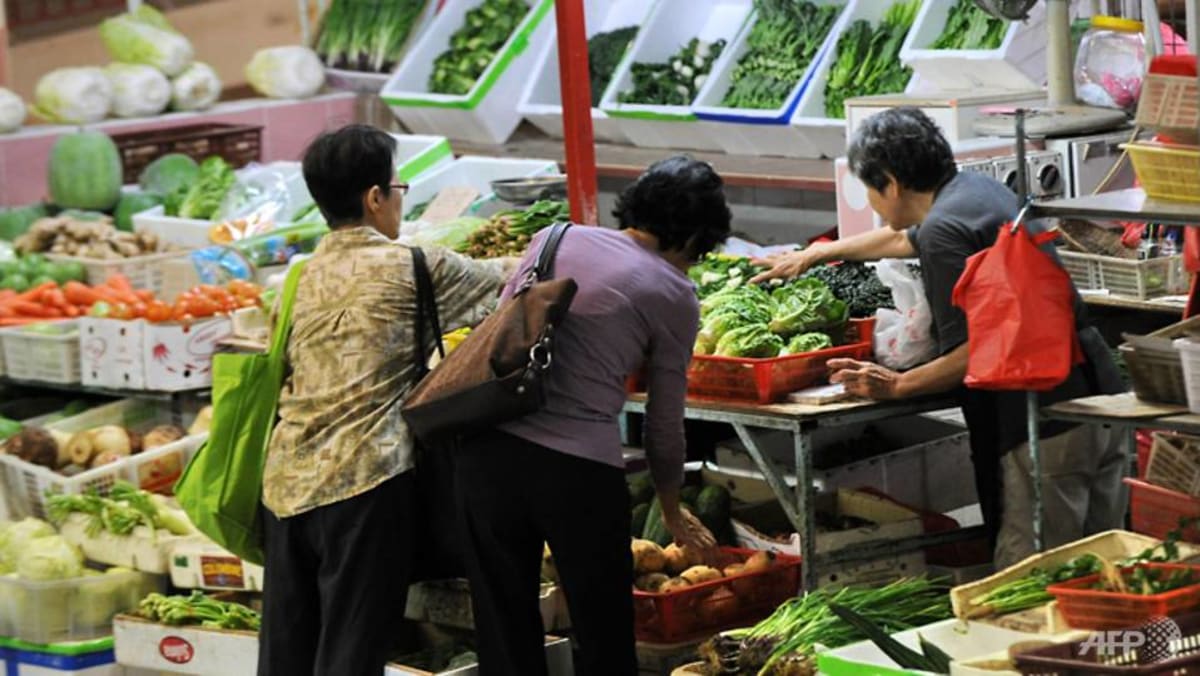
Three women pick out vegetables at a wet market in Singapore. (Photo: AFP/Roslan Rahman)
This audio is generated by an AI tool.
SINGAPORE: A food safety scandal thousands of kilometres away can quickly become a concern for Singapore.
That was demonstrated recently when reports emerged that traders in Hebei, China, had illegally treated cabbages with formalin , a solution of formaldehyde, to extend their shelf life. Formalin is a chemical commonly used as a disinfectant or preservative, and it is a known carcinogen.
Singapore responded by stepping up surveillance and testing. The Singapore Food Agency (SFA) on Sep 4 said it found no evidence of formalin contamination in the cabbages and other vegetables from China that it tested.
But the episode raises a larger question. In a country that imports more than 90 per cent of its food, how vulnerable are Singapore consumers to food safety failures occurring overseas, and what can we do about them?
CNA Games Guess Word Crack the word, one row at a time Buzzword Create words using the given letters Mini Sudoku Tiny puzzle, mighty brain teaser Mini Crossword Small grid, big challenge Word Search Spot as many words as you can Show More Show Less
THE PRICE OF FOOD RESILIENCE
Singapore’s food resilience depends on sourcing food from more than 180 countries and regions worldwide.
Geographic source diversification is one of our great strengths to deal with threats like plant and animal diseases, extreme weather, war or export restrictions. If supplies from one country are disrupted, importers can turn elsewhere.
But diversification creates the challenge of assuring the safety of food originating from sources that have different farming systems, climates, regulations and food-safety cultures.
A vegetable may pass from farm to collector, packing house, wholesaler, transporter, exporter, importer and retailer before reaching our kitchens. At every stage of the supply chain, something can go wrong.
The risks include bacteria such as salmonella and E. coli, viruses and parasites, pesticide residues, undeclared allergens, toxins and deliberate adulteration. The World Health Organization estimates that annually, around 866 million people worldwide become ill from contaminated food, with about 1.52 million deaths.
Even countries with sophisticated food-control systems are not exempt. In the United States this year, authorities have investigated E. coli associated with frozen blueberries and raw cheddar cheese, salmonella associated with eggs and jalapeno peppers, and cyclospora associated with iceberg lettuce.
Food safety failures are therefore not simply a problem of poorer countries or weak regulatory systems. They are an unavoidable risk of modern food systems. This is an important underpinning principle.
HOW DOES SINGAPORE PROTECT ITSELF?
Singapore's protection starts before some foods even leave their country of origin. Potentially higher-risk foods such as meat and eggs are subject to source accreditation to avoid contamination.
In 2025, for example, SFA approved new overseas sources for eggs, poultry, pork and beef subject to its regulatory framework.
Surveillance for contamination continues even after food enters Singapore. SFA adopts a “farm-to-fork” approach, regulating imports, primary production, local manufacturing and food retail. It assesses risks based on food safety incidents, reports of non-compliance and test results, then takes steps to mitigate such risks.
Between April 2024 and March 2025, SFA tested more than 6,000 food samples from retail outlets under its Market Monitoring Programme. The programme looks not only for conventional safety hazards but also problems such as undeclared allergens.
The effectiveness of SFA’s measures is encouraging. SFA reports that major foodborne illness cases associated with outbreaks involving at least 15 people fell from 22.8 per 100,000 population in 2024 to 16.8 in 2025.
ANTICIPATING THE NEXT THREAT
However, food safety breaches that originate abroad raise a harder question: Can we detect what we don’t suspect?
Singapore intensified testing after reports emerged of the formalin-treated cabbages in China. But what happens when there is no such report?
It is impossible to test every shipment for every conceivable hazard. A modern food-safety system must therefore do more than react to known threats. It must become increasingly good at anticipating where the next threat may come from.
That means combining conventional inspections with international intelligence-sharing, rapid exchange of outbreak information, better traceability and increasingly sophisticated data analytics. All this depends too on building networks with relevant national and international bodies.
Artificial intelligence could eventually help regulators detect unusual patterns across information on suppliers, previous violations, disease outbreaks, weather, laboratory results and international food alerts.
New laboratory capabilities are equally important, and Singapore is fortunate that it can afford sophisticated and often expensive diagnostics.
VIGILANCE, NOT ALARM
Consumers should therefore take overseas food scares seriously – but not panic whenever one appears.
Singapore's reliance on imports makes zero risk impossible. Indeed, no country can guarantee completely risk-free food.
What matters is having multiple layers of protection: reliable overseas suppliers, surveillance and laboratory testing, international information exchange, and responsible food handling by retailers and consumers.
Our best defence is therefore not to close ourselves off from global food trade, which we cannot do, but to become better at anticipating and detecting risks before they reach us. Early warning is far better than damage control.
In the end, Singapore's biggest vulnerability is not unsafe imports we know about, but emerging hazards we do not yet know to test for.
Paul Teng is Visiting Senior Fellow of the Climate Change in Southeast Asia Programme at ISEAS-Yusof Ishak Institute.
Get our pick of top stories and thought-provoking articles in your inbox
Stay updated with notifications for breaking news and our best stories
Join our channel for the top reads for the day on your preferred chat app
新加坡不能对全球食品贸易关闭大门,因此必须在风险到来之前预见并发现它们,ISEAS-Yusof Ishak 研究所的 Paul Teng 表示。
三名女子在新加坡一家菜市场挑选蔬菜。(图片:法新社/罗斯兰·拉赫曼)
这段音频是由人工智能工具生成的。
新加坡:远在数千公里之外的食品安全丑闻,很快就会引起新加坡的关注。
最近有报道称,中国河北省的商贩非法使用甲醛溶液(福尔马林)处理白菜,以延长其保质期。福尔马林是一种常用的消毒剂或防腐剂,也是一种已知的致癌物。
新加坡随即加强了监控和检测。新加坡食品局(SFA)于9月4日表示,其对来自中国的卷心菜和其他蔬菜进行的检测未发现甲醛污染的证据。
但这一事件引出了一个更大的问题。在一个超过90%的食品依赖进口的国家,新加坡消费者在多大程度上容易受到海外食品安全问题的影响,我们又能做些什么来应对这些问题呢?
CNA游戏 猜词游戏 逐行破解单词 流行词游戏 用给定的字母组成单词 迷你数独 小小谜题,挑战你的大脑 迷你填字游戏 小方格,大挑战 单词搜索 尽可能多地找出单词 显示更多 显示更少
粮食韧性的代价
新加坡的粮食安全依赖于从全球180多个国家和地区采购粮食。
地理来源多元化是我们应对动植物病害、极端天气、战争或出口限制等威胁的一大优势。如果一个国家的供应中断,进口商可以转向其他国家。
但多元化也带来了一个挑战,即如何确保来自不同农业系统、气候、法规和食品安全文化地区的食品安全。
蔬菜在到达我们厨房之前,可能要经过农场、收购商、包装厂、批发商、运输商、出口商、进口商和零售商等多个环节。供应链的每一个环节都可能出现问题。
这些风险包括沙门氏菌和大肠杆菌等细菌、病毒和寄生虫、农药残留、未申报的过敏原、毒素以及人为掺假。世界卫生组织估计,每年全球约有8.66亿人因食用受污染的食物而患病,其中约152万人死亡。
即使是拥有完善食品控制体系的国家也未能幸免。今年,美国当局调查了与冷冻蓝莓和生切达干酪相关的大肠杆菌、与鸡蛋和墨西哥辣椒相关的沙门氏菌,以及与卷心莴苣相关的环孢子虫。
因此,食品安全问题并非仅仅是较贫穷国家或监管体系薄弱的问题,而是现代食品体系不可避免的风险。这是一个重要的基本原则。
新加坡如何保护自己?
新加坡的食品安全保护措施甚至在某些食品离开原产国之前就开始了。肉类和鸡蛋等潜在风险较高的食品必须经过来源认证,以避免污染。
例如,2025年,国家食品局批准了鸡蛋、家禽、猪肉和牛肉的新海外来源,但须遵守其监管框架。
即使食品进入新加坡后,污染监测仍会继续进行。新加坡食品局(SFA)采用“从农场到餐桌”的监管模式,对进口、初级生产、本地加工和食品零售进行监管。SFA会根据食品安全事件、违规报告和检测结果评估风险,并采取措施降低风险。
2024年4月至2025年3月期间,新加坡食品局(SFA)根据其市场监测计划,对来自零售店的6000多个食品样本进行了检测。该计划不仅关注传统的食品安全隐患,还关注未申报的过敏原等问题。
新加坡食品局(SFA)的措施成效令人鼓舞。SFA报告称,涉及至少15人的重大食源性疾病暴发病例数从2024年的每10万人22.8例下降到2025年的16.8例。
预测下一个威胁
然而,源自国外的食品安全违规行为提出了一个更难的问题:我们能否发现我们没有怀疑的事情?
在中国出现甲醛处理白菜的报道后,新加坡加强了检测力度。但如果没有此类报道呢?
对每批货物进行所有可能危害的检测是不可能的。因此,现代食品安全体系不能仅仅被动应对已知威胁,还必须不断提高预测下一个威胁来源的能力。
这意味着要将传统检查与国际情报共享、疫情信息快速交换、更完善的溯源机制以及日益精密的数据分析相结合。所有这一切也取决于与相关国家和国际机构建立联系。
人工智能最终可以帮助监管机构发现供应商信息、以往违规行为、疾病爆发、天气、实验室结果和国际食品警报等方面的异常模式。
新的实验室能力同样重要,新加坡很幸运能够负担得起复杂且通常昂贵的诊断技术。
保持警惕,而非惊慌失措。
因此,消费者应该认真对待海外食品安全恐慌事件,但不必每次出现此类事件都惊慌失措。
新加坡对进口的依赖使得零风险成为不可能。事实上,没有哪个国家能够保证食品完全无风险。
重要的是要有多层保护:可靠的海外供应商、监控和实验室检测、国际信息交流,以及零售商和消费者负责任的食品处理。
因此,我们最好的防御措施并非将自己与全球食品贸易隔绝开来(我们做不到这一点),而是要提高预测和识别风险的能力,防患于未然。及早预警远胜于亡羊补牢。
归根结底,新加坡最大的脆弱性并非我们已知的那些不安全的进口商品,而是我们尚不了解、无法检测的新兴危险。
Paul Teng 是 ISEAS-Yusof Ishak 东南亚气候变化项目的高级访问研究员。
订阅我们的邮件,即可获取精选热点新闻和引人深思的文章。
订阅通知,第一时间获取突发新闻和精彩报道。
加入我们的频道,即可在您常用的聊天应用上获取当日热门文章。