After eight-year journey, spacecraft bound for Mercury faces ‘tricky’ arrival历经八年漫长旅程,前往水星的探测器将面临“棘手”的抵达。
PARIS, Sept 4 — A spacecraft carrying European and Japanese probes will complete an eight-year journey to arrive at Mercury today, while still facing high-risk manoeuvres to...
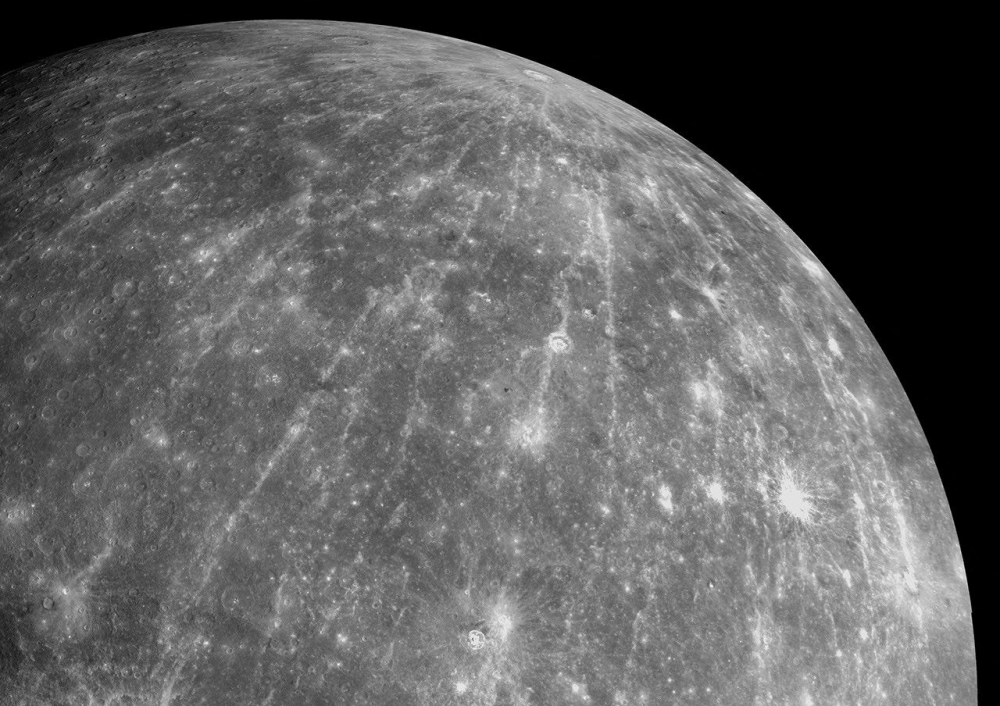
The BepiColombo mission, a collaborative endeavor by European and Japanese space agencies, has completed an eight-year journey to Mercury, aiming to study the least understood planet in our Solar System.
The mission involves complex, autonomous maneuvers to safely separate and deploy two probes that will investigate Mercury's surface, magnetic field, and space environment.
Despite previous challenges and the extreme conditions near the Sun, the mission seeks to provide unprecedented insights into Mercury with advanced instruments.
This ambitious project marks a significant chapter in planetary exploration, enhancing our understanding of the Solar System.
PARIS, Sept 4 — A spacecraft carrying European and Japanese probes will complete an eight-year journey to arrive at Mercury today, while still facing high-risk manoeuvres to study the Sun-scorched planet.
The BepiColombo mission set off from Earth in 2018 on a winding path to study the smallest and least understood planet in our Solar System with the aim of releasing the two probes into its orbit.
But first the spacecraft must begin the months-long arrival phase, described by the European Space Agency (ESA) as its “most operationally challenging planetary arrival sequences ever attempted”.
“It’s a very ambitious mission. Mercury is a challenging destination... because of the extreme environment so close to the Sun,” Santa Martinez, the mission manager at ESA, told a press conference ahead of its arrival.
Mercury’s relatively tiny mass — it is only slightly bigger than the Moon — means its gravitational pull is extremely weak compared to the Sun, making it complex for spacecraft to approach the planet without ending up incinerated or lost in space.
The spacecraft had to travel more than 10 billion kilometres, executing a series of nine flybys, to speed up, slow down and perfect its trajectory.
The two probes, which are attached to each other, will finally separate today at 1200 GMT from the transfer module that has propelled them.
“It’s going to be equivalent to launching a new spacecraft. Only this spacecraft happens to be around a different planet,” explained Ignacio Tanco, ESA’s head of inner solar system mission operations.
From April, ESA’s Mercury Planetary Orbiter (MPO) will begin studying the planet closest to the Sun with unprecedented precision, passing just 480 km from its surface, while the Japanese Mercury Magnetospheric Orbiter (Mio) will focus on its space environment and magnetic field, following an elliptical orbit that will carry it as far as 11,000 km away.
‘What can go wrong?’
Today, Mercury will be some 63 million km from the Sun and 200 million km from Earth.
“At these distances... any real-time operation becomes impossible,” Tanco said, explaining there is about a 30-minute delay between checks being performed and commands being executed from the ground to the craft.
It means the spacecraft has to check and execute the separation autonomously.
“It’s a tricky business,” Tanco admitted.
If all goes to plan, spring mechanisms will release the probes, gently pushing them away from the transfer module a few centimetres per second, he said, without any explosion or blast.
Many components, such as the thermal controls, propulsion and altitude systems, are being tested for the first time in this environment.
“So, what can go wrong? It’s probably easier to list the things that cannot go wrong, which are very few,” Tanco said, adding, “but of course, we are ready, we are flexible, and we need to be prepared for the unexpected.”
The mission has already faced hurdles, including a glitch with a thruster in 2024 causing the spacecraft to flyby closer than planned, delaying its overall trajectory.
The next tricky phase will come in December, when the two probes separate into their respective orbits.
Mercury is the least studied of the four rocky, innermost planets in our solar system, which include Venus, Earth and Mars.
Nasa’s Mariner 10 was the first probe to capture a close picture of its lunar-looking surface in 1974.
The MESSENGER probe then orbited the planet in 2011, but still many mysteries remain about its magnetic field, iron core and surface marked by hollows.
With its sixteen instruments and 1.7 billion-euro budget, BepiColombo “is going to bring to humanity and to the scientific community unprecedented views of Mercury... and it’s going to open a new chapter in our understanding of the solar system,” Martinez said. — AFP
From space-age dresses to global licensing empire, Pierre Cardin legacy lives on in Venice
What makes a town happy? Mersing, Kluang and Simpang Renggam offer different answers
‘Just the beginning’: Thailand’s dinosaur rush could soon uncover its 16th species
Penang steps up action to curb sewage pollution from pig farms in Kampung Selamat
Anwar to discuss further action on Sarawak haze with Abang Jo
Azalina calls for red flags at Desaru beaches after three teens drown
由欧洲和日本航天机构合作开展的 BepiColombo 任务,已完成为期八年的水星之旅,旨在研究我们太阳系中最不为人知的行星。
该任务涉及复杂的自主操作,以安全地分离和部署两个探测器,这两个探测器将调查水星的表面、磁场和太空环境。
尽管面临诸多挑战以及太阳附近的极端环境,该任务仍力求利用先进的仪器,为水星探测提供前所未有的见解。
这项雄心勃勃的计划标志着行星探索的一个重要篇章,增进了我们对太阳系的了解。
巴黎,9 月 4 日——一艘载有欧洲和日本探测器的宇宙飞船今天将完成长达八年的旅程抵达水星,同时它仍将面临高风险的机动飞行,以研究这颗被太阳炙烤的星球。
BepiColombo 任务于 2018 年从地球出发,沿着蜿蜒的路径前往研究我们太阳系中最小、最不为人知的行星,目的是将两个探测器释放到它的轨道上。
但首先,航天器必须开始长达数月的抵达阶段,欧洲航天局 (ESA) 将其描述为“有史以来最具操作挑战性的行星抵达序列”。
“这是一项雄心勃勃的任务。水星是一个充满挑战的目的地……因为它距离太阳非常近,环境极其恶劣,”欧洲航天局任务经理桑塔·马丁内斯在抵达前的新闻发布会上说道。
水星的质量相对较小——它只比月球略大一些——这意味着与太阳相比,它的引力非常弱,这使得航天器很难在不被烧毁或迷失在太空中的情况下接近这颗行星。
该航天器必须飞行超过 100 亿公里,执行一系列九次飞掠,以加速、减速并完善其轨迹。
这两个相互连接的探测器将于今天格林尼治标准时间 12:00 与将它们送入太空的转移模块最终分离。
“这相当于发射一艘新的航天器。只不过这艘航天器恰好绕着另一颗行星运行,”欧洲航天局内太阳系任务运营负责人伊格纳西奥·坦科解释说。
从 4 月起,欧洲航天局的水星行星轨道器 (MPO) 将以前所未有的精度研究这颗距离太阳最近的行星,它将从距离水星表面仅 480 公里处掠过;而日本的水星磁层轨道器 (Mio) 将专注于水星的空间环境和磁场,它将沿着椭圆轨道飞行,最远可达 11,000 公里。
“会出什么问题呢?”
今天,水星距离太阳约 6300 万公里,距离地球约 2 亿公里。
“在这样的距离下……任何实时操作都变得不可能,”坦科解释说,从地面向飞行器执行检查和命令之间大约有 30 分钟的延迟。
这意味着航天器必须自主检查并执行分离操作。
“这行很棘手,”坦科承认道。
他说,如果一切按计划进行,弹簧装置将释放探针,以每秒几厘米的速度轻轻地将它们从转移模块中推出,而不会发生任何爆炸或冲击波。
许多部件,例如热控系统、推进系统和高度控制系统,都是首次在这种环境下进行测试。
“那么,可能会出什么问题呢?或许列出不会出问题的事情更容易些,而这类事情其实很少,”坦科说道,“但当然,我们已经做好准备,我们很灵活,我们需要为意外情况做好准备。”
该任务已经面临诸多障碍,包括 2024 年推进器出现故障,导致航天器比计划飞得更近,从而延误了其整体轨迹。
下一个棘手的阶段将在 12 月到来,届时两个探测器将分离并进入各自的轨道。
在太阳系四颗岩质行星(包括金星、地球和火星)中,水星是研究最少的一颗。
1974 年,美国宇航局的“水手 10 号”探测器首次拍摄到其类似月球表面的近距离照片。
2011 年,信使号探测器绕着这颗行星运行,但关于它的磁场、铁核和布满凹陷的表面,仍然有很多谜团尚未解开。
马丁内斯表示,贝皮科伦坡望远镜配备16台仪器,预算达17亿欧元,“将为人类和科学界带来前所未有的水星观测成果……并将开启我们对太阳系认知的新篇章。”——法新社
从太空时代的礼服到全球授权帝国,皮尔·卡丹的传奇在威尼斯延续至今。
是什么让一座城市变得幸福?丰盛港、居銮和新邦令金给出了不同的答案
“这仅仅是个开始”:泰国的恐龙热潮或将很快发现第16种恐龙
槟城加大力度遏制甘榜斯拉末养猪场的污水污染
安华将与阿邦佐讨论应对砂拉越雾霾的进一步措施
阿扎利娜呼吁在迪沙鲁海滩悬挂红旗,此前三名青少年溺水身亡