Artillery goes trucking to survive drones swarming the battlefield炮兵部队为了躲避战场上蜂拥而至的无人机,不得不转战卡车。
The war in Ukraine has put long-range fires front and center at the Eurosatory defense show that kicks off in Paris on June 17.
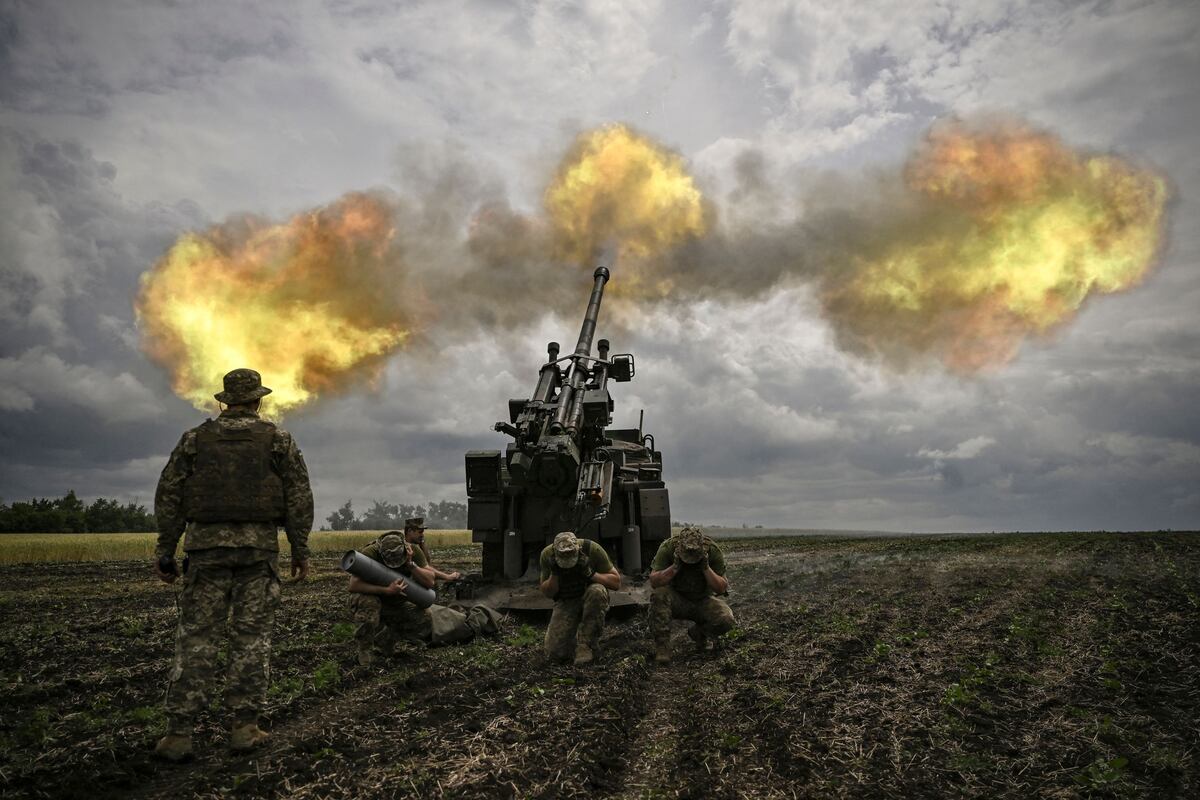
PARIS — French artillery engineers had a simple idea: Take a big gun, mount it on a truck, and you’ve got self-propelled artillery at relatively little cost. The wheeled guns have proved so effective on the Ukrainian battlefield that Western armies are taking a fresh look at the concept.
The war in Ukraine has put long-range fires front and center at the Eurosatory defense show that kicks off in Paris, France, on June 17, said Charles Beaudouin, the retired French general who heads the event. As drones and rapid counter-battery fire have put a premium on artillery mobility for survival, he expects KNDS France’s truck-mounted Caesar howitzer to be one of the stars of the show.
“The audacity of the wheeled cannon is the maximum efficiency,” Beaudouin told Defense News. “You sacrifice nothing in terms of firepower, rate of fire, precision and range, and you’ve got a truck, armored all the same, but which is able to be nimble, which is very stealthy.”
Beaudouin was part of the French Army’s decision to buy an upgraded Caesar, so he might be suspected of bias toward wheels. But at least nine other countries, including the U.K. and Germany, decided to invest in self-propelled wheeled howitzers in the past year. Analysts said the Ukrainian experience is driving military planners’ interest.
“Ukraine is definitely shaping the towed versus wheeled discussion,” said Paul Daniels, a defense industry consultant and retired U.S. Army officer who attended the Future Artillery conference in Paris in May, during which he said there has been “an uptick in focus on wheeled, self-propelled howitzers.”
Battlefield threats to artillery now include loitering munitions and precision-guided shells, said Elbit Systems, which makes the Atmos truck-mounted howitzer. The war in Ukraine has highlighted a “critical need” for mobility, the Israeli firm wrote in an email to Defense News.
Systems such as the Caesar and Atmos can pull into position, fire multiple rounds and race off in a matter of minutes — a tactic known in military parlance as “ shoot and scoot .”
Philippine troops fire Atmos howitzers during a military exercise with American forces on May 8, 2024, in the Ilocos Norte province. (Aaron Favila/AP)
Finland’s Patria is aiming to fit its 155mm towed artillery piece on a wheeled chassis in response to combat observations in Ukraine, the Finnish newspaper Aamulehti reported in April.
KNDS is seeing “a lot more interest” in Caesar, amplified by leaks from Russian soldiers indicating the weapon is particularly feared, according to spokesman Guillem Monsonis. Russian military bloggers on Telegram in April described the Caesar’s range, accuracy and mobility, saying the system killed numerous Russian artillerymen with counter-battery fire.
The Caesar’s advantage is its agility, which doesn’t give Russian forces enough time to locate and target the Ukrainian crews, an artilleryman told French broadcaster TF1 last year.
Ubiquitous drone observation means gun crews in Ukraine have to camouflage their positions or scram immediately after firing to avoid retaliatory strikes.
The “absolute saturation” of sensors will make hiding near-impossible on the future battlefield, Gen. James Rainey, the chief of U.S. Army Futures Command, said in a May 15 Senate hearing.
Rainey previously said the future for towed artillery with the Army “is not bright,” and the service is looking at the European theater as it considers modernization. “There are some very good wheeled howitzers that are having great effect in a place like Europe where the road systems are pretty mature,” Rainey said.
The Army has said it needs more range, mobility and autonomy, and will ask companies this year to demonstrate in-production artillery systems for a competitive evaluation in fiscal 2025. The service tested the Caesar, the Atmos, BAE Systems’ Archer and Yugoimport’s Nora-B-52 in 2021.
The modern, European self-propelled systems have 155mm, 52-caliber barrels for a standard range of about 40 kilometers (25 miles). That outranges the U.S. Army’s towed M777 and the tracked M109A6 Paladin howitzers, as well as Russian tube artillery, though drones pose a threat to Ukrainian crews out of Russian gun range.
Soldiers and airmen position an M109A6 Paladin to be loaded onto a Lockheed C-5 Galaxy aircraft during a air movement at Biggs Army Airfield on Fort Bliss, Texas, in 2015. (Staff Sgt. George Gutierrez/U.S. Army)
Elbit said the immediate need for artillery systems in light of the Ukrainian conflict caused customers to prioritize Atmos over other weapon systems. Meanwhile, KNDS said there are more and more wheeled systems on offer, and a lot more potential buyers.
Interest in wheeled self-propelled artillery flows from a desire for a “much higher degree of mobility and survivability” than towed guns, said Daniels. Military staff who see wheels as an attractive option over tracks “often define survivability in a broader way, as opposed to seeing it purely from the physical protection offered by onboard armor,” he added.
Eurosatory will feature at least 10 artillery makers; that’s more than in 2022. Cannon and rocket artillery will be major topics, with the M142 High Mobility Artillery Rocket System another centerpiece of the show, according to Beaudouin.
KNDS will premiere the six-wheeled Caesar MkII as well as display the eight-wheeled version of the cannon and the tracked Panzerhaubitze 2000. BAE Systems will show the M777 towed gun and a model of the Archer. Elbit had been planning to present its PULS multiple-rocket launcher and the Sigma next-generation howitzer, both wheeled, before the French government banned Israeli vendors from Eurosatory in late May over the Israeli military’s conduct in its war against Hamas in Gaza.
French President Emmanuel Macron, center, inspects a Caesar self-propelled artillery system during a visit to the Cherbourg naval base on Jan. 19, 2024. (Christophe Petit Tesson/AFP via Getty Images)
The Caesar prototype presented at Eurosatory in 1994 was a departure from the tracked and armored behemoths en vogue with many Western armies during the Cold War.
“Before the conflict in Ukraine, many gunners around the world thought that for high-intensity warfare, the only serious guns would be tracked armor,” said Monsonis, the KNDS spokesman. “The conflict in Ukraine has shown that, on the contrary, the Caesar is not only perfectly suited to high-intensity warfare but also fares better than other types of gun.”
Around 10% of Caesars in Ukraine had been destroyed by March, compared with almost a third of the tracked 52-caliber armored guns, according to the manufacturer.
Truck-mounted systems have gained in popularity in recent years, with the Turkish firm Asfat working on the Arpan 155 for the country’s army and the China North Industries Group Corp. in February unveiling a turreted truck-mounted howitzer .
The past six months hosted a flurry of wheeled-artillery purchases, include Belgium with the Caesar MkII, Brazil picking Atmos, and the U.K. and Germany announcing plans in April to acquire KNDS Deutschland’s RCH 155 based on the eight-wheeled Boxer.
Mobility has been key for governments turning to wheels. Belgium’s Defence Ministry said buying the Caesar was an investment in “exceptional mobility,” while Estonian Defence Minister Hanno Pevkur told local daily Postimees that the country plans to buy the wheeled cannons to add fast and flexible long-range fires to its fleet of “not very maneuverable” tracked K9 howitzers, made in South Korea.
With a host of technology flying over the battlefield, including loitering munitions, “the game today is not to be spotted, and that’s where Caesar has a huge advantage,” Pierre-André Moreau, a former senior weapons engineer for the French Army and the brains behind the truck-mounted howitzer, said in an interview last year with YouTube channel VA Plus. He said ubiquitous anti-tank munitions and drones on the battlefield mean armored artillery “is on the verge of becoming totally obsolete.”
France, Denmark and Ukraine agreed in March to finance 78 additional Caesar systems for Ukraine in 2024, adding to 49 systems already delivered. KNDS by early April was producing six of the howitzers per month, up from a rate of two before the war, with a target for 12 cannons per month.
Meanwhile, Ukraine has accelerated production of its homegrown wheeled howitzer Bohdana to 10 systems per month, President Volodymyr Zelenskyy said in April.
Ukrainian forces fire at a Russian position with a 155mm self-propelled 2C22 Bohdana howitzer in the Kharkiv region on April 21, 2024. (Anatolii Stepanov/AFP via Getty Images)
Russia joined the trend last year with the Malva wheeled howitzer, breaking with a tradition of tracked self-propelled artillery. State-owned manufacturer Rostec highlighted the greater maneuverability, making a link between better mobility and saving Russian forces’ lives. The range of the 152mm cannon may still leave the gun vulnerable to Ukraine’s longer-reaching systems.
The lower cost of wheels over tracks will matter for countries seeking to build up their artillery force, Beaudouin said. France agreed to buy 109 Caesar MkII weapons at the end of 2023 for a unit cost of €3.2 million (U.S. $3.5 million), compared with Germany buying 10 tracked Panzerhaubitze 2000s in March 2023 for €18.4 million (U.S. $20 million) apiece.
Operating and maintaining wheeled systems also tends to be cheaper, with studies from the U.S. and Europe indicating cost savings of roughly 30%.
The six-wheel Caesar and Atmos models are flyweights compared with their armored and tracked brethren, which explains their mobility and lower operating costs. The French gun comes in at less than 18 tons, and its Israeli rival at about 20 tons, compared with 57 tons for the Panzerhaubitze and 47 tons for the K9.
The turret on the RCH 155 adds bulk as well, pushing the weight to 39 tons. Tactical mobility for wheeled systems drops once loads exceed 8 tons per axle, according to Beaudouin, who said the Boxer chassis struggles under the weight of a gun turret.
The widespread use of wheeled artillery in Ukraine was dictated by availability rather than a tactical choice, said Spencer Jones, a senior lecturer in war studies at the U.K.-based University of Wolverhampton. In the end, the weapons worked well in a war characterized by intense counter-battery fire.
“Ukrainian use of shoot-and-scoot artillery fire suggests that the future lies in highly mobile artillery, be they tracked or wheeled,” Jones said.
Rudy Ruitenberg is a Europe correspondent for Defense News. He started his career at Bloomberg News and has experience reporting on technology, commodity markets and politics.
巴黎——法国炮兵工程师们有一个简单的想法:把一门大炮装到卡车上,就能以相对较低的成本得到自行火炮。这种轮式火炮在乌克兰战场上展现出了极高的效用,以至于西方军队正在重新审视这一概念。
乌克兰战争使得远程火力成为6月17日在法国巴黎开幕的欧洲防务展(Eurosatory)的焦点。展会负责人、退役法国将军查尔斯·博杜安表示,由于无人机和快速反炮兵火力使得火炮机动性对于生存至关重要,他预计法国KNDS公司的凯撒车载榴弹炮将成为本次展会的明星产品之一。
“轮式火炮的精妙之处在于其极高的效率,”博杜安告诉《防务新闻》。“火力、射速、精度和射程都毫不逊色,而且它还是一辆装甲卡车,却又非常灵活,隐蔽性极佳。”
博杜安参与了法国陆军购买升级版凯撒自行榴弹炮的决策,因此他可能被怀疑对轮式火炮有所偏爱。但至少还有九个国家,包括英国和德国,在过去一年里决定投资购买轮式自行榴弹炮。分析人士表示,乌克兰的经验正在激发军事规划者的兴趣。
“乌克兰无疑正在影响牵引式与轮式火炮的讨论,”国防工业顾问、退役美国陆军军官保罗·丹尼尔斯说道。他曾于 5 月参加了在巴黎举行的未来炮兵会议,并在会上表示,“人们对轮式自行榴弹炮的关注度有所提高”。
生产“阿特莫斯”(Atmos)车载榴弹炮的埃尔比特系统公司表示,战场上对火炮的威胁如今包括巡飞弹和精确制导炮弹。这家以色列公司在发给《防务新闻》的电子邮件中写道,乌克兰战争凸显了机动性的“迫切需求”。
凯撒和阿特莫斯等系统可以在几分钟内到达指定位置,发射多发炮弹并迅速撤离——这种战术在军事术语中被称为“打了就跑”。
2024年5月8日,在北伊罗戈省,菲律宾军队与美军举行联合军事演习,期间使用“阿特莫斯”榴弹炮进行实弹射击。(Aaron Favila/AP)
据芬兰报纸《晨报》4 月份报道,芬兰帕特里亚公司正计划将其 155 毫米牵引式火炮安装在轮式底盘上,以应对在乌克兰的战斗观察。
据KNDS发言人吉列姆·蒙索尼斯称,KNDS发现人们对“凯撒”导弹系统“兴趣大增”,俄罗斯士兵泄露的信息也加剧了这种兴趣,他们表示该武器尤其令人畏惧。今年4月,俄罗斯军事博客作者在Telegram上描述了“凯撒”导弹系统的射程、精度和机动性,称该系统利用反炮兵火力击毙了多名俄罗斯炮兵。
一名炮兵去年告诉法国广播公司TF1:“凯撒坦克的优势在于其灵活性,这使得俄罗斯军队没有足够的时间去定位和瞄准乌克兰炮兵部队。”
无处不在的无人机侦察意味着乌克兰的炮兵部队必须伪装他们的位置,或者在开火后立即撤离,以避免遭到报复性打击。
美国陆军未来司令部司令詹姆斯·雷尼将军在 5 月 15 日的参议院听证会上表示,传感器的“绝对饱和”将使未来战场上的隐藏几乎不可能。
雷尼此前曾表示,陆军牵引式火炮的未来“并不乐观”,陆军在考虑现代化改造时,正着眼于欧洲战场。“在欧洲这样公路系统相当成熟的地区,一些性能优异的轮式榴弹炮发挥了巨大作用,”雷尼说道。
美国陆军表示需要更远的射程、更强的机动性和更高的自主性,并将在今年要求各公司展示其在产火炮系统,以便在2025财年进行竞争性评估。陆军在2021年测试了凯撒(Caesar)、大气(Atmos)、英国航空航天系统公司(BAE Systems)的弓箭手(Archer)和南斯拉夫进口公司(Yugoimport)的诺拉-B-52(Nora-B-52)火炮。
现代欧洲自行火炮系统配备155毫米、52倍径炮管,标准射程约为40公里(25英里)。这超过了美国陆军的M777牵引式榴弹炮和M109A6“帕拉丁”履带式榴弹炮,以及俄罗斯的管式火炮。不过,无人机对乌克兰炮兵部队构成威胁,因为这些火炮位于俄罗斯火炮射程之外。
2015年,在德克萨斯州布利斯堡比格斯陆军机场,士兵和空军人员正在将一辆M109A6“帕拉丁”自行火炮装载到洛克希德C-5“银河”运输机上,准备进行空运。(美国陆军参谋军士乔治·古铁雷斯摄)
埃尔比特公司表示,鉴于乌克兰冲突,对火炮系统的需求迫在眉睫,因此客户优先考虑Atmos系统而非其他武器系统。与此同时,KNDS公司表示,市面上可供选择的轮式系统越来越多,潜在买家也更多。
丹尼尔斯表示,人们对轮式自行火炮的兴趣源于其对“比牵引式火炮更高的机动性和生存能力”的追求。他还补充道,那些认为轮式火炮比履带式火炮更具吸引力的军事人员“通常对生存能力的定义更为广泛,而不仅仅是从车载装甲提供的物理防护角度来看待它”。
欧洲防务展将至少有 10 家火炮制造商参展;比 2022 年的展会更多。据博杜安称,火炮和火箭炮将是主要议题,M142 高机动性火箭炮系统也将是展会的另一大亮点。
KNDS将首次展出六轮凯撒MkII型自行火炮,同时还将展示八轮版本的凯撒火炮和履带式Panzerhaubitze 2000型装甲榴弹炮。BAE系统公司将展出M777型牵引火炮和Archer装甲车的模型。埃尔比特系统公司原本计划展示其PULS多管火箭炮和Sigma下一代轮式榴弹炮,但由于以色列军队在加沙地带对哈马斯的战争中的行为,法国政府于5月下旬禁止以色列供应商参加欧洲防务展。
2024年1月19日,法国总统埃马纽埃尔·马克龙(中)在访问瑟堡海军基地期间视察了凯撒自行火炮系统。(图片来源:Christophe Petit Tesson/AFP via Getty Images)
1994 年在 Eurosatory 上展出的 Caesar 原型车与冷战时期许多西方军队流行的履带式装甲巨兽截然不同。
“在乌克兰冲突爆发前,世界各地的许多炮兵都认为,对于高强度战争而言,唯一真正有效的火炮就是履带式装甲车,”KNDS发言人蒙索尼斯说。“乌克兰冲突表明,事实恰恰相反,凯撒坦克不仅非常适合高强度战争,而且表现优于其他类型的火炮。”
据制造商称,截至 3 月,乌克兰境内约有 10% 的凯撒坦克被摧毁,而履带式 52 口径装甲炮的被摧毁数量接近三分之一。
近年来,车载系统越来越受欢迎,土耳其 Asfat 公司正在为该国军队研发 Arpan 155,而中国北方工业集团公司在 2 月份推出了一款带炮塔的车载榴弹炮。
过去六个月里,各国纷纷采购轮式火炮,包括比利时采购凯撒MkII型火炮,巴西选择Atmos公司,以及英国和德国在4月份宣布计划采购KNDS Deutschland公司基于八轮Boxer平台的RCH 155型火炮。
机动性一直是各国政府转向轮式火炮的关键因素。比利时国防部表示,购买“凯撒”轮式火炮是对“卓越机动性”的投资;而爱沙尼亚国防部长汉诺·佩夫库尔在接受当地日报《邮报》采访时表示,该国计划购买这种轮式火炮,为其“机动性欠佳”的韩国制造的K9履带式榴弹炮部队增添快速灵活的远程火力。
随着包括巡飞弹在内的各种高科技装备在战场上空穿梭,“如今的作战策略就是不被发现,而这正是凯撒榴弹炮的巨大优势所在,”法国陆军前高级武器工程师、车载榴弹炮的设计者皮埃尔-安德烈·莫罗去年在接受YouTube频道VA Plus采访时表示。他还指出,战场上无处不在的反坦克弹药和无人机意味着装甲火炮“即将彻底过时”。
今年3月,法国、丹麦和乌克兰达成协议,将在2024年为乌克兰增购78套“凯撒”榴弹炮系统,此前已交付49套。到4月初,KNDS公司每月可生产6门榴弹炮,高于战前每月2门的产量,目标是每月生产12门。
与此同时,乌克兰总统泽连斯基在4月份表示,乌克兰已加快生产其国产轮式榴弹炮“博赫达纳”的步伐,达到每月10门。
2024年4月21日,乌克兰军队在哈尔科夫地区使用155毫米2C22“博赫达纳”自行榴弹炮向俄军阵地开火。(Anatolii Stepanov/AFP via Getty Images)
俄罗斯去年也加入了这一趋势,推出了马尔瓦轮式榴弹炮,打破了以往使用履带式自行火炮的传统。国有制造商俄罗斯国家技术集团强调了该炮更高的机动性,并指出更好的机动性与挽救俄军士兵的生命息息相关。然而,这门152毫米火炮的射程可能仍然使其容易受到乌克兰远程火炮的攻击。
博杜安表示,轮式火炮相比履带式火炮成本更低,这对那些寻求扩充炮兵力量的国家来说至关重要。法国同意在2023年底前购买109门凯撒MkII型火炮,单价为320万欧元(约合350万美元);相比之下,德国计划在2023年3月购买10门履带式“铁甲榴弹2000”型火炮,单价为1840万欧元(约合2000万美元)。
轮式系统的运行和维护成本也往往更低,美国和欧洲的研究表明,轮式系统可以节省大约 30% 的成本。
与它们的装甲和履带式同系产品相比,六轮的凯撒和阿特莫斯型火炮重量轻得多,这也解释了它们为何机动性强且运行成本更低。法国的这款火炮重量不到18吨,其以色列竞争对手的重量约为20吨,而德军的“铁甲火箭炮”(Panzerhaubitze)重达57吨,K9型火炮重达47吨。
RCH 155上的炮塔也增加了重量,使整车重量达到39吨。博杜安表示,轮式系统的战术机动性一旦超过每轴8吨的载荷就会下降,他还指出,拳击手底盘难以承受炮塔的重量。
英国伍尔弗汉普顿大学战争研究高级讲师斯宾塞·琼斯表示,乌克兰广泛使用轮式火炮更多是出于武器可得性而非战术选择。最终,在以激烈反炮兵火力为特征的战争中,这些武器发挥了重要作用。
琼斯说:“乌克兰使用打了就跑的炮兵战术表明,未来在于高度机动的火炮,无论是履带式还是轮式火炮。”
鲁迪·鲁伊滕贝格是《防务新闻》的欧洲记者。他的职业生涯始于彭博新闻社,拥有报道科技、大宗商品市场和政治方面的经验。