Bill aims to strengthen contested logistics strategy in Pacific该法案旨在加强太平洋地区有争议的后勤战略。
Senators introduced bill today that aims to ensure the U.S. is on track to strengthen its contested logistics capability in Pacific to deter China.
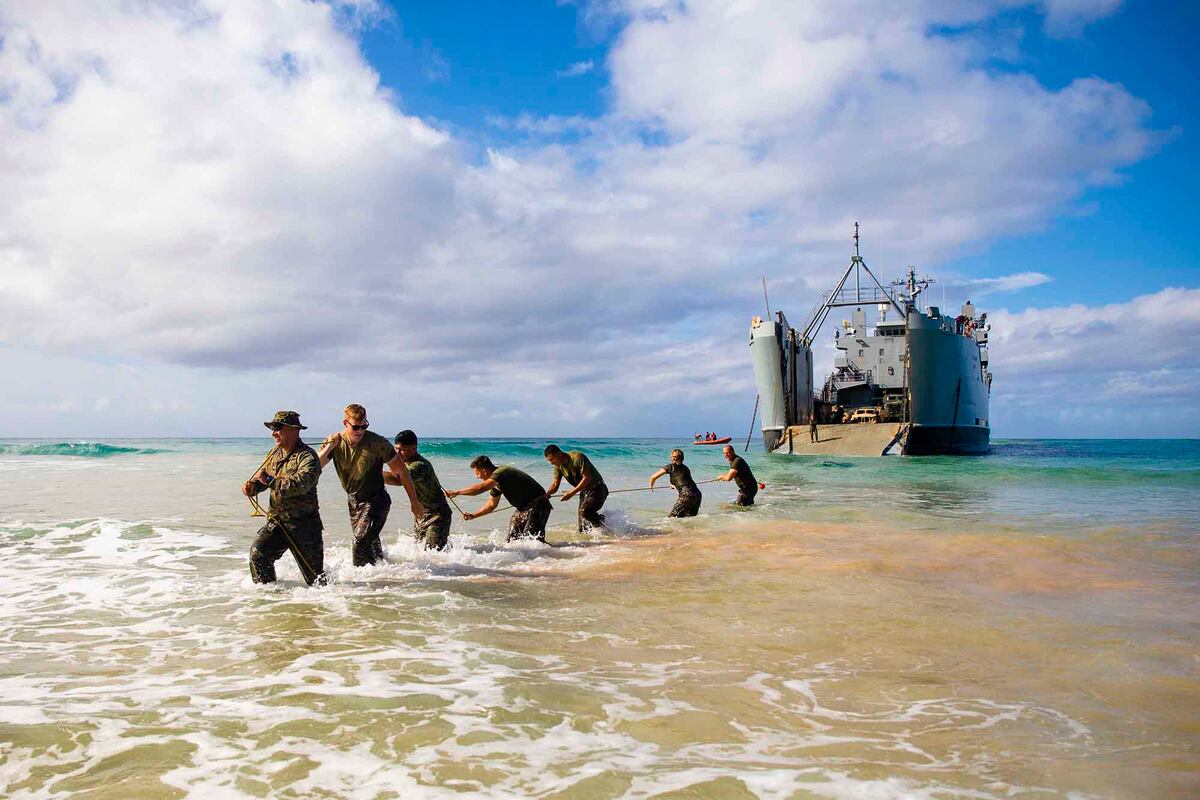
As the U.S. and its allies and partners in the Pacific face down an increasingly aggressive China, a bipartisan bill introduced in the Senate aims to strengthen the relationship between the U.S. and key countries in the region in order to better protect supply lines and ensure sustained operations, should a conflict occur.
Republican Sen. Mitt Romney, of Utah, who serves on the Foreign Relations Committee, and Democratic Sen. Mark Kelly, of Arizona, a member of the Armed Services Committee co-introduced the proposed legislation today.
“With each passing day, China’s military continues to improve and expand its capabilities.” Romney said in a statement to Defense News. “The Chinese Communist Party’s ambitions are clear. In the event of a conflict in the Indo-Pacific, the United States could face challenges effectively moving personnel and equipment in an area that comprises about half of the earth’s surface.”
The legislation “will help us address vulnerabilities and maintain our readiness in contested environments. By strengthening partnerships in the Indo-Pacific, we can better support our troops and uphold our commitments to our allies in the region,” Kelly added in the statement.
The bill would require increased oversight over the U.S. military’s various efforts to conduct logistics and sustainment in a contested environment and also lays the groundwork for increased partnerships specifically for maintenance and repair with allies and partners in the Pacific.
The Defense Department has been working on how to tackle contested logistics from fort to port to foxhole, but the bill would require a review and a report be submitted to Congress accounting for all of the various efforts across military departments.
The legislation would require the secretary of defense to assess each military services’ role within the joint force in a contested logistics environment, the bill states. Specifically, a review would focus on the services’ ability to effectively maintain and repair capabilities, preposition or store materials needed to surge capability or support operations, examine the ability to repair and maintain without dedicated maintenance facilities, and figure out the resources needed to “reduce or mitigate the risks associated with operations in a contested logistics environment.”
A report would be due no later than one year following the enactment of the act.
Additionally, while Australia, Canada, New Zealand and the U.K. are all able to provide product support to the U.S. in a contested logistics environment such as transferring spare parts to the U.S. in order to more efficiently repair equipment in conflict, the bill would require Japan and South Korea to be included in that group of allies.
Japan and the U.S. recently took new steps to strengthen its relationship , vowing to improve command-and-control systems, form an industrial council to build weapons together, network their missile defense systems with Australia’s and start a joint exercise in the United Kingdom.
South Korea and the U.S. are also exploring whether the country’s defense industry could help maintain, repair and overhaul American warships and weapons.
Lastly, the proposed legislation would authorize the Defense Department to conduct maintenance on certain surface vessels in foreign ports under a U.S. Navy pilot program called Ship Wartime Repair and Maintenance, or SWaRM.
In order to ensure ships can be repaired quickly and easily at foreign ports, the Navy’s SWaRM pilot program aims to test out the process of undergoing repairs away from U.S. ports and would allow the service to figure out how to navigate the contracting process, allowing foreign workers to work on American ships and ensuring those workers are trained in accordance with American standards and regulations.
Keeping ships operational to deliver capability to ports throughout the Pacific is critical to sustaining Navy readiness, the bill emphasizes.
The U.S. Army is also considering, as a part of its watercraft strategy still taking shape, how it might use ships, even commercial ones under contract, from allies and partners.
‘Mesh network of friends’
The Pentagon as well as the individual services have been ringing the alarm bells to ensure the U.S. is ready to supply and sustain the force in conflict in the Pacific. The Pacific accounts for over a quarter of the globe and the vast distances the U.S. must travel to within the theater creates an enormous challenge alone.
The U.S. Army has been working to adapt its approach to logistics to prepare for possible conflict with China but also deter it from increased aggression in the region. The service recognized contested logistics as a key contribution to its Multidomain Operations doctrine published in 2022 in a special annex and created a contested logistics cross-functional team in 2023 to develop capabilities critical to operations where projecting, supplying, maintaining and sustaining the force will be contested across the board by near peer adversaries.
The U.S. military has been working with allies and partners to create capability through exercises like Talisman Sabre in Australia, Operation Pathways and RIMPAC. These exercises give the U.S. the opportunity to see what ports might be ideal for delivering supplies via watercraft and where weapons and supplies can be kept on a more permanent basis.
The Army has been building a “mesh network of friends, partners and allies,” Lt. Gen. Xavier Brunson, who commands the service’s I Corps, said last fall.
Relationships are growing and strengthening, U.S. Army Pacific commander, Gen. Charles Flynn, emphasized in May at a conference in Hawaii. Flynn noted in his speech that the opportunity to increase multilateral cooperation is the highest he has ever seen.
Commanders are working on strategies to lighten the logistics tail in contested environments and keep more capability forward in theater.
Conversations are ongoing with foreign partners about the possibility of tapping local industry in the Pacific to provide repair parts, supplies (even blood) and other capabilities, arrangements that are likely to be essential when the U.S. cannot rely on bringing everything with it to respond to a crisis or conflict.
Following Talisman Sabre, for instance, the U.S. military was given permission to leave behind equipment in prepositioned stock in Australia.
“As logisticians, we need to be successful and to understand the theater and to really set conditions for those joint interior lines,” Maj. Gen. Jered Helwig, the Army’s 8th Theater Sustainment Command commander in the Pacific, said last fall “and build out that architecture that we know that, if we don’t rehearse in competition, will be very difficult to execute in crisis.”
Jen Judson is an award-winning journalist covering land warfare for Defense News. She has also worked for Politico and Inside Defense. She holds a Master of Science degree in journalism from Boston University and a Bachelor of Arts degree from Kenyon College.
随着美国及其在太平洋地区的盟友和伙伴面对日益咄咄逼人的中国,参议院提出了一项两党法案,旨在加强美国与该地区主要国家之间的关系,以便在发生冲突时更好地保护补给线并确保持续运作。
今天,犹他州共和党参议员米特·罗姆尼(Mitt Romney,参议院外交关系委员会成员)和亚利桑那州民主党参议员马克·凯利(Mark Kelly,参议院军事委员会成员)共同提出了这项立法提案。
罗姆尼在接受《防务新闻》采访时表示:“中国军队的能力与日俱增。中国共产党的野心昭然若揭。一旦印太地区爆发冲突,美国在地球表面积近一半的区域内有效调动人员和装备将面临挑战。”
凯利在声明中补充道:“这项立法将帮助我们应对脆弱性,并在充满挑战的环境中保持战备状态。通过加强在印太地区的伙伴关系,我们可以更好地支持我们的部队,并履行我们对该地区盟友的承诺。”
该法案将要求加强对美国军方在对抗环境中开展后勤保障工作的各种努力的监督,并为加强与太平洋地区盟友和伙伴在维护和修理方面的合作奠定基础。
国防部一直在研究如何解决从堡垒到港口再到战壕的后勤保障难题,但该法案要求对各军事部门所做的各种努力进行审查,并向国会提交一份报告。
该法案规定,国防部长将评估各军种在联合部队中,尤其是在后勤保障紧张的环境下,所扮演的角色。具体而言,评估将重点关注各军种有效维护和维修装备的能力,预置或储存提升能力或支援作战所需物资的能力,在没有专用维修设施的情况下进行维修和维护的能力,以及确定“降低或减轻在后勤保障紧张的环境下开展作战行动相关风险”所需的资源。
报告应在法案颁布后一年内提交。
此外,虽然澳大利亚、加拿大、新西兰和英国都能够在竞争激烈的后勤环境中向美国提供产品支持,例如向美国转移备件以便更有效地维修冲突中的设备,但该法案要求将日本和韩国也纳入盟友行列。
日本和美国最近采取了新的措施来加强两国关系,承诺改进指挥控制系统,成立工业委员会共同制造武器,将两国的导弹防御系统与澳大利亚的导弹防御系统联网,并在英国开始联合演习。
韩国和美国也在探讨韩国的国防工业是否可以帮助维护、修理和大修美国的军舰和武器。
最后,拟议的立法将授权国防部根据美国海军一项名为“战时舰艇维修和维护”(SWaRM)的试点计划,对外国港口的某些水面舰艇进行维护。
为了确保船舶能够在外国港口快速便捷地进行维修,海军的SWaRM试点项目旨在测试在美国港口以外进行维修的流程,并使海军能够弄清楚如何进行合同签订流程,允许外国工人在美国船舶上工作,并确保这些工人按照美国标准和法规接受培训。
该法案强调,保持舰船正常运转,为太平洋各地的港口提供作战能力,对于维持海军战备状态至关重要。
作为其仍在制定中的水上交通工具战略的一部分,美国陆军也在考虑如何使用来自盟友和伙伴的船只,甚至是根据合同订购的商用船只。
“朋友网络”
五角大楼和各军种一直在发出警报,确保美国做好充分准备,为在太平洋地区作战的部队提供后勤保障。太平洋地区占全球面积的四分之一以上,美国在该战区内需要跨越的广袤地域本身就是一个巨大的挑战。
美国陆军一直在努力调整其后勤保障策略,以应对可能与中国发生的冲突,并遏制中国在该地区日益增长的侵略性。陆军在2022年发布的《多域作战条令》特别附件中,将对抗性后勤保障视为一项关键内容。2023年,陆军成立了一个对抗性后勤保障跨职能团队,旨在发展在与势均力敌的对手全面对抗的情况下,对部队投送、补给、维护和保障至关重要的作战能力。
美国军方一直与盟友和伙伴合作,通过在澳大利亚举行的“护身军刀”演习、“路径行动”和“环太平洋军演”等演习来提升自身能力。这些演习使美国有机会考察哪些港口最适合通过水路运输物资,以及哪些地方更适合长期存放武器和物资。
陆军第一军司令泽维尔·布伦森中将去年秋天表示,陆军一直在构建一个“由朋友、伙伴和盟友组成的网状网络”。
美国太平洋陆军司令查尔斯·弗林将军5月在夏威夷举行的一次会议上强调,各方关系正在不断发展和加强。弗林在讲话中指出,加强多边合作的机会是他前所未见的。
指挥官们正在制定战略,以减轻敌对环境下的后勤负担,并将更多能力保持到战区前沿。
美国正与外国伙伴就利用太平洋地区当地产业提供维修零件、物资(甚至血液)和其他能力的可能性进行对话,当美国无法依靠携带所有物资来应对危机或冲突时,这些安排可能至关重要。
例如,在“护身军刀行动”之后,美军获准将预先部署在澳大利亚的装备留在澳大利亚。
“作为后勤人员,我们需要取得成功,了解战区情况,真正为联合内线创造条件,”陆军太平洋战区第8战区保障司令部司令杰里德·赫尔维格少将去年秋天表示,“并构建我们知道的架构,如果我们不在竞争中进行演练,那么在危机中将很难执行。”
珍·贾德森是一位屡获殊荣的记者,为《防务新闻》报道陆地战争。她也曾为《政治报》和《内幕防务》工作。她拥有波士顿大学新闻学硕士学位和凯尼恩学院文学学士学位。