ST Logistics trains workers for new roles as it ramps up warehouse automation随着仓库自动化进程的加快,新科物流正在培训员工胜任新岗位。
The new system uses 14 autonomous shuttles to store and retrieve goods across 23 storeys of racks. Read more at straitstimes.com.
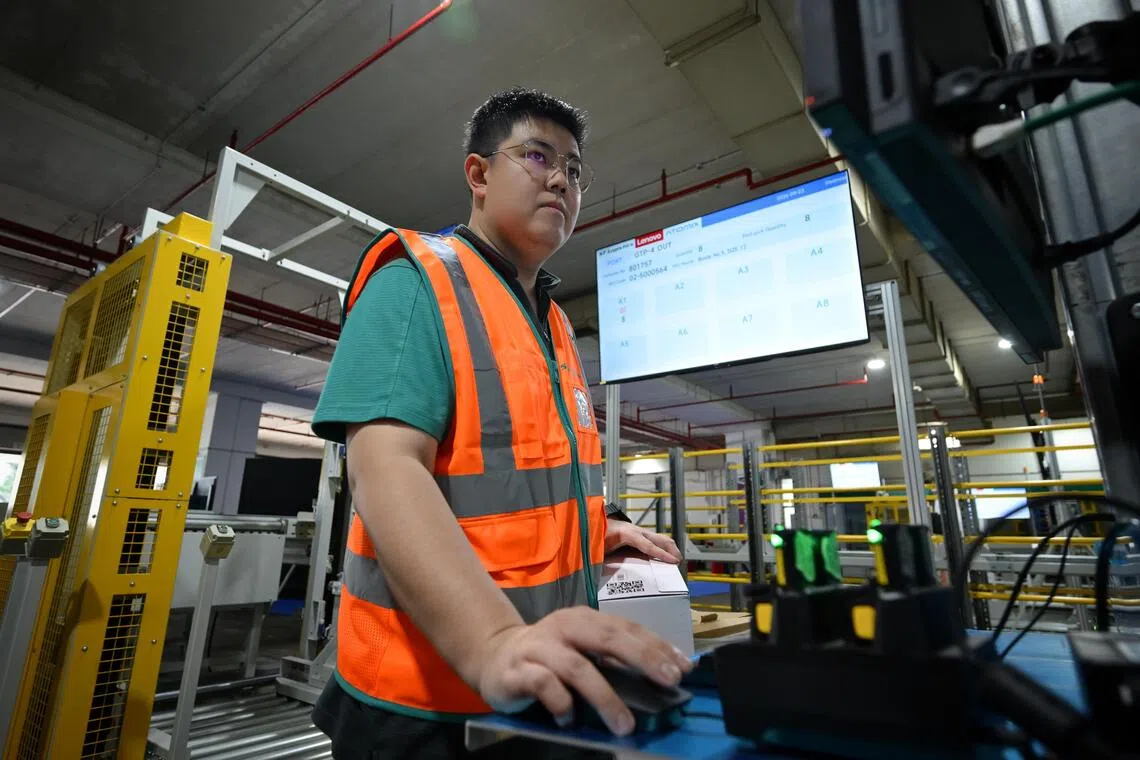
Frederick Wong, senior executive at ST Logistics, has learnt to manage new software and troubleshoot robotic equipment as the warehouse he works in adopts automation.
ST PHOTO: NG SOR LUAN
Published Sep 23, 2026, 07:40 PM
Updated Sep 23, 2026, 07:40 PM
ST Logistics has upgraded its Clementi warehouse with a smart storage and retrieval system using 14 autonomous shuttles, increasing storage capacity by over 20 per cent.
The company retrained about 40 workers, including Frederick Wong, to ensure jobs evolve alongside technology.
The new system boosts efficiency by moving over 70 pallets per hour with AI-optimised routes.
SINGAPORE – When Frederick Wong began working at ST Logistics nine years ago, filling an order meant getting behind the wheel of a forklift or pallet truck and criss-crossing warehouse aisles to retrieve goods from different shelves.
Today, the 32-year-old senior executive barely has to leave his workstation at ST Logistics’ Clementi warehouse. The facility stores supplies such as uniforms, shoes and berets for the Singapore Police Force and Singapore Civil Defence Force.
Automated systems now bring the goods directly to Wong and his colleagues for packing.
His job has evolved with the technology, from manually moving goods, to learning to manage new software, and troubleshooting the machines that now do much of the legwork.
“If an automated shuttle stops, for example, I can check the system to diagnose the problem. Sometimes its sensors may have detected an obstacle even when the path is clear, so I can restart the system and get it moving again. If it is a mechanical issue that I cannot resolve, I will escalate it to our technicians,” Wong said.
Wong is among workers whose jobs have been redesigned as ST Logistics automates more of its operations, with training supported by the NTUC Company Training Committee (CTC) Grant.
The grant funds up to 70 per cent of qualifying costs for projects that transform businesses and workers, including new equipment and software and training for redesigned jobs.
ST Logistics also worked with the Supply Chain Employees’ Union to identify roles that could be redesigned and the new skills workers would need.
About 100 employees have been identified for training, with 40, including Wong, trained so far.
“We don’t see automation as a shortcut to jobless growth, doing the same work with fewer people,” said ST Logistics chief executive Loganathan Ramasamy. “That’s why our investment in AI and robotics has always come with an equal investment in our people.”
The latest technology to reshape jobs at the company is a new smart storage and retrieval system unveiled at its Clementi warehouse on Sept 23.
Standing at 28m tall, the system uses 14 autonomous shuttles to store and retrieve goods from across 23 storeys of racks. Wong took about a month to learn how to operate it through company-supported training.
“The new system is on a different scale – more shuttles, more levels, more complexity – and it demands a much higher level of skill to operate,” he said.
It replaces a system of three automated cranes that moved between seven aisles. The smaller shuttles move within the storage racks themselves, slotting underneath pallets to pick them up and transport them through the system.
Doing away with the space needed for the cranes and their aisles has allowed ST Logistics to increase storage capacity by more than 20 per cent without expanding the warehouse .
“The system is able to hold up to 10,600 pallets – a significant increase in density compared with our earlier system, achieved entirely within the same physical footprint,” said Hamarian Bin Mohamad, senior vice-president of homeland security at ST Logistics.
ST Logistics invested at least $10 million in the new system, which took about a year to build and became operational in August. It worked with technology company Lenovo on the project, including on the software that coordinates the shuttles and tracks where pallets of goods are stored.
Lenovo had deployed similar technology in its own warehouse operations in China about a decade ago.
The 28m-tall system which uses autonomous shuttles has increased storage capacity by more than 20 per cent. ST PHOTO: NG SOR LUAN
The 28m-tall system which uses autonomous shuttles has increased storage capacity by more than 20 per cent.
The system also uses AI to optimise where goods are stored, placing frequently needed items, based on demand, closer to the front.
“It tracks where pallets are, manages shuttle traffic and optimises how retrieval tasks are sequenced,” said Nigel Lee, general manager of Lenovo Singapore.
“As demand shifts, the system can recalculate the fastest retrieval path rather than continuing with a fixed sequence,” he added.
The number of pallets moved each hour has increased from about 10 to more than 70, as the shuttles move faster than the cranes they replaced and AI helps determine the shortest routes for them to take.
ST Logistics is considering rolling out the new automated system to a few of its other warehouses.
Li Ying is a technology correspondent covering online safety, cybersecurity and the impact of artificial intelligence.
AI/artificial intelligence
Artificial Intelligence
新科物流高级主管黄先生(Frederick Wong)在他工作的仓库采用自动化技术的过程中,学会了管理新软件和排除机器人设备的故障。
圣徒照片:吴索銮
发布于2026年9月23日晚上7:40
更新于2026年9月23日晚上7:40
ST Logistics 对其金文泰仓库进行了升级,采用了智能存储和检索系统,使用 14 辆自主穿梭车,存储容量增加了 20% 以上。
该公司对包括 Frederick Wong 在内的约 40 名员工进行了再培训,以确保工作能够随着技术的发展而发展。
新系统通过人工智能优化路线,每小时可移动超过 70 个托盘,从而提高效率。
新加坡——九年前,当 Frederick Wong 开始在 ST Logistics 工作时,完成一个订单意味着驾驶叉车或托盘车,穿梭于仓库的通道,从不同的货架上取货。
如今,这位32岁的高级主管几乎不用离开他在新加坡科技物流公司金文泰仓库的工作岗位。该仓库储存着新加坡警察部队和新加坡民防部队的制服、鞋子和贝雷帽等物资。
现在,自动化系统直接将货物送到黄和他的同事那里进行包装。
随着科技的发展,他的工作也随之演变,从手动搬运货物,到学习管理新软件,再到排除机器故障,这些机器现在承担了大部分的繁重工作。
“例如,如果自动穿梭巴士停止运行,我可以检查系统以诊断问题。有时,即使路径畅通,其传感器也可能检测到障碍物,因此我可以重启系统并使其重新运行。如果是我无法解决的机械故障,我会将其上报给我们的技术人员,”黄先生说。
黄先生是众多工作岗位因新加坡科技物流公司(ST Logistics)的运营自动化而重新设计的员工之一,他的培训得到了全国职工总会公司培训委员会(CTC)拨款的支持。
该拨款可资助符合条件的项目高达 70% 的费用,这些项目旨在改变企业和员工,包括购置新设备和软件,以及为重新设计的工作岗位提供培训。
新科物流还与供应链员工工会合作,确定了可以重新设计的岗位以及员工需要掌握的新技能。
约有 100 名员工被确定接受培训,目前已有 40 人(包括 Wong)接受了培训。
“我们并不认为自动化是实现无就业增长的捷径,也不是用更少的人做同样的工作,”新加坡科技物流首席执行官洛加纳坦·拉马萨米表示。“正因如此,我们对人工智能和机器人技术的投资始终与对员工的同等投入并存。”
该公司最新推出的智能存储和检索系统,旨在重塑公司的工作岗位。该系统于 9 月 23 日在其金文泰仓库亮相。
这套高达28米的系统使用14辆自动穿梭车,在23层货架上进行货物的存储和提取。黄先生通过公司提供的培训,花了大约一个月的时间学会了如何操作这套系统。
他说:“新系统的规模完全不同——更多的穿梭机、更多的楼层、更复杂的结构——对操作人员的技能要求也更高。”
它取代了原先由三台自动起重机组成的系统,这些起重机在七个通道之间移动。小型穿梭车在存储货架内部运行,滑入托盘下方,将托盘抓取并运送到系统各处。
由于省去了起重机及其通道所需的空间,ST Logistics 无需扩建仓库,即可将存储容量提高 20% 以上。
“该系统能够容纳多达 10,600 个托盘——与我们之前的系统相比,密度显著提高,而且完全是在相同的物理占地面积内实现的,”新加坡科技物流国土安全高级副总裁哈马里安·本·穆罕默德 (Hamarian Bin Mohamad) 表示。
新科物流为这套新系统投资至少1000万美元,该系统历时约一年建成,并于8月投入运营。新科物流与联想科技公司合作开发了该项目,包括用于协调穿梭车和追踪货物托盘存放位置的软件。
联想大约十年前就已在中国自己的仓库运营中部署了类似的技术。
这座28米高的自动穿梭车系统使存储容量增加了20%以上。(海峡时报图片:吴淑銮)
这个28米高的系统采用了自主穿梭车,使存储容量增加了20%以上。
该系统还利用人工智能优化货物的存储位置,根据需求将常用物品放置在更靠近前端的位置。
“它可以跟踪托盘的位置,管理穿梭车交通,并优化检索任务的排序方式,”联想新加坡总经理 Nigel Lee 说。
“随着需求的变化,系统可以重新计算最快的检索路径,而不是继续按照固定的顺序进行检索,”他补充道。
由于穿梭车的运行速度比它们取代的起重机更快,而且人工智能可以帮助确定它们要走的最短路线,因此每小时移动的托盘数量已从大约 10 个增加到 70 多个。
新科物流正在考虑将这套新的自动化系统推广到旗下其他几个仓库。
李颖是一名科技记者,报道网络安全、网络安全保护以及人工智能的影响。
人工智能
人工智能