Simba admits exceeding spectrum limits amid failed M1 deal; parent firm’s full-year profit surges 277%Simba承认在与M1的交易失败后超出频谱使用限制;母公司全年利润飙升277%。
Management attributed the unauthorised usage to a combination of both hardware and software issues. Read more at straitstimes.com.
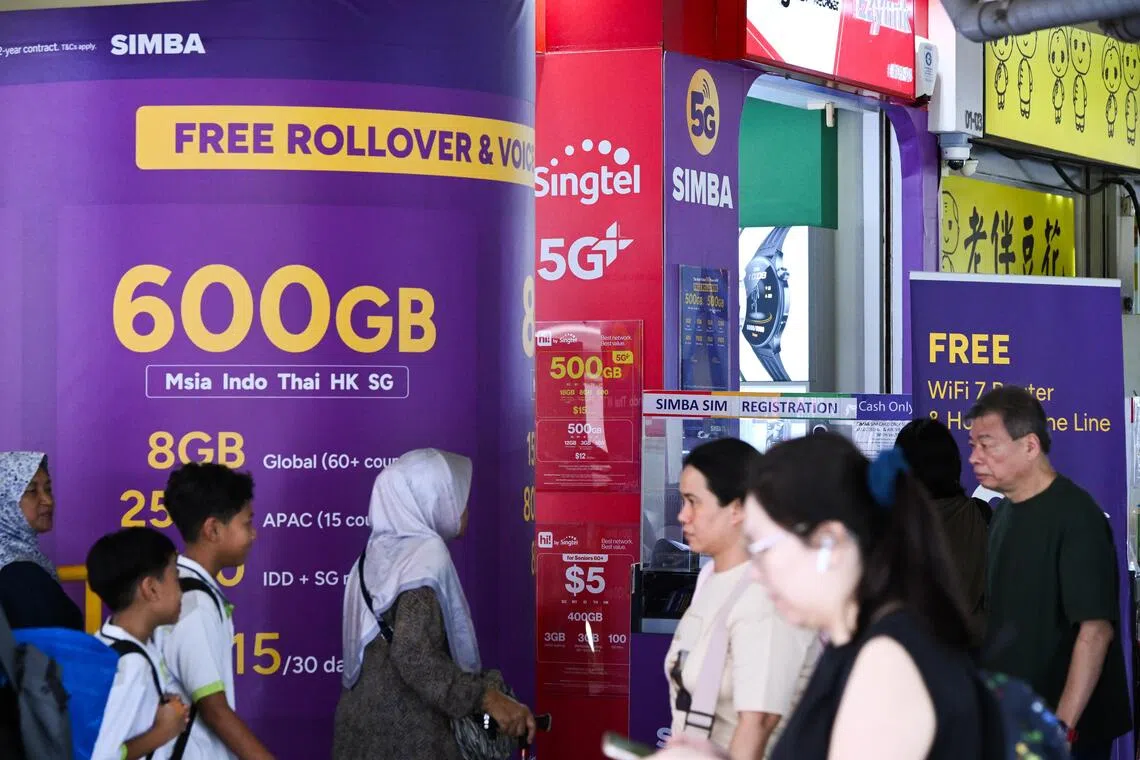
Tuas’ net profit stood at about $26 million for the full year ended July 31.
ST PHOTO: LIM YAOHUI
Young Zhan Heng and Shikhar Gupta
Published Sep 23, 2026, 10:00 AM
Updated Sep 23, 2026, 07:57 PM
SINGAPORE – Simba has shed more light on the unauthorised spectrum usage that contributed to the collapse of its proposed acquisition of M1, saying on Sept 23 that it used spectrum beyond the limits permitted by the regulator.
“There was some use of spectrum that was permitted by the IMDA (Infocomm Media Development Authority), and we then used it outside the limitations that were in that purpose,” said Tony Moffatt, company secretary of Simba’s Australian-listed parent Tuas, in an earnings call.
Management attributed the unauthorised usage of the 2,300 megahertz spectrum – used for 4G networks – to a combination of both hardware and software issues, without giving further details.
In May, the $1.4 billion deal between Simba and M1 fell through after IMDA said that Simba could have used radio frequency bands it was not assigned to provide mobile services, which would constitute a breach of Singapore’s Telecommunications Act.
Tuas said in its annual report that IMDA has yet to advise Simba on what consequences would follow should it find that spectrum has been misused.
Such consequences may include financial penalties, modifications to, or termination of Simba’s licences to operate in Singapore, and personal consequences for individuals found to have been involved, it added.
Moffatt said that the company does not have further information about when IMDA will be making its decision.
“We remain fully cooperative with the IMDA regarding the unauthorised spectrum usage matter and are currently awaiting their formal decision,” wrote David Teoh, executive chairman of Tuas, in the annual report.
In a statement to The Business Times on Sept 23, an IMDA spokesperson said that the regulatory body is still investigating the matter.
The spokesperson added that the authority will take the “appropriate enforcement actions” should any issues be established.
Profits more than treble
Despite ongoing regulatory uncertainty, Tuas saw its full-year net profit more than treble on the back of subscriber growth and a broader mix of plans catering to different customer segments.
Net profit stood at about $ 26 million for the full year ended July 31, up 277 per cent from about $6.9 million in 2025 .
Revenue increased 24 per cent year on year to $187.6 million, from $151.3 million.
Earnings per share rose from 1.48 cents to 4.78 cents, while underlying earnings before interest, taxes, depreciation and amortisation (Ebitda) was up 22 per cent at $83.8 million.
Underlying Ebitda excluded “significant items of $3.7 million” related to due diligence and professional engagements around the failed M1 acquisition from Keppel.
Tuas raised $322 million from institutional investors through a placement and $42.5 million through a share purchase plan from existing shareholders to support the M1 acquisition.
With the deal now off, the board said it is yet to make a decision on the use of the raised capital.
Simba’s active mobile services increased from about 1.3 million at the end of the 2025 financial year to nearly 1.5 million as at July 31, 2026 , despite an “increasingly competitive market”.
Its fibre broadband business ended the 2026 financial year with 62,000 subscribers.
Gross mobile average revenue per user stood at $9.42 and did not include interconnect revenue, which is growing with Simba’s larger subscriber base, said the company.
Tuas does not believe that Simba would necessarily be excluded from future consolidation in Singapore’s telco market following the failed M1 acquisition.
“I don’t think we will be blocked from participating in consolidation should an opportunity arise,” said Moffatt. “But there is nothing that is happening at this stage that would lead us to a view that it is likely to happen in the near term.”
For the new financial year, Tuas said that it expects Simba to incur an additional $15 million to $30 million in capital and operating expenditure.
This will help it meet cybersecurity requirements imposed by Singapore regulators, said management.
Teoh added that Simba is also developing “new innovative products for the Singapore market”, set to be launched in the new financial year.
Richard Tan, CEO of Simba, noted that the telco is eyeing more growth in the business and enterprise space, specifically within the enterprise broadband space.
Shares of Tuas on the Australian Securities Exchange closed 23.4 per cent or 54.4 Australian cents lower at A$1.785 on Sept 23, after the announcement.
In the year to date, shares of Tuas have fallen A$5.30 or 74.8 per cent from A$7.08. THE BUSINESS TIMES
截至7月31日的整个财年,Tuas的净利润约为2600万美元。
ST 照片:林耀辉
杨占恒和希卡尔·古普塔
发布于2026年9月23日上午10:00
更新于2026年9月23日晚上7:57
新加坡——Simba 就其收购 M1 的计划失败所导致的未经授权的频谱使用问题作出了进一步说明。该公司于 9 月 23 日表示,其使用的频谱超出了监管机构允许的范围。
Simba 的澳大利亚上市母公司 Tuas 的公司秘书 Tony Moffatt 在财报电话会议上表示:“我们利用了 IMDA(新加坡资讯通信媒体发展局)允许的一些频谱,然后将其用于超出该目的限制之外的用途。”
管理层将未经授权使用 2300 兆赫频谱(用于 4G 网络)归咎于硬件和软件问题的综合影响,但没有提供更多细节。
今年 5 月,Simba 与 M1 之间价值 14 亿美元的交易告吹,原因是新加坡资讯通信媒体发展局 (IMDA) 表示,Simba 可能使用了未被分配的无线电频段来提供移动服务,这将构成对新加坡电信法的违反。
Tuas在年度报告中表示,IMDA尚未就如果发现频谱被滥用将会产生哪些后果向Simba提供建议。
声明还补充说,此类后果可能包括经济处罚、修改或终止 Simba 在新加坡的经营许可证,以及对被发现参与其中的个人采取个人行动。
莫法特表示,该公司目前尚不清楚新加坡资讯通信媒体发展局(IMDA)何时会做出决定。
“我们将继续全力配合新加坡资讯通信媒体发展局(IMDA)处理未经授权的频谱使用事宜,目前正在等待他们的正式决定,”大士集团执行主席大卫·张在年度报告中写道。
9月23日,IMDA发言人在接受《商业时报》采访时表示,该监管机构仍在调查此事。
发言人补充说,如果查明存在任何问题,有关部门将采取“适当的执法行动”。
利润超过三倍
尽管监管方面仍存在不确定性,但由于用户增长和针对不同客户群体的更广泛套餐组合,大士集团全年净利润增长超过三倍。
截至 7 月 31 日的整个财年,净利润约为 2600 万美元,比 2025 年的约 690 万美元增长了 277%。
营收同比增长 24%,从 1.513 亿美元增至 1.876 亿美元。
每股收益从 1.48 美分增至 4.78 美分,而扣除利息、税项、折旧和摊销前的基本收益(EBITDA)增长了 22%,达到 8380 万美元。
基础EBITDA不包括与收购吉宝集团旗下M1失败相关的尽职调查和专业服务相关的“370万美元重大项目”。
Tuas 通过配售从机构投资者处筹集了 3.22 亿美元,并通过现有股东的股份购买计划筹集了 4250 万美元,以支持对 M1 的收购。
由于交易告吹,董事会表示尚未决定如何使用筹集的资金。
尽管“市场竞争日益激烈”,但截至 2026 年 7 月 31 日,Simba 的活跃移动服务用户数已从 2025 财年末的约 130 万增至近 150 万。
其光纤宽带业务在 2026 财年结束时拥有 62,000 名用户。
该公司表示,移动端平均每用户收入为 9.42 美元,不包括互联互通收入,而随着 Simba 用户群的扩大,互联互通收入也在增长。
Tuas认为,在M1收购失败后,Simba未必会被排除在新加坡电信市场的未来整合之外。
莫法特表示:“我认为,如果出现机会,我们不会错过参与整合的机会。但目前没有任何迹象表明,这种情况近期内可能会发生。”
Tuas表示,预计新财年Simba将额外产生1500万至3000万美元的资本和运营支出。
管理层表示,这将有助于公司满足新加坡监管机构提出的网络安全要求。
Teoh补充说,Simba也在为新加坡市场开发“新的创新产品”,这些产品将在新的财政年度推出。
Simba 首席执行官 Richard Tan 指出,该电信公司正着眼于在商业和企业领域,特别是企业宽带领域,寻求更大的增长。
消息公布后,Tuas 股票在澳大利亚证券交易所于 9 月 23 日收盘下跌 23.4% 或 54.4 澳分,报 1.785 澳元。
今年以来,Tuas的股价已从7.08澳元下跌5.30澳元,跌幅达74.8%。《商业时报》