Air, Space Forces pick up research pace for orbital cargo delivery空军和太空部队加快轨道货物运输的研究步伐
The current focus is on low cost, high volume commercial cargo reentry pods, an Air Force Research Laboratory spokesperson told Breaking Defense.
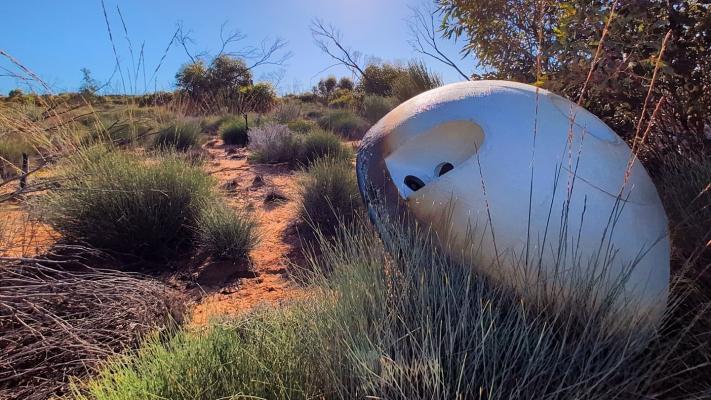
Varda landed its sixth cargo reentry capsule in the Australian Outback in May. (Photo: Australia Space Agency)
WASHINGTON — The Air and Space Forces over the past year have been picking up the pace of their multi-tiered research initiative aimed at developing an unusual idea seemingly straight from science fiction: the capability to rapidly deliver cargo into global hot zones by launching it through space.
But while the Pentagon was originally looking primarily at using large, reusable rockets for the delivery of goods, the military is now shifting its attention towards smaller reentry capsules.
The bi-service effort to leverage commercial capabilities for point-to-point delivery via space is somewhat confusing because it encompasses different programs with money in different budget pots — some funded jointly and some through service-specific spending.
The mother of them all, however, was the Air Force Research Laboratory’s (AFRL) high-priority Vanguard program called Rocket Cargo , which began in June 2021 and focused on launching rockets filled with 30 tons of logistical supplies from the United States, into space, and down on far-flung bases and battlefields.
While that program is being phased down — the Air Force zeroed out funds in its fiscal 2026 budget and the Space Force gave it only a few million dollars in FY26 and FY27 — the children of Rocket Cargo live on and prosper today.
An AFRL spokesperson revealed that reason for the shift in focus towards reentry capsules is because of several promising advantages, including :
the logistics of rapidly unloading cargo at the delivery site,
the ability to deliver cargo to a more diverse range of austere sites and terrain,
the ability to deploy multiple reentry capsules in a single launch to deliver cargo to the point of need at several different locations, and
near-term potential for broad vendor diversity, both in the reentry capsule systems and options to deliver reentry capsules from multiple launch providers.
There are three primary efforts focused on cargo delivery through orbit, each with its own technological focus and budgets. Here’s what to know.
Payload Delivery System (P2D)
The development of reentry capsules now is being undertaken by an AFRL program called the Payload Delivery System (PDS) funded jointly by the Air and Space Forces.
“Due to the nature of these multi-disciplinary challenges spanning both Air and Space, the PDS project is structured to leverage expertise and resources across the services. While the U.S. Space Force is the lead service, the technology challenges are joint in nature,” the spokesperson added. “One example is the end-to-end cargo transport environments, including space, during reentry, and during delivery at an austere site (this may include land or sea).”
The two services began joint funding of the PDS program this year, with the Air Force fiscal 2026 budget slating $30.6 million and the Space Force’s $21.2 million. The Air Force asked for $32.3 million in its FY27 request; the Space Force asked for $16.5 million.
AFRL is working with a number of commercial firms under PDS, some established and some brand new, to find a solution that hits the sweet spot of low-cost pods that can carry a lot of cargo.
Reentry capsules are not a new thing: NASA, of course, has been using them for years to recover experiments as well as astronauts. These are very large, and also very expensive.
More recently, firms such as Varda Space Industries and Inversion Space have begun demonstrating smaller reentry vehicles for commercial uses, such as growing pharmaceuticals and building microchips in space and bringing them back to Earth.
According to market tracking website Factories in Space , there were 65 registered companies around the world working at some developmental stage on cargo reentry vehicles as of last September. Included in that number are big players SpaceX, which launched its first Starfall pod demo on June 23 , and Blue Origin, which has yet to launch.
“Under the Rocket Cargo Vanguard and the Payload Delivery System project, we are engaged with industry to explore the potential trade-space for large, low-cost reentry capsules that are more suitable for rapid global mobility. To date, we have engaged with a number of potential commercial vendors, including SpaceX, Blue Origin, Rocket Lab, Sierra Space, Varda, Inversion Space, Outpost Space, and a number of other small businesses,” the AFRL spokesperson said.
“Ultimately, we would like a broad vendor base for low-cost reentry solutions with the cargo capacity and delivery capability to austere sites for rapid global mobility,” the spokesperson added.
Point-to-Point Delivery (P2D)
The Space Force’s Servicing, Mobility, and Logistics (SML) program managed by System Delta 80 is responsible for the Point-to-Point Delivery (P2D) program, as one of its two mission areas. P2D is aimed at “orbital supply prepositioning and operational downmass as well as responsive sub-orbital and orbital point-to-point delivery operations,” according to service budget documents.
“The near-term focus of the P2D project will leverage technology developed within both commercial independent research and development (IRAD) and AFRL’s Rocket Cargo Vanguard program to study and develop P2D reference missions,” the budget documents say. (A reference mission is a concept study looking at the feasibility of a technology and/or capability.)
The Space Force began the P2D program in FY25 with $3.9 million, slated $19.3 million for it in FY26, and asked for $9.7 million in FY27 — with a similar amount projected each year through FY31.
Rocket Experimentation For Global Agile Logistics (REGAL)
Related to the P2D program is an AFRL Other Transaction Authority contract vehicle called Rocket Experimentation for Global Agile Logistics (REGAL), first published in 2021, with the terms of reference updated in 2024 .
Under REGAL, no funds are being provided to develop commercial rockets. Instead, the focus is on funding P2D-related tech and demonstrations. Further, included in REGAL are no-cost agreements, so the overarching value of ongoing work is unclear.
Sierra Space in October 2024 announced an undisclosed REGAL contract; similarly Rocket Lab announced an undisclosed REGAL award in May 2025 .
AFRL awarded Blue Origin $1.3 million and Anduril $1 million under REGAL in September 2025 . In July, the lab added $11.7 million to Blue Origin’s contract bringing the total up to $13 million.
今年5月,瓦尔达号航天飞机在澳大利亚内陆地区成功回收了第六艘货运返回舱。(图片:澳大利亚航天局)
华盛顿——过去一年,美国空军和太空部队加快了其多层次研究计划的步伐,该计划旨在开发一种看似直接来自科幻小说的不寻常想法:通过太空发射,将货物快速运送到全球热点地区的能力。
但尽管五角大楼最初主要考虑使用大型可重复使用的火箭来运送货物,但现在军方正在将注意力转移到较小的再入舱上。
利用商业能力通过太空进行点对点交付的双军种合作计划有些令人困惑,因为它涵盖了不同的项目,资金来自不同的预算池——有些是联合资助的,有些是通过特定军种的支出资助的。
然而,所有这些计划之母,是美国空军研究实验室 (AFRL) 的高优先级先锋计划,名为“火箭货运”。该计划于 2021 年 6 月启动,重点是将装满 30 吨后勤物资的火箭从美国发射到太空,并降落到遥远的基地和战场。
虽然该计划正在逐步缩减——空军在 2026 财年预算中取消了拨款,太空军在 2026 财年和 2027 财年也只给了它几百万美元——但火箭货运的后代们如今依然存在并蓬勃发展。
美国空军研究实验室(AFRL)发言人透露,之所以将研究重点转向再入舱,是因为再入舱具有多项显著优势,其中包括:
在交货地点快速卸载货物的物流,
能够将货物运送到更多不同条件艰苦的地点和地形,
能够在一次发射中部署多个再入舱,将货物运送到多个不同地点的所需地点;
近期内,供应商多样性具有很大的潜力,无论是再入舱系统,还是从多个发射供应商交付再入舱的选择。
目前有三项主要计划致力于通过轨道运送货物,每项计划都有其自身的技术重点和预算。以下是您需要了解的内容。
有效载荷投送系统(P2D)
再入舱的研发目前由空军研究实验室 (AFRL) 的一个项目负责,该项目名为有效载荷投送系统 (PDS),由空军和太空军联合资助。
发言人补充道:“鉴于这些涉及航空航天领域的多学科挑战的性质,PDS项目旨在充分利用各军种的专业知识和资源。虽然美国太空军是牵头军种,但技术挑战本质上是各军种共同面临的。例如,端到端的货物运输环境,包括太空环境、再入大气层过程以及在条件艰苦的地点(可能包括陆地或海上)的交付过程。”
今年,空军和太空军开始联合资助PDS项目,空军2026财年预算拨款3060万美元,太空军拨款2120万美元。空军在2027财年预算申请中要求拨款3230万美元,太空军申请拨款1650万美元。
AFRL 正在与 PDS 下的多家商业公司合作,其中一些是老牌公司,一些是新公司,以找到一种既能低成本又能承载大量货物的解决方案。
再入舱并非新生事物:美国宇航局(NASA)多年来一直使用它们来回收实验设备和宇航员。这些返回舱体积庞大,造价也极其昂贵。
最近,瓦尔达航天工业公司和逆向航天公司等企业开始展示用于商业用途的小型再入飞行器,例如在太空中培育药品和制造微芯片,然后将其带回地球。
据市场追踪网站“太空工厂”(Factories in Space)的数据显示,截至去年9月,全球共有65家注册公司正在研发货运再入飞行器。其中包括SpaceX和蓝色起源两大巨头。SpaceX于6月23日发射了首个“星陨”(Starfall)吊舱演示样机,而蓝色起源尚未进行发射。
“在火箭货运先锋号和有效载荷运载系统项目下,我们正与业界合作,探索大型、低成本再入舱的潜在交易空间,这种再入舱更适合快速的全球运输。迄今为止,我们已与多家潜在的商业供应商进行了接洽,包括SpaceX、蓝色起源、火箭实验室、Sierra Space、Varda、Inversion Space、Outpost Space以及其他一些小型企业,”空军研究实验室发言人表示。
发言人补充说:“最终,我们希望拥有广泛的供应商基础,提供低成本的再入解决方案,并具备向条件艰苦的地点运送货物的能力,以实现快速的全球流动性。”
点对点交付 (P2D)
由Delta 80系统管理的太空军后勤、机动和物流(SML)项目负责点对点交付(P2D)项目,这是其两大任务领域之一。根据太空军预算文件,P2D的目标是“轨道补给预置和作战物资下放,以及快速响应的亚轨道和轨道点对点交付行动”。
预算文件指出,“P2D项目的近期重点将利用商业独立研发(IRAD)和空军研究实验室(AFRL)火箭货运先锋计划中开发的技术,研究和开发P2D参考任务。”(参考任务是对某项技术和/或能力可行性的概念研究。)
太空部队于 2025 财年启动了 P2D 计划,预算为 390 万美元,2026 财年预算为 1930 万美元,2027 财年预算为 970 万美元——预计到 2031 财年,每年的预算金额都将大致相同。
全球敏捷物流火箭实验(REGAL)
与 P2D 计划相关的 AFRL 其他交易授权合同工具是全球敏捷物流火箭实验 (REGAL),该合同于 2021 年首次发布,其职权范围于 2024 年更新。
根据REGAL计划,不提供资金用于开发商业火箭。相反,该计划的重点是资助与P2D相关的技术和演示。此外,REGAL计划包含无成本协议,因此正在进行的工作的总体价值尚不明确。
Sierra Space 于 2024 年 10 月宣布了一项未公开的 REGAL 合同;同样,Rocket Lab 于 2025 年 5 月宣布了一项未公开的 REGAL 合同。
2025 年 9 月,AFRL 根据 REGAL 协议向 Blue Origin 授予 130 万美元,向 Anduril 授予 100 万美元。7 月,该实验室向 Blue Origin 的合同追加了 1170 万美元,使总额达到 1300 万美元。