ACM brings China UNESCO site Mogao Caves and 13m-long reclining Buddha to S’poreACM将中国联合国教科文组织世界遗产莫高窟和13米长的卧佛带到新加坡
ACM brings China Unesco site Mogao caves and 13m-long reclining Buddha to S’pore. Read more at straitstimes.com.
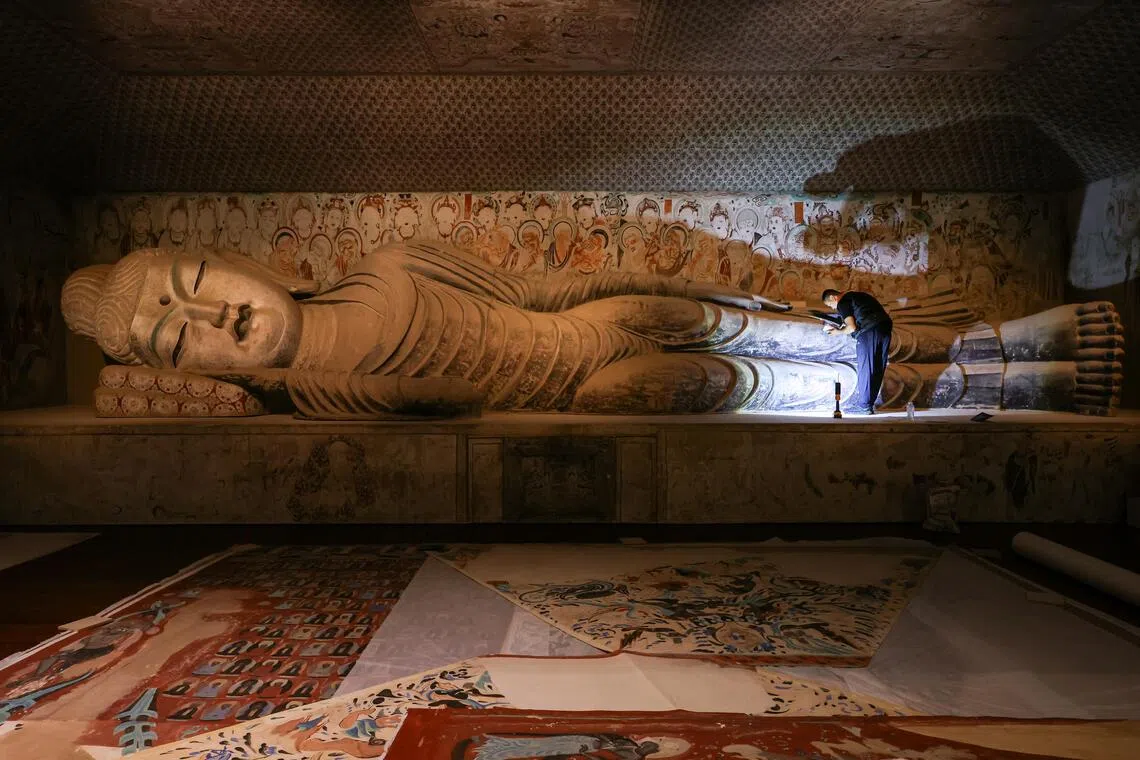
Dunhuang Academy staff touching up a 13m-long Buddha sculpture ahead of the Sacred Caves: Dunhuang, Buddhism, And The Silk Road exhibition at the Asian Civilisations Museum.
Published Sep 23, 2026, 02:37 PM
Updated Sep 24, 2026, 05:48 AM
The Asian Civilisations Museum in Singapore hosts the Sacred Caves exhibition, showcasing replicas and original artefacts from China's Mogao Caves.
The UNESCO World Heritage Site is a multi-religious explosion of frescos and giant sculptures.
The exhibition also emphasises everyday artefacts from Dunhuang, including portraits that show early make-up.
DUNHUANG – On the lawn of the Asian Civilisations Museum (ACM), a 6m inflatable jostles for height with nearby trees.
This illuminated cartoon figure with a cherubic smile, draped in a gravity-defying sash, is an avatar of the apsaras, the “cheerleaders” of Buddhism. Where they are, it is said, there is music and flowers, a nirvana saturated with fragrance.
These celestial beings have become synonymous with the north-western Chinese desert city of Dunhuang – a tourist hot spot for China’s domestic travellers.
A slice of this arid city now sits at the ACM’s blockbuster exhibition, Sacred Caves: Dunhuang, Buddhism, And The Silk Road, created in partnership with China’s state-run Dunhuang Academy.
From Sept 25, visitors can step into 1,000-year-old grottoes filled with monumental sculptures and floor-to-ceiling murals from the renowned UNESCO World Heritage site Mogao Caves, so named for its “peerless” status.
Comprising four full replica caves, 22 paintings and 47 original artefacts, it is the biggest show of Dunhuang treasures in South-east Asia and is on till March 7.
The Mogao Caves, a hive of 500 ornately decorated chambers chipped into the soft gravel facade of the Mingsha mountains, is still relatively little-known outside China. But in culture and history circles, it has long been famous as a repository of some of the world’s most eloquent Buddhist art.
Think the Sistine Chapel in Vatican City, but multiplied hundredfold.
The man-made caves are diverse in size and are illustrative of the prayers of humble workers and the demonstrative vanity of the rich, their efforts at accumulating merit spanning the fourth to 14th centuries.
An inflatable apsara stands tall on the Empress Lawn in front of the ACM. ST PHOTO: JASON QUAH
An inflatable apsara stands tall on the Empress Lawn in front of the ACM.
ST PHOTO: JASON QUAH
The images they contain are a portal into humanity’s reverential imaginings, from a human-faced bird in Chinese mythology to Hindu elephant-faced Ganesha to suggestions of Greek sun god Apollo.
ACM curator Louise Lui says: “Even though ancient Dunhuang and contemporary Singapore are very far apart in time and space, they share many traits. One is on the Overland Silk Road, the other is on the Maritime Silk Road.
ACM curator Louise Lui in front of a replica of a Mogao Caves mural in Dunhuang, China. PHOTO: LIANHE ZAOBAO
ACM curator Louise Lui in front of a replica of a Mogao Caves mural in Dunhuang, China.
PHOTO: LIANHE ZAOBAO
“Both cities were shaped by trade movement, and cultural encounter and exchange, which is not something that is modern, but something that’s been happening for thousands of years.”
In the ACM foyer, a 13m-long reclining Buddha greets visitors, a shrunken replica as the original at 15.6m was simply too long for the space. Assembled in parts, its head alone weighs some 200kg and required 12 full-grown men to manoeuvre up the heritage building’s stairs.
Bringing history out of China
It is patently impossible to capture in ACM the mystique of the Mogao Caves, around which an entire tourist industry has blossomed, catering to nearly 20 million visitors annually.
Apsara sculptures tower in hotel lobbies. Two elaborate immersive theatre shows with purpose-built arenas are powered by state-of-the-art light equipment, with hundreds of actors popping out from niches to tell the Mogao Caves story, given a nationalistic spin.
One is directed by Wang Chaoge, co-director of the opening and closing ceremonies of the 2008 Beijing Olympics. Actresses playing goddesses wail from behind gauzy sheets: “After so much time, tell me, am I still pretty?”
Elaborate immersive shows tell the stories of the Mogao Caves in Dunhuang, digging into the endless possibilities of its pantheon. PHOTO: LIANHE ZAOBAO
Elaborate immersive shows tell the stories of the Mogao Caves in Dunhuang, digging into the endless possibilities of its pantheon.
A chorus bemoans the traitorous 20th-century sales of precious manuscripts found in the caves to Western archaeologists.
Chinese domestic tourists still make up the bulk of visitors. For those committed to seeing them in person, the Mogao Caves is a 12-hour flight from Singapore via a Beijing transfer, and then a one-hour car ride from the airport.
Securing entry requires fast fingers: Ticket sales are limited to 6,000 a day, tied to identity card numbers to prevent multiple bookings and price gouging, with extra “emergency tickets” during peak seasons.
Each slot allows visitors entry to just four to eight caves to prevent overcrowding. Curator Lui, on her third visit to Dunhuang, has seen fewer than 20 even with privileged access.
The Mogao Caves is carved into the cliffs on the edge of the Gobi Desert. PHOTO: LIANHE ZAOBAO
The Mogao Caves is carved into the cliffs on the edge of the Gobi Desert.
Human sweat and breath are all hazardous to the delicate works. At any point, vigilant guides are wont to usher visitors out when a hygrometer measuring humidity sounds the alarm.
Despite all precautions, there is damage, most visibly from before 1944 when the state began institutional protection. Without doors, animals took shelter in the caves and chafed against the stone surface. Pre-modern visitors were not averse to graffiti. Sun rays exacted a toll.
The ACM exhibition – and Dunhuang Academy’s role in exporting it – is, therefore, primarily a matter of access.
The show features four replica caves, mostly reproduced in a one-to-one ratio either by digital scans or hand-drawn over years by Dunhuang Academy artists in a copying tradition called linmo drawings. Three are special access caves that are highly regulated and cost more to enter in Dunhuang.
A linmo artist takes months to complete a drawing, building it layer by layer. PHOTO: LIANHE ZAOBAO
A linmo artist takes months to complete a drawing, building it layer by layer.
They are constructed just as one would encounter them. Access is through a narrow entryway.
Inside, the space opens up high and wide to reveal an intricate pantheon where the Eastern practice of leaving empty space is ignored.
Deity sculptures, moulded from wooden frames and given flesh with straw, occupy each cave nominally created to honour them. Despite harsher lights, their eyes still slope downwards, entreating visitors to bend for a brief moment of darshan, or mutual gazing.
The story the ACM wants to tell, however, is not one of reconstruction of temples.
In the eclectic fusion of figures in the paintings, so numerous they require a guide and glossary, is a tale of multiculturalism before the word came into vogue and provoked recent global backlash.
Curator Lui says of Dunhuang’s cosmopolitan nature: “The early caves adopted a lot of Indian and Central Asian painting styles, and you find t his u nique synthesis. In a way, Dunhuang and Mogao transmit these kinds of styles towards the central plains and that influences ‘traditional’ Chinese painting as well.”
One of the replica caves shows the commingling of Buddhist, Taoist and other imagery from Chinese mythology. ST PHOTO: JASON QUAH
One of the replica caves shows the commingling of Buddhist, Taoist and other imagery from Chinese mythology.
That cross-cultural cosmos manifests in unexpected ways.
One can spot horoscopes, originally from ancient Mesopotamia (a historical region in the Middle East), making their way into paintings by way of Greece.
That 13m reclining Buddha, sponsored by Tibetan monks, is flanked by a gory fresco of rulers from far-ranging parts of the world mourning by cutting into their chests or painfully removing their noses.
Its dense iconography means not all mysteries have been unravelled. The ACM exhibition has chosen to begin its story with the enigmatic symbol of three rabbits in a circle, found adorning the symbolic fireproof capstone of one of the caves.
This is a motif that has been sighted across Eurasia, from Iranian metalwork to Jewish synagogues to European churches. The example in Dunhuang is its earliest provenance, though its meaning has been endlessly speculated upon, from rabbits being associated with water and the moon to the Holy Trinity.
Curator Louise Lui during a media preview of the ACM exhibition. ST PHOTO: JASON QUAH
Curator Louise Lui during a media preview of the ACM exhibition.
Lui says: “We don’t actually know the origins of it and why and how it was transmitted. I think the reason it has been so pervasive i s that di fferent cultures adopted it and made it their own.”
The Mogao Caves also cannot be seen purely through a religious lens. Some of the original artefacts are sutras – recordings of Buddhist sermons in a variety of scripts – telling of the evolution of written language .
There are coins and custom permits. Narrative paintings speak of the bandits caravans encountered on trade routes, while portraits of female patrons show the distinctive use of flower petal paintings or appliques as make-up, again pre-empting the modern use of the pimple patch or glitter for creative expression.
The increasing size of the figures tells its own implicit story of human ego. Measured from headdress to dress hem, one comes up to nearly 2m tall, a donor aspiring to the scale of the gods.
Larger-than-life portraits of patron women show the distinctive use of flower petal paintings or appliques as make-up. PHOTO: LIANHE ZAOBAO
Larger-than-life portraits of patron women show the distinctive use of flower petal paintings or appliques as make-up.
“A lot of them relate very closely to our contemporary experiences,” says Lui, who made sure a section of the exhibition is reserved for the secular.
“We have mundane things like a piece of paper where someone was practising their calligraphy.
“I hope people will find joy in or be moved by these, and we also have things that speak to deeper emotions like filial piety and devotion.”
Today, Dunhuang Academy exports exhibitions all around the world, and engages in a race against time to digitise the contents of its fertile caves.
Its deputy director Zhang Yuanlin says this is in part because of the belief that Dunhuang can provide inspiration for a framework from which to build humanity’s common destiny.
Dunhuang Academy uses high-resolution scans and other methods of 3D imaging to digitise the Mogao Caves. PHOTO: LIANHE ZAOBAO
Dunhuang Academy uses high-resolution scans and other methods of 3D imaging to digitise the Mogao Caves.
He is aware there are those who still see the replicas they export as inferior, but says: “They are true to the original. People can look at them without a barrier between themselves and the work. We’ve even captured their decolourisation over time, and they are good enough for us in our research.”
Linmo paintings, the copies of the original by hand, are regarded as works of art in their own right in China, completed by famed artists including Dunhuang Academy’s founding director Chang Shuhong.
Naturally, there are spectacles ACM could not bring to South-east Asian shores, including a 35.5m-tall Maitreya Buddha that is the third-largest Buddha sculpture in China, housed in a nine-storey pagoda built directly against the cliff edge.
Size constraints aside, Lui, who has dreamt of working on the Mogao Caves, says the fulfilment rate of her wish list was “pretty good”, including several that have not been exhibited outside China.
There is a tragic epilogue to this city. Spanning over 10 Chinese dynasties including the best-known Tang Dynasty, Dunhuang would meet an ignominious end in the Yuan Dynasty due to desertification and the rise of the Maritime Silk Road.
The desert dunes of Dunhuang have become photo hot spots for dolled-up tourists. PHOTO: LIANHE ZAOBAO
The desert dunes of Dunhuang have become photo hot spots for dolled-up tourists.
The effects of climate change may not be directly addressed in the exhibition, but there are obvious parallels.
Still, the successive generations of workmen offer a rejoinder to Percy Bysshe Shelley’s lament of autocratic vaingloriousness Ozymandias (1818) – “Round the decay/ Of that colossal wreck, boundless and bare/ The lone and level sands stretch far away.”
In China, the sands still stretch, but over 700 years since the last drop of ink dried, their achievement now sounds echoes across the seas.
Dunhuang Academy’s Zhang says: “They show us what happens when different civilisations interact. What changed? Why did some things change or didn’t change? It’s one of the reasons so many people love our site.”
Book It/Sacred Caves: Dunhuang, Buddhism, And The Silk Road
Where: Asian Civilisations Museum, 1 Empress Place When: Sept 25 to March 7, Saturdays to Thursdays, 10am to 7pm; Fridays, 10am to 9pm Admission: $10 for Singaporeans and permanent residents; $25 for foreigners Info: str.sg/qWhWB
The reporter’s trip to Dunhuang was sponsored by the Asian Civilisations Museum.
Asian Civilisations Museum
在亚洲文明博物馆举办的“神圣石窟:敦煌、佛教与丝绸之路”展览之前,敦煌研究院的工作人员正在对一尊 13 米长的佛像进行修缮。
发布于 2026 年 9 月 23 日下午 2:37
更新于2026年9月24日 上午5:48
新加坡亚洲文明博物馆举办“神圣洞穴”展览,展出中国莫高窟的复制品和原件文物。
这座联合国教科文组织世界遗产地是多宗教融合的艺术瑰宝,拥有丰富的壁画和巨型雕塑。
展览还重点展示了敦煌出土的日常用品,包括展现早期化妆的人像画。
敦煌——在亚洲文明博物馆(ACM)的草坪上,一个6米高的充气物与附近的树木争夺高度。
这个面带天使般笑容、身披飘逸长袍、闪闪发光的卡通人物,是佛教“啦啦队”——阿普萨拉斯的化身。据说,她们所在之处,便有音乐和鲜花,弥漫着芬芳的涅槃。
这些天上的神灵已经成为中国西北部沙漠城市敦煌的代名词——敦煌是中国国内游客的热门旅游目的地。
如今,这座干旱城市的一角,在ACM的重磅展览“神圣的石窟:敦煌、佛教与丝绸之路”中得以展现。该展览由ACM与中国官方的敦煌研究院合作举办。
从 9 月 25 日起,游客可以进入拥有 1000 年历史的洞穴,欣赏莫高窟——联合国教科文组织世界遗产——中巨大的雕塑和从地板到天花板的壁画。莫高窟因其“举世无双”的地位而得名。
该展览包括四个完整的复制洞窟、22幅壁画和47件原件,是东南亚最大的敦煌文物展,将持续到3月7日。
莫高窟位于鸣沙山柔软的砾石层上,由500多个装饰精美的洞室组成,在中国以外的地方仍然鲜为人知。但在文化和历史界,它早已被誉为世界上最精美的佛教艺术宝库之一。
想象一下梵蒂冈的西斯廷教堂,但规模要扩大百倍。
这些人工开凿的洞穴大小不一,体现了卑微劳动者的祈祷和富人的炫耀性虚荣,他们为积累功德所做的努力跨越了公元四世纪到十四世纪。
在亚洲文化中心前的皇后草坪上,矗立着一座高大的充气仙女像。(海峡时报摄影:JASON QUAH)
在ACM前的皇后草坪上,矗立着一座高大的充气仙女像。
《海峡时报》摄影:JASON QUAH
它们所包含的图像是通往人类敬畏想象的门户,从中国神话中的人脸鸟到印度教象头神伽内什,再到希腊太阳神阿波罗的暗示。
ACM策展人路易丝·刘表示:“尽管古代敦煌和现代新加坡在时间和空间上相距甚远,但它们有很多共同之处。一个位于陆上丝绸之路,另一个位于海上丝绸之路。”
ACM 策展人路易丝·吕 (Louise Lui) 在中国敦煌莫高窟壁画复制品前。图片来源:联合早报
ACM 策展人路易丝·吕 (Louise Lui) 在中国敦煌莫高窟壁画复制品前。
图片来源:联合早报
“这两个城市都受到贸易往来、文化交流和碰撞的影响,这不是现代才有的事情,而是几千年来一直在发生的事情。”
在ACM的大厅里,一尊13米长的卧佛迎接来访者。这尊佛像是一个缩小版的复制品,因为原像长达15.6米,对于这个空间来说实在太长了。这尊佛像由多个部件组装而成,仅头部就重达200公斤,需要12个成年男子才能将其抬上这座历史建筑的楼梯。
将历史带出中国
显然,ACM 无法捕捉到莫高窟的神秘魅力,围绕着莫高窟已经发展出一个完整的旅游业,每年接待近 2000 万游客。
酒店大堂里耸立着仙女雕像。两场精心打造的沉浸式戏剧表演,在专门建造的舞台上,借助最先进的灯光设备,数百名演员从壁龛中探出头来,讲述莫高窟的故事,并赋予其民族主义色彩。
其中一部由2008年北京奥运会开幕式和闭幕式联合导演王朝歌执导。片中扮演女神的女演员们躲在薄纱床单后哀叹:“过了这么久,告诉我,我还会漂亮吗?”
精心打造的沉浸式表演讲述了敦煌莫高窟的故事,深入挖掘了其神祇体系的无限可能。图片:联合早报
精心设计的沉浸式表演讲述了敦煌莫高窟的故事,挖掘了其神祇体系的无限可能性。
合唱团哀叹 20 世纪将洞穴中发现的珍贵手稿卖给西方考古学家的背叛行为。
中国国内游客仍然是游客的主力军。对于那些决心亲眼目睹莫高窟的人来说,从新加坡经北京转机,飞行12小时后再从机场驱车1小时即可到达莫高窟。
想要顺利入场需要手速:门票每天限售 6000 张,并与身份证号码绑定,以防止重复预订和哄抬物价,旺季期间还会额外发放“紧急门票”。
为了避免过度拥挤,每个参观名额只允许游客进入四到八个洞窟。策展人刘女士第三次来到敦煌,即使拥有优先参观权,也只参观了不到20个洞窟。
莫高窟开凿于戈壁沙漠边缘的峭壁之上。图片来源:联合早报
莫高窟是在戈壁沙漠边缘的悬崖峭壁上开凿出来的。
人的汗液和呼吸都会对这些精密的装置造成损害。任何时候,当湿度计发出警报时,细心的导游都会立即引导游客离开。
尽管采取了各种预防措施,但洞穴仍然遭受了破坏,其中最明显的是1944年之前,也就是国家开始对其进行机构保护之前造成的。由于没有洞门,动物们只能在洞穴里栖身,它们会摩擦石质表面。前现代的访客们也乐于在洞穴里涂鸦。阳光照射也对洞穴造成了损害。
因此,ACM展览——以及敦煌研究院在向外推广该展览方面所发挥的作用——主要是一个准入问题。
展览展出了四个仿古洞窟,大部分仿古洞窟均以1:1的比例复制而成,复制方式包括数码扫描或敦煌研究院艺术家们耗时数年手工绘制的临摹作品。其中三个是敦煌特别开放的洞窟,参观需严格管制,且门票价格较高。
一位油画艺术家需要花费数月时间,一层一层地绘制完成一幅作品。图片来源:联合早报
一位油画艺术家需要花费数月时间才能完成一幅画作,一层一层地绘制而成。
它们的构造与人们实际见到的完全一样。入口很窄。
进入其中,空间高大开阔,展现出一个错综复杂的神殿,东方留白的习俗在这里被忽略了。
每个洞穴中都供奉着神像,这些神像以木框为骨架,用稻草填充而成,栩栩如生。尽管洞穴内光线昏暗,它们的目光依然向下倾斜,仿佛在恳求来访者俯身片刻,进行“达显”(darshan),即彼此凝视。
然而,ACM想要讲述的故事并不是关于重建寺庙的故事。
这些画作中人物形象丰富多样,数量之多以至于需要一份指南和词汇表来解释,它们讲述了一个多元文化主义的故事,而“多元文化主义”一词在当时还未流行,也未引发近期的全球强烈反对。
策展人刘先生谈到敦煌的国际化特质时说:“早期洞窟吸收了许多印度和中亚的绘画风格,形成了这种独特的融合。从某种意义上说,敦煌和莫高窟将这些风格传播到中原地区,这也影响了‘传统’中国绘画。”
其中一个仿制洞穴展现了佛教、道教以及中国神话中其他意象的融合。(海峡时报摄影:JASON QUAH)
其中一个仿制洞穴展现了佛教、道教和中国神话中其他意象的融合。
这种跨文化的宇宙以意想不到的方式展现出来。
人们可以看到,起源于古代美索不达米亚(中东的一个历史地区)的星座图案,经由希腊传入绘画作品中。
那尊由藏族僧侣赞助的 13 米高的卧佛像,两侧是一幅血腥的壁画,描绘了来自世界各地的统治者们通过割开胸膛或痛苦地割掉鼻子来哀悼的场景。
由于其丰富的图像学特征,并非所有谜团都已被解开。ACM展览选择以一个神秘的符号作为开篇:三个兔子围成一个圆圈,这个符号装饰在其中一个洞穴的防火顶石上。
这种纹饰在欧亚大陆各地均有发现,从伊朗的金属工艺品到犹太教堂,再到欧洲的教堂,都能见到它的身影。敦煌的这件藏品是目前已知最早的此类纹饰,但其含义却众说纷纭,从兔子与水和月亮的关联到圣三位一体的象征,不一而足。
策展人路易丝·刘在ACM展览媒体预览会上。ST摄影:JASON QUAH
策展人 Louise Lui 在 ACM 展览的媒体预览会上。
刘说:“我们其实并不了解它的起源,也不知道它为什么以及如何传播开来。我认为它之所以如此普遍,是因为不同的文化都吸收了它,并将其融入了自己的文化之中。”
莫高窟也不能仅仅从宗教角度来解读。一些原始文物是经文——用多种文字记录的佛教教义——讲述了文字的演变过程。
这里有硬币和海关许可证。叙事性绘画描绘了贸易路线上遇到的强盗商队,而女性顾客的肖像画则展现了用花瓣绘画或贴花作为化妆品的独特用法,这再次预示了现代使用祛痘贴或亮片进行创意表达的方式。
这些雕像尺寸的不断增大,本身就隐含着人类的自我意识。从头饰到裙摆,其中一个雕像高达近2米,仿佛捐赠者渴望达到神祇的高度。
赞助人女性的巨幅肖像画展现了她们独特的妆容,以花瓣彩绘或贴花点缀。图片:联合早报
赞助女性的巨幅肖像画展现了她们独特的妆容,画中运用了花瓣图案或贴花。
“其中很多作品都与我们的当代经历密切相关,”刘说,他还特意为展览留出了一部分世俗作品。
“我们这里有一些很普通的东西,比如一张纸,上面有人练习书法。
“我希望人们能从中找到快乐或被这些作品所感动,我们也有一些作品能触动人们内心深处的情感,比如孝道和奉献精神。”
如今,敦煌研究院的展览已遍及世界各地,同时正与时间赛跑,力求将其丰富的洞窟藏品数字化。
该机构副主任张元林表示,部分原因是人们相信敦煌可以为构建人类共同命运提供灵感框架。
敦煌研究院利用高分辨率扫描和其他三维成像技术对莫高窟进行数字化处理。图片来源:联合早报
敦煌研究院利用高分辨率扫描和其他三维成像技术对莫高窟进行数字化处理。
他知道有些人仍然认为他们出口的复制品质量较差,但他表示:“它们忠实地还原了原作。人们可以毫无顾忌地欣赏它们。我们甚至记录了它们随着时间推移而发生的褪色过程,这些复制品对我们的研究来说已经足够好了。”
临墨画是手工临摹原作的画作,在中国被视为独立的艺术作品,由敦煌研究院院长常树宏等著名艺术家创作。
当然,ACM 也无法将某些奇观带到东南亚,例如高达 35.5 米的弥勒佛像,它是中国第三大佛像,供奉在一座直接建在悬崖边的九层宝塔中。
撇开规模限制不谈,一直梦想着参与莫高窟项目的刘女士表示,她的愿望清单上的项目实现率“相当不错”,其中包括一些尚未在中国境外展出的作品。
这座城市有着悲惨的结局。敦煌历经十多个中国朝代,其中包括最著名的唐朝,最终在元朝因沙漠化和海上丝绸之路的兴起而走向衰落。
敦煌沙漠的沙丘已成为盛装打扮的游客们拍照打卡的热门地点。图片来源:联合早报
敦煌的沙漠沙丘已成为盛装打扮的游客们的热门拍照地点。
展览可能没有直接探讨气候变化的影响,但两者之间存在明显的相似之处。
然而,一代又一代的工人对珀西·比希·雪莱在《奥西曼德斯》(1818 年)中对专制虚荣的哀叹做出了回应——“在那巨大的残骸周围,无边无际、荒凉一片,孤独而平坦的沙滩一直延伸到远方。”
在中国,沙海依旧绵延,但距离最后一滴墨迹干涸已过去700多年,他们的成就如今已在海外引起轰动。
敦煌研究院的张教授说:“它们向我们展示了不同文明互动时会发生什么。发生了哪些变化?为什么有些东西变了,有些东西没变?这也是很多人喜欢我们网站的原因之一。”
预订/圣洞:敦煌、佛教与丝绸之路
地点:亚洲文明博物馆,皇后坊1号 时间:9月25日至3月7日,周六至周四,上午10点至下午7点;周五,上午10点至晚上9点 门票:新加坡公民及永久居民10新元;外国人25新元 详情:str.sg/qWhWB
记者此次敦煌之行由亚洲文明博物馆赞助。
亚洲文明博物馆