The A-10 Era Is Over At Nellis AFB内利斯空军基地的A-10时代已经结束
The Warthog’s departure leaves the USAF's mastery of close air support in a tenuous transition. The Warthog’s departure closes out a decades-long role in tactical development and advanced training at the Nevada base.
新闻视频
Published Sep 23, 2026 8:19 PM EDT
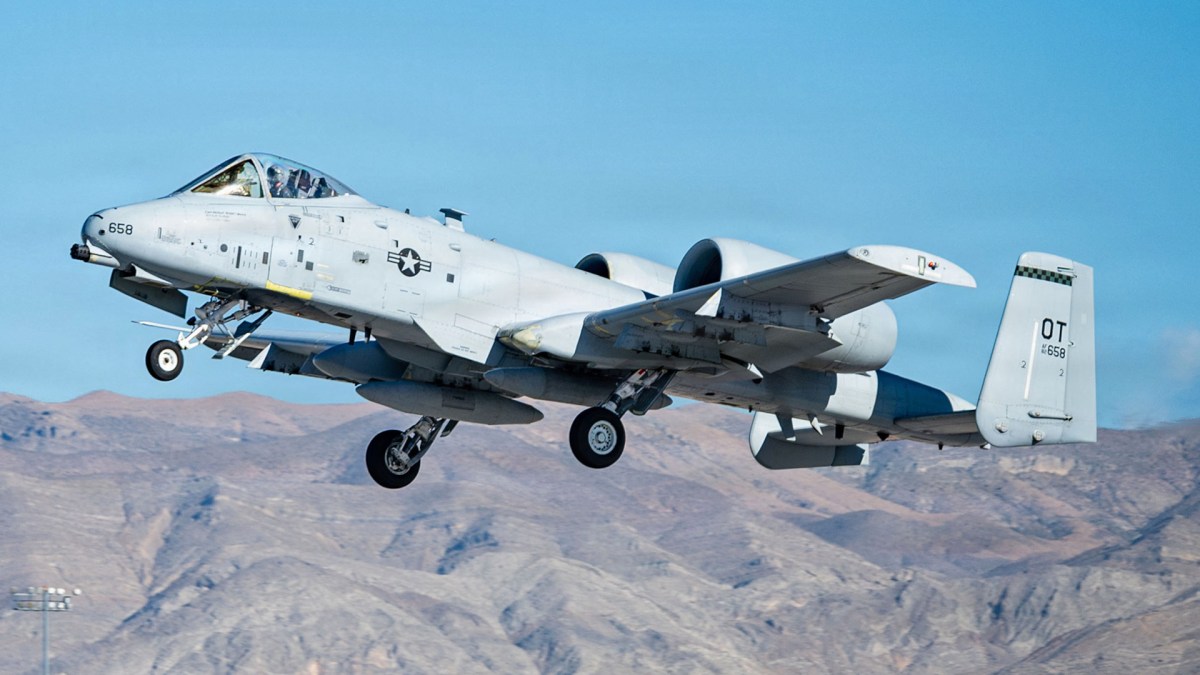
A U.S. Air Force A-10 Thunderbolt II aircraft takes off from Nellis Air Force Base, Nevada, Sept. 22, 2026. The flight marked the final departure of Nellis’ last A-10 and honored nearly half a century of close air support service and the maintainers, pilots, and support personnel who kept the fleet mission-ready. USAF/ Airman Isabella Borrillo
The last A-10 Thunderbolt II assigned to Nellis Air Force Base , Nevada, left the installation on September 22. The departure marks the end of nearly five decades of Warthog operations, including tactics development and testing, at the Air Force’s most high-profile fighter base. It also reflects a broader shift in which close air support expertise and some associated missions are supposedly being distributed among the F-15 , F-16, and F-35 communities, although the move is controversial, to say the least.
Nearly 70 airmen assigned to Nellis gathered along the flight line to salute the aircraft as it departed. The final takeoff closes a chapter that began in 1977, when the first A-10 arrived at the base, which subsequently became a major center for developing and refining the aircraft’s operational employment.
U.S. Air Force Maj. Kyle S. Adkinson, a weapons and tactics officer assigned to the Nevada Air National Guard’s 232nd Combat Training Squadron, conducts pre-flight checks on an A-10 Thunderbolt II aircraft at Nellis Air Force Base, Nevada, Sept. 22, 2026. U.S. Air Force photo by Airman Annika Schermerhorn
Over the decades, Nellis-based units worked on the A-10’s software, avionics, and precision weapons capabilities , while the U.S. Air Force Weapons School’s 66th Weapons Squadron trained more than 300 A-10 weapons officers through approximately 100 classes. Many of the tactics in the A-10’s playbook emanated from the base.
The A-10’s departure consequently represents more than the retirement of another aircraft from a Nellis ramp. It also marks the end of a dedicated training and institutional ecosystem that developed around an aircraft specifically designed for close air support.
Earlier this year, Jamie Hunter of TWZ visited the U.S. Air Force A-10 Weapons Instructor Course as it was in the process of closing down, as documented in these exclusive videos:
The Air Force is now attempting to carry at least some of that expertise into a force built around multirole fourth- and fifth-generation fighters.
“We are maintaining the culture of the A-10 by involving as many other fighter communities involved in the close air support mission,” Lt. Col. Ridge Flick, commander of the 66th Weapons Squadron, said. “We are also training F-15 Eagle, F-35 Lightning II and F-16 Fighting Falcon pilots to take on some roles we have had in combat search and rescue.”
U.S. Air Force Maj. Kyle S. Adkinson, right, a weapons and tactics officer assigned to the Nevada Air National Guard’s 232nd Combat Training Squadron, salutes Senior Airman Segio Lopez, a crew chief assigned to the 757th Aircraft Maintenance Squadron, before a flight at Nellis Air Force Base, Nevada, Sept. 22, 2026. U.S. Air Force photo by Airman Annika Schermerhorn
The A-10 was developed specifically for close air support, with its design emphasizing survivability at relatively low altitude, weapons employment against ground targets, and the ability to persist in the vicinity of friendly forces. In contrast, the F-16C/D and F-15E/EX were developed primarily as multirole fighters, while the F-35 combines strike, air-to-air, intelligence, surveillance and reconnaissance, and networking capabilities with a low-observable design.
Rather than replacing the A-10 with a single successor, the Air Force is therefore distributing elements of its former mission set across several aircraft and communities. The service insists its close air-support capability is not being reduced as the Warthog fleet retires, but at the very least the transition does represent a significant change in how that capability is generated and employed.
U.S. airmen assigned to Nellis Air Force Base salute an A-10 Thunderbolt II aircraft at Nellis AFB, Nevada, Sept. 22, 2026. U.S. Air Force photo by Airman Annika Schermerhorn
Regardless, the USAF’s claim that the impact of losing the heart of the A-10’s braintrust will not dramatically impact key mission sets in a negative manner has been viewed with extreme skepticism by some. It’s not uncommon for subject matter experts to believe the close air support and ‘Sandy’ aircrew recovery mission braintrust that the Warthog community represents is a far bigger loss than the aircraft itself, and that the USAF is not prepared to preserve this critical expertise, regardless of the service’s stated intentions.
The end of A-10 operations at Nellis also put what may be the final nail in the A-10’s coffin, as reconstituting these operations would be very challenging and costly. All this points to the Warthog being on its final glide path to retirement, once and for all.
You can read all about this controversy in our past special feature linked here .
U.S. Air Force Maj. Kyle S. Adkinson, a weapons and tactics officer assigned to the Nevada Air National Guard’s 232nd Combat Training Squadron, taxis an A-10 Thunderbolt II aircraft at Nellis Air Force Base, Nevada, Sept. 22, 2026. U.S. Air Force photo by Airman Annika Schermerhorn
Beyond the redistribution of Nellis’s A-10 pilots, the transition is also affecting the maintainers who supported the base’s A-10 fleet. Airmen assigned to the 757th Aircraft Maintenance Squadron’s Thunder Aircraft Maintenance Unit are being reassigned to other squadrons and airframes, including the F-35 and F-16. The Air Force is consequently moving not only personnel, but also decades of experience maintaining an aging and structurally demanding aircraft into programs supporting newer fighters.
For Staff Sgt. Eva Kehn, a weapons load crew chief with the 757th AMXS, the end of the A-10 era has an especially personal dimension because of her family’s connection to the aircraft and to aviation.
A U.S. Air Force A-10 Thunderbolt II aircraft takes off from Nellis Air Force Base, Nevada, Sept. 22, 2026. U.S. Air Force photo by Airman Annika Schermerhorn
“Working on the A-10 is meaningful to me because that is something that I share with my grandfather,” Kehn said. “I’m very excited to have that new chapter and bond over that again with my grandfather.”
Kehn is transferring to an F-35 unit at Nellis, where that connection will continue in a different form. Her grandfather is now a civilian F-35 instructor, giving the two an opportunity to remain professionally connected even as the A-10 disappears from the installation.
U.S. airmen assigned to Nellis Air Force Base salute an A-10 Thunderbolt II aircraft at Nellis AFB, Nevada, Sept. 22, 2026. U.S. Air Force photo by Airman Isabella Borrillo
Master Sgt. Aaron Edmonds, an aircraft section chief with the 757th AMXS, is also moving on from the Warthog after spending the past five years maintaining the aircraft. Edmonds previously worked on the F-16 earlier in his career and will now return to the Viper community.
“It’s a bittersweet moment,” Edmonds said. “I enjoyed my time with the A-10, but I’m excited because this departure marks the closing of one chapter and the start of another.”
Edmonds said the experience gained on the A-10 should be carried into the next aircraft rather than left behind with the airframe. “The advice I would give airmen who are transitioning from one airframe to another is to be open-minded, willing to learn and carry on the great work ethic from your previous aircraft over to your new one,” he said.
U.S. Air Force Maj. Kyle S. Adkinson, a weapons and tactics officer assigned to the Nevada Air National Guard’s 232nd Combat Training Squadron, taxis an A-10 Thunderbolt II aircraft at Nellis Air Force Base, Nevada, Sept. 22, 2026. U.S. Air Force photo by Airman Isabella Borrillo
With the A-10 no longer present at Nellis, at least some of the expertise attached to it is being incorporated into a fighter force in which other aircraft types can contribute to the close air support mission in very different ways. An F-35, for example, can use its sensors and networking capabilities to identify and share information about targets and the battlespace, and it can go where other fighters can’t. An F-15 can contribute heavier weapons and longer endurance, among other capabilities, depending on the mission. This is not exactly new, either, as all types of aircraft provided CAS during the Global War on Terror-era, although the masters of exactly how to do it and how to execute the critical airborne forward air control (FAC-A) mission existed in the A-10 community. Still, the resulting force will be considerably different from the one centered on the Warthog, even where the underlying requirement to support troops on the ground remains.
A U.S. Air Force A-10 Thunderbolt II aircraft takes off from Nellis Air Force Base, Nevada, Sept. 22, 2026. U.S. Air Force photo by Airman Isabella Borrillo
As noted, the A-10’s retirement now looks to be gathering pace, despite repeated efforts to keep the A-10 in service and recent employment in combat operations in the Middle East. The Pentagon has granted three Warthog squadrons a reprieve to continue operating through 2030. In July, a bipartisan group of Congressmen introduced a bill that, if passed and signed into law, would require the Air Force to keep flying the jets through Fiscal Year 2033. Still, the aircraft’s eventual fate appears increasingly clear , with growing numbers heading to the 309th Aerospace Maintenance and Regeneration Group (AMARG) boneyard in Arizona for storage, including the last one from Nellis.
The ongoing retirement of the A-10 is bringing a fundamental change in how the Air Force organizes and executes the missions for which the Warthog became synonymous. Nellis will remain an important center for developing those capabilities, even though the aircraft around which that expertise was built is no longer part of the equation.
Contact the author: thomas@thewarzone.com
Comments couldn’t be loaded. Please refresh the page.
发布于美国东部时间2026年9月23日晚上8:19
2026年9月22日,一架美国空军A-10“雷电II”攻击机从内华达州内利斯空军基地起飞。此次飞行标志着内利斯基地最后一架A-10的最后一次离去,也向近半个世纪以来为该机提供近距离空中支援服务的维护人员、飞行员和后勤人员致敬,感谢他们让这支机队始终保持战备状态。美国空军/空军士兵伊莎贝拉·博里洛
最后一架驻扎在内华达州内利斯空军基地的A-10“雷电II”攻击机于9月22日离开该基地。此次离开标志着“疣猪”攻击机在该空军最负盛名的战斗机基地近五十年的作战行动告一段落,其中包括战术研发和测试。这也反映出一种更广泛的转变,即近距离空中支援技术及一些相关任务据称正在分配给F-15、F-16和F-35战机部队,尽管这一举措至少可以说颇具争议。
近70名驻扎在内利斯空军基地的空军人员聚集在跑道旁,向即将起飞的飞机致敬。此次起飞标志着一段始于1977年的篇章的结束。当时,第一架A-10攻击机抵达该基地,此后,内利斯空军基地发展成为研发和完善A-10作战应用的重要中心。
2026年9月22日,在内华达州内利斯空军基地,隶属于内华达州空中国民警卫队第232战斗训练中队的武器战术军官、美国空军少校凯尔·S·阿德金森正在对一架A-10“雷电II”攻击机进行飞行前检查。照片由美国空军士兵安妮卡·舍默霍恩拍摄。
几十年来,内利斯空军基地的各个单位致力于A-10攻击机的软件、航空电子设备和精确制导武器能力的研发,而美国空军武器学校第66武器中队则通过大约100期培训班,培养了300多名A-10武器军官。A-10作战手册中的许多战术都源自该基地。
因此,A-10的退役不仅仅意味着内利斯空军基地又一架飞机的退役,它也标志着围绕这款专为近距离空中支援而设计的飞机而建立起来的专门训练和机构体系的终结。
今年早些时候,TWZ 的 Jamie Hunter 参观了正在关闭的美国空军 A-10 武器教官培训课程,以下独家视频记录了这一过程:
空军现在正试图将至少部分专业知识运用到以多用途第四代和第五代战斗机为核心的部队中。
“我们通过让参与近距离空中支援任务的其他战斗机部队参与进来,来维护A-10的作战文化,”第66武器中队指挥官里奇·弗里克中校说。“我们还在训练F-15鹰式战斗机、F-35闪电II战斗机和F-16战隼战斗机的飞行员,让他们承担我们过去在战斗搜救任务中承担的一些职责。”
2026年9月22日,在内华达州内利斯空军基地,美国空军少校凯尔·S·阿德金森(右)向隶属于第757飞机维修中队的机组长塞吉奥·洛佩兹高级空军士兵敬礼。阿德金森少校是内华达州空中国民警卫队第232战斗训练中队的武器战术军官。照片由美国空军士兵安妮卡·舍默霍恩拍摄。
A-10专为近距离空中支援而研发,其设计重点在于低空生存能力、对地攻击能力以及在友军附近持续作战的能力。相比之下,F-16C/D和F-15E/EX主要作为多用途战斗机而研发,而F-35则集打击、空对空、情报、监视与侦察以及网络作战能力于一体,并采用低可探测性设计。
因此,空军并没有用单一的后继机型取代A-10,而是将原有任务的不同部分分散到多种机型和部队中。空军坚称,随着“疣猪”机队的退役,其近距离空中支援能力并未减弱,但至少这种转变标志着该能力的产生和运用方式发生了重大变化。
2026年9月22日,在内华达州内利斯空军基地,驻扎在内利斯空军基地的美国空军官兵向一架A-10“雷电II”攻击机敬礼。美国空军照片,由空军士兵安妮卡·舍默霍恩拍摄。
然而,美国空军声称失去A-10核心智囊团不会对关键任务造成显著负面影响,这一说法遭到了部分人士的强烈质疑。许多专家认为,A-10战机核心智囊团所代表的近距离空中支援和“桑迪”飓风机组人员救援任务的损失远大于战机本身,而且无论空军如何宣称,他们都没有做好保留这项关键技术的准备。
内利斯空军基地A-10作战行动的结束,或许也为A-10的退役埋下了伏笔,因为重建这些作战行动将极其困难且成本高昂。这一切都表明,“疣猪”战机正走上最终退役的道路,彻底告别赛场。
您可以点击此处链接阅读我们之前的专题报道,了解这场争议的全部内容。
2026年9月22日,内华达州内利斯空军基地,隶属于内华达州空中国民警卫队第232战斗训练中队的武器战术军官、美国空军少校凯尔·S·阿德金森驾驶一架A-10“雷电II”攻击机滑行。照片由美国空军士兵安妮卡·舍默霍恩拍摄。
除了内利斯空军基地A-10飞行员的重新分配外,此次调整也影响到负责该基地A-10机队维护的人员。隶属于第757飞机维护中队“雷霆”飞机维护分队的空军人员将被重新分配到其他中队和机型,包括F-35和F-16。因此,空军不仅要转移人员,还要转移数十年来维护老旧且结构复杂的飞机的经验,并将这些经验转移到支持新型战斗机的项目中。
对于第 757 航空维修中队的武器装载组组长伊娃·凯恩中士来说,A-10 时代的结束具有特别的个人意义,因为她的家族与这种飞机和航空业有着密切的联系。
2026年9月22日,一架美国空军A-10“雷电II”攻击机从内华达州内利斯空军基地起飞。美国空军照片,由空军士兵安妮卡·舍默霍恩拍摄。
“参与A-10项目对我意义非凡,因为这是我和祖父共同的爱好,”凯恩说。“我非常兴奋能开启这段新的旅程,并再次与祖父建立深厚的感情。”
凯恩将调往内利斯空军基地的F-35部队,在那里,她与祖父的联系将以另一种形式延续。她的祖父现在是一名F-35的民用教官,这使得即使A-10攻击机从该基地退役,两人仍有机会保持职业上的联系。
2026年9月22日,驻扎在内华达州内利斯空军基地的美国空军官兵向一架A-10“雷电II”攻击机敬礼。美国空军照片,摄影:空军士兵伊莎贝拉·博里洛
隶属于第757航空维修中队的飞机分队队长亚伦·埃德蒙兹中士也将离开“疣猪”战机,此前他已在该机上工作了五年。埃德蒙兹早年曾在F-16战机上工作,如今他将重返“蝰蛇”战机阵营。
“这真是百感交集,”埃德蒙兹说。“我很享受在A-10服役的时光,但同时我也很兴奋,因为这次离开标志着一个篇章的结束和另一个篇章的开始。”
埃德蒙兹表示,在A-10上积累的经验应该运用到下一架飞机上,而不是随着这架飞机一起被弃置。“我对那些正在从一种机型过渡到另一种机型的飞行员的建议是,要保持开放的心态,乐于学习,并将你在之前机型上培养的优秀工作态度延续到你的新飞机上。”他说。
2026年9月22日,美国空军少校凯尔·S·阿德金森(Kyle S. Adkinson)驾驶一架A-10“雷电II”攻击机在内华达州内利斯空军基地滑行。阿德金森少校是内华达州空中国民警卫队第232战斗训练中队的武器战术军官。(美国空军照片,由空军士兵伊莎贝拉·博里洛拍摄)
随着A-10攻击机从内利斯空军基地撤离,至少部分与其相关的专业技术正被整合到一支战斗机部队中,其他机型也能以截然不同的方式参与近距离空中支援任务。例如,F-35可以利用其传感器和网络能力识别并共享目标和战场信息,而且它还能飞到其他战斗机无法到达的区域。F-15则可以根据任务需要,提供更强大的武器和更长的续航时间等其他能力。这其实并非什么新鲜事,因为在反恐战争时期,各种类型的飞机都曾提供过近距离空中支援,尽管真正掌握如何执行这项任务以及如何执行关键的空中前沿空中管制(FAC-A)任务的专家仍然掌握在A-10部队手中。尽管支援地面部队的基本需求依然存在,但最终形成的这支部队将与以“疣猪”攻击机为中心的部队有显著的不同。
2026年9月22日,一架美国空军A-10“雷电II”攻击机从内华达州内利斯空军基地起飞。美国空军照片,摄影:空军士兵伊莎贝拉·博里洛
如前所述,尽管各方多次努力争取让A-10继续服役,且该机近期还在中东的作战行动中投入使用,但A-10的退役进程似乎正在加速。五角大楼已批准三个“疣猪”中队继续服役至2030年。今年7月,一个由两党议员组成的小组提出一项法案,如果该法案获得通过并签署成为法律,将要求空军继续使用该型战机至2033财年。然而,随着越来越多的A-10被送往位于亚利桑那州的第309航空航天维护与再生大队(AMARG)飞机坟场封存,包括内利斯空军基地最后一架A-10,该机的最终命运似乎越来越明朗。
A-10攻击机的持续退役,从根本上改变了空军组织和执行任务的方式,而“疣猪”攻击机正是这些任务的代名词。尽管围绕A-10建立这些专业技术的飞机已不再是其中的一部分,但内利斯空军基地仍将是发展这些能力的重要中心。
联系作者:thomas@thewarzone.com
评论加载失败,请刷新页面。