The US Army’s quiet rotation in the Philippines美国陆军在菲律宾的悄然轮换
The U.S. Army’s rotation in the Philippines is easy to overlook. Experts say that might be the point.
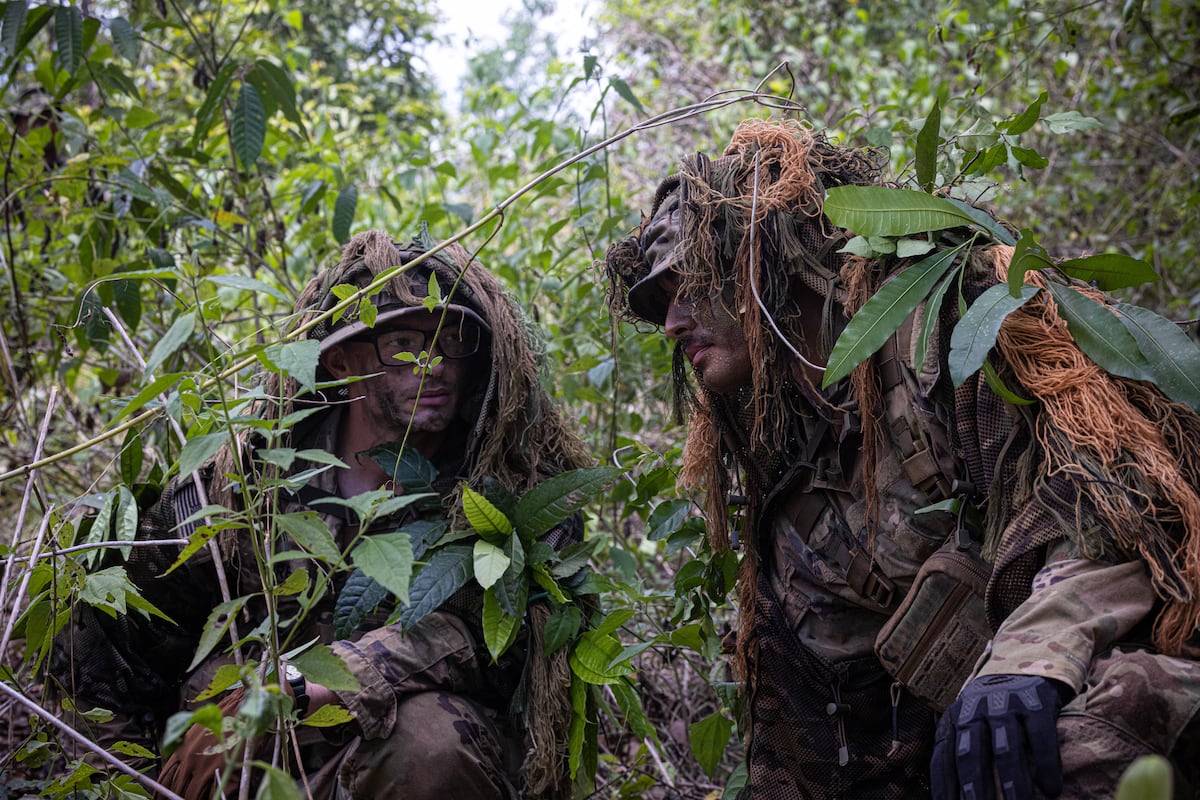
The U.S. Army’s rotation in the Philippines is easy to overlook. Experts say that might be the point.
The service confirmed this week that in July 2025, it established a rotational presence in the Southeast Asian nation. The roughly 50-person force is operating under U.S. Army Pacific with coordination through Task Force Philippines, a spokesman said Wednesday.
The move marks a change in how the Army engages with the sprawling archipelago, the service said.
“While the rotational force is not permanently assigned, this represents a shift from previous year’s iterative engagement cycle to a more sustained rotational presence, enabling deeper and more consistent collaboration with our Philippine Army counterparts,” Col. Isaac Taylor, chief of public affairs for U.S. Army Pacific, said in a statement.
The contingent’s mission centers on building “army-to-army partnerships,” and “improving infrastructure,” he said.
The Philippines once played host to a large U.S. military presence, but permanent U.S. ground forces largely left in the early 1990s after, against a backdrop of growing nationalism, the country’s lawmakers voted to close the major American installations.
Later military agreements allowed U.S. forces back to the country, but to a smaller and less-permanent degree.
U.S. Defense Secretary Pete Hegseth and his counterpart, Philippine Defense Secretary Gilbert Teodoro Jr., announced the formation of Task Force Philippines last fall. The effort, analysts said , could deter China from acting on its claims to the contested South China Sea.
U.S. soldiers train alongside their Philippine partners in Northern Luzon, Philippines, June 17, 2025. (Spc. Noe Cork/U.S. Army)
While U.S. naval and air forces have anchored U.S. military posture in the region, the Army’s role has historically been more limited.
“The Navy and the Air Force tend to dominate the Indo-Pacific, just based on the capabilities they have in place,” said Katherine Kuzminski, director of studies at the Center for a New American Security. The new task force, she said, “is reinforcing the need for the Army as part of the joint force in regional security.”
Gregory Poling, director of the Southeast Asia Program at the Center for Strategic and International Studies, said the significance of the Army’s rotation lies in how it formalizes a presence that had already become routine. U.S. forces have operated in the Philippines regularly for years through training and exercises , even before this new development.
The service’s latest move reflects continuity and is taking a “model of a more persistent heel-toe rotational presence focused on the South China Sea and making it a little larger,” Poling told Military Times.
Those waters, in some areas rich in resources, are also claimed in part by Vietnam, Malaysia, Brunei, Indonesia and the Philippines. Tensions between the Philippines and China have escalated in recent years to include confrontations between Chinese coast guard ships and fishermen in disputed waters.
Poling also said that formalizing a task force could enable “quicker, higher-level communications” and increase the “pace of day-to-day interactions” between U.S. military personnel — particularly Army personnel — and their Philippine partners.
Incremental steps toward better connections between leaders of both countries — and the timing of when new military capabilities are introduced — can matter as much as their presence, according to Stacie Pettyjohn, director of the defense program at the Center for a New American Security.
The rotation is “a really modest step,” that is “very small, but it is not necessarily an inconsequential one,” Pettyjohn said in an interview with Military Times.
Those “smaller, gradual steps,” she said, “are likely to be denounced by Beijing, but not to provoke some greater response.”
Eve Sampson is a reporter and former Army officer. She has covered conflict across the world, writing for The New York Times, The Washington Post and The Associated Press.
美军在菲律宾的轮换部署很容易被忽视。专家表示,这或许正是其目的所在。
该军种本周证实,将于2025年7月在东南亚国家菲律宾建立轮换驻军。一位发言人周三表示,这支约50人的部队隶属于美国太平洋陆军,并通过菲律宾特遣部队进行协调。
军方表示,此举标志着陆军与这个幅员辽阔的群岛互动方式发生了变化。
“虽然轮换部队并非永久驻扎,但这标志着从去年的迭代式接触周期转向更持久的轮换部署,从而能够与菲律宾陆军同行进行更深入、更一致的合作,”美国太平洋陆军公共事务主管艾萨克·泰勒上校在一份声明中表示。
他说,该特遣队的任务重点是建立“军队间的伙伴关系”和“改善基础设施”。
菲律宾曾经驻扎着大量美军,但在 20 世纪 90 年代初,随着民族主义情绪高涨,菲律宾议员投票决定关闭主要的美军基地,此后,常驻美军地面部队基本撤离。
后来的军事协议允许美军重返该国,但规模较小,驻扎时间也较短。
美国国防部长皮特·赫格塞斯和菲律宾国防部长吉尔伯特·特奥多罗于去年秋季宣布成立菲律宾特遣部队。分析人士称,此举可能有助于阻止中国在南海争议地区采取行动。
2025年6月17日,美军士兵在菲律宾吕宋岛北部与菲律宾伙伴进行联合训练。(美国陆军下士诺伊·科克/美国陆军)
虽然美国海军和空军一直是美国在该地区军事态势的支柱,但陆军的作用历来较为有限。
“仅凭海军和空军现有的能力,它们就往往主导着印太地区,”新美国安全中心研究主任凯瑟琳·库兹明斯基说。她表示,新成立的特遣部队“正在强调陆军作为联合部队在区域安全中发挥作用的必要性”。
战略与国际研究中心东南亚项目主任格雷戈里·波林表示,美军轮换驻扎的意义在于,它将此前已成惯例的驻军活动正式化。事实上,早在此次轮换之前,美军就已通过训练和演习等方式在菲律宾开展了多年的定期行动。
波林告诉《军事时报》,该军种的最新举措体现了连续性,并采用了一种“更加持久的轮换部署模式,重点是南海,并将其规模扩大了一些”。
这些水域部分区域资源丰富,越南、马来西亚、文莱、印度尼西亚和菲律宾也声称对其拥有主权。近年来,菲律宾和中国之间的紧张关系不断升级,中国海警船与渔民在争议水域发生冲突。
波林还表示,正式成立特别工作组可以实现“更快、更高层次的沟通”,并加快美国军方人员(特别是陆军人员)与其菲律宾伙伴之间的“日常互动”。
据新美国安全中心国防项目主任斯泰西·佩蒂约翰 (Stacie Pettyjohn) 称,逐步改善两国领导人之间联系的举措,以及引入新军事能力的时机,与他们的出兵一样重要。
佩蒂约翰在接受《军事时报》采访时表示,这次轮换“只是一个非常小的举措”,“虽然幅度很小,但并非无关紧要”。
她表示,这些“较小、渐进的举措”可能会遭到北京的谴责,但不会引发更大的反应。
伊芙·桑普森是一名记者,也是一名前陆军军官。她曾报道过世界各地的冲突,为《纽约时报》、《华盛顿邮报》和美联社撰稿。