CIA And Skunk Works Secretly Planned To Turn The A-12 Spy Plane Into A Space Launch Mothership中央情报局和臭鼬工厂曾秘密计划将A-12侦察机改装成太空发射母舰。
The proposal sheds more light on decades of secretive U.S. work to realize air-launched space access capabilities.
新闻视频
By Joseph Trevithick
Updated Dec 1, 2019 6:34 AM EST
For decades, there have been reports, which we at The War Zone
recently examined in depth , about the possible existence of a U.S. military space vehicle that would hitch a ride on a supersonic mothership aircraft into the upper atmosphere, after which it would blast itself into orbit. There remains only circumstantial evidence that any such combination of aircraft and space vehicle ever came to be, but declassified documents show that there was interest in using the Central Intelligence Agency’s high- and fast-flying A-12 Oxcart spy plane for a very similar satellite-launching role nearly 60 years ago.
Lockheed’s Skunk Works, which had developed the A-12, the progenitor of the U.S. Air Force’s SR-71 Blackbird , produced the feasibility study on using the aircraft as a space launch platform in September 1962 . It is unclear whether the CIA or the National Reconnaissance Office (NRO), the super-secret U.S. intelligence agency primarily responsible for satellite intelligence, requested the report initially, but the CIA paid for it . The very existence of the NRO remained officially classified until 1992.
CIA, with input from NRO, released the document in 2002 with some redactions, but placed it in its CIA Records Search Tool ( CREST ) electronic database, which was only accessible via computer terminals at the National Archives in College Park, Maryland at the time. After fighting to maintain this obtuse arrangement for years, a three-year lawsuit finally pushed the Agency to put the documents online in January 2017.
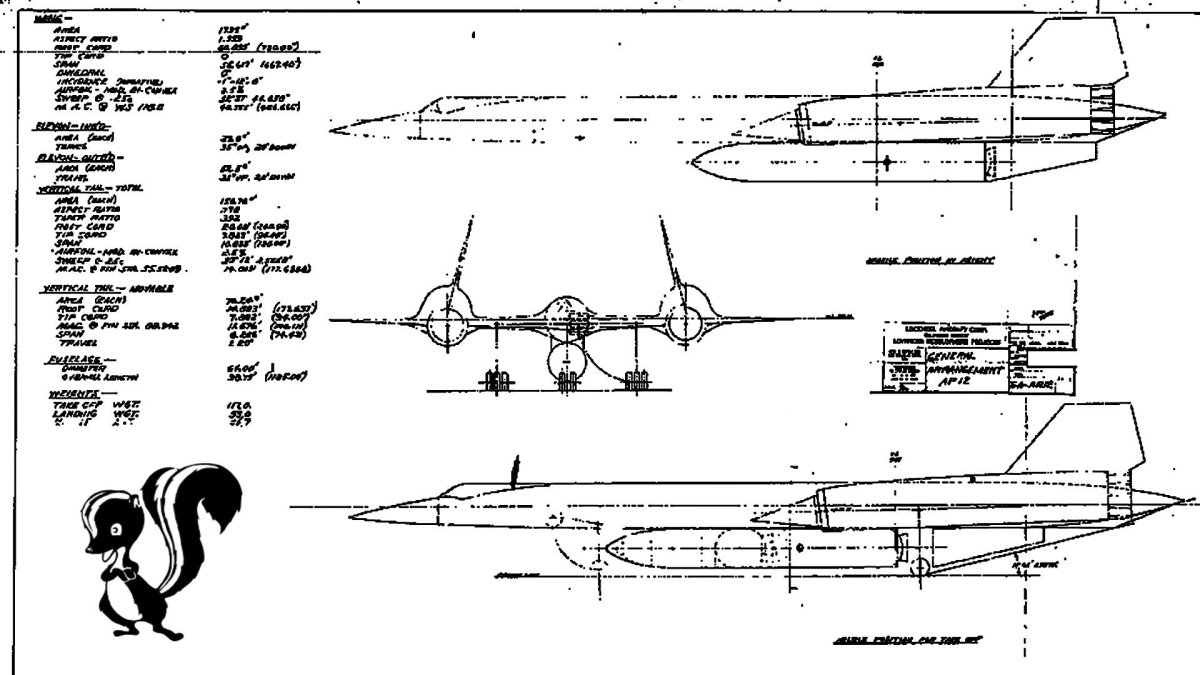
A line drawing of a modified A-12 spy plane configured as a space launch platform., Lockheed via CIA
“The purpose of this report is to review the technical evaluation concerning the feasibility for utilization of an A-12 vehicle to launch an orbital reconnaissance vehicle over the Soviet land area,” the study’s introduction explains. “As a result of the preliminary evaluation, a configuration is recommended.”
The proposed modified A-12 aircraft would carry a satellite and its booster rocket on a set of rails forming a track along the bottom of the aircraft’s fuselage. The single-seat spy plane would also need an additional crew member to help with “navigation, approach [to the launch point], and separation maneuvers.”
SR-71s, the successor to the A-12, under construction., CIA
The complete payload, a modified Polaris A3 submarine-launched ballistic missile (SLBM), another Lockheed product, would be more than 420 inches long and more than 54 inches in diameter. The new mothership would be designated the AP-12, with the “P” likely standing for Polaris.
Lockheed’s study focuses almost exclusively on the AP-12 aircraft. A companion report from Lockheed on the air-launched satellite and its booster do not appear to be available through CREST.
A separate study on an “air-launched, single-pass, low-orbit reconnaissance system,” which predates the AP-12 report, is available and does provide more detail on three possible payload configurations. CIA also released this document after NRO reviewed its contents.
This second document explained that the original requirements for this aerial space launch concept called for a satellite and booster that would be smaller than Polaris. As such, the first configuration was less than 360 inches long and only 40 inches wide. These dimensional stipulations subsequently got relaxed for unspecified reasons to allow the use of a modified version of the SLBM, according to the report.
The second configuration was essentially a standard Polaris A3 with a satellite in place of the nuclear warhead. The third and final configuration, which matches the dimensions in the Lockheed AP-12 report, featured an additional third stage to improve performance. Additional proposals from Lockheed included adding tail fins to the end of the booster for added stabilization after release from the mothership, but before the rocket motor actually ignited.
The final configuration of the proposed air-launched space vehicle using a modified Polaris A3 design., CIA
A proposed version of the air-launched space vehicle with tail fins for added stability., Lockheed via CIA
The “low-orbit reconnaissance system” was a small spy satellite that could carry one of three different cameras. Two of these were already in service at the time on the Corona spy satellites . A third stereoscopic panoramic camera design was under development in 1962 when the CIA and NRO were investigating this air-launched concept.
A graphic depicting the internal arrangement of the second possible configuration of the satellite which would carry the 24-inch Corona “mural” camera., CIA
Lockheed’s design study says that the complete payload design was long enough to extend rearward beyond the main landing gear when loaded onto the AP-12. However, the report adds that ground clearance would not be any more of an issue during takeoff than with a standard A-12. The plane’s landing gear itself would need modifications to accommodate the changes in weight and overall aircraft handing during both takeoff and taxing, though.
To further help keep the aircraft stable on the ground and in flight, the AP-12 would only carry half the fuel load of a standard A-12 and the payload would shift rearward along the rails after takeoff to assume an “optimum cruise” position. If a fault were to occur before launch, the crew could still land the plane with the payload locked to the rear.
A diagram showing the carriage system for the proposed AP-12, as well as how the payload would shift to the rear once the aircraft was in flight., Lockheed via CIA
Lockheed said that it had otherwise determined that the basic A-12 had sufficient power, cooling, and other supporting functions to carry the satellite-tipped Polaris missile. It does say that the mothership aircraft could still require some modifications to the air cycle system the Oxcart used to cool its systems.
A backup plan was to use the liquid cooling system Lockheed had developed for the U.S. Air Force’s AF-12 Kedlock high-altitude, high-speed interceptor aircraft, which was derived from the A-12. This aircraft eventually became known as the YF-12A and would have carried a payload of AIM-47 Falcon long-range air-to-air missiles, which could be equipped with nuclear warheads.
An early AF-12 Kedlock aircraft., CIA
President Lyndon Johnson declassified the existence of YF-12A in 1964, in part to conceal the still-secret A-12. With the Kedlocks flying publicly from Edwards Air Force Base in California, the U.S. government could dismiss any sightings of Oxcarts operating from Groom Lake in neighboring Nevada, better known as Area 51, as people simply seeing the interceptors. The Pentagon finally canceled the Kedlock program entirely in 1968.
With regards to the AP-12 mothership, the AF-12/YF-12A would no doubt have otherwise served as a basis for that aircraft, at least in part, given that it was also a two-seat design. As noted earlier, the A-12 and AF-12/YF-12A both led to the development of the Air Force’s two-place SR-71 Blackbird spy plane.
Lockheed’s study provides two notional mission profiles, one involving the aircraft cruising back to base at supersonic speeds after launching the satellite and another with the aircraft making the return trip at subsonic speeds.
Notional mission profiles for the AP-12., Lockheed via CIA
A more detailed graphic showing the exact notional flight profile for an AP-12 supercruising to the launch point., Lockheed via CIA
The profile of a mission where the AP-12 would return home at subsonic speed., Lockheed via CIA
In both cases, the assumption is that the plane would fly from a base inland in the Contiguous United States more than 2,340 miles to a position east of Hawaii. The two mission profiles also required the mothership to refuel in flight near the base after takeoff to fill its tanks to close to 100 percent capacity, before setting out into the Pacific, where it would refuel again.
Once there, the aircraft would conduct a pull-up maneuver while flying at Mach 3.1 at 80,000 feet and release the payload. Five seconds later, the booster rocket would ignite, blasting the satellite into orbit. Afterward, the AP-12 would return to base.
From the launch site, the satellite would enter a shallow orbit, passing over South America, the South Atlantic, or Antarctica, before heading up over Africa and the Middle East toward the Soviet Union, according to the separate report on the “low-orbit reconnaissance system.” Depending on the exact mission profile, it might pass over India and the People’s Republic of China, which were also major areas of interest for the United States in the 1960s.
A low-quality scan of a map showing possible single orbits for an air-launched satellite. In these missions, the craft would travel east from the Pacific and then re-enter the atmosphere near the Johnson Atoll ., CIA
If all went according to plan, a recovery capsule containing the film canister would detach from the rest of the satellite and re-enter the atmosphere over the Pacific to the West of Hawaii. It would automatically deploy parachutes for a safe recovery in mid-air using specialized C-119 Flying Boxcar and C-130 Hercules cargo aircraft, and later or helicopters.
The Air Force, together with the CIA and NRO, developed these aircraft and the associated operating concept in the 1950s to grab descending film canisters from more persistent spy satellites. This remained a key method of retrieving imagery and other data from satellites, but became increasingly obsolete as it became more practical for space-based systems to send imagery and other data wirelessly down to ground stations.
A diagram showing the recovery capsule that would bring the film back to earth., CIA
A JC-130B Hercules practices the maneuver requires to catch falling film and data canisters from US spy satellites near Edwards Air Force Base in 1969., USAF
The documents available in CREST do not offer any clear indication of how far the CIA and NRO moved ahead with the AP-12 concept or whether Lockheed actually converted any aircraft. The CIA’s public website on the Oxcart “family” does not mention the AP-12 at all.
The potential benefits of an air-launched space-based intelligence gathering system, especially at the time, are obvious. In 1960, the Soviet Union shot down Gary Powers as he flew his U-2 spy plane over their country, sparking an international incident .
Afterward, the U.S. government moved almost exclusively to spy satellites to collect imagery and other data about sensitive activities deep within the Soviet Union. However, satellites are relatively rigid tools that are difficult, if not impossible to rapidly reposition on short notice.
An air-launched satellite, or reusable space vehicle, offers added flexibility in orbits and can be more readily deployed to respond to new information. It also provides a system that is far less predictable than a satellite moving in a regular orbit, which makes it harder for an opponent to conceal their activities.
The AP-12 concept, and those that followed, also require less infrastructure than traditional space launches, have a faster turnaround time for follow-on missions, and cost less. At the time, it could also have preserved A-12’s role in conducting intelligence operations over the Soviet Union without having to put the aircraft themselves at risk.
With all this in mind, it is interesting to note that Lockheed’s 1962 design study had also investigated an A-12 configuration with the payload mounted on top of the aircraft. The report describes this arrangement as not only sub-optimal, but also potentially dangerous.
A diagram depicting the possible top-mounted configuration for the proposed AP-12 that Lockheed rejected internally., Lockheed via CIA
“Asymmetric fuselage loads require a severe structural beefup to support this concept,” the design study explained. “Separation safety is considered much more critical, and additional separation pre-ignition timing degrades performance, compared to the belly launch. The [space launch] vehicle affects upper surface flow and reduces the predictability of the directional stability compared to the underside installation.”
This is significant because around the same time Lockheed was working on the AP-12, it was also beginning work on what would become the supersonic D-21 drone , also known by its codename Tagboard. The original plan was for a modified A-12, known as the M-21 , to carry the unmanned aircraft on top and carry it to a designated launch point.
This combination was never deployed operationally, though. Test launches in 1966 confirmed the concerns that Lockheed had with the top-mounted AP-12 configuration in spectacular and ultimately deadly ways.
An M-21 with the D-21 drone on top of its fuselage., USAF
During the very first test launch, the D-21 separated from the M-21, but remained dangerously close to the aircraft before speeding off on its way. In the fourth test flight, the mothership’s crew attempted to launch the drone from a straight and level flight profile with catastrophic results. The unmanned aircraft’s engine suffered a fault and it crashed back into the carrier aircraft, destroying them both.
The two pilots ejected, but only the pilot, Bill Park, survived. The Launch Control Officer, Ray Torrick, drowned. In the end, the only operational Tagboard launches occurred using a specially configured B-52 bomber . None of the four missions, all of which occurred over China, were successful and the entire program came to an end in 1971.
But, as with the air-launched satellite concept, Tagboard was a product of the post-Gary Powers desire for a more rapidly employable, penetrating long-range intelligence gathering platform that could reach deep into the Soviet Union and Communist China. The drone offered the potential of a lower-risk alternative to direct manned overfights at the time.
Other documents that the CIA and NRO have released regarding the status of both spy plane and satellite programs from the same time frame point to still-classified developments that could include an air-launched satellite system. One NRO report from 1963 mentions Oxcart and Tagboard, along with Idealist, the codename for the U-2 . It also includes the codenames Corona , Laynard , and Gambit , which refer to various spy satellites.
But a seventh codename remains redacted. The existence of the codenames Isinglass and Rheinberry , which refer to potential A-12 or SR-71 replacements, has long been declassified now, even if many details of those programs remains hidden away. This makes it unlikely that this redacted entry refers to either of those programs.
We know that Lockheed continued developing top-mounted launch options for the A-12 family for years after deriding the general idea internally. It is possible that this concept proved to be just as complicated, costly, and disappointing as Tagboard, at least at the time, and the CIA, NRO, and Air Force shifted their attention and resources elsewhere. On the other hand, they could have continued to work on a mothership/space vehicle combination in their preferred configuration.
In the end, we don’t have any clear evidence that Lockheed’s concept progressed beyond the drawing board, but there is also much that remains classified about the A-12 and SR-71 programs.
Contact the author: jtrevithickpr@gmail.com
Comments couldn’t be loaded. Please refresh the page.
作者:约瑟夫·特雷维西克
更新于美国东部时间2019年12月1日上午6:34
几十年来,一直有报道称,我们《战区》栏目对此进行了报道。
最近,一项深入研究探讨了美国军用航天器可能存在的可能性,这种航天器将搭乘超音速母机进入高层大气,然后自行加速进入轨道。目前只有间接证据表明这种飞机和航天器的组合曾经存在过,但解密文件显示,早在近60年前,中央情报局就曾考虑使用其高速高空侦察机A-12“牛车”执行类似的卫星发射任务。
洛克希德公司的臭鼬工厂(Skunk Works)曾研发出A-12,即美国空军SR-71“黑鸟”侦察机的原型机。1962年9月,臭鼬工厂完成了一份关于将该飞机用作太空发射平台的可行性研究报告。目前尚不清楚这份报告最初是由中央情报局(CIA)还是国家侦察局(NRO,美国负责卫星情报的主要秘密情报机构)委托撰写的,但最终是由中央情报局支付了费用。国家侦察局的存在直到1992年才被公开,此前一直处于官方机密状态。
中央情报局在国家侦察局的协助下,于2002年发布了这份文件,但对其进行了部分删减。不过,该文件被存放在其“中央情报局档案检索工具”(CREST)电子数据库中,当时只能通过位于马里兰州大学城国家档案馆的电脑终端访问。经过多年努力维持这种繁琐的安排后,一场历时三年的诉讼最终迫使中央情报局于2017年1月将这些文件上线。
一张改装后的A-12侦察机的线描图,该飞机被配置成太空发射平台。(洛克希德公司,图片来自中央情报局)
该研究报告的引言部分解释说:“本报告的目的是审查关于利用A-12飞行器向苏联陆地上空发射轨道侦察飞行器的可行性技术评估。初步评估的结果提出了一种配置方案。”
拟议的改进型A-12飞机将携带一颗卫星及其助推火箭,这些助推火箭安装在机身底部的轨道上。这架单座间谍飞机还需要一名额外的机组人员来协助“导航、接近发射点和分离机动”。
SR-71侦察机(A-12的后继机型)正在建造中。(中央情报局)
完整的有效载荷是一枚改进型的北极星A3潜射弹道导弹(SLBM),同样出自洛克希德·马丁公司,其长度将超过420英寸,直径将超过54英寸。新型母舰将被命名为AP-12,“P”很可能代表北极星(Polaris)。
洛克希德公司的这项研究几乎完全集中于AP-12飞机。关于空射卫星及其助推器的配套报告似乎无法通过CREST获取。
一份关于“空射单程低轨道侦察系统”的独立研究报告早于AP-12报告,该报告提供了关于三种可能有效载荷配置的更多细节。中央情报局在国家侦察局审阅其内容后也公布了这份文件。
第二份文件解释说,最初对这种空中发射方案的要求是卫星和助推器都要比北极星卫星小。因此,第一版方案的长度不到360英寸,宽度只有40英寸。报告称,出于不明原因,这些尺寸限制后来有所放宽,以便使用改进型的潜射弹道导弹(SLBM)。
第二种方案本质上是标准的北极星A3火箭,只是用卫星取代了核弹头。第三种也是最后一种方案,其尺寸与洛克希德AP-12报告中的尺寸相符,增加了一个第三级以提高性能。洛克希德公司还提出了其他方案,包括在助推器尾部加装尾翼,以便在与母舰分离后、火箭发动机点火前增强其稳定性。
采用改进型北极星A3设计的拟议空射航天器的最终配置。(中央情报局)
洛克希德公司通过中央情报局发布的一份关于空射航天器方案,该方案带有尾翼以增加稳定性。
“低轨道侦察系统”是一种小型间谍卫星,可搭载三种不同的相机之一。其中两种相机当时已在“科罗娜”间谍卫星上服役。第三种立体全景相机设计方案于1962年研发中,当时中央情报局和国家侦察局正在研究这种空射方案。
一张图示描绘了卫星第二种可能配置的内部结构,该卫星将搭载24英寸的Corona“壁画”相机。(中央情报局)
洛克希德公司的设计研究表明,完整的有效载荷设计长度足以使其在装载到AP-12飞机上时向后延伸超过主起落架。然而,报告补充说,起飞时的离地间隙不会比标准A-12飞机更大。不过,飞机的起落架本身需要进行改装,以适应起飞和滑行过程中重量和整体操控性的变化。
为了进一步提高飞机在地面和飞行中的稳定性,AP-12 的燃油载量仅为标准 A-12 的一半,有效载荷在起飞后会沿导轨向后移动,以达到“最佳巡航”位置。如果在起飞前发生故障,机组人员仍然可以在有效载荷锁定在后部的情况下成功着陆。
一张示意图展示了拟议的AP-12的挂载系统,以及飞机飞行后有效载荷如何向后移动。(洛克希德公司,图片来自中央情报局)
洛克希德公司表示,他们已经确定,基本型A-12拥有足够的动力、冷却能力和其他辅助功能,可以携带带有卫星标记的北极星导弹。不过,该公司也指出,母机可能仍需对“牛车”攻击机用于冷却系统的空气循环系统进行一些改进。
备用方案是使用洛克希德公司为美国空军AF-12“凯德洛克”高空高速截击机开发的液冷系统,该机源自A-12。这款飞机最终被称为YF-12A,它将携带AIM-47“猎鹰”远程空空导弹,该导弹可以配备核弹头。
一架早期的AF-12“凯德洛克”战斗机。(中央情报局)
1964年,林登·约翰逊总统解密了YF-12A的存在,部分原因是为了掩盖当时仍处于保密状态的A-12。由于凯德洛克战斗机已在加利福尼亚州的爱德华兹空军基地公开飞行,美国政府便可将任何关于在邻近的内华达州格鲁姆湖(即著名的51区)附近出现的“牛车”(Oxcart)战斗机的目击报告,都归咎于人们看到的只是拦截机。五角大楼最终于1968年彻底取消了凯德洛克计划。
就AP-12母机而言,AF-12/YF-12A无疑会成为其设计基础,至少部分如此,因为它也是双座设计。如前所述,A-12和AF-12/YF-12A都促成了美国空军双座SR-71“黑鸟”侦察机的研发。
洛克希德公司的研究提供了两种设想的任务方案,一种方案是飞机在发射卫星后以超音速巡航返回基地,另一种方案是飞机以亚音速返回基地。
AP-12 的设想任务概况,洛克希德公司通过中央情报局提供
一张更详细的图表,展示了AP-12超音速巡航至发射点的精确理论飞行剖面图。(洛克希德公司,经中央情报局发布)
AP-12以亚音速返回基地的任务概要。(洛克希德公司通过中央情报局提供)
两种情况下,都假设飞机将从美国本土内陆的基地起飞,飞行超过2340英里(约3750公里)到达夏威夷以东的某个位置。两种任务方案都要求母机在起飞后于基地附近进行空中加油,将油箱加满至接近100%,然后再飞往太平洋,在那里再次加油。
抵达目标地点后,飞机将在8万英尺高空以3.1马赫的速度飞行,并进行拉起机动,释放有效载荷。五秒钟后,助推火箭点火,将卫星送入轨道。之后,AP-12将返回基地。
根据另一份关于“低轨道侦察系统”的报告,这颗卫星从发射场进入浅轨道,飞越南美洲、南大西洋或南极洲,然后飞越非洲和中东,最终抵达苏联。根据具体的任务方案,它还可能飞越印度和中华人民共和国上空,这两个地区在20世纪60年代也是美国重点关注的地区。
一张低质量的地图扫描件,显示了空射卫星可能的单次轨道。在这些任务中,卫星将从太平洋向东飞行,然后在约翰逊环礁附近重返大气层。(中央情报局)
如果一切按计划进行,装有胶片盒的回收舱将从卫星主体分离,并重返夏威夷以西太平洋上空的大气层。回收舱将自动展开降落伞,以便使用专用的C-119“飞行货车”和C-130“大力神”运输机(之后可能使用直升机)在空中安全回收。
20世纪50年代,美国空军与中央情报局和国家侦察局合作,研发了这些飞机及其相关的操作理念,用于从持续运行的间谍卫星上回收下降的胶片盒。这曾是获取卫星图像和其他数据的关键方法,但随着天基系统能够更便捷地将图像和其他数据无线传输到地面站,这种方法逐渐被淘汰。
一张示意图,展示了将胶片带回地球的回收舱。(中央情报局)
1969年,一架JC-130B“大力神”运输机在爱德华兹空军基地附近进行演练,以回收从美国间谍卫星上掉落的胶片和数据罐。(美国空军)
CREST数据库中现有的文件并未明确表明中央情报局和国家侦察局在AP-12项目上取得了多大进展,也未说明洛克希德公司是否实际改装过任何飞机。中央情报局在其关于“牛车”系列飞机的公开网站上也完全没有提及AP-12。
在当时,空射天基情报收集系统的潜在优势显而易见。1960年,苏联击落了驾驶U-2侦察机飞越其领空的加里·鲍尔斯,引发了一起国际事件。
此后,美国政府几乎完全依赖间谍卫星来收集苏联境内敏感活动的图像和其他数据。然而,卫星是一种相对固定的工具,即使不是完全不可能,也很难在短时间内迅速重新部署。
空射卫星,或称可重复使用航天器,在轨道运行方面具有更大的灵活性,能够更快地部署以应对新信息。此外,与沿固定轨道运行的卫星相比,空射卫星的运行轨迹更难以预测,这使得对手更难掩盖其活动。
AP-12概念及其后续方案,所需的配套设施比传统太空发射更少,后续任务的周转时间更快,成本也更低。当时,它还可以在不让A-12飞机本身面临风险的情况下,继续执行对苏联的情报任务。
考虑到以上种种,值得注意的是,洛克希德公司1962年的设计研究也曾探讨过A-12的有效载荷安装在飞机顶部的配置方案。该报告指出,这种布局不仅并非最优,而且存在潜在危险。
一张示意图,描绘了洛克希德公司内部否决的拟议AP-12的可能顶部安装配置方案。(图片来自中央情报局)
设计研究解释说:“非对称机身载荷需要大幅加强结构以支撑这一设计理念。分离安全性被认为更为关键,与腹部发射相比,额外的分离预点火时间会降低性能。与底部安装相比,这种(航天器)发射方式会影响上表面气流,并降低方向稳定性的可预测性。”
这意义重大,因为在洛克希德公司研发AP-12的同时,它也开始研发后来成为超音速D-21无人机的机型,该机型也以代号“Tagboard”而闻名。最初的计划是用一架改装后的A-12(代号M-21)将无人机搭载在机身上,并将其运送到指定的发射点。
然而,这种组合从未投入实战部署。1966年的试射以惊人的、最终致命的方式证实了洛克希德公司对顶部安装AP-12配置的担忧。
一架M-21运输机,机身上搭载着D-21无人机。(美国空军)
在首次试飞中,D-21无人机与M-21母机分离,但在加速离开前仍与母机保持着危险的近距离。在第四次试飞中,母机机组人员试图以直线平飞的方式发射无人机,结果却酿成灾难。无人机的发动机发生故障,坠回母机,两机损毁。
两名飞行员弹射逃生,但只有飞行员比尔·帕克幸存。发射控制官雷·托里克溺水身亡。最终,Tagboard导弹的唯一一次作战发射是使用一架经过特殊改装的B-52轰炸机进行的。四次任务均在中国上空进行,但全部失败,整个项目于1971年终止。
但是,与空射卫星概念一样,“标签板”无人机也是后加里·鲍尔斯时代人们渴望拥有更快速部署、穿透力更强、能够深入苏联和共产主义中国腹地的远程情报收集平台的产物。在当时,无人机提供了一种比直接载人空战风险更低的替代方案。
中央情报局和国家侦察局公布的其他文件也涉及同一时期间谍飞机和卫星项目的进展情况,这些文件指向一些仍处于保密状态的研发项目,其中可能包括空射卫星系统。一份1963年的国家侦察局报告提到了“牛车”(Oxcart)和“标签板”(Tagboard)这两个代号,以及U-2侦察机的代号“理想主义者”(Idealist)。报告还提到了“科罗娜”(Corona)、“莱纳德”(Laynard)和“赌徒”(Gambit)等代号,这些代号指的是不同的间谍卫星。
但第七个代号仍处于保密状态。代号为“伊辛格拉斯”(Isinglass)和“莱茵贝里”(Rheinberry)的飞机,分别指代A-12和SR-71的潜在替代机型,虽然这些项目的许多细节仍然保密,但其存在早已解密。因此,这个被保密的条目不太可能与这两个项目有关。
我们知道,洛克希德公司在内部对A-12系列飞机的顶部发射方案嗤之以鼻之后,仍然持续研发了多年。或许,至少在当时,这个方案和“塔格博德”(Tagboard)方案一样复杂、昂贵且令人失望,因此中央情报局、国家侦察局和空军将注意力和资源转移到了其他项目上。另一方面,他们也可能继续按照自己偏好的方案研发母舰/航天器组合体。
最终,我们没有任何明确的证据表明洛克希德公司的概念已经超越了图纸阶段,但关于 A-12 和 SR-71 项目也有很多机密信息。
联系作者:jtrevithickpr@gmail.com
评论加载失败,请刷新页面。