Veteran Sailor On Why Navy Ships Can Be Most Vulnerable In Port And How To Change That一位资深水兵讲述了海军舰艇为何在港口最容易受到攻击以及如何改变这种状况。
USS Bonhomme Richard's catastrophic fire should prompt big changes to in port practices. The Navy should start by looking at its nuclear vessels.
Published Jul 15, 2020 11:34 AM EDT
The Navy is facing a unique and severe disaster in what could be the total loss of the amphibious assault ship USS Bonhomme Richard. What is so puzzling to many is how this could happen to a capital ship that was unarmed and sitting at rest at one of the world’s most capable naval bases that is situated along the shores of a major American city. The answer may come as disturbing to some—U.S. naval ships can be at their most vulnerable while sitting at rest in their homeport.
Many have also asked what would the situation be like if this had occurred aboard a nuclear-powered supercarrier, three of which are based just across San Diego Bay from the Bonhomme Richard at Naval Base Coronado. The answer to that question is interesting in of itself, but it may actually provide a way to help make sure that similar disasters don’t occur on conventionally-powered vessels in the future.
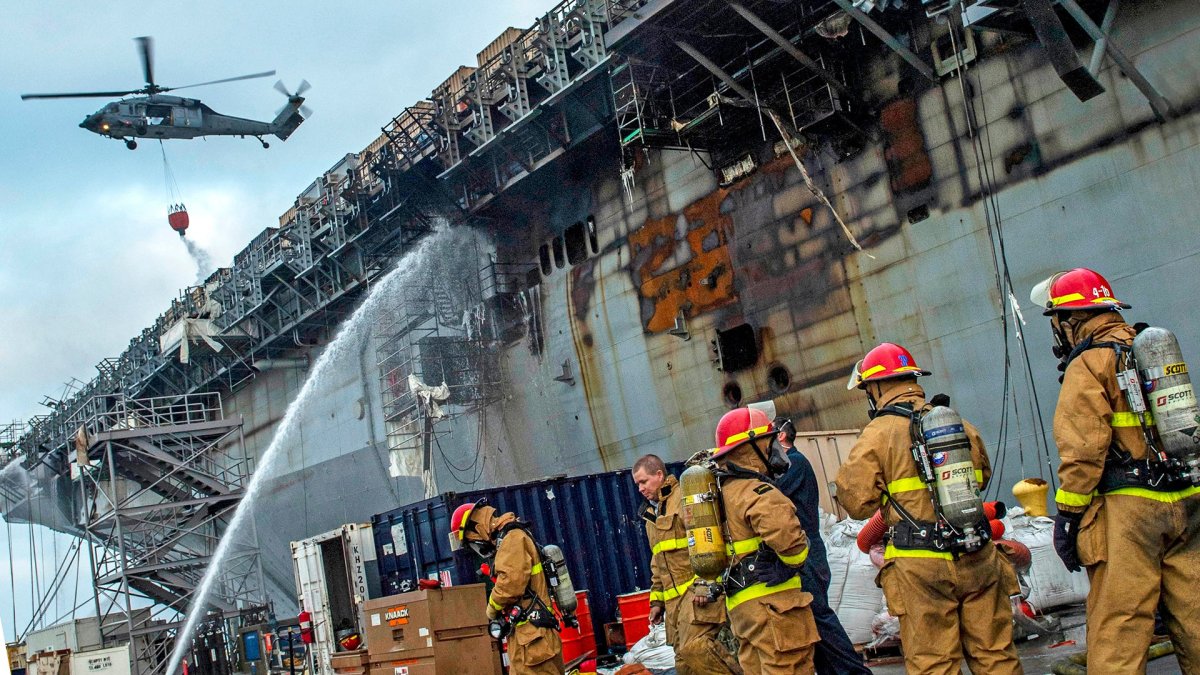
An MH-60S Sea Hawk from Helicopter Sea Combat Squadron Three (HSC-3) flies over the badly damaged Bonhomme Richard. , USN
The Dangers Of Sitting Still
The USS Bonhomme Richard was in an unusual condition on July 12th before an explosion onboard would set the ship ablaze. The amphibious assault ship was wrapping up a significant maintenance period at the General Dynamics NASSCO shipyard and had been moved to Naval Base San Diego’s Pier 2. The maintenance activity was still ongoing at the time of the “casualty,” or accident.
This means many systems were offline. The ship was full of shipyard personnel wrapping up their parts of the project. Under these circumstances, the decks can be littered with welding crews bonding fixtures to the outboards, cutting torches removing old mounts, grinding disks showering sparks into a fire-retardant cloth, and various workspace debris. Other workers would be working on ship’s wiring, air conditioning, and pretty much anything else.
Aviation Ordnanceman Airman David Gaona conducts preservation maintenance on an elevator aboard amphibious assault ship USS Bonhomme Richard . , USN
During these maintenance periods, passageways of the ship are often clogged with cables powering temporary light bulbs that cast shadows in corners. White strings tie up thick, black ventilation hoses that hum with air. Temporary alarm panels and fire hoses are mounted at critical locations shrinking the already highly limited corridor space. To provide these services to lower decks, some hatches are “fouled,” preventing or obstructing access. All this dramatically restricts how the crew can move between levels. They have to snake their way past obstructed hatches to get to an available ladder to move to the next level. Sailors and shipyard workers constantly weave around these obstacles during the workday to get to their workspaces.
When a vessel is in a long maintenance availability window, the ship is in a constant state of filth. Dust, fiber, shavings, and oils begin to pool in corners and crevices the moment a vessel begins a refit. If left unattended, this debris quickly becomes kindling for fires.
Sunshine streams into the upper vehicle deck of the amphibious assault ship USS Bonhomme Richard as Sailors and contractors prepare the ship for dry-dock circa 2010 , USN
This noisy, cluttered, hot work environment is precisely the type of fire hazard that sparks disasters onboard ships. Every shipyard worker and crewmember must police themselves and the area around them to identify and mitigate potential flashpoints.
A clean ship is fire-resistant.
During these long in-port periods, many experienced sailors are rotating off the ship to new commands. Many of the crewmen who report to the ship while in a maintenance availability either have not been to sea for years or are new and have never been to sea at all. They may struggle to navigate to their workspace and have never visited some parts of the ship when it is in this condition. This lack of familiarity with their vessel creates delays in response to casualties.
Every month the ship is in maintenance, it becomes more susceptible to disaster, not only from its inherent condition, but from the lack of onboard crew experience.
Sailors assigned to the amphibious assault ship USS Bonhomme Richard walk through early morning fog to the ship and the messing and berthing barge., USN
Many of the crew who do not rotate to new commands are often temporarily detached to other sea commands for experience and proficiency retention. This shrinks the crew below normal manning numbers and removes some of the most experienced sailors from its roster. This leaves the remaining sailors responsible for a large ship they may not be familiar with that is also in a state labyrinthian disarray. Crew manning is a managed risk the command leadership is responsible for maintaining. They must have a proficiently trained crew on the ship during a difficult and long in-port period while providing some of their sailors at sea experience whenever possible.
The maintenance availability environment is ripe for discipline issues. Crews see their ship in pieces with entire systems removed. They know they will not stand a watch at sea for months and it’s easy to fall into a sense of complacency. It is human nature to prepare for the moment and not the eventuality.
At a time when the ship is scheduled to be in port for months, the crew will need management and motivation to train harder because of the lack of sea experience, not despite it. From the deck plate crewman looking up at this top-down management, it appears unnecessarily harsh, and this lowers morale.
It is part of the maintenance availability process. Morale will suffer when sailors are pushed hard in port.
USS Bonhomme Richard undergoes maintenance in San Diego in 2016. , USN
Declining morale ripples across the crew like a tide. It begins with the crew not focusing during training or work parties and showing up late or not showing up at all. The sailor’s uniforms are often stained or dirty from the shipyard environment and cleaning they do every day. If allowed to continue, the crew will spiral into a lethargic, undisciplined pool of individuals who resent their command. This weighs on the crew mentally and instead of serving their country, they feel like they are serving the sweeping broom. Their performance will decline the more prolonged the ship and its crew remain in this condition.
At sea, the USS Bonhomme Richard fire would have been resolved much differently. It probably would not have happened in the first place.
Sailors aboard the amphibious assault ship USS Bonhomme Richard conduct a hangar bay fire drill while underway to Sasebo, Japan, USN
Underway, there is a full complement of crew, many of whom are experienced sailors. They can recognize a casualty and respond before it spreads beyond control. The entire crew is trained to respond cooperatively to an emergency and that training to do so is current and well administered. At sea, the ship is not fouled with temporary fixtures that block the passageways and they are well lit and orderly. At sea, the ship is easier to maintain and clean, preventing the potential spontaneous combustion of discarded materials.
The fire aboard Bonhomme Richard appears to have been started with maintenance debris left unattended in a vehicle storage area. These spaces are in use and monitored more closely while underway.
In other words, if the fire had happened while the ship was underway, it would have been much better prepared to handle the casualty because the crew is trained to prevent, contain, and resolve battle damage. The damage control tools and teams would have been on board, well trained and motivated, and in sufficient numbers to respond quickly.
Sailors assigned to the amphibious assault ship USS Bonhomme Richard check the structural integrity of Landing Craft Air Cushion 21 (LCAC 21) during a fire drill., USN
To minimize the chance of this disaster from repeating itself, the U.S. Navy should look at its practices. In fact, the Navy has the very model for success deployed on their nuclear-powered ships and submarines under the authority of NAVSEA and the U.S. Department of Energy . That model emanates from the Naval Nuclear Propulsion Program, better known as Naval Reactors . Naval Reactors has an excellent track record of few casualties onboard U.S. nuclear-powered ships since its inception. If the Navy would enforce standards required in the maintenance, watchstanding, and operation of nuclear power on all ships, crew performance would improve and we would lose less fighting capability due to poor practices.
Borrowing A Proven Strategy And Applying It To All
Imagine if the Bonhomme Richard was a nuclear-powered ship. That may seem terrifying at first, but the reality is really the opposite. Naval Reactors sets the standard for nuclear-powered ships and submarines in the Navy. These standards are strictly enforced and have a high-level redundancy from top to bottom. From the most complicated evolution involving year-long maintenance availability to relatively simple valve maintenance, every evolution is a minimum two-man operation or reader-worker routine. This breeds accountability. Accountability to each other and for the ship’s combat readiness. Accountability imparts hard work values on sailors. Those values become pride when the task is complete. Pride in a job done well raises morale.
Every sailor must be reminded of their purpose and their value to the crew, especially during long maintenance availability periods.
On a nuclear-powered vessel during a refit period, everything you bring on the ship comes off with you when you leave. A nuclear-powered vessel is not a storage locker for your tools, trash, and rags. This means cardboard and crates are often left on the pier during a refit. Rags and tools are kept with the worker at all times, not stored on board for convenience.
Convenience breeds complacency.
The Navy Reactors’ standard of performance is about much more than reactor safety. It is a standard that creates a culture on board a vessel that is less likely to incur a casualty.
Ohio class ballistic missile submarine USS Nebraska undocks from a dry dock at Puget Sound Navy Shipyard and Intermediate Maintenance Facility on March 8, 2016., USN
Cleanliness on a ship is a safety issue. This cannot be stressed enough. Dust accumulated is tinder. Oiled rags in an unventilated pile can react chemically and can eventually begin to burn. Workspaces must be inspected after work is complete by a supervisory element. This often falls on the Chief Petty Officer responsible for the area.
It’s about enforcing a command policy that requires shipyard personnel to check out with the duty section when their work is complete. It’s about taking the time to ensure a clean, safe ship environment. This has been the Nuclear Navy’s standard for decades.
Nuclear-powered Nimitz class supercarriers birthed at Naval Base Coronado across from downtown San Diego. , USN
The Nuclear Navy is held to an exceedingly high standard, from construction to maintenance to operation, both at sea and during shipyard periods. These practices are reviewed annually by an Operational Reactor Safety Examination inspection team that includes performance standards by the entire crew. The ship itself must meet the Naval Reactors ORSE standard to operate. This demands a culture of high performance and cleanliness that results in fewer fires, or other catastrophes, and a timely response when something goes wrong.
Perhaps, after the Bonhomme Richard disaster, it is time to hold the entire Navy to Naval Reactors’ standards for crew performance, cleanliness, and preservation of our fighting capability. In the event of catastrophic fire or flooding, the nuclear power plant cannot be abandoned . We must not fail.
Let’s bring this attitude to the entire service.
Navy sailors and civilian firefighters stand at attention for reveille at Naval Base San Diego as the USS Bonhomme Richard continues to burn in the background., USN
Aaron Amick is a retired U.S. Navy submarine sonarman. He served in both Atlantic and Pacific Oceans on 688 Los Angles class fast attack and Ohio class ballistic missile submarines. He has published two audiobooks on Cold War-era submarines, Akula SSN Project 971 Sub Brief and USS Nautilus SSN-571 Sub Brief . Now, Aaron manages a small Patreon page and contributes to The War Zone.
Contact the editor: Tyler@thedrive.com
Comments couldn’t be loaded. Please refresh the page.
发布于美国东部时间2020年7月15日上午11:34
美国海军正面临一场前所未有的严重灾难,两栖攻击舰“好人理查德”号可能彻底沉没。许多人百思不得其解的是,一艘未携带武器、停泊在世界最先进海军基地之一(该基地位于美国一座主要城市的海岸线上)的主力舰,为何会发生这样的事情。答案或许会让一些人感到不安——美国海军舰艇在母港停泊时,往往是最脆弱的。
许多人还想知道,如果这起事故发生在核动力超级航母上会是什么情况。目前,有三艘核动力超级航母就停泊在圣地亚哥湾对岸的科罗纳多海军基地,与“好人理查德”号隔湾相望。这个问题本身就很有意思,而且或许还能为防止未来在常规动力舰艇上发生类似灾难提供一些思路。
美国海军第三海上作战直升机中队(HSC-3)的一架MH-60S“海鹰”直升机飞越严重受损的“好人理查德”号航母。
久坐不动的危险
7月12日,在舰上发生爆炸并引发火灾之前,“好人理查德”号两栖攻击舰处于异常状态。这艘两栖攻击舰当时正在通用动力NASSCO造船厂进行重要的维护保养,并已移至圣地亚哥海军基地2号码头。事故发生时,维护工作仍在进行中。
这意味着许多系统都处于离线状态。船上挤满了造船厂的工人,他们正在收尾各自的项目工作。在这种情况下,甲板上到处都是焊工在将夹具连接到舷外机上,切割工在拆除旧支架,砂轮机火花四溅地打在防火布上,还有各种各样的工作垃圾。其他工人则在进行船上的线路、空调以及其他各种维修工作。
美国海军航空军械兵大卫·加奥纳正在两栖攻击舰“好人理查德”号上对一部电梯进行维护保养。
在这些维护期间,船上的通道常常被为临时照明灯泡供电的电缆堵塞,这些灯泡在角落里投下阴影。白色的绳子捆扎着粗大的黑色通风软管,发出嗡嗡的气流声。临时警报面板和消防水带安装在关键位置,进一步压缩了本就十分有限的走廊空间。为了向下层甲板提供这些服务,一些舱口被“堵塞”,导致无法或阻碍通行。所有这些都极大地限制了船员在不同楼层之间的移动。他们不得不绕过被堵塞的舱口,才能找到可用的梯子前往下一层。在工作日,水手和造船厂工人不得不不断地绕过这些障碍物才能到达他们的工作区域。
当船舶处于长时间维护保养期时,船体内部会一直处于脏污状态。一旦船舶开始改装,灰尘、纤维、刨花和油污就会开始在角落和缝隙中堆积。如果不及时清理,这些杂物很快就会成为火灾的引燃物。
大约在2010年,阳光洒进两栖攻击舰“好人理查德”号的上层车辆甲板,水兵和承包商正在为该舰进入干船坞做准备。(美国海军)
这种嘈杂、杂乱、闷热的工作环境正是引发船舶灾难的火灾隐患。每位造船厂工人和船员都必须时刻警惕自身及周围区域,识别并消除潜在的火灾隐患。
干净的船体具有防火性能。
在漫长的港口停泊期间,许多经验丰富的船员会轮换到其他岗位。许多在船舶进行维护保养期间到岗的船员要么多年未曾出海,要么是新来的,从未有过海上经验。他们可能难以找到自己的工作区域,而且在船舶处于这种维护保养状态时,他们可能从未到过船上的某些区域。这种对船舶缺乏熟悉会导致在发生事故时反应迟缓。
船舶每维修一个月,就更容易发生灾难,这不仅是因为船舶本身的状况,还因为船上船员缺乏经验。
隶属于两栖攻击舰“好人理查德”号的水兵们在清晨的薄雾中走向舰艇和伙食及住宿驳船。(美国海军)
许多不轮换到新岗位的船员通常会被暂时调派到其他海上单位,以保持经验和技能。这导致船员人数低于正常编制,并带走了一些经验最丰富的船员。这样一来,剩下的船员就得负责一艘他们可能并不熟悉的大型舰艇,而且舰艇内部还处于混乱不堪的状态。船员配备是一项可控风险,指挥领导层有责任维持这种状态。他们必须在漫长而艰难的港口停泊期间,确保舰上拥有一支训练有素的船员队伍,同时尽可能为部分船员提供海上实践经验。
维护可用性环境极易引发纪律问题。船员们眼睁睁地看着自己的船被拆得支离破碎,整个系统都被拆除。他们知道自己几个月都无法在海上值班,很容易因此产生一种麻痹大意的心态。人性使然,人们总是倾向于为眼前的状况做好准备,而不是为可能发生的情况做好准备。
在船舶计划停靠港口数月的情况下,船员们需要的是管理和激励,让他们因为缺乏海上经验而更加努力地训练,而不是无视经验。从甲板上的普通船员的角度来看,这种自上而下的管理方式显得过于严苛,这会打击士气。
这是维护可用性流程的一部分。如果水兵在港口被过度劳累,士气会受到影响。
2016年,美国海军“好人理查德”号航空母舰在圣地亚哥进行维护保养。
士气低落如同潮水般在船员中蔓延。首先是船员在训练或工作中注意力不集中,经常迟到甚至缺席。由于造船厂的环境和每天的清洁工作,水兵的制服常常沾满污渍或污垢。如果这种情况持续下去,船员们将逐渐变得萎靡不振、纪律涣散,并对指挥心生怨恨。这会给船员带来沉重的精神负担,他们感觉自己不是在为国家效力,而是在做扫地的工作。舰船和船员在这种状态下持续的时间越长,他们的表现就越差。
如果是在海上,邦霍姆·理查德号航空母舰的火灾处理方式会截然不同。它很可能根本就不会发生。
美国海军“好人理查德”号两栖攻击舰上的水兵在前往日本佐世保的途中进行机库消防演习
航行中,船上配备齐全的船员,其中许多人都是经验丰富的航海员。他们能够识别事故并及时应对,防止事态失控。全体船员都接受过协同应对紧急情况的训练,并且这些训练内容与时俱进,执行到位。在海上,船上没有临时搭建的设施堵塞通道,通道照明充足,整洁有序。在海上,船舶更易于维护和清洁,从而避免了废弃物自燃的风险。
“好人理查德”号上的火灾似乎是由车辆存放区内无人看管的维修杂物引起的。这些区域在航行期间都会被使用,并受到更严格的监控。
换句话说,如果火灾发生在航行途中,舰上人员会更有准备应对事故,因为船员接受过预防、控制和处理战斗损伤的训练。损管设备和人员都已配备齐全,训练有素、积极性高,并且人数充足,能够迅速做出反应。
隶属于两栖攻击舰“好人理查德”号的水兵在消防演习中检查21型气垫登陆艇(LCAC 21)的结构完整性。(美国海军)
为了最大限度地降低此类灾难重演的可能性,美国海军应该审视自身的操作规范。事实上,海军在其核动力舰艇和潜艇上部署了一套行之有效的成功模式,该模式由海军海上系统司令部(NAVSEA)和美国能源部负责实施。这套模式源自海军核动力推进计划,也就是人们熟知的海军反应堆。自该计划启动以来,海军反应堆在美国核动力舰艇上鲜有人员伤亡,记录堪称卓越。如果海军能够严格执行所有舰艇核动力维护、值班和运行方面的标准,船员的工作表现将会得到提升,我们也能减少因操作不当而造成的战斗力损失。
借鉴行之有效的策略并将其应用于所有领域
想象一下,如果“好人理查德”号是一艘核动力舰艇。乍听之下或许令人恐惧,但事实恰恰相反。海军反应堆公司为海军的核动力舰艇和潜艇制定了标准。这些标准得到严格执行,并且从上到下都具有高度冗余性。从需要全年维护的最复杂操作,到相对简单的阀门维护,每一项操作都至少需要两人完成,或者说是例行的读卡器和操作员配合。这培养了责任感。这种责任感体现在对彼此的责任以及对舰艇战备状态的责任上。责任感赋予水兵勤奋工作的价值观。当任务完成时,这些价值观会转化为自豪感。对出色工作的自豪感能够提升士气。
必须时刻提醒每一位水手他们的使命以及他们对船员的价值,尤其是在长时间的维护保养期间。
在核动力船舶改装期间,所有上船物品都会随您一起卸下。核动力船舶不是存放工具、垃圾和破布的储物柜。这意味着纸板箱和板条箱在改装期间通常会留在码头上。破布和工具始终由工作人员随身携带,不会为了方便而存放在船上。
便利滋生安逸。
海军反应堆的性能标准远不止于反应堆安全。它更是一种在舰艇上营造文化氛围的标准,这种文化能降低事故发生的可能性。
2016年3月8日,俄亥俄级弹道导弹核潜艇“内布拉斯加”号从普吉特海湾海军造船厂和中级维修设施的干船坞驶出。(美国海军)
船上的清洁卫生关乎安全,这一点怎么强调都不为过。积聚的灰尘如同引火物。堆放在通风不良处的油渍抹布会发生化学反应,最终可能燃烧。工作区域必须在工作完成后由主管人员进行检查。这项职责通常由负责该区域的首席士官承担。
这关乎执行一项指挥政策,该政策要求造船厂人员在完成工作后向值班部门报到。这关乎花时间确保舰船环境的清洁和安全。这几十年来一直是核动力海军的标准。
核动力尼米兹级超级航母在位于圣地亚哥市中心对面的科罗纳多海军基地下水。
核动力海军从建造、维护到运行,无论是在海上还是在船厂内,都遵循着极高的标准。这些操作流程每年都会由反应堆运行安全检查小组进行审查,该小组还会对全体船员的绩效标准进行评估。舰艇本身必须符合海军反应堆运行安全检查标准才能运行。这要求舰艇具备卓越的性能和高度的洁净度,从而减少火灾或其他灾难的发生,并在出现问题时能够及时响应。
或许,在“好人理查德”号核电站事故之后,是时候让整个海军都按照海军核反应堆的标准来要求船员表现、清洁度和作战能力的维护了。一旦发生灾难性火灾或洪水,核电站绝不能被弃置。我们绝不能失败。
让我们把这种态度带到整个服务部门。
在圣地亚哥海军基地,海军水兵和民用消防员肃立聆听起床号,背景中“好人理查德”号两栖攻击舰仍在燃烧。
亚伦·阿米克是美国海军退役潜艇声纳兵。他曾在大西洋和太平洋服役,先后在洛杉矶级快速攻击潜艇(688型)和俄亥俄级弹道导弹潜艇上服役。他出版了两本关于冷战时期潜艇的有声读物:《阿库拉号核潜艇971项目简报》和《鹦鹉螺号核潜艇571项目简报》。如今,亚伦运营着一个小型Patreon页面,并为《战区》网站撰稿。
联系编辑:Tyler@thedrive.com
评论加载失败,请刷新页面。