S’pore joins regional bid to add Malay dance form zapin to UNESCO intangible cultural heritage list新加坡加入区域申办行列,力争将马来舞蹈形式扎宾列入联合国教科文组织非物质文化遗产名录。
Singapore, Brunei, Indonesia and Malaysia aim to submit the nomination file to UNESCO in March 2027. Read more at straitstimes.com.
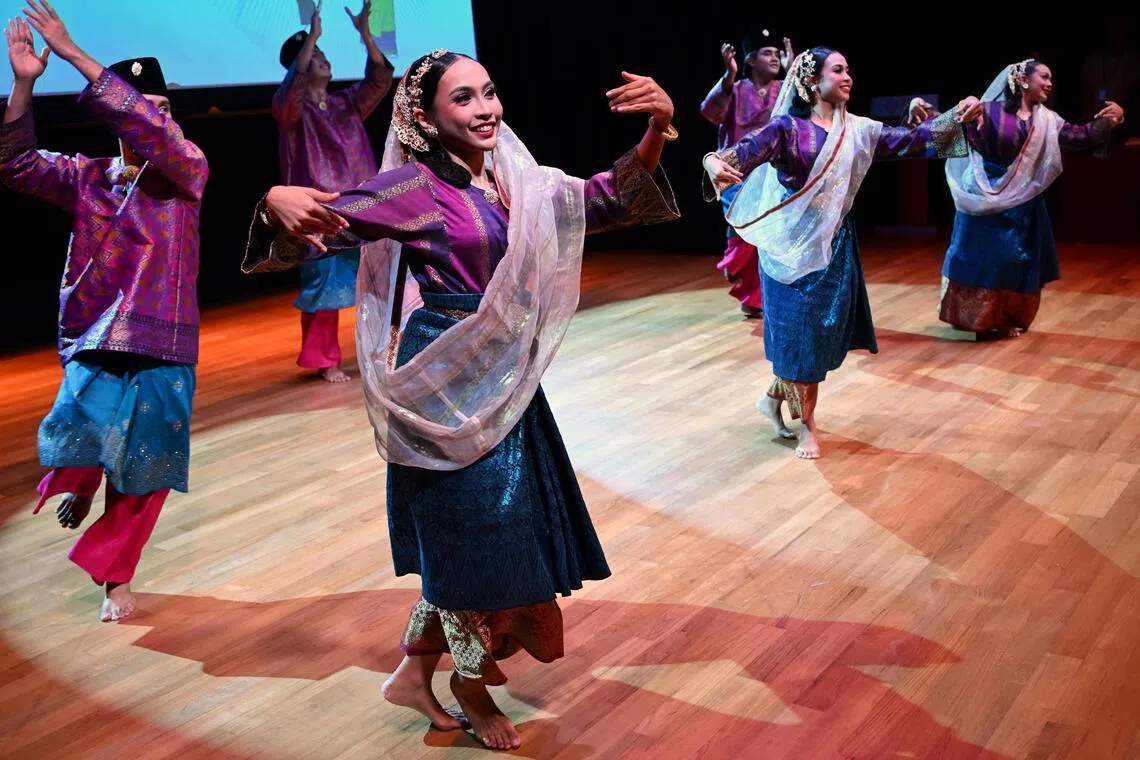
Zapin practitioners giving a demonstration of the dance at the Malay Heritage Centre on Sept 24.
ST PHOTO: KUA CHEE SIONG
Published Sep 24, 2026, 05:00 PM
Updated Sep 24, 2026, 05:00 PM
Singapore, Brunei, Indonesia, and Malaysia will jointly nominate the traditional Malay art form zapin for Unesco's intangible cultural heritage list by March 2027.
Zapin is a lively dance with deep cultural roots, performed widely and sustained by strong community involvement and education in Singapore and the region.
The nomination highlights zapin's regional history, promotes its preservation, and aims to inspire younger generations to continue this living heritage.
SINGAPORE – Singapore, Brunei, Indonesia and Malaysia will be putting up a joint bid for zapin, a traditional Malay performing art with deep roots in the region, to be inscribed on UNESCO’s intangible cultural heritage list.
The four participating countries aim to submit their nomination to UNESCO in March 2027, said the National Heritage Board (NHB) on Sept 24.
NHB chief executive Chang Hwee Nee said the nomination underscores the cultural significance of zapin for communities in Singapore and across the region.
“We hope this milestone will inspire a new generation of practitioners to keep this cherished dance form alive as part of our living heritage, while encouraging Singaporeans to explore and embrace its rich traditions,” she said.
This is the first time Singapore is jointly nominating a performing art form to UNESCO’s list. It is the Republic’s fourth nomination.
Intangible cultural heritage refers to traditions or living expressions that are inherited and passed on between generations, such as performing arts, social practices, rituals and festive events.
Zapin is an upbeat dance associated with budaya (culture), nilai (values) and adab (etiquette). It is believed to have been introduced to the Malay Archipelago during the 13th to 15th centuries by Arab Muslim communities. It is one of five dance forms commonly practised by the Malay dance community in Singapore – the others are asli, inang, joget and masri.
It is characterised by dance movements choreographed to lively melodies, which are performed using musical instruments such as the gambus (short-necked lute), accordion and rebana (traditional drum). Its dance moves often mimic the movements of animals and the natural world, including the keluang (fruit bat), batang (tree trunk) and pusau (swirl).
Georgina Koh, NHB’s director of heritage policy and research, said zapin has a vibrant practising community here.
“We have also heard from the practitioners that they frequent festivals not just in Singapore to share zapin with the community here, but also participate in regional festivals where zapin is being shared, both as local variants as well as cross-sharing between the regions,” she said.
The multinational nomination builds upon decades of regional community collaboration, with festivals such as Zapin D’Muara, which later evolved into the annual Muara Festival in Singapore, featuring dancers and musicians across the region, said NHB.
There are various zapin subgenres performed in the region. One form that has its roots in Singapore is Zapin Asyik, created by choreographer Liau Ah Choon in the 1960s after she watched performers at a Terengganu wedding and adapted it back in Singapore.
In the past, zapin was only performed in Singapore at significant or ceremonial occasions such as weddings. Today, the traditional dance has grown in popularity, and is widely performed at various events and festivals by Malay dancers and students, ranging from specialised dance companies to student interest groups, said NHB.
It is sustained through strong community participation and education here, added NHB. Traditional Malay performing arts groups play a pivotal role as longstanding community anchors, mentoring the next generation of zapin enthusiasts and regularly showcasing zapin to the wider public.
Complementing these efforts are local educational institutions, which offer co-curricular activities and clubs dedicated to traditional Malay dance to students across various cultural backgrounds.
Zapin practitioners at the Malay Heritage Centre on Sept 24. ST PHOTO: KUA CHEE SIONG
Zapin practitioners at the Malay Heritage Centre on Sept 24.
Som Said, 75, founder of dance company Sri Warisan Som Said Performing Arts, has been involved in the zapin community for 61 years. She has created multiple works like Zapin Telok Blangah, a subgenre which has been performed in over 100 cities around the world.
“I hope that zapin will be further recognised on the international stage,” she said, adding that she wants to continue promoting zapin locally and internationally and to help younger generations appreciate the art form.
Osman Abdul Hamid, 64, who founded Era Dance Theatre, said zapin is a living heritage that carries the history, values and collective memory of the community.
“When you learn zapin in Indonesia or in Malaysia, it’s different from what we are in Singapore,” he said. “That shows Malay arts is very rich. It’s not stagnant, it’s not just one type of zapin.”
He has tried to create new genres and approaches to zapin which are more energetic and contemporary to reach out to the younger generation.
“Once they are engaged with us, we will teach them the more traditional zapin which is more structured... and then we transfer the values of zapin,” he said, adding that the dance form’s graceful and disciplined steps reflect the values of respect, humility and togetherness.
Both veteran dancers are past recipients of the Steward of Intangible Cultural Heritage awards, in recognition of their safeguarding efforts in the field of traditional Malay dance including zapin.
Young practitioners of zapin here include 20-year-old Mohammad Aniq Haqif, a member and student choreographer of zapin as part of Dharma Endari, a traditional Malay dance group based at Republic Polytechnic.
He started learning zapin in primary school as a co-curricular activity, drawn by its distinctive sound, rhythm, beat and values that the art form instils, such as respect for the elderly.
“The nomination is motivation especially for the younger generation,” he said. “We need it to boost our energy and to continue what the older generation has passed on to us.”
Zapin is an upbeat dance associated with budaya (culture), nilai (values) and adab (etiquette). ST PHOTO: KUA CHEE SIONG
Zapin is an upbeat dance associated with budaya (culture), nilai (values) and adab (etiquette).
Since UNESCO’s intangible cultural heritage list was launched in 2008, 716 intangible cultural heritage elements have been inscribed as of December 2025.
Singapore’s first nomination was hawker culture which was successfully inscribed in 2020. The second was the kebaya, a joint nomination with Brunei , Malaysia, Indonesia and Thailand, that was successfully inscribed in 2024. The third nomination of Chingay with Malaysia is currently awaiting evaluation by UNESCO.
Results for the fourth nomination will possibly be made known in two to three years’ time after its submission in March 2027, said NHB.
UNESCO’s evaluation takes into account how the participating countries ensure the promotion and transmission of the practice, and how the bid involved the participation of the community in each country.
Zapin practitioners giving a demonstration of the dance at the Malay Heritage Centre on Sept 24. ST PHOTO: KUA CHEE SIONG
NHB said it will conduct focus group discussions throughout the nomination process to seek views on the social and cultural significance of zapin, as well as safeguarding measures for it. It will also work closely with the community to raise public awareness and participation in zapin involving Singaporeans of all backgrounds.
Koh said discussions will also involve documentation of the art form, as zapin is mostly shared through oral forms or actual practice.
Noramin Farid, co-founder and resident producer of Malay dance troupe DIAN Dancers, and senior lecturer at the Faculty of Creative Arts of the Universiti Malaya, said he hopes the nomination inspires audiences to discover its rich regional history and to actively engage with zapin.
“This joint effort beautifully reflects the art form’s long history as a practice shared across borders, which binds our neighbouring countries together through a shared sense of belonging,” he said.
Chin Soo Fang is senior correspondent at The Straits Times, covering a wide range of topics including community, politics, social issues, consumer, culture and heritage.
National Heritage Board
9月24日,扎宾舞表演者在马来文化中心进行舞蹈演示。
《海峡时报》摄影:郭志雄
发布于2026年9月24日下午5:00
更新于2026年9月24日下午5:00
新加坡、文莱、印度尼西亚和马来西亚将于 2027 年 3 月前联合提名马来传统艺术形式扎宾(zapin)进入联合国教科文组织非物质文化遗产名录。
Zapin 是一种充满活力的舞蹈,有着深厚的文化根基,在新加坡和该地区广泛流行,并得到强大的社区参与和教育的支持。
该提名突出了扎平的地区历史,促进了对其的保护,并旨在激励年轻一代继续传承这一活态遗产。
新加坡——新加坡、文莱、印度尼西亚和马来西亚将联合申办扎宾(zapin),这是一种在该地区有着深厚根基的马来传统表演艺术,希望将其列入联合国教科文组织非物质文化遗产名录。
韩国国家文物局(NHB)于9月24日表示,这四个参与国计划于2027年3月向联合国教科文组织提交提名。
新加坡国家文物局首席执行官张慧妮表示,这项提名凸显了扎宾对新加坡及整个地区社区的文化意义。
“我们希望这一里程碑能够激励新一代的从业者,将这种珍贵的舞蹈形式传承下去,使其成为我们活态遗产的一部分,同时鼓励新加坡人探索和拥抱其丰富的传统,”她说。
这是新加坡首次与其他国家和地区联合提名一种表演艺术形式列入联合国教科文组织世界遗产名录,也是新加坡第四次提名该类艺术形式。
非物质文化遗产是指代代相传的传统或活态表现形式,例如表演艺术、社会习俗、仪式和节庆活动。
扎宾舞是一种欢快的舞蹈,与马来文化(budaya)、价值观(nilai)和礼仪(adab)紧密相关。据信,它是在13至15世纪由阿拉伯穆斯林社群传入马来群岛的。它是新加坡马来舞蹈社群常跳的五种舞蹈形式之一,其他四种分别是阿斯利舞(asli)、伊南舞(inang)、乔格舞(joget)和马斯里舞(masri)。
它的特点是舞蹈动作与欢快的旋律相配,并使用甘布斯琴(短颈琵琶)、手风琴和雷巴纳鼓(传统鼓)等乐器进行演奏。其舞蹈动作经常模仿动物和自然界的动作,包括蝙蝠(果蝠)、树干(树干)和旋转(漩涡)。
新加坡国家文物局遗产政策与研究主任 Georgina Koh 表示,扎平在这里拥有一个充满活力的实践社群。
“我们也从从业者那里了解到,他们不仅经常参加新加坡的各种节日活动,与当地社区分享扎宾,还会参加区域性的节日活动,分享扎宾,既有本地的变体,也有区域间的交叉分享,”她说。
国家文物局表示,这项跨国提名建立在数十年来区域社区合作的基础上,例如 Zapin D'Muara 节,该节日后来发展成为新加坡一年一度的 Muara 节,汇聚了来自该地区的舞蹈家和音乐家。
该地区有多种扎宾舞的亚流派。其中一种起源于新加坡的形式是扎宾阿西克舞,由编舞家廖亚春在20世纪60年代创作,当时她在登嘉楼的一场婚礼上观看了表演,并将其改编后带回新加坡。
新加坡国家文物局表示,过去,扎宾舞只在新加坡的重要场合或庆典上表演,例如婚礼。如今,这种传统舞蹈越来越受欢迎,马来舞者和学生,从专业舞蹈团到学生兴趣团体,都会在各种活动和节日中广泛表演。
国家文物局补充说,当地社区的积极参与和教育是维持马来传统舞蹈得以传承的关键。传统的马来表演艺术团体作为社区的长期支柱,发挥着至关重要的作用,他们指导下一代扎宾爱好者,并定期向公众展示扎宾艺术。
与这些努力相辅相成的是当地的教育机构,它们为来自不同文化背景的学生提供课外活动和专门从事马来传统舞蹈的俱乐部。
9 月 24 日,马来遗产中心的 Zapin 练习者。ST 照片:KUA CHEE SIONG
9月24日,马来文化中心的扎宾疗法从业者。
75岁的Som Said是舞蹈公司Sri Warisan Som Said Performing Arts的创始人,她从事扎宾舞社群已有61年之久。她创作了许多作品,例如扎宾·特洛克·布兰加(Zapin Telok Blangah),这是一种在世界各地100多个城市演出过的舞蹈亚类型。
“我希望扎宾舞能在国际舞台上得到更多认可,”她说道,并补充说她希望继续在国内和国际上推广扎宾舞,帮助年轻一代欣赏这种艺术形式。
64 岁的奥斯曼·阿卜杜勒·哈米德是时代舞蹈剧院的创始人,他说扎宾舞是一种活的文化遗产,承载着社区的历史、价值观和集体记忆。
他说:“在印尼或马来西亚学习的扎宾舞与新加坡的扎宾舞截然不同。这表明马来艺术非常丰富,它并非一成不变,也不仅仅只有一种扎宾舞。”
他尝试创造出更具活力和现代感的扎宾新流派和新方法,以吸引年轻一代。
“一旦他们与我们建立联系,我们将教他们更有条理的传统扎宾舞……然后我们将扎宾舞的价值观传递给他们,”他说道,并补充说,这种舞蹈形式优雅而有纪律的舞步体现了尊重、谦逊和团结的价值观。
这两位资深舞蹈家都曾获得非物质文化遗产守护者奖,以表彰他们在保护马来传统舞蹈(包括扎宾舞)方面所做的努力。
这里年轻的扎宾舞练习者包括 20 岁的 Mohammad Aniq Haqif,他是 Dharma Endari 的成员和学生编舞,Dharma Endari 是一个位于共和理工学院的传统马来舞蹈团体。
他小学时开始学习扎宾,作为一项课外活动,被扎宾独特的声音、节奏、节拍以及这种艺术形式所灌输的价值观(例如尊重长辈)所吸引。
“这项提名对年轻一代来说尤其具有激励作用,”他说。“我们需要它来提振我们的士气,并将老一辈传承给我们的东西继续发扬光大。”
Zapin是一种欢快的舞蹈,与budaya(文化)、nilai(价值观)和adab(礼仪)密切相关。ST PHOTO:KUA CHEE SIONG
Zapin 是一种欢快的舞蹈,与 budaya(文化)、nilai(价值观)和 adab(礼仪)有关。
自联合国教科文组织于 2008 年推出非物质文化遗产名录以来,截至 2025 年 12 月,已有 716 项非物质文化遗产被列入名录。
新加坡首次提名的是小贩文化,已于2020年成功列入世界遗产名录。第二次是与文莱、马来西亚、印度尼西亚和泰国共同提名的马来西亚传统服饰卡巴雅,已于2024年成功列入世界遗产名录。第三次提名是与马来西亚共同提名的妆艺大游行,目前正在等待联合国教科文组织的评估。
国家文物局表示,第四轮提名结果可能会在2027年3月提交后的两到三年内公布。
联合国教科文组织的评估考虑了参与国如何确保推广和传播这一做法,以及申办过程中各国社区的参与情况。
9月24日,扎宾舞表演者在马来文化中心进行舞蹈演示。(海峡时报摄影:郭志雄)
国家文物局表示,将在整个提名过程中开展焦点小组讨论,以征求各方对扎宾的社会和文化意义以及保护措施的意见。文物局还将与社区紧密合作,提高公众对扎宾的认识和参与度,让新加坡各界人士都能参与其中。
Koh表示,讨论还将涉及对这种艺术形式的记录,因为扎宾主要通过口头形式或实际练习来传承。
马来舞蹈团 DIAN Dancers 的联合创始人兼常驻制作人、马来亚大学创意艺术学院高级讲师 Noramin Farid 表示,他希望这一提名能够激励观众去发现其丰富的区域历史,并积极参与到 zapin 的活动中来。
他说:“这种共同努力完美地体现了这种艺术形式悠久的历史,它是一种跨越国界的共享实践,通过共同的归属感将我们的邻国联系在一起。”
Chin Soo Fang 是《海峡时报》的资深记者,报道范围广泛,包括社区、政治、社会问题、消费者、文化和遗产等话题。
国家文物局