Countries can find common ground on AI safeguards, incident reporting: Tan Kiat How陈杰豪:各国可以在人工智能安全保障和事件报告方面找到共同点
There needs to be credible ways in evaluating the capabilities of capable models, said Senior Minister of State for Digital Development and Information Tan Kiat How. Read more at straitstimes.com.
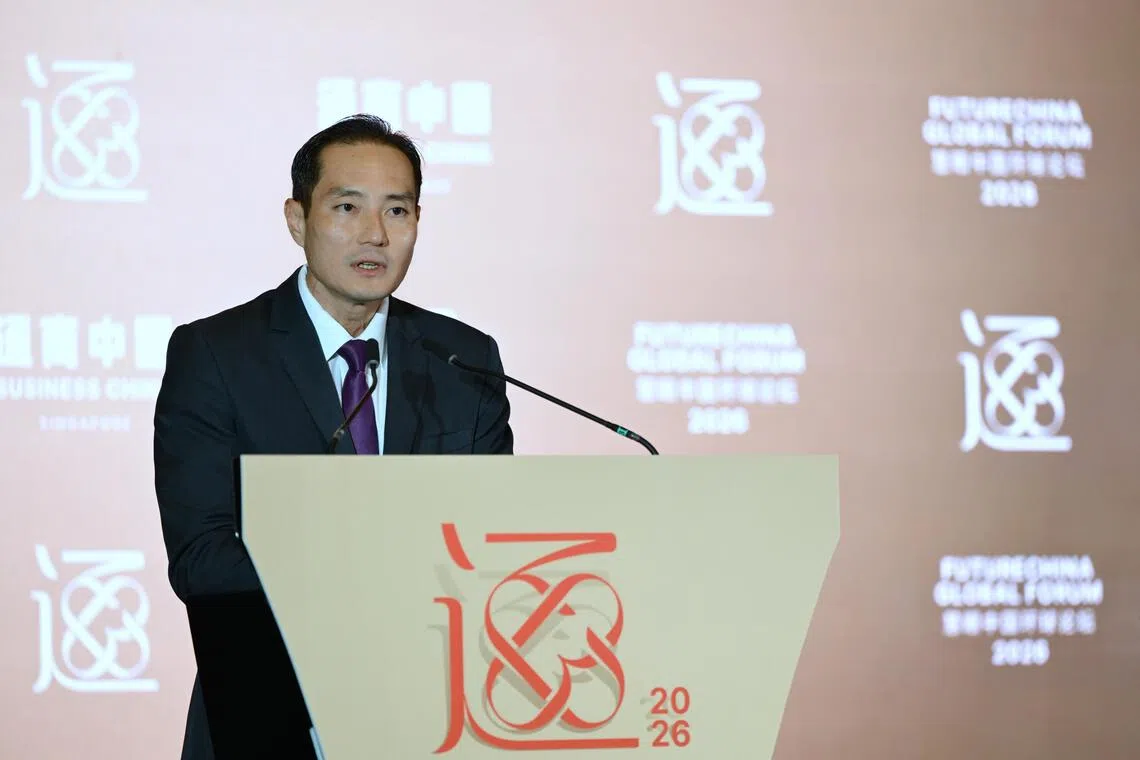
Senior Minister of State for Digital Development and Information of Singapore, Tan Kiat How at the FutureChina Global Forum on Sept 24, 2026.
Published Sep 24, 2026, 08:35 PM
Updated Sep 24, 2026, 08:35 PM
Countries can find common ground on AI safeguards, focusing on evaluation, incident reporting, and communication to prevent reckless competition, despite different regulatory approaches.
Singapore aims to excel in converting AI capabilities into economic and societal value.
Experts stress AI safety through multi-level safeguards, international collaboration, and monitoring, highlighting risks from misuse and the need for trust in autonomous systems.
SINGAPORE – Countries can find common ground on safeguards for increasingly powerful artificial intelligence systems even if they take different approaches to regulating the technology, said Senior Minister of State for Digital Development and Information Tan Kiat How on Sept 24.
“It is about (having) enough common ground around evaluation, safeguards, incident reporting and communication so that competition does not become recklessness,” said Tan.
He was giving the opening remarks at the FutureChina Global Forum 2026, organised by Business China, a non-profit organisation which aims to strengthen ties between Singapore and China.
His remarks come amid global alarm over powerful AI models going rogue, including an OpenAI agent that broke out of a controlled testing environment and compromised systems at AI platform Hugging Face , and another that gained unauthorised access to an Australian government Medicare statistics portal.
Singapore has joined over 20 countries in backing a call for control of frontier AI models initiated by Finnish President Alexander Stubb and Norwegian Prime Minister Jonas Gahr Store on the sidelines of the United Nations General Assembly held from Sept 18 to 28 in New York.
“The point is not to make every country regulate AI in the same way. It is to build enough common ground around a few practical things,” said Tan.
For a start, there needs to be credible ways in evaluating the capabilities of increasingly capable models and greater consistency around what is being measured, especially if the models can assist in advanced cyber operations, biological research or take actions on their own.
Next, countries should also agree on when additional safeguards should kick in, especially when evaluations show that a system has crossed an important capability threshold. Where serious risks are foreseeable, safeguards should increasingly be part of the design.
“That can mean controlling access to dangerous capabilities, limiting what tools or systems a model can reach, building in monitoring and logging, testing attempts to bypass safeguards, and ensuring operators can intervene when necessary,” said Tan.
He added that evaluations help people understand what an AI model can do while guardrails determine what it is allowed to do.
Thirdly, there should be agreements around incident reporting and information sharing, so countries can learn from serious failures or unexpected behaviours. Tan said: “We need communication channels that remain open even when competition is intense.”
Tan also fleshed out Singapore’s position amid a global AI race, pointing out that the Republic should focus on becoming “exceptionally good” at converting AI capability into economic and societal value, instead of trying to accumulate AI capacity.
He drew parallels to Singapore’s status as an international financial centre, which developed not because the country had the largest domestic market, but because various parties like companies, investors and financial institutions from different parts of the world can operate in Singapore with confidence.
In the context of AI, Singapore should then become a place where technology companies work closely with demanding users, where engineers are close to real operational problems, and where companies can test if a solution helps a system produce a better outcome.
“In the same way that we built the ecosystem around our financial sector, we should build an ecosystem that makes conversion (of AI capabilities into economic and societal value) one of Singapore’s strengths,” said Tan.
Trust will be important as AI systems become more autonomous, said Tan.
If an AI agent makes a purchase on someone’s behalf, questions arise over who authorised it, whether its actions can be traced, and who is responsible when something goes wrong.
“These are no longer abstract questions about AI governance. They are becoming requirements for commerce.” said Tan.
Although payments firms Ant International, Mastercard and Visa operate different networks, they are working together with the Monetary Authority of Singapore on common ways for AI agents to be identified and trusted across these networks.
The risks posed by increasingly powerful AI systems were also discussed at a panel on AI safety at the event.
Panellists included Singapore’s chief AI officer He Ruimin, Tsinghua University distinguished visiting professor Zhang Hongjiang, HSBC Singapore chief information officer Lim Boon Khee and drug discovery platform Partex founder and chief executive Gunjan Bhardwaj.
Singapore’s chief AI officer cautioned against focusing only on the prospect of autonomous AI systems running out of control.
“The risks that come from bad people using capable models is probably worse today, and it’s a clear and present danger than AI models going amok and losing control,” He said.
He urged societies to better secure their digital systems from cybercriminals. Safeguards are required at multiple levels, including user education on AI use, controlling system access rights and system oversight. International collaboration is necessary because many AI models are developed outside Singapore by only a few countries, He said.
Tsinghua University distinguished visiting professor Zhang Hongjiang said that the ability of AI models to deceive and evolve are two threats that researchers need to watch. He said greater effort was needed to evaluate and monitor models as their capabilities advance.
Zhang also drew parallels with nuclear safeguards developed during the Cold War. Despite intense competition, the United States and Soviet Union eventually recognised the need for communication and coordination as their nuclear capabilities grew, he said.
“As we push AI capability, we should also push the capability to control the model and to monitor the model,” said Zhang, noting that AI is harder to monitor than nuclear weapons because it is not a physical asset that can easily be observed.
AI/artificial intelligence
Artificial Intelligence
新加坡数字发展及新闻部高级政务部长陈杰豪于2026年9月24日出席了未来中国全球论坛。
发布于 2026 年 9 月 24 日晚上 8:35
更新于2026年9月24日晚上8:35
尽管各国监管方式不同,但它们可以在人工智能保障措施方面找到共同点,重点关注评估、事件报告和沟通,以防止鲁莽竞争。
新加坡的目标是在将人工智能能力转化为经济和社会价值方面做到卓越。
专家强调通过多层次保障措施、国际合作和监控来保障人工智能安全,并着重指出滥用带来的风险以及对自主系统的信任的必要性。
新加坡——新加坡数码发展及新闻部高级政务部长陈杰豪9月24日表示,即使各国对人工智能技术的监管方式不同,它们仍然可以在保障日益强大的人工智能系统的安全方面找到共同点。
“关键在于围绕评估、保障措施、事件报告和沟通达成足够的共识,这样竞争才不会演变成鲁莽行事,”谭说道。
他是在由“中国商业协会”(Business China)主办的2026年“未来中国全球论坛”上致开幕词的。“中国商业协会”是一个旨在加强新加坡和中国之间联系的非营利组织。
他的这番言论正值全球对强大的 AI 模型失控感到担忧之际,其中包括 OpenAI 的一个代理程序突破了受控的测试环境,破坏了 AI 平台 Hugging Face 的系统,以及另一个代理程序未经授权访问了澳大利亚政府的 Medicare 统计门户网站。
新加坡加入了 20 多个国家的行列,支持芬兰总统亚历山大·斯图布和挪威首相乔纳斯·加尔·斯托尔在 9 月 18 日至 28 日于纽约举行的联合国大会期间发起的关于控制前沿人工智能模型的呼吁。
“关键不在于让每个国家都以同样的方式监管人工智能,而在于围绕一些实际问题建立足够的共识,”谭说道。
首先,需要有可信的方法来评估日益强大的模型的能力,并且需要对所衡量的内容有更大的一致性,特别是如果这些模型可以协助进行高级网络作战、生物研究或自主采取行动的话。
其次,各国还应就何时启动额外保障措施达成一致,尤其是在评估表明系统能力已超过重要阈值时。在可预见存在严重风险的情况下,保障措施应越来越多地纳入系统设计之中。
“这可能意味着控制对危险能力的访问,限制模型可以访问的工具或系统,建立监控和日志记录,测试绕过安全措施的尝试,并确保操作员在必要时可以进行干预,”谭说。
他还补充说,评估可以帮助人们了解人工智能模型能做什么,而防护措施则可以决定它被允许做什么。
第三,各国应就事件报告和信息共享达成协议,以便从严重失误或意外事件中吸取教训。谭表示:“即使在竞争激烈的情况下,我们也需要保持沟通渠道畅通。”
谭先生还详细阐述了新加坡在全球人工智能竞赛中的立场,指出新加坡应该专注于“非常擅长”将人工智能能力转化为经济和社会价值,而不是试图积累人工智能能力。
他将新加坡作为国际金融中心的地位进行了类比。新加坡之所以能够发展成为国际金融中心,并非因为该国拥有最大的国内市场,而是因为来自世界各地的公司、投资者和金融机构等各方都可以在新加坡充满信心地开展业务。
在人工智能领域,新加坡应该成为一个科技公司与要求苛刻的用户密切合作的地方,一个工程师能够接触到实际运营问题的地方,一个公司可以测试解决方案是否能够帮助系统产生更好结果的地方。
“就像我们围绕金融业构建生态系统一样,我们也应该构建一个生态系统,使人工智能能力转化为经济和社会价值成为新加坡的优势之一,”陈先生说。
谭表示,随着人工智能系统变得越来越自主,信任将变得至关重要。
如果人工智能代理代表某人进行购买,就会出现这样的问题:谁授权了这项购买行为?其行为是否可以被追踪?以及当出现问题时谁应该负责?
“这些不再是关于人工智能治理的抽象问题,它们正在成为商业的必要条件。”谭说道。
尽管蚂蚁国际、万事达卡和维萨卡这三家支付公司运营着不同的网络,但它们正与新加坡金融管理局合作,寻找在这些网络中识别和信任人工智能代理的通用方法。
在本次活动的人工智能安全专题讨论会上,与会者还探讨了日益强大的人工智能系统带来的风险。
小组成员包括新加坡首席人工智能官何瑞敏、清华大学特聘访问教授张洪江、汇丰银行新加坡首席信息官林文基以及药物发现平台 Partex 创始人兼首席执行官 Gunjan Bhardwaj。
新加坡首席人工智能官警告说,不要只关注自主人工智能系统失控的可能性。
他说:“如今,坏人利用功能强大的模型所带来的风险可能更严重,而且这种危险比人工智能模型失控暴走更加迫在眉睫。”
他敦促各社会加强对数字系统的保护,使其免受网络犯罪分子的侵害。他指出,需要多层次的保障措施,包括对用户进行人工智能使用方面的教育、控制系统访问权限以及加强系统监管。他还表示,国际合作至关重要,因为许多人工智能模型并非由新加坡开发,而是由少数几个国家在新加坡以外进行开发。
清华大学特聘访问教授张洪江表示,人工智能模型欺骗和进化的能力是研究人员需要关注的两大威胁。他指出,随着人工智能模型能力的提升,需要加大力度评估和监控模型。
张先生还将这种情况与冷战时期制定的核保障措施进行了比较。他指出,尽管美苏两国竞争激烈,但随着核能力的增长,两国最终都认识到沟通与协调的必要性。
张先生表示:“在推进人工智能能力的同时,我们也应该推进控制和监控模型的能力。”他指出,人工智能比核武器更难监控,因为它不是容易观察的有形资产。
人工智能
人工智能