How To Land A Fighter On An Aircraft Carrier On A Stormy Night如何在暴风雨之夜驾驶战斗机降落在航空母舰上
For Navy fighter aircrews, the toughest part of any combat mission can be getting home. Here's how they do it.
新闻视频
By LCDR Joe “Smokin” Ruzicka
Updated Jul 2, 2020 2:52 PM EDT
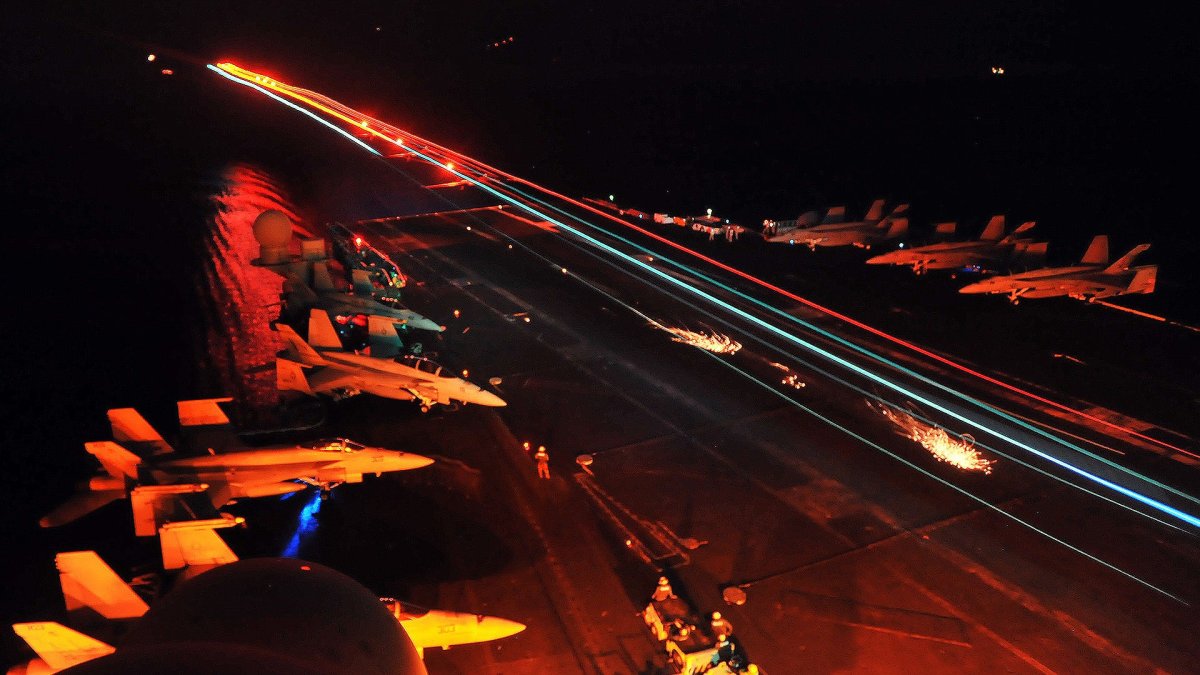
It’s dark— scary dark. Like when you are five years old hiding under the covers to avoid monsters dark.
There might be a few stars in the sky and maybe a partial moon above a thick layer of clouds near the ocean floor. But below the cloud deck is just a vast expanse of black ocean; every once in a while a large tanker might break up the darkness with its running lights. While it’s nice to see someone else out there with you, that distant tanker really can’t do anything to help you.
“Alone and unafraid”—that’s the term Naval Aviators use in jest. Flying at night over the open ocean as a naval aviator has a certain haunting loneliness to it that only a few people have experienced. The critical task of landing a multi-million dollar aircraft onto a moving vessel belongs only to you. It is a lonely task that becomes even more difficult when the weather is uncooperative.
This is where the soul of a naval aviator is forged: at night, alone, and directly behind 90,000 tons of floating steel.
Editor’s Note: Our good friend Joe “Smokin” Ruzicka has taken us inside the cockpit during an F-14 flight demonstration , explained tthe five prohibited maneuvers you just don’t do in a Tomcat , described in great detail what it was like to go to war in the F-14 , taught us some “unique” naval aviation terminology , and painted an incredibly complex picture of what exactly it takes to get launched off a carrier at night . Now he is back, this time to take us through the heart-pounding process of boarding the 4.5 acre floating airport in the dark, while Mother Nature fights you the whole way.
A few things to note about carrier aviation before we take you “down the chute:”
At the end of a mission, planes return to the ship one of two ways: The standard Case I approach during the day in good weather, or a Case III, at night or during poor weather. (Case II is a mix of the other two types and used when the weather is “so-so”). Both I and III have standard procedures, routes, and altitudes that all aircraft in the Air Wing obey to ensure a safe and effective recovery of all aircraft involved.
Additionally, aircraft returning to the carrier are under the watchful radar scopes of air traffic controllers located in what is known as CATTC (Carrier Air Traffic Control Center). These controllers are some of the most competent sailors on the ship and their job is easily transferable to the civilian equivalent of air traffic controllers. I always liked to tell them they were the only people on the ship that could give an officer an order without reprisal—and the officer had to do it.
Under normal flight operations, the ship has 10 to 12 aircraft airborne during what is known as a “cycle.” Each cycle lasts about an hour and a half. The ship launches airplanes at the start of each cycle to clear the flight deck, giving the deck crew enough space to reposition remaining aircraft for the next recovery. Space is a premium item aboard the carrier, and anything you can do to acquire more of it—like launching aircraft—is done quickly and efficiently.
There are four arresting wires on Nimitz class ships. An arresting hook from the respective aircraft catches one of the four wires, bringing the plane from 150 mph to a complete stop in about 1.5 seconds. Naval Aviators call it a “controlled crash.” Most civilians would agree. The Air Force has no clue.
The most aft wire on the ship is #1 wire. The most forward wire is #4. The target wire is #3. You always try to avoid #1 because it is uncomfortably close the back end of the ship. Truthfully, catching any of them is considered a success. While each pilot is graded on each pass at the ship, this business is difficult enough that pretty much any arrested landing is a welcome return.
When an aircraft hits the landing area of the deck, the pilot sets the throttles to full military power (full power without afterburner). We do this so that, should the aircraft misses the wires, it will still have enough power to get airborne again. Failing to catch a wire and subsequently getting airborne again is referred to as a bolter . Failing to catch a wire and not getting airborne again results in an ejection. Taxpayers get tired of paying for jets with severe saltwater damage, therefore it is in a pilot’s best interest to touch down at full military power.
The bolter pattern is a level oval racetrack pattern above the ship that aircraft enter after an attempted landing. If an aircraft needs to get gas, the pilot elevates to the tanker pattern, which is located above the bolter pattern. When an aircraft is low on fuel, Air Operations—or “AIROPS”—designates an airborne tanker to “hawk” (monitor the situation and be in position to provide aerial refueling) for the low fuel-state aircraft.
The complex holding pattern aircraft initially enter during nighttime and adverse weather conditions is called the “Marshall Stack.” The best way to visualize this pattern is to think of a stack of pancakes above the ship, with each pancake being a separate pattern. Altitude between patterns is the primary method of separation. To keep track of all this, the departure and recovery status boards, along with a graphic depiction of the pattern called “Mr. Hands,” reflect in real-time the location of every aircraft that is airborne.
When an aircraft checks in with the marshal controller in CATCC, it provides a fuel state and side number. “State” is the term used to define how much gas you have left. Instead of saying your tank is half full, pilots express their fuel remaining in pounds, which is shortened to two numbers. For example, if a Hornet with aircraft side number 301 has 6,500 lbs of gas remaining, the pilot would say “301, State 6.5.”
Initial check-in with the marshal controller goes something like this:
Aircrew: “Marshal, 101 checking in state 6.5”
Controller: “101, expect CV-1 recovery Case III approach, altimeter 29.92, marshal on the 240 radial, 21, angels six, expected push time 22”
Aircrew: “101, marshal on the 240, 21, angels six, 29.92, state 6.4”
In just a few seconds, the pilot has instructions on where to hold position behind the boat (240 radial at 21 miles at 6000 feet), what recovery pattern to use, and when he will have to hit the “push point” (22 minutes after the hour).
Note that each plane’s fuel state is added on at the end of a radio transmission because aircraft fuel state is one of the most critical pieces of information. Fuel states are tracked excruciatingly close by AIROPS and pilots are normally asked to “update state” every ten minutes. Many times a carrier may not be within range of a suitable divert airfield, meaning the only place to land is the ship—this is referred to as “blue water ops.” Fuel is expressed in pounds because aircraft weight (basic aircraft weight plus fuel on board) determines the tension setting for the arresting gear. Prior to each aircraft landing, the tension for the arresting gear is adjusted to the maximum weight for that aircraft. Additionally, distances to divert airfields are referenced by the amount of gas required to fly there. If a pilot needed to divert, or “bingo”, he would depart the aircraft carrier pattern at the fuel state required to fly to that field.
Example: Aircraft 301’s fuel state is 2.6, fuel required to Navy North Island is 2.4. Since it takes more than 200lbs of fuel to make it around the pattern to attempt another landing, Aircraft 301 cannot make another attempt with their current amount of gas. He or she will likely be told, “your signal divert” from the Air Boss.
AIROPS is the carrier’s hub for all night flying activity. There are two status boards in AIROPS: one that tracks every plane launched and one that tracks every plane about to recover. Fuel states, aircraft mission, pilot names, aircraft side numbers, landing attempts and any miscellaneous information is displayed on these status boards, which is then piped through the ship’s internal TV system for everyone to see.
On the ship’s internal TV, there’s also a platform camera that shows a view from the landing area looking back to the stern of the ship. This channel is always on throughout the ship, including the bridge, AIROPS, and Primary Flight Control, where the Air Boss sits. It is also shown in all the ready rooms. Pilots routinely watch their buddies coming down for a trap or use it as a debriefing tool to see how their pass went.
Hanging out in marshal can be boring—except when you’re waiting for an impending night trap. More often than not, you would rather just get the approach over with than wait for your push time. Think of the Marshall Stack as looking like a staircase from the side, with the lowest plane on the lowest step and each corresponding aircraft owning a step as you go up. Within their step (i.e. a specific altitude and distance from the ship), each plane holds in a pattern to effectively hit their push point—on altitude, on distance, on time. In poor weather, it is imperative to watch out for everyone else while also making sure you remain within your step. The main concern is to not push late, as this will cause interference with everyone behind you.
There is a song by the Foo Fighters called “Learning To Fly” that always reminds me of sitting in marshal. Dave Grohl sings a line that sounds something like “…sat around laughing in marshal at the last one down.” While those aren’t the exact words, I always felt sorry for the poor person who got the last push time given out by marshal. They had to know the other planes were laughing at their bad luck (many times this is the E-2 Hawkeye). When our squadron’s last plane had landed, our ready room duty officer would play Johnny Cash’s “Ring of Fire” over the loud speakers.
So if you are still with us in marshal, get ready, because your push time is coming up and this is going to be a tough night. There is a broken layer of clouds at about 2,000 feet above the water with scattered layers all the way up to 15,000 feet, along with some thunderstorms nearby. The closest divert is about 400 miles away, so your only real option tonight is the ship. The sea state has begun to pick up and the ship is pitching considerably. If you were to switch the auxiliary radio momentarily over to the final control frequency, you would hear the Landing Signal Officers (LSO’s) give a few screaming “POWER!” calls to those planes currently trying to land. You don’t do this. Best to “stay in your box”; you have your own problems.
Crosscheck your watch with the clock in the jet as you cross the push point right on time at 22+00 after the hour. You calmly key the microphone, “101, commencing, state 6.0”. You sound in control, but everyone in the Air Wing knows voices can be deceiving on the radio.
You push the aircraft nose over and begin your descent to 5000 feet, what is referred to as “platform” altitude, headed towards the ship. At night, below platform is always a dangerous place to be. The “platform” call is a safety reminder of where you are.
On a clear night you can spot the conga-line of aircraft out in front of you, their night lights blinking softly against a backdrop of darkness. Not so tonight. Layers of clouds obscure any real vision you might have. This is a full instrument approach to a landing that will need all of your skill and attention.
At ten miles from the ship you stop your descent at 1,200 feet above sea level and report your position to CATCC, which says to “stay clean thru 10.” They are trying to help with the spacing of multiple aircraft in front of you. You hold off on changing to the landing configuration until just before 8 miles. Once your TACAN displays 8 miles from “mother” (aka the carrier), you quickly run through the landing checklist. Landing gear and flaps come down along with the arresting hook. You double check all of those settings and note your fuel state. You are still 6 miles away from the ship, but it is less than 2 minutes until you make your first pass.
Back on the ship, AIROPS has become a tense place. There are currently three aircraft that have “boltered” because of the ship pitching up and down in the rough seas. All three are still airborne. Two are in the bolter pattern and the other has been sent to rendezvous on the primary airborne tanker to receive gas. His state was too low to make another pass and the decision was made by AIROPS in consultation with a squadron representative to send him to the tanker. A senior member of each squadron in the air wing stands watch in AIROPS for the recovery period. They are there to help monitor their respective aircraft and relay information back to the individual squadrons.
The Captain of the ship calls down to inform AIROPS that he has to turn the ship slightly to find the relative wind. This could cause more of a train wreck than what is already happening. The ship cannot be in a turn while aircraft are attempting to land. However, finding the appropriate amount of relative wind is a crucial factor in carrier operations. Without an appropriate amount of wind over the deck, Landing Signal Officers will wave off aircraft for safety reasons and force them to go around again. On some nights, the ship will chase the wind incessantly.
Just prior to 3 miles from the ship, your aircraft picks up the ILS, or Instrument Landing System, or the “Bullseye.” This is an aircraft system that receives glideslope, azimuth, and elevation signals that are converted into “fly-to” indications (needles) on the pilot’s Heads-Up Display (HUD). Then an additional system called the Automatic Carrier Landing System (ACLS) locks onto the aircraft and provides similar information. The main difference between the two systems is ACLS is a two-way communication handshake from the ship to the aircraft and back, while ILS is only a one-way communication—ship to the aircraft. Both provide azimuth and glideslope information, but the ACLS is more accurate.
ACLS and ILS are used in conjunction to lower you to a good “start” position—meaning on centerline, intercepting the glideslope at approximately ¾ mile behind the ship at 360 feet above the water with a 650 to 750 feet-per-minute rate of descent, and a controlled on-speed (not too fast, not too slow). The optimum rate of descent will vary with glideslope angle, approach speed, and headwind component, and timely corrections to the rate of descent will be critical to your success.
Remember, the runway in front of you is a moving target, so getting to a good start is a must. There is very little time to make corrections once you get closer to the ship. You carefully position your aircraft, using slight stick and throttle modifications with information from the HUD to get to a good start.
At ¾ of a mile from the ship, CATCC hands control of your aircraft to the Landing Signal Officers perched alongside the landing area. The communication goes something like this:
CATCC: “101, on course, on glide path, ¾ mile, call the ball.”
Aircraft: “101, Tomcat ball, 5.0.”
LSOs: “Roger, ball, deck’s moving, you’re a little high.”
At first glance, you think to yourself how amazing it is that something over a 1000 feet long can look pretty small in the dark, but you quickly focus back to the glideslope indicator on the port side of the ship, referred to as the “meatball.” With the rough seas and the subsequent pitching deck, it is difficult to discern your glideslope position using the meatball. You have to listen to the LSOsm, who will verify your position via radio calls.
The aircraft carrier is big, so big that most waves don’t affect the ship at all. But tonight is a little different. As large swells pass the ship, the stern falls slowly, pitching the bow up above the horizon. Your brain has been trained to look at a fixed object, but with such a dramatic change of the landing area, it gets confused.
Another swell passes behind the ship, and the stern begins to slowly pitch up. Frighteningly, the stern is now staring at you instead of the landing area. The stern stays up at its highest point for 1 to 2 seconds. This slow cycle repeats itself over and over, like one of the horses on a carousel ride.
As you descend down toward the landing area, your heart is racing. At touchdown, you hear a slight “ping, ping” sound, but feel no arrestment. You immediately double-check that you are at military power, hold your aircraft attitude and begin to climb away.
The LSO’s call over the radio:
“ Bolter, bolter, bolter. Hook skip bolter!”
You mutter under your breath: “Dammit!”
The LSOs have noted that your hook bounced over the arresting wires. Below in AIROPS, the Air Wing representatives who have gathered shout a collective “Aarrgghhhh!” around the room. The carrier is having difficulty finding a calm sea state and that has resulted in missed arrestments. The tension on board the ship increases. Yet another bolter. The train is beginning to wreck—ever so slowly.
Your low fuel state has now put you in a tanking situation. At the upwind position from the ship, you call departure control and tell them your fuel state. You continue to fly the wave off/bolter pattern until departure gives you vectors (steering directions) to the tanker. With tonight’s weather an issue, the tankers have flown above the cloud decks to find clear air. This makes them more difficult to spot and more difficult to reach.
In a moment of frustration, you think to yourself: “Why can’t the ship move to a clear weather area? This is a floating runway, for God’s sake!” You think the ship has the innate ability to find the worst weather—most aviators will attest to this. But you can’t worry about that now. You must “compartmentalize,” or concentrate only on the most important factor: plugging into the tanker for a squirt of much needed gas.
You spot the flashing lights of the tanker above and to the right. Switching to the “tanker common” frequency you slowly join on him from the inside. The drogue’s hose and basket unravel out while you extend your aircraft’s refueling probe. A flash of lightning off in the distance reminds you there is a storm hauntingly close. It is imperative to make this a quick evolution and get back to the boat.
The basket is now just 5 feet from the nose of your jet, but the strong winds are creating turbulence that is bouncing both the basket and your aircraft all around. The basket darts about jokingly while you advance the throttles in an effort to plug into the refueling probe. Your first attempt is a horrific miss. The probe catches the side of the basket and flips it carelessly away. Methodically, you put the aircraft back into position for a second attempt. Success. You see the green light illuminated on the drogue are now “plugged and receiving.”
The tanker pilot radios =the amount of fuel he will be giving you. It won’t be much—enough for one or two more passes.
The tanking evolution lasts only two or three minutes, time to catch your breath. Departure control gives you vectors back into the pattern. You put on your game face. There was nothing you could have done about the hook skip, and you put it out your mind. As the tanker shuts off fuel flow, you disengage from the basket and retract your refueling probe. You are now vectored downwind from the ship for a second attempt. There is little time and no fuel to waste.
CATTC hooks you back into the direction of the ship with a steering vector. It is time to repeat the process. Methodically, you go through the same procedures, configuring your aircraft properly to land, carefully flying what your HUD is telling you to do, and praying that the ship finds a moment of a calm when you get there.
You arrive at ¾ of a mile behind the ship a pick up the meatball. You are confident and cautiously optimistic.
The optical landing system aka “The Meatball.”, USN
From this position there is only about 20 seconds to touchdown. The ship has very few lights on it, just a small outline of a box in the landing area and a few lights off to the starboard side near the tower. Darkness is the theme. You continue to focus on the meatball, listening to the LSO’s give you a soft “ little power ” call. You adjust your throttles ever so slightly and find an angle of attack to keep the aircraft just above glideslope. You don’t want to get overpowered in close and cause a bolter. Precision is the master key to success during the most critical part of the boarding process.
As you get closer, your peripheral vision picks up more of the ship. Things start to move faster in your brain and a feeling of ground rush (or in this case “ship” rush) begins to overtake your senses. The plane descends over the stern of the ship and down into the landing area. The few ship lights whiz past. At the moment of touchdown, you can feel the landing gear thud into the carrier deck. You already have the throttles at full military power. There is a split-second where you are waiting for that feeling of deceleration, knowing the hook has grabbed a wire.
This is the moment that separates carrier aviators from all others.
You feel the deceleration first in your shoulder harness straps, then your head, and finally your whole body as you violently move forward in the ejection seat. The aircraft tugs on the wire and pulls it out like a rubber band, bringing you to a violent—but very welcome—stop. The initial feeling is a sense of relief, followed by a recognition of just how difficult that entire evolution was. You notice your knees shaking as you retract the arresting hook and flaps, and then taxi out of the landing area.
Congratulations on a successful landing. You have added a thick layer to your aviator soul. Somewhere decks below you the ready room is playing “Ring of Fire.”
Contact the Tyler at tyler@thedrive.com
Comments couldn’t be loaded. Please refresh the page.
作者:海军中校乔·“斯莫金”·鲁齐卡
更新于美国东部时间2020年7月2日下午2:52
外面很黑——黑得吓人。就像五岁时躲在被子里躲避怪物一样。
天空或许会闪烁几颗星辰,海底附近厚厚的云层上可能挂着一轮残月。但云层之下,只有一望无际的黑色海洋;偶尔,一艘大型油轮的航行灯会划破这片黑暗。虽然看到有人与你同行令人欣慰,但那艘远处的油轮实际上也帮不上你什么忙。
“孤身一人,无所畏惧”——这是海军飞行员们常开玩笑的说法。作为一名海军飞行员,夜间飞越茫茫大海,会有一种令人难以忘怀的孤独感,这种感觉只有极少数人才能体会。将价值数百万美元的飞机降落在移动的舰艇上,这项至关重要的任务完全由你一人承担。这是一项孤独的任务,而当天气恶劣时,难度更是倍增。
这就是海军飞行员灵魂锻造的地方:在夜晚,独自一人,就在9万吨漂浮钢铁的正后方。
编者按:我们的好朋友乔·“斯莫金”·鲁齐卡曾带我们进入F-14战斗机的驾驶舱,体验了一次飞行演示,讲解了驾驶“雄猫”战机绝对不能做的五种动作,详细描述了驾驶F-14战机参战的感受,教了我们一些“独特的”海军航空术语,并描绘了夜间从航母上起飞的复杂过程。现在他又回来了,这次他将带我们体验在黑暗中登上这片4.5英亩的浮动机场的惊险过程,全程还要与大自然搏斗。
在我们带你“深入体验”航母航空之前,有几点需要注意:
任务结束后,飞机返回舰艇有两种方式:一种是白天天气良好时采用的标准方式(I类),另一种是夜间或恶劣天气时采用的标准方式(III类)。(II类是前两种方式的混合,用于天气状况一般的情况。)I类和III类都有标准的程序、航线和高度,航空联队的所有飞机都必须遵守,以确保所有飞机安全有效地返回。
此外,返回航母的飞机都在位于航母空中交通管制中心(CATTC)的空中交通管制员的严密雷达监视之下。这些管制员是舰上最优秀的官兵之一,他们的工作很容易就能转移到民用空中交通管制员的岗位上。我常跟他们开玩笑说,他们是舰上唯一可以向军官下达命令而不用担心遭到报复的人——而且军官必须执行命令。
在正常的飞行作业中,航母在一个“循环”内会有10到12架飞机在空中飞行。每个循环大约持续一个半小时。航母会在每个循环开始时起飞飞机,以腾出飞行甲板,让甲板人员有足够的空间重新部署剩余飞机,为下一次回收做好准备。空间在航母上是极其宝贵的资源,任何能够增加空间的措施——例如起飞飞机——都会迅速高效地完成。
尼米兹级航母上有四根阻拦索。飞机上的阻拦钩会钩住其中一根,使飞机在约1.5秒内从150英里/小时的速度完全停止。海军飞行员称之为“可控坠毁”。大多数平民也会认同这种说法。但空军对此一无所知。
舰上最靠后的拦阻索是1号索,最靠前的拦阻索是4号索,目标拦阻索是3号索。你总是要尽量避开1号索,因为它离舰尾太近了,很不舒服。说实话,能拦阻到任何一根拦阻索都算是成功。虽然每次拦阻都会给每位飞行员打分,但这项任务难度很高,所以几乎任何一次成功拦阻着陆都算是令人欣喜的胜利。
当飞机降落在甲板着陆区时,飞行员会将油门推至全军用功率(不使用加力燃烧室的全功率)。这样做是为了确保即使飞机未能抓住着陆索,仍有足够的动力再次起飞。未能抓住着陆索但随后再次起飞的情况称为“脱钩起飞”(bolter)。未能抓住着陆索且无法再次起飞的情况则需要弹射。纳税人已经厌倦了为严重海水损坏的喷气式飞机买单,因此,飞行员最好以全军用功率着陆。
着陆航线是舰艇上方的一条水平椭圆形跑道航线,飞机在尝试着陆后会进入该航线。如果飞机需要加油,飞行员会爬升到位于着陆航线上方的加油航线。当飞机燃油不足时,空中作战部门(简称“AIROPS”)会指定一架空中加油机“监视”(监控情况并随时准备提供空中加油)该低油量飞机。
飞机在夜间和恶劣天气条件下最初进入的复杂等待航线被称为“马歇尔叠层航线”。要形象地理解这种航线,可以想象成一摞薄饼堆在飞机上方,每一块薄饼代表一个独立的航线。航线之间的间隔主要依靠高度。为了实时掌握所有情况,起飞和降落状态指示牌,以及名为“Mr. Hands”的航线图形指示牌,会实时显示每架在空中飞行的飞机的位置。
当飞机向空中交通管制中心(CATCC)的管制员报到时,需要提供燃油状态和机舱编号。“状态”是指剩余燃油量。飞行员不会说油箱半满,而是用磅数来表示剩余燃油量,这样就简化成了两个数字。例如,如果一架机舱编号为301的“大黄蜂”战斗机剩余燃油量为6500磅,飞行员会说“301,状态6.5”。
与调度员的初始签到流程大致如下:
机组人员:“Marshal,101号机正在6.5号州际公路上检查”
管制员:“101,预计CV-1恢复方案III进近,高度表读数29.92,引导员位于240径向线上,21,角度6,预计推进时间22”
机组人员:“101,240号航站楼上的执法人员,21,天使六号,29.92,州6.4”
短短几秒钟内,飞行员就收到了关于在船后方保持位置(240 径向线,21 英里,6000 英尺)的指示,以及要使用的恢复模式,还有他何时必须到达“推进点”(整点后 22 分钟)。
请注意,每次无线电传输结束时都会添加飞机的燃油状态信息,因为飞机燃油状态是最关键的信息之一。空中作战指挥部 (AIROPS) 会极其密切地跟踪燃油状态,通常要求飞行员每十分钟“更新状态”。很多时候,航母可能不在合适的备降机场的航程范围内,这意味着唯一的着陆地点就是航母本身——这被称为“远海作战”。燃油以磅为单位,因为飞机重量(飞机基本重量加上机上燃油)决定了阻拦装置的张力设置。每次飞机着陆前,阻拦装置的张力都会调整到该飞机的最大重量。此外,到备降机场的距离是根据飞往该机场所需的燃油量来计算的。如果飞行员需要备降,或者说“急需”,他会在达到飞往该机场所需的燃油状态时离开航母航线。
例如:301号飞机的燃油量为2.6磅,飞往北岛海军基地所需的燃油量为2.4磅。由于绕场一周尝试再次着陆需要超过200磅的燃油,301号飞机目前的燃油量不足以进行再次尝试。此时,机长很可能会指示他/她“改降其他航线”。
AIROPS是该航母夜间飞行活动的枢纽。AIROPS内有两个状态显示屏:一个显示所有起飞飞机的飞行状态,另一个显示所有即将降落的飞机的飞行状态。燃油状态、飞机任务、飞行员姓名、飞机编号、着陆尝试以及其他各种信息都会显示在这些状态显示屏上,然后通过舰载电视系统传输给舰上所有人观看。
舰上的内部电视还配备了一个平台摄像头,可以显示从着陆区向舰尾方向拍摄的画面。这个频道在舰上始终开启,包括舰桥、空中作战指挥中心和主飞行控制中心(空中指挥官所在的位置)。所有准备室也都能看到这个画面。飞行员们经常观看同伴降落进行诱饵着陆的画面,或者将其作为任务汇报的工具,了解自己这次飞行的情况。
在进近管制区闲逛可能会很无聊——除非你是在等待即将到来的夜间进近。通常情况下,你宁愿尽快完成进近,而不是等待最佳起飞时间。你可以把进近管制区想象成从侧面看像一个楼梯,最低的飞机位于最低一级,然后每架飞机依次占据一级。在各自的一级范围内(即特定的高度和与主飞机的距离),每架飞机都按照既定的航线飞行,以有效地到达各自的起飞点——高度、距离和时间都符合要求。在恶劣天气下,必须时刻注意其他飞机,同时确保自己始终保持在自己的一级范围内。最重要的是不要延迟起飞,因为这会干扰后面所有飞机的飞行。
Foo Fighters乐队有一首歌叫《Learning To Fly》,总是让我想起坐在引导员位置上的情景。戴夫·格罗尔唱的一句歌词大概是“……坐在引导员位置上,看着最后一架飞机坠毁,哈哈大笑”。虽然歌词并非如此,但我总是很同情那些被引导员安排最后起飞的倒霉蛋。他们肯定知道其他飞机都在嘲笑他们的霉运(很多时候是E-2“鹰眼”预警机)。我们中队最后一架飞机降落后,值班军官会在候机室的扬声器里播放约翰尼·卡什的《Ring of Fire》。
所以,如果你还在指挥中心,做好准备吧,因为你的推进时间快到了,今晚将会很艰难。水面以上约2000英尺处有一层破碎的云层,一直到15000英尺都有零星云层,附近还有一些雷暴。最近的备降机场在400英里之外,所以今晚你唯一的选择就是待在船上。海况开始恶化,船身摇晃得厉害。如果你把辅助无线电短暂地切换到最终控制频率,你会听到着陆信号官(LSO)向那些正在尝试着陆的飞机发出几声刺耳的“动力!”呼叫。千万不要这样做。最好“待在你的区域内”;你还有自己的问题要处理。
你准时于22:00通过了推进点,同时对照飞机上的时钟确认时间。你镇定地按下麦克风:“101,开始,状态6.0。”你的声音听起来很镇定,但空军联队的每个人都知道,无线电里的声音有时会具有欺骗性。
你将飞机机头向下压,开始下降到5000英尺,也就是所谓的“平台”高度,朝着舰船方向飞去。夜间,平台以下始终是一个危险的地方。“平台”呼叫是为了提醒大家你所在的位置,确保安全。
晴朗的夜晚,你可以看到前方一长串飞机,它们的夜灯在黑暗的背景下轻轻闪烁。但今晚并非如此。层层云层遮蔽了你的视线。这是一次需要全仪表进近的着陆,需要你倾注全部的技巧和注意力。
距离舰艇十英里时,你在海拔1200英尺处停止下降,并向空中交通管制中心(CATCC)报告位置。CATCC指示你“保持10英里范围内的空域”。他们这样做是为了帮助你保持前方多架飞机之间的间距。你等到距离舰艇八英里时才切换到着陆构型。当你的战术空中导航系统(TACAN)显示距离“母舰”(即航母)八英里时,你迅速完成着陆检查清单。起落架、襟翼和阻拦钩都已放下。你再次检查了所有设置,并记录了燃油状态。你距离舰艇还有六英里,但距离第一次通过舰艇还有不到两分钟的时间。
回到舰上,空中作战指挥中心(AIROPS)的气氛变得紧张起来。由于舰艇在波涛汹涌的海面上剧烈摇晃,目前有三架飞机“脱离”了航线。这三架飞机目前仍在空中。其中两架正在进行脱离航线的编队飞行,另一架已被派往主加油机处接受加油。这架飞机的燃油量过低,无法再次飞行,空中作战指挥中心与中队代表协商后决定将其送往加油机。在飞机恢复期间,航空联队各中队的一名高级成员会在空中作战指挥中心值守。他们的职责是协助监控各自中队的飞机,并将信息传递回各个中队。
舰长向下呼叫空中作业指挥部,告知需要稍微调整舰艇方向以寻找合适的相对风向。这可能会造成比目前情况更严重的混乱。舰艇在飞机试图着陆时不能转弯。然而,找到合适的相对风向是航母作战的关键因素。如果甲板上没有合适的风向,出于安全考虑,着陆信号官会挥手示意飞机停止着陆,并要求其复飞。有些夜晚,这艘航母将不得不不停地追逐风向。
在距离舰船不到3英里时,您的飞机将接收到ILS(仪表着陆系统)信号,也称为“靶心”。该系统接收下滑道、方位角和仰角信号,并将这些信息转换成飞行员平视显示器(HUD)上的“飞向”指示(指针)。随后,另一个名为自动舰载着陆系统(ACLS)的系统会锁定飞机并提供类似的信息。这两个系统的主要区别在于,ACLS是舰船与飞机之间的双向通信,而ILS只是舰船与飞机之间的单向通信。两者都提供方位角和下滑道信息,但ACLS的精度更高。
ACLS 和 ILS 配合使用,可将飞机下降到良好的“起始”位置——即位于跑道中心线,在距离飞机约 3/4 英里处、水面以上 360 英尺的高度截获下滑道,下降率为每分钟 650 至 750 英尺,并保持可控的进近速度(既不能太快,也不能太慢)。最佳下降率会随下滑道角度、进近速度和逆风分量而变化,及时修正下降率对成功着陆至关重要。
记住,你面前的跑道是移动的,所以起步至关重要。一旦接近目标,你几乎没有时间进行修正。你需要根据HUD上的信息,通过轻微调整操纵杆和油门,小心翼翼地控制飞机位置,以获得良好的起步。
距离舰船四分之三英里时,空中交通管制中心(CATCC)会将飞机的控制权移交给位于着陆区旁的着陆信号员。通讯过程大致如下:
CATCC:“101,在航线上,在滑翔道上,四分之三英里,喊球。”
飞机:“101,雄猫球,5.0。”
LSO:“收到,球,甲板在移动,你有点高了。”
乍一看,你会惊叹于一艘超过1000英尺长的船在黑暗中看起来竟然如此渺小,但很快你的注意力就会回到船左舷的下滑道指示器上,也就是俗称的“肉丸”。由于海面波涛汹涌,甲板也随之剧烈摇晃,仅凭“肉丸”指示器很难辨认下滑道位置。你必须听从着陆信号官(LSO)的指示,他们会通过无线电通话确认你的位置。
航空母舰体型庞大,大多数海浪对它几乎毫无影响。但今晚的情况略有不同。当巨浪涌过舰体时,船尾缓缓下沉,船首则高高翘起,直冲地平线。你的大脑习惯于注视固定的物体,但着陆区如此剧烈的变化,让它感到困惑。
又一个涌浪从船后掠过,船尾开始缓缓抬起。令人胆战心惊的是,此时船尾不再正对着登陆区,而是直直地盯着你。船尾在最高点停留一到两秒。这种缓慢的循环周而复始,就像旋转木马上的骏马一样。
飞机下降到着陆区时,你的心跳加速。着陆时,你听到轻微的“叮叮”声,但感觉不到任何阻力。你立即再次确认发动机处于军用动力模式,保持飞机姿态,开始爬升离开。
伦敦交响乐团通过无线电发出呼叫:
“爆弹枪,爆弹枪,爆弹枪。吊钩式爆弹枪!”
你低声咒骂道:“该死!”
着舰信号官们注意到你的钩子跳过了阻拦索。楼下空中作战室里,聚集在一起的舰载机联队代表们齐声惊呼:“啊啊啊啊!”航母难以找到平静的海况,导致阻拦索失效。舰上的气氛愈发紧张。又一架飞机脱钩了。这列火车正在缓慢地、缓慢地脱轨。
您的低燃油状态已使您处于紧急加油状态。在上风位置,您呼叫离港管制并告知您的燃油状态。您继续执行离港/紧急起飞航线,直到离港管制给出前往油轮的航向指示。由于今晚天气状况不佳,油轮已飞越云层寻找晴朗空域。这使得它们更难被发现,也更难接近。
在沮丧的瞬间,你心想:“为什么这艘船就不能飞到晴朗的海域?这可是条海上跑道啊!”你觉得这艘船似乎天生就能找到最糟糕的天气——大多数飞行员都会认同这一点。但你现在没时间想这些。你必须“集中精力”,只专注于最重要的事:连接油轮,补充急需的燃油。
你看到右上方油轮的闪光灯。切换到油轮通用频率,你从机舱内缓缓加入通信。你伸出飞机的空中加油探管,同时展开了油轮的软管和吊篮。远处一道闪电提醒你,一场风暴正逼近。必须尽快完成这次任务,返回船上。
现在,加油吊篮距离你的喷气机机头只有5英尺,但强风造成的湍流使吊篮和飞机都颠簸不已。吊篮在你加大油门试图连接加油探管时,也跟着晃动。第一次尝试以惨败告终。探管撞到了吊篮的侧面,把它粗暴地掀翻在地。你稳稳地将飞机重新调整到合适的位置,准备进行第二次尝试。成功了!你看到吊钩上的绿灯亮起,显示“已连接并正在接收”。
加油机飞行员通过无线电告知你将要加油的油量。不多——只够再飞一两次。
加油过程只有两三分钟,正好可以喘口气。离港管制会引导你回到航线上。你迅速进入战斗状态。对于钩子跳出的情况,你无能为力,也把它抛诸脑后。当加油机停止供油时,你脱离吊篮,收回加油探管。现在,你被引导到下风方向,准备进行第二次尝试。时间紧迫,燃油也所剩无几。
CATTC会用转向矢量将你重新拉回飞船方向。现在是时候重复这个过程了。你一丝不苟地执行相同的步骤,正确配置飞机以进行着陆,仔细按照HUD的指示飞行,并祈祷飞船在你到达目的地时能迎来片刻平静。
你到达距离船尾四分之三英里处,捡起了肉丸。你信心满满,谨慎乐观。
光学着陆系统,又称“肉丸”,美国海军
从这个位置到着陆只剩大约20秒了。飞机上几乎没有灯光,只有着陆区一个小小的方框轮廓,以及右舷塔台附近的几盏灯。一片漆黑。你继续专注于目标,聆听着着陆信号官轻柔的“小功率”指令。你极其细微地调整油门,找到一个合适的迎角,使飞机保持在下滑道上方。你不想在近距离被敌机超越,导致失控。在登机过程中最关键的阶段,精准是成功的关键。
随着距离的拉近,你的余光捕捉到了更多舰船的轮廓。大脑运转的速度加快,一种强烈的地面冲击感(或者更确切地说,是舰船的冲击感)开始占据你的感官。飞机掠过舰尾,降落在着陆区。舰上几盏灯光飞速掠过。着陆的那一刻,你能感觉到起落架重重地撞击在航母甲板上。你的油门已经推到了最大。有一瞬间,你等待着减速的感觉,知道起落架已经钩住了钢索。
正是这一刻,将航母飞行员与其他所有飞行员区分开来。
你首先感觉到肩部安全带的减速,然后是头部,最后是全身,你猛地向前冲去,弹射座椅也随之剧烈震动。飞机拉动钢索,像橡皮筋一样将你猛地拉出,让你猛然停住——虽然很猛烈,但却是令人欣慰的。最初的感觉是如释重负,随后才意识到整个过程有多么艰难。你注意到膝盖在颤抖,你收起阻拦钩和襟翼,然后滑出着陆区。
恭喜你成功着陆。你的飞行员精神又增添了一层厚厚的底蕴。在你下方的某个甲板上,准备室里正在播放《烈焰之环》。
请联系Tyler,邮箱地址是tyler@thedrive.com
评论加载失败,请刷新页面。