MRT viaducts overhead, limited space below: How Garden Bloom @ Tengah earned its builder an HDB accolade地铁高架桥横亘其上,下方空间有限:Garden Bloom @ Tengah 如何为其开发商赢得建屋发展局 (HDB) 的赞誉
Learn how Chiu Teng kept the Garden Bloom @ Tengah BTO project on track. Read more at straitstimes.com.
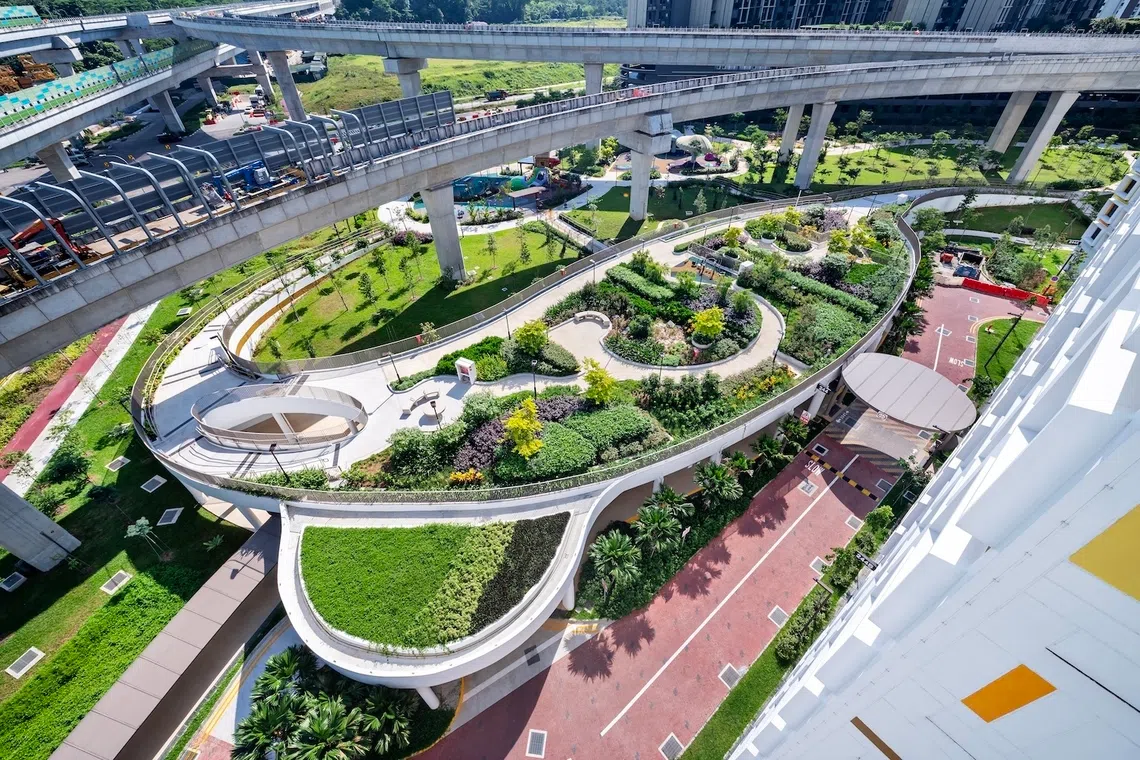
Chiu Teng Construction re-sequenced works, tightened safety measures and adopted just-in-time delivery of materials to keep the project on track
Two Jurong Region Line viaducts run through Garden Bloom @ Tengah’s common green area, where home-grown builder Chiu Teng Construction had to build facilities while rail works were under way.
PHOTO: CHIU TENG CONSTRUCTION
Published Sep 25, 2026, 04:00 AM
Building seven blocks of flats and the playgrounds, gardens and other facilities around them was already a sizeable undertaking.
At Garden Bloom @ Tengah, home-grown builder Chiu Teng Construction had another challenge looming overhead: two MRT viaducts were being built above part of the site at the same time.
The viaducts form part of the upcoming Jurong Region Line, which will serve Tengah and other areas in western Singapore when it opens in stages from 2027.
The two viaducts fork across Garden Bloom’s common green area, passing above a ramped linkway and children’s playground and alongside facilities including a multi-purpose court and fitness stations. One also runs directly in front of the childcare centre in the estate.
The MRT works occupied about 15 per cent of the 782-unit build-to-order (BTO) project’s site throughout Chiu Teng’s 30-month construction contract.
That left the builder with less room to store materials and stage construction activities, while workers and heavy machinery from the two projects had to operate in close proximity.
The Chiu Teng team had to ensure that work on the housing project could continue safely without getting in the way of the rail project – and vice versa.
Its handling of the complex construction environment was among the reasons why the firm received a Certificate of Merit in the construction category at the HDB Awards 2026.
How Chiu Teng worked around the MRT viaducts
Planning for the overlapping works began early, with Chiu Teng’s project team working with the MRT contractor before both projects entered their most intensive phases.
The two teams coordinated equipment movements, construction sequences and safety zones so that work could proceed without one project holding up the other.
Lai Hsueh Cheang, Chiu Teng’s project manager for Garden Bloom @ Tengah, says: “We started the project with some trepidation due to the major MRT infrastructure within our site. This faded away with close collaboration and continuous dialogue.
“By intentionally merging our schedules, re-sequencing activities and coordinating site logistics, we avoided running our critical activities into each other.”
Such coordination became particularly important when Chiu Teng began work on the development’s common facilities and landscaping beneath or adjacent to the viaduct while rail construction was still taking place overhead.
Chiu Teng had to coordinate construction of common facilities beneath and alongside the viaducts. PHOTO: CHIU TENG CONSTRUCTION
Chiu Teng had to coordinate construction of common facilities beneath and alongside the viaducts.
The common green area was divided into three work zones, covering facilities such as playgrounds, fitness stations, a multi-purpose court and rain gardens.
Fixed barricades protected the viaduct’s support columns from accidental impact, while additional cameras were installed to monitor work around them. Construction in the common green area also had to end by 7pm to ensure sufficient daylight for visibility and supervision.
Beyond the mandatory video surveillance system, Chiu Teng installed three solar-powered cameras that provided round-the-clock, 360-degree views of the three work zones.
Using innovation to ease the space crunch
The space taken up by the MRT works also meant less room to store and move materials, while internal routes around the site were fragmented.
Chiu Teng’s solution was to minimise the amount of material waiting around on site.
It adopted a just-in-time system for the prefabricated modules used to build the flats, coordinating their production, transportation and installation so that they arrived when needed.
Work areas were divided into zones, and deliveries carefully sequenced to reduce clashes and avoid materials having to be moved repeatedly around the site.
According to Chiu Teng, this reduced site congestion by up to 50 per cent and improved material-handling efficiency by 25 per cent. The company says manpower needed for these operations was also reduced by 15 per cent.
Technology helped keep the process running.
Chiu Teng used building information modelling (BIM). This technology allows builders to create detailed digital representations of a project and plan construction before carrying out the actual work.
The prefabricated modules were also fitted with QR codes, allowing the team to track them through different stages of production.
Knowing when each module would be ready meant Chiu Teng could better coordinate its delivery and installation – particularly useful on a site with little room for modules to sit and wait.
How prefabrication helped speed up construction
Garden Bloom’s seven 15-storey residential blocks were built using 3,839 prefabricated prefinished volumetric construction (PPVC) modules.
The 782-unit Garden Bloom @ Tengah comprises seven residential blocks and was built using 3,839 prefabricated modules. PHOTO: CHIU TENG CONSTRUCTION
The 782-unit Garden Bloom @ Tengah comprises seven residential blocks and was built using 3,839 prefabricated modules.
The construction method shifts much of the work away from the building site. Room-sized modules are manufactured in a factory with finishes and fittings already installed, before being transported to the development, lifted into position by cranes and joined together.
Besides reducing construction activity at the constrained Garden Bloom site, factory production provided a more controlled environment for maintaining consistent workmanship.
Chiu Teng estimates that using PPVC resulted in manpower and productivity savings of about 30 per cent and shortened construction time by about 15 per cent.
Garden Bloom @ Tengah earned Chiu Teng Construction a Certificate of Merit in the construction category at the HDB Awards 2026. PHOTO: CHIU TENG CONSTRUCTION
Garden Bloom @ Tengah earned Chiu Teng Construction a Certificate of Merit in the construction category at the HDB Awards 2026.
The development was completed with 782 flats, four playgrounds, five fitness stations, a multi-purpose court, a roof garden and a childcare centre, as well as common green spaces, two precinct pavilions and an eight-storey multi-storey car park.
The Certificate of Merit adds to a series of HDB accolades for Chiu Teng, whose previous winning projects include Alkaff Vista in Bidadari and Keat Hong Pride in Choa Chu Kang.
For Chiu Teng managing director Ng Chee Hwa, the latest recognition builds on a track record the company has established over several decades.
He says: “We have come a long way, consistently delivering our projects with an unwavering commitment to quality and trustworthiness. The accolades and awards we are recognised for will spur our staff to dedicate their efforts towards further and continuous excellence.”
Learn more about Chiu Teng Construction and its award-winning projects .
邱腾建筑调整了施工顺序,加强了安全措施,并采取了材料准时交付的方式,以确保项目按计划进行。
裕廊区域线的两座高架桥穿过登加花园的公共绿地,在铁路工程进行期间,本土建筑商邱腾建筑不得不在此建造设施。
照片:邱腾建筑
发布于 2026 年 9 月 25 日 上午 4:00
建造七栋公寓楼以及周围的游乐场、花园和其他设施本身就是一项相当大的工程。
在 Garden Bloom @ Tengah,本土建筑商邱腾建筑面临着另一个挑战:两座地铁高架桥同时在部分工地上方建造。
这些高架桥是即将开通的裕廊区域线的一部分,该线路将于 2027 年起分阶段开通,届时将服务于登加及新加坡西部其他地区。
两座高架桥横跨花园布鲁姆的公共绿地,一座从坡道连接通道和儿童游乐场上方穿过,另一座则与多功能球场和健身站等设施相邻。其中一座高架桥还直接位于小区内的托儿中心正前方。
在邱腾30个月的施工合同期间,捷运工程占用了该782套预购组屋(BTO)项目工地约15%的面积。
这导致建筑商存放材料和进行施工活动的空间减少,而两个项目的工人和重型机械不得不近距离作业。
邱腾团队必须确保房屋项目能够安全继续进行,不会妨碍铁路项目——反之亦然。
该公司对复杂施工环境的处理是其在 2026 年建屋发展局奖中获得建筑类优异证书的原因之一。
邱腾是如何绕过捷运高架桥的
重叠工程的规划工作很早就开始了,邱腾的项目团队在两个项目进入最密集的阶段之前就与捷运承包商进行了合作。
两个团队协调设备调动、施工顺序和安全区域,以确保工程能够顺利进行,互不干扰。
邱腾集团“花园绽放@登加”项目经理赖学昌表示:“由于项目场地内有大型地铁基础设施,我们一开始有些忐忑。但通过密切合作和持续沟通,这种忐忑逐渐消散了。”
“通过有意地合并日程安排、重新排序活动以及协调现场物流,我们避免了关键活动相互冲突。”
当邱腾开始在桥梁下方或附近进行开发项目的公共设施和景观美化工作,而铁路建设仍在上方进行时,这种协调就显得尤为重要。
邱腾建筑公司需要协调高架桥下方及两侧公共设施的建设。图片:邱腾建筑
邱腾需要协调高架桥下及两侧公共设施的建设。
公共绿地被划分为三个工作区,涵盖了游乐场、健身站、多功能球场和雨水花园等设施。
固定路障保护高架桥的支撑柱免受意外撞击,同时还安装了额外的摄像头来监控周围的施工情况。为了确保充足的日光以便于观察和监督,公共绿地上的施工也必须在晚上7点前结束。
除了强制性的视频监控系统外,邱腾还安装了三台太阳能摄像机,可对三个工作区进行全天候 360 度全景监控。
利用创新缓解空间紧张问题
地铁工程占用的空间也意味着用于存放和搬运材料的空间减少,同时场地内部的通道也变得支离破碎。
邱腾的解决方案是尽量减少现场积压的材料数量。
该项目对用于建造公寓的预制模块采用了准时制系统,协调其生产、运输和安装,以便它们在需要时到达。
工作区域被划分为若干区域,货物的运送也经过精心安排,以减少冲突,避免材料在工地内反复搬运。
邱腾表示,此举使现场拥堵减少了高达50%,物料搬运效率提高了25%。该公司称,这些操作所需的人力也减少了15%。
技术帮助维持了这一进程的进行。
邱腾采用了建筑信息模型(BIM)。这项技术使建筑商能够在实际施工前创建项目的详细数字模型并制定施工计划。
预制模块还配备了二维码,使团队能够跟踪它们在不同生产阶段的进展情况。
知道每个模块何时准备就绪,意味着邱腾可以更好地协调其交付和安装——这在几乎没有空间放置模块等待的工地上尤其有用。
预制构件如何帮助加快施工速度
Garden Bloom 的七栋 15 层住宅楼采用 3,839 个预制预制体积结构 (PPVC) 模块建造而成。
位于登加的 Garden Bloom 共有 782 个单元,由七栋住宅楼组成,采用 3,839 个预制模块建造而成。图片:邱腾建筑
拥有 782 个单元的 Garden Bloom @ Tengah 由七栋住宅楼组成,采用 3,839 个预制模块建造而成。
这种建造方法将大部分工作转移到了施工现场之外。房间大小的模块在工厂预制完成,内部装修和配件均已安装完毕,然后运送到施工现场,由起重机吊装到位并组装在一起。
除了减少受限的 Garden Bloom 工地上的施工活动外,工厂化生产还为保持一致的工艺质量提供了更可控的环境。
邱腾估计,使用 PPVC 可节省约 30% 的人力和生产力,并缩短约 15% 的施工时间。
邱腾建筑承建的登加花园项目荣获2026年建屋发展局奖建筑类优异奖。图片:邱腾建筑
Garden Bloom @ Tengah 为 Chiu Teng Construction 赢得了 2026 年建屋发展局奖建筑类优异奖。
该项目建成后包括 782 套公寓、四个游乐场、五个健身站、一个多功能球场、一个屋顶花园和一个托儿中心,以及公共绿地、两个社区凉亭和一个八层高的多层停车场。
邱腾凭借此次的优异成绩,再次荣获建屋发展局颁发的多项荣誉,此前他获奖的项目包括比达达利的 Alkaff Vista 和蔡厝港的 Keat Hong Pride。
对于邱腾董事总经理吴志华而言,此次获得认可巩固了公司几十年来取得的良好业绩。
他表示:“我们一路走来,始终秉持对质量和信誉的坚定承诺,出色地完成项目。我们所获得的赞誉和奖项将激励我们的员工继续努力,追求卓越。”
了解更多关于邱腾建筑及其屡获殊荣的项目的信息。