From English classes to painting robots: Behind an award-winning HDB BTO project从英语课程到机器人喷漆:屡获殊荣的组屋预购计划背后的故事
HDB Awards Construction Award winner Hi-Tek Construction’s approach at MacPherson Weave spanned worker welfare and resident support. Read more at straitstimes.com.
Hi-Tek Construction’s approach at MacPherson Weave spanned worker welfare and resident support, even as its team navigated MRT tunnels and flight restrictions on site
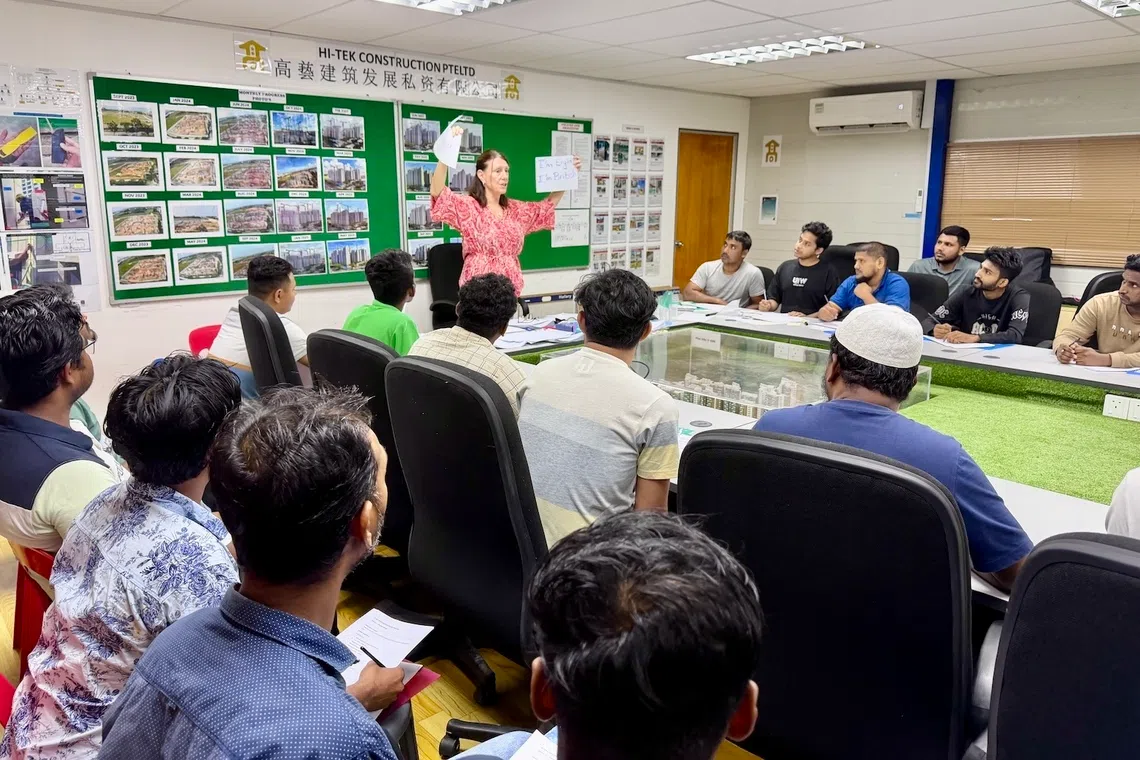
Hi-Tek Construction holds after-work English lessons for migrant workers to help them communicate with greater confidence.
PHOTO: HI-TEK CONSTRUCTION
Published Sep 25, 2026, 04:00 AM
For some of this home-grown builder’s migrant workers, learning does not stop when the construction site closes for the day.
From 7pm to 9pm, meeting rooms are turned into classrooms, where a volunteer teacher gives English lessons to workers keen to communicate better in Singapore.
Hi-Tek Construction started the lessons after noticing that some workers were hesitant to speak to supervisors and managers because of the language barrier, says its corporate safety manager Raymond Lee.
“Many workers really want to learn English so that they can communicate well in Singapore. We hope this builds confidence among our workers for both work and their daily lives,” he says.
That attention extends beyond the workforce. At MacPherson Weave, which won a Construction Award at this year’s HDB Awards , Hi-Tek applied the same care to the residents who would eventually call it home.
Improving the resident experience at MacPherson Weave
Almost half the residents at MacPherson Weave submitted letters of compliments after moving in, according to Hi-Tek.
Hi-Tek had to navigate MRT tunnels and flight restrictions while building MacPherson Weave. PHOTO: HI-TEK CONSTRUCTION
Hi-Tek had to navigate MRT tunnels and flight restrictions while building MacPherson Weave.
Lee attributes the response partly to the company’s customer relations officers, who helped residents with defect lists during the one-year defects liability period. They also went the extra mile, he says, by offering renovation tips and advice on caring for tiles and fittings.
Good service, however, had to be matched by workmanship. Besides HDB’s inspection checks, Hi-Tek had its own quality assurance and quality control team. Materials such as tiles and sanitary fittings were secured and stored under cover before installation to reduce the risk of damage or discolouration.
For Hi-Tek, which was founded in 1983 and has previously won HDB Construction Awards, such details are part of the job rather than a means of chasing accolades.
“When we start a project, we must do it well,” says Lee. “We are responsible and take ownership of what we are doing.”
He also credits the company’s track record to collaboration rather than hierarchy. The main contractor, consultants and subcontractors worked as “one big team”, he says, with specialist views taken seriously even when they came from subcontractors.
How painting robots help boost productivity and safety
Technology also played a role at MacPherson Weave.
Hi-Tek used painting robots that could first map a flat using laser scanning, then spray rooms automatically along a preset route.
Painting robots helped reduce man-hours at MacPherson Weave, with one worker able to operate two robots at a time. PHOTO: HI-TEK CONSTRUCTION
Painting robots helped reduce man-hours at MacPherson Weave, with one worker able to operate two robots at a time.
One worker using a tablet could operate two robots in separate rooms at the same time. Conventional spray painting typically requires at least two workers and can expose them to noise and paint fumes for long periods.
“These painting robots really help in productivity and safety of workers,” says Lee.
Hi-Tek is now exploring the use of robots for other jobs, including painting external walls and skimming work.
The company also introduced a system to tackle a decidedly everyday safety risk: workers becoming distracted by their mobile phones.
Under its safekeeping mobile phone initiative, workers who did not need their phones for work kept them in lockers or dormitories during working hours.
“If the workers keep using their handphones, they will get distracted,” says Lee, adding that this could lead to more safety incidents.
Hi-Tek was among the first to introduce such a system on an HDB project. According to the company, the initiative resulted in an estimated 20 per cent reduction in safety non-compliances.
The practice has since been made mandatory for all new HDB projects.
Building around MRT tunnels and flight zones
Some of MacPherson Weave’s biggest challenges came from its location.
The project was built next to MacPherson MRT station. Below ground, the team had to account for MRT tunnels. Above ground, it had to work within the Paya Lebar Air Base flight zone.
Construction near the MRT tunnels required monitoring equipment to track vibrations and ensure that works did not affect train operations.
Crane operations presented another challenge. Erecting and dismantling tower cranes required approvals from the Republic of Singapore Air Force and the Civil Aviation Authority of Singapore, as well as real-time clearance when the work was carried out.
MacPherson Weave residents at a communal space within the BTO project, which won a Construction Award at this year’s HDB Awards. PHOTO: HI-TEK CONSTRUCTION
MacPherson Weave residents at a communal space within the BTO project, which won a Construction Award at this year’s HDB Awards.
If required to stop, the team had to lower the boom of its mobile crane within 15 minutes.
Some crane work could also be carried out only after MRT services ended close to midnight and had to stop before services resumed in the morning.
The combination meant the project team had little room for error, whether coordinating workers, machinery or construction schedules.
For Hi-Tek, the HDB Construction Award was recognition of the work that went into navigating those constraints while maintaining standards in quality and safety.
Lee says the company’s approach ultimately comes down to something simpler.
“Safety first is not a slogan,” he says. “It is something that we want everyone on site to believe in and practise every day.”
Learn more about Hi-Tek Construction and its portfolio of projects.
Hi-Tek Construction在麦弗逊织造厂项目上的做法涵盖了工人福利和居民支持,即便其团队在施工过程中还要应对地铁隧道和航班限制等诸多挑战。
Hi-Tek Construction公司为外来务工人员提供下班后的英语课程,帮助他们更有信心地进行交流。
照片:HI-TEK CONSTRUCTION
发布于 2026 年 9 月 25 日 上午 4:00
对于这家本土建筑公司的某些外来务工人员来说,即使建筑工地一天的工作结束了,学习也不会停止。
晚上 7 点到 9 点,会议室会变成教室,由一名志愿者教师为渴望在新加坡更好地沟通的工人们提供英语课程。
Hi-Tek Construction 公司安全经理 Raymond Lee 表示,该公司注意到一些工人由于语言障碍而不愿与主管和经理交谈,因此开始提供相关课程。
他说:“很多员工都非常想学习英语,以便在新加坡能够更好地交流。我们希望这能增强员工在工作和日常生活中的自信心。”
这种关注不仅体现在员工身上。在今年的建屋发展局奖中荣获建筑奖的麦弗逊织造厂,Hi-Tek 也对最终将住在这里的人倾注了同样的关怀。
改善麦克弗森织造厂居民的体验
据 Hi-Tek 称,MacPherson Weave 近一半的居民在入住后提交了表扬信。
Hi-Tek在建造麦弗逊织造厂时,必须克服地铁隧道和航班限制等诸多困难。图片:HI-TEK CONSTRUCTION
Hi-Tek在建造麦弗逊织造厂时,不得不克服地铁隧道和航班限制等诸多困难。
李先生认为,部分原因是公司客户关系人员的积极响应,他们在为期一年的缺陷责任期内帮助居民整理缺陷清单。他还表示,他们也尽心尽力,提供装修技巧和瓷砖、配件保养方面的建议。
然而,优质的服务必须与精湛的工艺相匹配。除了建屋发展局的检查之外,Hi-Tek 还拥有自己的质量保证和质量控制团队。瓷砖和卫浴配件等材料在安装前都会被妥善保管并存放于遮蔽处,以降低损坏或变色的风险。
对于成立于 1983 年并曾获得建屋发展局建筑奖的 Hi-Tek 公司来说,这些细节是工作的一部分,而不是追求荣誉的手段。
李说:“我们一旦启动一个项目,就必须把它做好。我们对自己的工作负责,并承担起全部责任。”
他还认为公司取得的成功归功于协作而非等级制度。他说,总承包商、顾问和分包商像“一个大团队”一样合作,即使是分包商的专业意见也会得到认真对待。
喷涂机器人如何帮助提高生产效率和安全性
技术在麦克弗森织造厂也发挥了作用。
Hi-Tek公司使用喷漆机器人,可以先用激光扫描绘制平面图,然后沿着预设路线自动喷涂房间。
喷漆机器人帮助麦克弗森织造厂减少了工时,一名工人可以同时操作两台机器人。图片:HI-TEK CONSTRUCTION
喷漆机器人帮助麦克弗森织造厂减少了工时,一名工人可以同时操作两台机器人。
一名工人使用平板电脑即可同时操控两个房间内的机器人。传统的喷漆作业通常至少需要两名工人,并且会让他们长时间暴露在噪音和油漆气味中。
李说:“这些喷漆机器人确实有助于提高生产效率和保障工人安全。”
Hi-Tek 目前正在探索将机器人用于其他工作,包括粉刷外墙和刮腻子等工作。
该公司还引入了一套系统来解决一个非常普遍的安全风险:工人因使用手机而分心。
根据其手机安全保管计划,工作中不需要使用手机的员工在工作时间将手机存放在储物柜或宿舍中。
李说:“如果工人们继续使用手机,他们会分心。”他还补充说,这可能会导致更多安全事故。
Hi-Tek是最早将此类系统引入组屋项目的公司之一。据该公司称,这项举措使安全违规行为减少了约20%。
此后,所有新建组屋项目都强制执行这一做法。
在地铁隧道和飞行区周围进行建设
MacPherson Weave面临的一些最大挑战来自其地理位置。
该项目建在麦波申地铁站旁。地下部分,施工团队必须考虑地铁隧道;地上部分,施工则必须在巴耶利峇空军基地的飞行区域内进行。
地铁隧道附近的施工需要监测设备来跟踪振动情况,以确保施工不会影响列车运行。
起重机作业带来了另一项挑战。塔式起重机的架设和拆卸需要获得新加坡空军和新加坡民航局的批准,并且在作业进行时还需要实时获得许可。
麦弗逊编织 (MacPherson Weave) 的居民们在组屋 (BTO) 项目内的公共空间里。该项目荣获了今年建屋发展局 (HDB) 奖的建筑奖。照片:HI-TEK CONSTRUCTION
MacPherson Weave 的居民们在 BTO 项目内的公共空间里,该项目在今年的建屋发展局 (HDB) 颁奖典礼上获得了建筑奖。
如果需要停车,团队必须在 15 分钟内放下移动式起重机的吊臂。
有些起重机作业只能在地铁服务接近午夜结束后进行,并且必须在早上服务恢复之前停止。
这种组合意味着项目团队几乎没有犯错的余地,无论是协调工人、机械还是施工进度。
对于 Hi-Tek 而言,HDB 建筑奖是对其在克服重重限制的同时保持质量和安全标准的认可。
李表示,公司的方法最终可以归结为一个更简单的道理。
“安全第一不是一句口号,”他说。“我们希望现场的每个人都相信这一点,并每天践行。”
了解更多关于Hi-Tek Construction及其项目组合的信息。