At least $8.8m lost to scammers claiming to be ICA officers, fake ads offering help to get S’pore PR至少有880万美元被冒充移民与关卡局(ICA)官员的骗子骗走,这些骗子发布虚假广告,声称可以帮助人们获得新加坡永久居民身份。
Protect yourself from ICA scams in Singapore involving fake officers and fraudulent PR ads, with tips to verify authenticity and avoid financial loss. Read more at straitstimes.com.
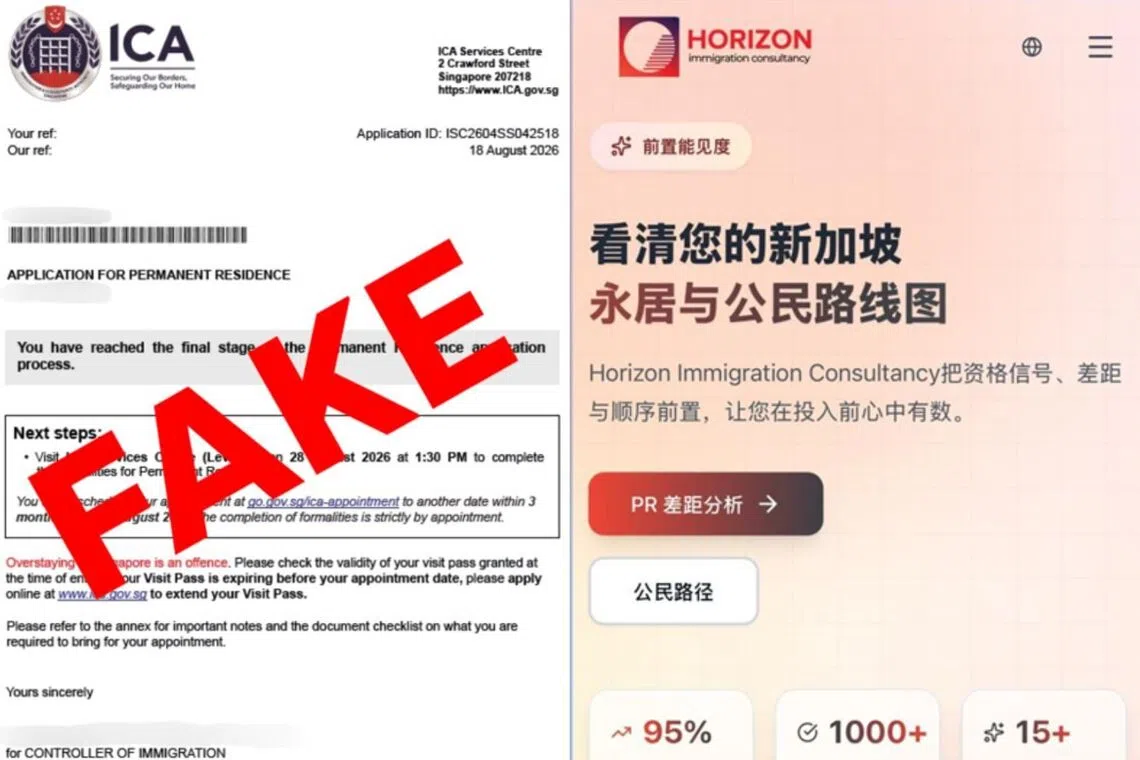
Examples of the fake websites and documents of fake advertisements offering help with applying for a Singapore Permanent Resident (PR) status.
PHOTOS: SINGAPORE POLICE FORCE, IMMIGRATION & CHECKPOINTS AUTHORITY
Published Sep 25, 2026, 04:03 PM
Updated Sep 25, 2026, 04:03 PM
At least $8.8 million was lost in 148 scams involving fake ICA officers and fraudulent PR application ads since January, with victims tricked into transferring money or submitting personal details.
Scammers impersonated ICA officers and China officials to demand money for fake investigations or bail, while fake PR ads on social media led victims to pay fees for false approval letters.
Authorities urged the public to apply directly via ICA's website, verify communications, avoid unsolicited requests for money or personal info, and use ScamShield and other tools to detect scams.
SINGAPORE – At least $8.8 million has been lost to scams involving the Immigration and Checkpoints Authority (ICA) since January, the authorities said.
ICA and the police, in a joint statement on Sept 25, said there have been at least 148 reported cases across two different types of scams.
One involved scammers impersonating ICA officers to demand money and the other involved fake advertisements offering help with applying for a Singapore Permanent Resident (PR) status.
In the first scenario, victims would receive calls from scammers claiming to be from ICA, who would tell victims that their personal details have been misused , or that their phone numbers have been linked to criminal activities, such as transmitting scam messages.
The calls would then be transferred to another scammer impersonating a China official, who would demand that victims transfer monies or hand over cash for “investigation” or “bail” purposes.
In some cases, victims were also asked to meet unknown individuals to sign fake documents.
Most victims would realise that they had been scammed only after making multiple monetary transfers or when the scammer became uncontactable.
At least 117 of such cases have been reported since January, with at least $8.4 million lost.
In the second scenario, victims would come across advertisements on social media platforms, such as Facebook, offering help with getting PR status in Singapore.
Those who click on the advertisements would be directed to the website of a fake consultancy agency where they would be prompted to submit their personal particulars, including their mobile numbers, through a form.
The scammers would then contact the victims via WhatsApp and ask them to pay “fees” ranging from $200 to $90,000 to proceed with the PR application.
This is done “under the pretext of improving their chances of success through investments in companies, purchases of academic certifications and donations”, said the statement.
The victims were instructed to make bank transfers or pay cash to unknown individuals, before receiving a fake automated acknowledgement e-mail supposedly from the ICA.
The e-mail would contain an attachment of a fake InPrinciple Approval (IPA) letter bearing the ICA letterhead.
Some victims realised they had been scammed only when they asked ICA to verify the authenticity of the IPA letters.
The ICA has been alerted to at least 31 reports of cases involving such fake e-mails, resulting in losses of at least $400,000.
The Straits Times earlier reported that a 62-year-old Malaysian woman had lost RM762,700 (S$238,500) after falling for such a ruse.
“ICA is aware of commercial entities or consultants who claim to be able to help applicants improve their chances of success in obtaining long-term immigration facilities such as Singapore PR,” the statement said.
“ICA does not support or endorse such services. Applicants who choose to engage commercial entities or consultants are advised to exercise caution.”
The authority has advised the public to submit any applications directly to ICA on its website.
Those who want to verify if a call or e-mail is from the ICA can do so via its feedback form or over the phone.
The police and ICA also reminded the public that Singapore Government officials will not ask anyone to transfer or hand over money, luxury watches gold or cryptocurrency, borrow from licensed moneylenders, share banking log-in details, install mobile apps from unverified app stores, or transfer calls to the police or other government officials.
“Do not trust unsolicited communications, even if the caller appears to have your personal information,” said the statement.
They also encouraged the public to add the ScamShield app and set up security features for bank accounts and internet banking transactions, and check for signs of scam with official sources.
The public can check the legitimacy of suspicious messages, phone numbers and website links via the ScamShield app or website.
They can also use the Infocomm Media Development Authority’s SIMCardHowMany tool to verify the number of postpaid SIM cards registered under their name.
Any discrepancies should be reported to their telco and the police immediately, said the statement.
Internet crimes and scams
以下是一些虚假网站和虚假广告文件的示例,这些网站和文件声称可以帮助申请新加坡永久居民(PR)身份。
照片来源:新加坡警察部队、移民与关卡局
发布于 2026 年 9 月 25 日下午 4:03
更新于2026年9月25日下午4:03
自今年1月以来,涉及假冒移民与关卡局官员和虚假永久居民申请广告的148起诈骗案造成至少880万美元的损失,受害者被骗转账或提交个人信息。
诈骗分子冒充移民与关卡局官员和中国官员,以虚假调查或保释为由索要钱财;同时,社交媒体上的虚假公关广告诱使受害者支付费用以获取虚假的批准信。
当局敦促公众直接通过ICA网站申请,核实沟通信息,避免主动索要钱财或个人信息,并使用ScamShield和其他工具来识别诈骗。
新加坡——当局表示,自今年1月以来,涉及移民与关卡局(ICA)的诈骗案已造成至少880万美元的损失。
移民与关卡局和警方在9月25日发表的联合声明中表示,已接到至少148起涉及两种不同类型诈骗的报案。
其中一起案件涉及诈骗分子冒充移民与关卡局 (ICA) 官员索要钱财,另一起案件涉及虚假广告,声称可以帮助申请新加坡永久居民 (PR) 身份。
在第一种情况下,受害者会接到诈骗者的电话,这些诈骗者自称是移民与关卡局 (ICA) 的工作人员,会告诉受害者他们的个人信息已被滥用,或者他们的电话号码与犯罪活动有关,例如发送诈骗信息。
然后,这些电话会被转接到另一个冒充中国官员的诈骗者,该诈骗者会要求受害者以“调查”或“保释”为由转账或交出现金。
在某些情况下,受害者还被要求与陌生人见面并签署伪造文件。
大多数受害者只有在多次转账后或骗子无法联系时才会意识到自己被骗了。
自 1 月以来,已报告至少 117 起此类案件,损失至少达 840 万美元。
在第二种情况下,受害者会在 Facebook 等社交媒体平台上看到广告,声称可以帮助他们获得新加坡的永久居民身份。
点击广告的人会被引导至一个虚假咨询机构的网站,该网站会提示他们通过表格提交个人信息,包括手机号码。
骗子随后会通过 WhatsApp 联系受害者,要求他们支付 200 美元到 9 万美元不等的“费用”才能继续办理永久居民申请。
声明称,这样做是“以投资公司、购买学历证书和捐款来提高自身成功几率为借口”。
受害者被指示向不知名人士进行银行转账或支付现金,之后会收到一封伪造的自动确认电子邮件,该电子邮件据称来自ICA。
该电子邮件将包含一份伪造的原则性批准 (IPA) 信函附件,信函抬头为 ICA。
有些受害者直到要求ICA验证IPA信函的真实性时才意识到自己被骗了。
ICA 已接到至少 31 起涉及此类虚假电子邮件的案件报告,造成的损失至少达 40 万美元。
《海峡时报》早前报道,一名 62 岁的马来西亚妇女因落入此类骗局而损失了 762,700 令吉(238,500 新元)。
声明称:“ICA注意到一些商业实体或顾问声称能够帮助申请人提高获得新加坡永久居民等长期移民待遇的成功率。”
“ICA不支持或认可此类服务。选择聘用商业机构或顾问的申请人务必谨慎行事。”
当局建议公众直接通过ICA网站提交申请。
想要确认来电或电子邮件是否来自ICA的人可以通过ICA的反馈表或电话进行确认。
警方和移民与关卡局也提醒公众,新加坡政府官员不会要求任何人转移或交付金钱、名表、黄金或加密货币,不会要求任何人向持牌放贷机构借款,不会要求任何人分享银行登录信息,不会要求任何人从未经核实的应用商店安装手机应用,也不会要求任何人将电话转接给警方或其他政府官员。
声明称:“不要相信未经请求的通信,即使来电者似乎掌握了您的个人信息。”
他们还鼓励公众安装 ScamShield 应用,为银行账户和网上银行交易设置安全功能,并通过官方渠道检查是否存在诈骗迹象。
公众可以通过 ScamShield 应用程序或网站检查可疑信息、电话号码和网站链接的合法性。
他们还可以使用新加坡资讯通信媒体发展管理局的 SIMCardHowMany 工具来验证以自己名义注册的后付费 SIM 卡数量。
声明称,任何异常情况都应立即向电信运营商和警方报告。
网络犯罪和诈骗