Proposed StarHub-M1 merger could create stronger rival to Singtel but reduce consumer perks, say analysts分析人士称,StarHub与M1的拟议合并可能会打造出比Singtel更强大的竞争对手,但也会减少消费者的福利。
StarHub and Keppel had confirmed that they are in talks over a potential deal, months after a proposed acquisition of M1 by rival Simba fell through.
StarHub and Keppel had confirmed that they are in talks over a potential deal, months after a proposed acquisition of M1 by rival Simba fell through.
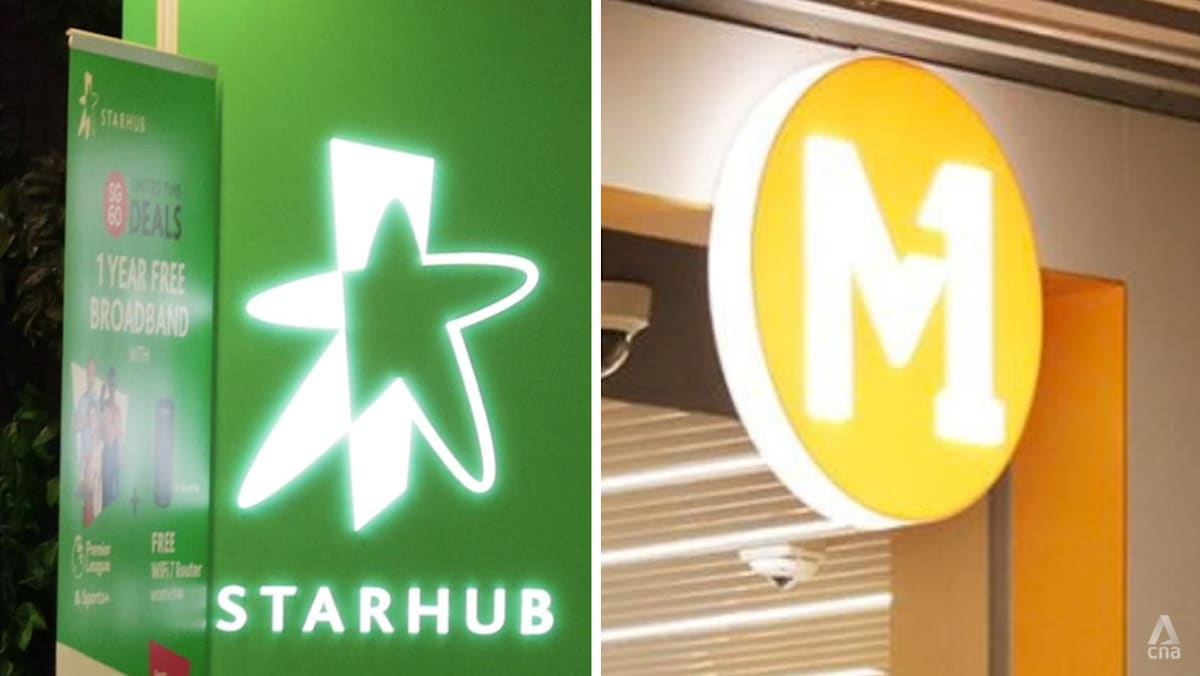
A Starhub shop and an M1 shop at Causeway Point in Woodlands, Singapore, on Aug 19, 2025. (File photos: CNA/Ooi Boon Keong)
This audio is generated by an AI tool.
SINGAPORE: A potential merger between StarHub and M1 could forge a large enough rival to market leader Singtel and reshape Singapore’s telecommunications landscape, though analysts warn that consumers could see today’s fierce price competition come to an end.
StarHub and Keppel had confirmed on Wednesday (Sep 23) that they are in talks over a potential deal, months after a proposed acquisition of M1 by rival Simba fell through.
“If StarHub and M1 merge, it would put StarHub in a stronger position to compete as it would enlarge its customer base significantly and offer more economies of scale,” said tech industry observer Oo Gin Lee.
Dr Xu Le, a lecturer from the National University of Singapore Business School’s strategy and policy department, said that based on the current market share data, such a merger would create “the largest provider in both the post-paid mobile and fixed broadband markets” here.
CNA Games Guess Word Crack the word, one row at a time Buzzword Create words using the given letters Mini Sudoku Tiny puzzle, mighty brain teaser Mini Crossword Small grid, big challenge Word Search Spot as many words as you can Show More Show Less "A StarHub-M1 merger would allow the two companies to share network infrastructure and reduce overlapping costs, making the combined entity a stronger competitor against Singtel,” said Mr Puar Leong Sing, course manager for Nanyang Polytechnic’s business management diploma. PRICING PRESSURES TO EASE? Analysts said the telco market in Singapore would become more concentrated if the number of network operators were to fall from four to three, with consumers feeling the effect in pricing. It would “ease the competitive price pressure of the very brutal mobile subscription as there is now one less major telco”, said Mr Oo. In theory, less competition should mean that prices should moderate, he said. “In the short term, the reduction in competition could ease pricing pressure, which may not be favourable for consumers,” said Mr Puar. Dr Xu also noted that with fewer operators to choose from, consumers could see fewer discounts and promotions as competitive pressure eases. The StarHub-M1 combination would likely have a greater impact on market competition than the previously proposed deal involving Simba, due to the “substantially larger and more concentrated market position” they would hold as established incumbents, she said. Mr Puar added: “This would also move Singapore's telecoms market further towards an oligopoly structure, where a small number of dominant players control the market.” Amid the prospect of such a shift, he emphasised that regulatory focus on whether the reduction in operators leads to higher prices and less choice for consumers would become increasingly important.
"A StarHub-M1 merger would allow the two companies to share network infrastructure and reduce overlapping costs, making the combined entity a stronger competitor against Singtel,” said Mr Puar Leong Sing, course manager for Nanyang Polytechnic’s business management diploma.
PRICING PRESSURES TO EASE?
Analysts said the telco market in Singapore would become more concentrated if the number of network operators were to fall from four to three, with consumers feeling the effect in pricing.
It would “ease the competitive price pressure of the very brutal mobile subscription as there is now one less major telco”, said Mr Oo.
In theory, less competition should mean that prices should moderate, he said.
“In the short term, the reduction in competition could ease pricing pressure, which may not be favourable for consumers,” said Mr Puar.
Dr Xu also noted that with fewer operators to choose from, consumers could see fewer discounts and promotions as competitive pressure eases.
The StarHub-M1 combination would likely have a greater impact on market competition than the previously proposed deal involving Simba, due to the “substantially larger and more concentrated market position” they would hold as established incumbents, she said.
Mr Puar added: “This would also move Singapore's telecoms market further towards an oligopoly structure, where a small number of dominant players control the market.”
Amid the prospect of such a shift, he emphasised that regulatory focus on whether the reduction in operators leads to higher prices and less choice for consumers would become increasingly important.
Despite the potential consolidation, analysts said that smaller players, including Simba, could still impact pricing levels in the sector, depending on the strategies they adopt.
“I wouldn't rule out what Simba might do as it is the maverick that has been shaking up the market, so we still need to see what Simba's response will be,” said Mr Oo.
He noted that Singtel and StarHub are both seeing reductions in mobile Average Revenue Per User (ARPU) recently, currently sitting between S$20 and S$22. In contrast, Simba’s ARPU is around S$9 to S$10.
“Because Simba’s ARPU is more than half of the competition and it has still been profitable, it is showing that it can already make money at a lower selling price,” said Mr Oo.
Since entering the sector here, Simba is known for its low-cost mobile plans with large data bundles.
“If the Simba-M1 merger had taken place instead of StarHub-M1, I feel that the new Simba would add even more competitive pressure,” said Mr Oo.
He added that Simba, as the new entrant, has been growing from zero in just a few years, against the three other telcos who have been around for much longer and have been seeing their mobile profits drop.
Mr Puar said that in a newly consolidated market, if the StarHub-M1 deal goes through, competition could still stay alive if smaller budget brands can easily enter the market.
“Smaller operators such as CirclesLife can still provide a degree of price competition, but only if they continue to receive fair access to the merged entity's network,” he said.
Analysts, however, noted the trade-offs between price and longer-term investment and innovation by the telco firms.
“A cut-throat business is not necessarily for the benefit of the industry as a whole. If the telcos all can't make money, then it could slow future innovation or affect quality of service,” said Mr Oo.
Mr Puar said that over the longer term, cost synergies from a potential StarHub-M1 deal could unlock “substantial capital to reinvest in future generation network infrastructure and product innovation”.
“Whether consumers ultimately benefit will depend on whether the merged company passes those savings on through better pricing and services, or retains them as profit,” he said.
Get our pick of top stories and thought-provoking articles in your inbox
Stay updated with notifications for breaking news and our best stories
Join our channel for the top reads for the day on your preferred chat app
星和与吉宝集团已证实,双方正在就一项潜在交易进行谈判。此前数月,竞争对手辛巴集团拟收购M1的计划宣告失败。
2025年8月19日,新加坡兀兰Causeway Point购物中心的一家星和(Starhub)商店和一家M1商店。(资料照片:CNA/Ooi Boon Keong)
这段音频是由人工智能工具生成的。
新加坡:星和电信 (StarHub) 与 M1 的潜在合并可能会打造出足以与市场领导者新加坡电信 (Singtel) 抗衡的强大竞争对手,并重塑新加坡的电信格局。不过,分析人士警告称,消费者可能会看到目前激烈的价格竞争就此结束。
星和集团和吉宝集团于周三(9月23日)证实,双方正在就一项潜在交易进行谈判。此前数月,竞争对手辛巴集团拟收购M1的计划宣告失败。
“如果 StarHub 和 M1 合并,StarHub 将处于更有利的竞争地位,因为它将大幅扩大其客户群,并提供更大的规模经济效益,”科技行业观察人士 Oo Gin Lee 表示。
新加坡国立大学商学院战略与政策系讲师徐乐博士表示,根据目前的市场份额数据,这样的合并将打造“新加坡后付费移动和固定宽带市场最大的供应商”。
CNA游戏 猜词游戏 逐行破解单词 流行词游戏 用给定的字母组成单词 迷你数独 小谜题,脑力挑战 迷你填字游戏 小方格,大挑战 单词搜索 尽可能多地找出单词 显示更多 显示更少 “星和(StarHub)与M1的合并将使两家公司能够共享网络基础设施并减少重叠成本,使合并后的实体成为新加坡电信(Singtel)更强大的竞争对手,”南洋理工学院商业管理文凭课程经理蒲良星先生表示。 价格压力会缓解吗? 分析人士表示,如果新加坡的网络运营商数量从四家减少到三家,电信市场将变得更加集中,消费者将感受到价格方面的影响。 吴先生表示,这将“缓解竞争激烈的移动订阅价格压力,因为现在少了一家主要电信公司”。 他说,理论上,竞争减少应该意味着价格会趋于缓和。 蒲先生表示:“短期内,竞争减少可能会缓解价格压力,但这可能对消费者不利。”徐博士还指出,随着运营商数量的减少,消费者可选择的折扣和促销活动也会减少,因为竞争压力会降低。她表示,由于星和(StarHub)和M1合并后将拥有“规模更大、市场集中度更高的市场地位”,因此,与之前提出的涉及Simba的交易相比,星和与M1的合并可能会对市场竞争产生更大的影响。普亚先生补充道:“这将使新加坡的电信市场进一步向寡头垄断结构靠拢,少数几家主导企业将控制整个市场。” 鉴于这种转变的可能性,他强调,监管机构将越来越关注运营商数量的减少是否会导致价格上涨和消费者选择减少。
南洋理工学院商业管理文凭课程经理蒲良星先生表示:“星和与M1合并将使两家公司能够共享网络基础设施并减少重叠成本,使合并后的实体成为与新加坡电信竞争的更强大的对手。”
价格压力会缓解吗?
分析人士表示,如果新加坡的网络运营商数量从四家减少到三家,电信市场将变得更加集中,消费者将感受到价格方面的影响。
Oo 先生表示,这将“缓解竞争非常残酷的移动订阅价格压力,因为现在少了一家主要的电信公司”。
他表示,理论上讲,竞争减少应该意味着价格会趋于缓和。
“短期来看,竞争减少可能会缓解价格压力,这对消费者来说可能并不有利,”普阿尔先生说。
徐博士还指出,由于可供选择的运营商减少,竞争压力缓解,消费者可能会看到更少的折扣和促销活动。
她表示,由于 StarHub-M1 合并后将作为既有企业占据“更大、更集中的市场地位”,因此与之前提议的涉及 Simba 的交易相比,合并后的交易可能会对市场竞争产生更大的影响。
Puar先生补充道:“这将使新加坡的电信市场进一步向寡头垄断结构靠拢,少数几家占主导地位的企业控制市场。”
在这种转变的前景下,他强调,监管机构将越来越重视运营商减少是否会导致价格上涨和消费者选择减少。
尽管存在潜在的整合,但分析师表示,包括 Simba 在内的规模较小的企业仍然可能影响该行业的定价水平,这取决于它们采取的策略。
“我不会排除辛巴会采取什么行动,因为它是颠覆市场的特立独行者,所以我们仍然需要看看辛巴会作何反应,” Oo 先生说。
他指出,新加坡电信和星和电信近期移动用户平均收入(ARPU)均有所下降,目前在20新元至22新元之间。相比之下,Simba的ARPU约为9新元至10新元。
“因为 Simba 的 ARPU 已经超过竞争对手的一半,而且仍然盈利,这表明即使售价较低,它也能赚钱,” Oo 先生说。
自进入该行业以来,Simba 以其低价移动套餐和大流量包而闻名。
“如果Simba-M1合并而不是StarHub-M1合并,我觉得新的Simba会带来更大的竞争压力,”Oo先生说。
他还补充说,作为新进入者,Simba 在短短几年内就从零发展壮大,而其他三家电信公司成立时间更长,移动利润却一直在下降。
Puar 先生表示,在一个新整合的市场中,如果 StarHub-M1 交易达成,只要规模较小的廉价品牌能够轻松进入市场,竞争就能继续存在。
他说:“像 CirclesLife 这样的小型运营商仍然可以提供一定程度的价格竞争,但前提是他们能够继续公平地接入合并后实体的网络。”
然而,分析师们注意到电信公司在价格和长期投资及创新之间存在权衡取舍。
“残酷的竞争未必对整个行业有利。如果电信公司都无法盈利,那么未来的创新可能会放缓,服务质量也会受到影响。” Oo先生说道。
Puar 先生表示,从长远来看,StarHub 与 M1 潜在的交易带来的成本协同效应可以释放“大量资金,用于再投资于未来一代的网络基础设施和产品创新”。
“消费者最终能否受益,将取决于合并后的公司是将节省下来的成本通过更优惠的价格和服务回馈消费者,还是将其作为利润保留下来,”他说道。
订阅我们的邮件,即可获取精选热点新闻和引人深思的文章。
订阅通知,第一时间获取突发新闻和精彩报道。
加入我们的频道,即可在您常用的聊天应用上获取当日热门文章。