Ng Teng Fong General Hospital, first to repurpose dialysis water to water plants, given PUB award黄廷方综合医院率先将透析水用于植物浇灌,荣获公用事业局奖项
37 organisations honoured at Singapore Watermark Awards 2026 for innovative water conservation and sustainability efforts across healthcare, industry, and education sectors. Read more at straitstimes.com.
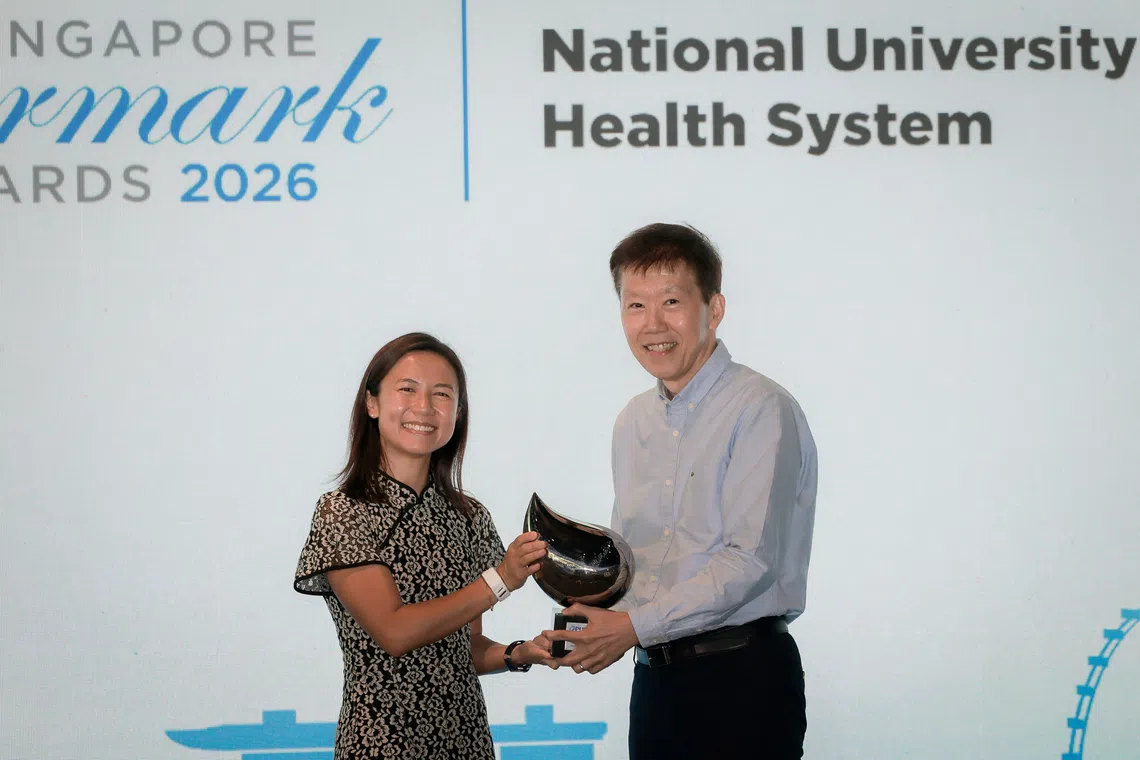
Senior Parliamentary Secretary for the Ministry of Sustainability and the Environment Goh Hanyan (left) presents the Singapore Watermark Award to NUHS Chief Operating Officer Ng Kian Swan at the award ceremony on Sept 25.
Published Sep 25, 2026, 07:30 PM
Updated Sep 25, 2026, 07:30 PM
The National University Health System (NUHS) recognised for reclaiming 70% of rejected dialysis water, saving 612 million litres in FY2025 and applying circular economy principles in healthcare.
Amazon Web Services Singapore and Micron Technology were honoured for innovative water-saving technologies in cooling and semiconductor processes, significantly reducing water usage.
The Institute of Technical Education integrated water stewardship into its campus and curriculum, promoting sustainability and student outreach on water conservation.
SINGAPORE – A hospital here has found a way to recycle the water left behind by a patient going through kidney dialysis, by using it to water plants within the compound.
This initiative, which started in 2025, helped the Ng Teng Fong General Hospital save 9 million litres of water every year - the volume of almost four Olympic-sized swimming pools.
This was one of the water-saving initiatives under the National University Health System (NUHS) that helped it clinch the Singapore Watermark Award at a ceremony on Sept 25. It was the first recipient from the healthcare sector to receive the award, which was first given out in 2007.
Ng Teng Fong General Hospital is one of four hospitals under NUHS. The others include the National University Hospital, Alexandra Hospital and Jurong Community Hospital.
The award organised by national water agency PUB is given once every two years.
This year, NUHS was one of four recipients of the Singapore Watermark Award, which honours organisations and individuals who have shown “exceptional leadership and remarkable contributions” toward advancing Singapore’s water sustainability goals, said PUB.
This year’s event was held at the Gardens by the Bay’s Flower Field Hall.
Other than the four winners of the top award, another 34 recipients were given the Water Efficiency Award .There were also four project-based award winners for leadership in advancing the nation’s water sustainability agenda.
During the event, Senior Parliamentary Secretary for the Ministry of Sustainability and the Environment Goh Hanyan highlighted the urgency of water stewardship as Singapore’s water demand is projected to almost double by 2065. Singapore’s current water demand is about 440 million gallons a day, which is enough to fill about 800 Olympic-sized swimming pools.
“Managing water demand, instead of solely increasing supply, is an important strategy to strengthen Singapore’s water resilience and support our continued growth,” Goh said.
“For our businesses, industries and institutions, making every drop count is especially important, as Singapore’s economy grows, the non-domestic sector is expected to be a key driver of future water demand growth.”
Goh commended NUHS for demonstrating that healthcare institutions “can apply circular economy principles to achieve significant water savings without compromising patient safety or operational reliability.”
Ng Kian Swan, chair of the energy & water taskforce and chief sustainability officer at Ng Teng Fong General Hospital, said of the effort to recycle discharge water from the kidney dialysis process : “The idea was actually very simple – we wanted to make every drop count.”
Ng, who is also chief operating officer for group facilities management at NUHS, added: “ Although the discharged water cannot be re-used for dialysis, we saw an opportunity to give this water a second life for suitable non-clinical purposes.”
In kidney dialysis, reverse osmosis (RO) filtration systems force tap water through fine membranes to produce ultrapure water for treatment.
After the treatment, the ultrapure water - which now carries the metabolic waste pulled from the patient - passes back out.
The hospital now recovers about 70 per cent of its dialysis RO reject water.
The reclaimed water feeds into a wider campus irrigation network alongside harvested rainwater, NEWater, and chiller condensate from air-conditioning systems.
Together, these non-potable sources irrigate the hospital’s trees and greenery, saving around nine million litres of potable water each year through the dialysis recovery project alone.
NUHS Chief Operating Officer Ng Kian Swan poses with his Singapore Watermark Award at the award ceremony. ST PHOTO: GAVIN FOO
NUHS Chief Operating Officer Ng Kian Swan poses with his Singapore Watermark Award at the award ceremony.
Implementing the recovery system within a healthcare environment required upfront resources and rigorous safety evaluations. Ng noted that while the project required investment in infrastructure to collect, store and redistribute the reject water, financial metrics were not the primary driver.
“For us, the project was not driven purely by financial payback,” Ng said. “We also looked at the value of conserving potable water, reducing wattage and strengthening our overall water resilience.”
Ng said N UHS is studying plans to expand the use of recovered reject water to toilet flushing and selected cleaning or maintenance uses, while considering similar water-recovery architecture in the design of future healthcare facilities.
“We are very happy to share our experience with any healthcare organisation involved in renal dialysis that is interested in adopting a similar approach,” Ng said.
Meanwhile, the Institute of Technical Education (ITE) was also the first full campus cluster to win the Singapore Watermark Award, for its student outreach efforts. This includes initiatives to install flush saver cistern bags - a water-saving device aimed to reduce the volume of water used with every flush - i n residential homes.
Other winners of the Singapore Watermark Award include semiconductor manufacturer Micron Technology and tech giant Amazon Web Services (AWS) Singapore.
Both firms had incorporated technology in their operations to reduce water consumption, and organised programmes to advocate for water stewardship.
Ministry of Sustainability and the Environment
Environmental issues
9月25日,在颁奖典礼上,永续发展及环境部高级政务次长吴汉彦(左)向新加坡国立大学医院首席运营官吴建生颁发新加坡水印奖。
发布于2026年9月25日晚上7:30
更新于2026年9月25日晚上7:30
新加坡国立大学医疗系统 (NUHS) 因回收利用 70% 的废弃透析用水而受到认可,在 2025 财年节省了 6.12 亿升水,并在医疗保健领域应用了循环经济原则。
亚马逊网络服务新加坡公司和美光科技公司因在冷却和半导体工艺中采用创新节水技术而获得表彰,这些技术显著降低了用水量。
技术教育学院将水资源管理融入校园和课程中,促进可持续发展,并鼓励学生参与节水活动。
新加坡——当地一家医院找到了一种方法,可以回收利用肾透析患者产生的废水,并将其用于浇灌院内的植物。
这项始于 2025 年的举措,帮助黄廷方综合医院每年节约 900 万升水——相当于近四个奥运会标准游泳池的容量。
这是新加坡国立大学医疗系统 (NUHS) 的一项节水举措,帮助其在 9 月 25 日的颁奖典礼上荣获新加坡节水标志奖。NUHS 是医疗保健行业首个获得该奖项的机构,该奖项于 2007 年首次颁发。
黄廷方综合医院是新加坡国立大学医院系统(NUHS)旗下的四家医院之一。其他三家分别是新加坡国立大学医院、亚历山大医院和裕廊社区医院。
该奖项由国家水务局(PUB)组织,每两年颁发一次。
新加坡公用事业局表示,今年,新加坡国立大学健康科学中心是新加坡水资源标志奖的四个获奖者之一,该奖项旨在表彰在推进新加坡水资源可持续发展目标方面展现出“卓越领导力和杰出贡献”的组织和个人。
今年的活动在滨海湾花园的花卉展厅举行。
除了四位最高奖项获得者外,另有 34 位获奖者获得了节水奖。此外,还有四位项目获奖者,以表彰他们在推进国家水资源可持续发展议程方面所展现的领导力。
活动期间,永续发展及环境部高级政务次长吴汉彦强调了水资源管理的紧迫性,因为预计到2065年,新加坡的用水需求将几乎翻一番。新加坡目前的日用水需求约为4.4亿加仑,足以填满约800个奥运标准游泳池。
“管理用水需求,而不是仅仅增加供水,是增强新加坡水资源韧性并支持我们持续增长的重要策略,”吴作栋说。
“对于我们的企业、行业和机构而言,节约每一滴水尤为重要,因为随着新加坡经济的增长,非家庭用水部门预计将成为未来用水需求增长的关键驱动力。”
吴先生赞扬新加坡国立大学医院证明,医疗机构“可以应用循环经济原则,在不损害患者安全或运营可靠性的前提下,实现显著的节水”。
能源与水资源工作组主席兼黄廷方综合医院首席可持续发展官黄建生在谈到回收肾透析过程中产生的废水时说:“这个想法其实很简单——我们想让每一滴水都发挥作用。”
吴先生同时也是新加坡国立大学医院集团设施管理首席运营官,他补充道:“虽然排放的水不能再用于透析,但我们看到了让这些水发挥第二次生命,用于合适的非临床用途的机会。”
在肾透析中,反渗透 (RO) 过滤系统迫使自来水通过精细膜,以产生用于治疗的超纯水。
治疗结束后,超纯水(其中含有从患者体内提取的代谢废物)会排出体外。
目前,该医院可回收约 70% 的透析反渗透废水。
再生水与收集的雨水、新生水和空调系统的冷凝水一起,流入更广泛的校园灌溉网络。
这些非饮用水源共同灌溉医院的树木和绿地,仅透析回收项目每年就节约了约 900 万升饮用水。
新加坡国立大学医院首席运营官黄建文在颁奖典礼上手持新加坡水印奖奖杯合影。(海峡时报摄影:Gavin Foo)
新加坡国立大学医院首席运营官黄建生在颁奖典礼上与他的新加坡水印奖合影。
在医疗环境中实施这套回收系统需要前期投入资源并进行严格的安全评估。吴指出,虽然该项目需要投资建设基础设施来收集、储存和重新分配废水,但财务指标并非主要驱动因素。
“对我们来说,这个项目并非完全出于经济回报的考虑,”吴先生说。“我们也考虑到了节约饮用水、降低能耗以及增强我们整体用水韧性的价值。”
Ng表示,N UHS正在研究扩大回收废水用途的计划,包括用于冲厕和部分清洁或维护用途,同时考虑在未来医疗保健设施的设计中采用类似的废水回收架构。
“我们非常乐意与任何对采用类似方法感兴趣的肾透析医疗机构分享我们的经验,”吴先生说。
与此同时,工艺教育学院(ITE)也凭借其学生在节水方面的努力,成为首个荣获新加坡水印奖的完整校区集群。这些努力包括在居民家中安装节水冲水袋——一种旨在减少每次冲水用水量的节水装置。
新加坡水印奖的其他获奖者包括半导体制造商美光科技和科技巨头亚马逊网络服务(AWS)新加坡。
两家公司都在运营中采用了技术来减少用水量,并组织了倡导水资源管理的计划。
可持续发展与环境部
环境问题