These Are The Briefings President-Elect Trump Got On The F-35, Air Force One, and Nukes以下是候任总统特朗普听取的关于F-35战斗机、空军一号和核武器的简报
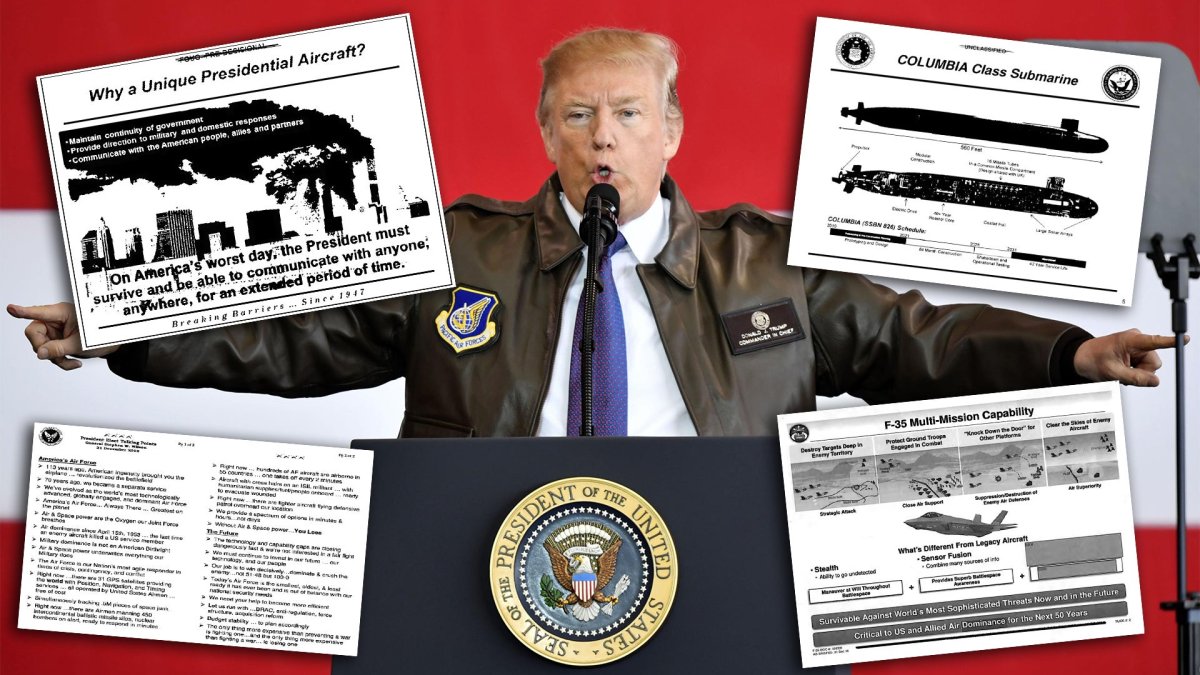
The presentations provide a window into what kinds of information he was receiving, and how, during a particularly critical time in history.
By Joseph Trevithick
Updated Dec 1, 2019 6:48 AM EST
Just shy of a month before his inauguration in 2017, then-President-Elect Donald Trump held a series of meetings with senior officials from the U.S. Air Force and other branches of the U.S. military, as well as executives from Lockheed Martin and Boeing , at his Mar-a-Lago club in Florida. At the time, reports said that the primary topics of discussion were the F-35 Joint Strike Fighter and the Air Force One replacement effort, programs Trump criticized the cost of before and after the meetings , but which he began to soften on in the months afterward. Now, thanks to the Freedom of Information Act, we have more details about exactly what information Trump received from the military briefers, including that he received a presentation on the U.S. Nuclear Triad , as well.
On Dec. 21, 2016, Trump met with multiple flag officers from the U.S. Air Force and the U.S. Navy. The War Zone obtained a total of three unclassified briefings and one set of unclassified talking points through FOIA. U.S. Air Force Lieutenant General Chris Bogdan , then head of the F-35 Joint Program Office, briefed the President-Elect on the stealthy fighter jet and U.S. Air Force General Carlton Everhart, chief of Air Mobility Command, provided an overview of the Air Force One recapitalization program. U.S. Air Force Lieutenant General Jack Weinstein , Deputy Chief of Staff for Strategic Deterrence and Nuclear Integration, and U.S. Navy Vice Admiral David Johnson , the principal military deputy for the Assistant Secretary of the Navy Research, Development and Acquisition, jointly briefed Trump on the Nuclear Triad. U.S. Air Force Vice Chief of Staff General Stephen Wilson prepared talking points for the meeting. Bogdan, Everhart, Johnson, and Weinstein have all since retired.
“America’s Air Force … Always There … Greatest on the planet,” one of Wilson’s talking points reads. This looks very much like an appeal to Trump’s heavy focus on American “ greatness ” on the campaign trail, including his signature slogan, “Make America Great Again.”
“Without Air & Space power … You Lose,” another one declares with the second part bolded for emphasis, again seeming to speak to the president-elect’s campaign trail promises to reinvigorate America’s military capabilities and readiness. “Our job is to win decisively … dominate & crush the enemy … not 51-48 but 100-0.”
U.S. Air Force General Carlton Everhart, at left, talks with U.S. Navy Admiral William Moran ahead of the meetings at Mar-a-Lago on Dec. 21, 2016. Marine is presently Vice Chief of Naval Operations and is now in line to become his service’s top officer., AP
Wilson’s talking points, which you can see below in their entirety, contain a number of other relatively common refrains from the U.S. military at the time, many of which continue to be general talking points to this day. “The technology and capability gaps are closing dangerously fast & we’re not interested in a fair fight,” one says. “Today’s Air Force is the smallest, oldest, & least ready it has ever been and is out of balance with our national security needs.”
The talking points otherwise include a fair amount of mundane details and end with a plea for stable defense budgets going forward, something the U.S. military as a whole had been calling for after years of short-term spending bills from Congress, also known as Continuing Resolutions. It also implores Trump to “Let us run with … BRAC [ Base Realignment and Closure ], anti-regulation, force structure, [and] acquisition reform.”
The Trump Administration, with help from a Republican-controlled Congress, would succeed in passing the first full defense budget in a decade, covering the 2019 Fiscal Year , in September 2018. There were also reports that he initially delegated a significant amount of decision making authority to former Secretary of Defense James Mattis. Trump forced Mattis out in December 2018 after the two men disagreed over the President’s desire to withdraw all U.S. forces from Syria.
U.S. Air Force Vice Chief of Staff General Stephen Wilson’s talking points for the meeting with Then-President-Elect Trump., USAF via FOIA
Wilson undoubtedly wanted to give his compatriots the best possible start to what had the potential to be a contentious meeting.
Trump had slammed the F-35 program multiple times on the campaign trail, decrying it as a waste of money and just “ not a very good ” airplane.
“The F-35 program and cost is out of control,” Trump Tweeted out on Dec. 12, 2016, a little over a week before his meetings at Mar-a-Lago. “Billions of dollars can and will be saved on military (and other) purchases after January 20th.”
To his credit, Lieutenant General Bogdan’s presentation is one of the most candid official assessments of the F-35 program to ever become public. The briefing starts out with two slides highlighting well-established talking points about the F-35’s feature set, especially its electronic warfare and sensor fusion capabilities , and a note about the array of allies involved in the program.
“Critical to U.S. and allied air dominance for the next 50 years,” a line at the bottom of the first slide reads. “Big, complicated program with significant allied participation,” a similar chyron notes at the bottom of the second.
The slide covering F-35 capabilities. It’s interesting to note that the Air Force redacted two items because they are still “pre-decisional.”, USAF via FOIA
The slide about the different F-35 variants and allied participation., USAF via FOIA
But the third slide, covering the program’s history, efficiently uses space to catalog a host of serious missteps and mistakes in its execution up to that point. It mentions the delay over the F-35B weight issues, the solution to which may have subsequently caused additional problems , and that the decision to begin serial production in 2007 was premature. The entry for 2009 shows that basically everything that could go wrong for the program, did go wrong.
Bodgan’s briefing goes even further to say that government intervention in 2011, which led to an effective rebooting of the program with a new schedule and cost estimates, offered a “marked improvement, but not perfect.” The bottom of this slide says, without caveat “Difficult to overcome a troubled past, but program is improving.”
A pretty devastating overview of the F-35’s history., USAF via FOIA
The program history slide included a box redacted for being “pre-decisional,” suggesting that there are still more granular parts of the F-35 program schedule that are subject to change. These kinds of redactions continue onto the final slide, which covers costs. The unit price estimates for the F-35A for production lots 10 through 13 are redacted, even though Lockheed Martin has released its own data and cost estimates for production well beyond the timeframe in the chart in Bogdan’s 2016 briefing.
The final slide in the F-35 briefing Trump received. , USAF via FOIA
If Trump’s Tweeting is anything to judge by, the F-35 briefing fell flat, or may have even confirmed his presuppositions. On Dec. 22, 2016, the day after, he Tweeted out “Based on the tremendous cost and cost overruns of the Lockheed Martin F-35, I have asked Boeing to price-out a comparable F-18 Super Hornet !”
This attitude, of course, didn’t last forever. It seems in hindsight like it may have been an attempt at a ruse to try to put pressure on Lockheed Martin to offer a better price.
“We’re just beginning – it’s a dance,” Trump had told reporters outside Mar-a-Lago after the meetings on Dec. 21, 2016 . “It’s a little bit of a dance. But we’re going to get the costs down and we’re going to get it done beautifully.”
Both Lockheed Martin and the Air Force did work hard to drive down the unit prices and Trump’s attitude toward the F-35 has changed dramatically, to put it mildly . There are still very serious concerns about how much it will cost to actually sustain the F-35s in the decades to come, but the President has clearly become enamored with the Joint Strike Fighters, which he often touts as literally “ invisible .”
Prior to the meeting at Mar-a-Lago, Trump had publicly complained about the cost of buying new Air Force One’s. On Dec. 6, 2016 , he had publicly called for canceling the program entirely over its $4 billion price tag.
“Boeing is building a brand new 747 Air Force One for future presidents, but costs are out of control, more than $4 billion,” he Tweeted. “Cancel order!”
That was the environment General Everhart was walking into to make his own briefing about the Air Force One replacement program. The officer got straight to the point of how critical it is to have these presidential planes and why they invariably cost so much. The very first two slides focus entirely on how President George W. Bush rode on one of the existing VC-25A planes in the immediate wake of the 9/11 terrorist attacks.
The Air Force included Everharts talking points for this briefing in the FOIA release, though the bulk of them are redacted. It does note that he stressed when talking about the specific features of the future 747-8i-based VC-25B aircraft that one engine out on a four-engine plane meant “land as soon as practical,” while one engine out on a two-engine plane meant “land as soon as possible.” Trump had regularly used his own personal twin-engine Boeing 757, nicknamed Trump Force One , on the campaign trail.
A slide covering Air Force One’s features, including the reasoning for picking a four-engine versus a two-engine platform. Descriptions of a number of features are redacted, including those for a component of the future aircraft’s defensive suite , two of the plane’s specialized internal compartments , and some portion of the engines., USAF via FOIA
The slide on the program’s cost estimates, which remain the subject of significant controversy , is redacted entirely, though many of the talking points remain. Curiously, the Air Force appeared to argue that what it was doing at the time was in line with the acquisition of the two VC-25A aircraft in the 1980s and the sustainment and upgrading of those aircraft afterward. The VC-25As, “including costs associated with major upgrades performed after delivery,” would have cost $3.7 billion in Fiscal Year 2017 dollars, according to the briefing.
But if this was the case, this was a nonsensical argument, since the Air Force said at the time, and has said ever since , that the cost of buying and modifying the two new VC-25Bs will total around $4 billion up front , not including any subsequent updates after delivery. In March 2019 , it revealed that the entire program, inclusive of a variety of infrastructure upgrades and other ancillary purchases, would cost more than $5 billion.
The redacted cost estimate slide and associated talking points., USAF via FOIA
Everhart capped off the briefing with a slide highlighting the increasing age and difficulting in sustaining the existing VC-25As, necessitating a replacement. The general specifically highlighted difficulties in acquiring spare parts for the 747-200-based presidential aircraft, including an unusual note that the Air Force apparently tries to source these items anonymously in at least some cases. The most likely reason for that would be to keep the supply chain secure from hostile actors, but this would certainly add to the complexities in obtaining replacement components. More specific descriptions on the reasons for “increasing duration and cost of heavy maintenance,” are entirely redacted.
Unlike with the F-35, Trump did not issue a Tweet directly aimed the Air Force One replacement program after the briefing. It subsequently emerged that Boeing CEO Dennis Muilenburg reportedly proffered up four cost-reduction options to Trump in his own meeting with the President-Elect later on Dec. 21, 2016.
The White House subsequently said that Trump had rejected all of these proposals, but had negotiated his own deal that shaved $1 billion off the final price point. As The War Zone
noted at the time , it was unclear how or even if these savings had occurred. The latest cost information for Air Force One replacement program has only further called into question whether there have been any cuts to the program’s costs.
America’s nuclear arsenal
Previously unreported, Trump also received a very rudimentary briefing on America’s nuclear arsenal at Mar-a-Lago as part of the meetings on Dec. 21, 2016. The President-Elect had already caused a stir when he appeared to have no knowledge about the Nuclear Triad during a debate with rival Hillary Clinton during the campaign in 2015.
Lieutenant General Weinstein and U.S. Navy Vice Admiral Johnson provided an overview of the basics of the Triad in their briefing, which includes silo-based intercontinental ballistic missiles , nuclear-capable bombers , and ballistic missile submarines . It also focuses heavily on arguments for modernizing the nuclear arsenal, an effort that had begun in earnest under President Barack Obama . The briefing provided general details on the four key strategic weapons programs the U.S. military was pursuing at the time, the Ground-Based Strategic Deterrent (GBSD) ICBM, the B-21 Raider stealth bomber , the Long Range Stand-Off (LRSO) air-launched cruise missile, and the Columbia -class ballistic missile submarine, all of which are still ongoing.
You can see the slides, such as they were provided via FOIA, below:
This last slide, which is a backup that Trump may not have actually seen, is interesting in that it indicates that the Air Force, at this time, intended to continue operating the B-2A Spirit stealth bomber alongside the B-21 and the B-52H. In February 2018, the Air Force revealed a new plan to outright replace B-2s, as well as the B-1s, entirely as the B-21 enters service, while retaining the B-52Hs.
This existence of this briefing explains why Trump took to Twitter on Dec. 22, 2016, to talk about modernizing America’s nuclear stockpile, which at the time seemed otherwise unprompted . “The United States must greatly strengthen and expand its nuclear capability until such time as the world comes to its senses regarding nukes,” he posted on his preferred social media platform.
A lot has changed since December 2016 in regards to all three of these topics, as well as Trump’s attitudes toward them. But being able to put Trump’s nuclear Tweet in context with an actual briefing underscores how the President’s Tweets are often linked directly to closed-door meetings he is receiving from senior officials.
These briefings also add valuable new context to the events and important details that are still relevant more than two years later, especially with regards to the capabilities and unit prices of the three F-35 variants and the exact cost of the Air Force One replacement program. Though Trump remained pugnacious on the matters of the F-35 and Air Force One immediately after the meetings at Mar-a-Lago, they appear to have served as a watershed moment in his opinions of both efforts, or the beginnings of a more active U.S. military effort, with the help of Lockheed Martin and Boeing, to craft arguments more likely to change his mind.
In February 2017 , Trump claimed he had shaved $1 billion from the cost of the Air Force One program. By May 2017 , the President was boasting that he had personally “straightened out” the F-35 program. In both cases, he had also adopted a much more favorable tone toward those programs.
In addition, the briefings offer a window into how the U.S. military talks to Trump, or at least did so initially. Stories over the years have highlighted the President’s apparent preference for shorter briefings with “ killer graphics ” – a direct quote from then-Director of the Central Intelligence Agency Mike Pompeo, who has since become Secretary of State.
The December 2016 meetings in Mar-a-Lago themselves followed a flurry of reports that the President-Elect was only taking one intelligence briefing a week , far fewer than any of his predecessors during the transition period. Trump responded to that news by saying he didn’t need daily updates because he was a “ smart person .”
All told, being able to see these briefings, even in their redacted form, provide a significant new perspective on the information Trump was getting, and how he might have been digesting it, during a very important time in history.
Contact the author: jtrevithickpr@gmail.com
Comments couldn’t be loaded. Please refresh the page.
作者:约瑟夫·特雷维西克
更新于美国东部时间2019年12月1日上午6:48。
2017年就职典礼前不到一个月,时任候任总统唐纳德·特朗普在其位于佛罗里达州的海湖庄园俱乐部与美国空军及其他军种的高级官员,以及洛克希德·马丁公司和波音公司的高管举行了一系列会晤。当时的报道称,会晤的主要议题是F-35联合攻击战斗机和空军一号的更换计划。特朗普在会晤前后都曾批评过这些项目的成本,但在会后的几个月里,他的态度有所缓和。如今,得益于《信息自由法》,我们得以了解更多关于特朗普从军方简报员那里获得的信息细节,包括他还听取了关于美国核三位一体的汇报。
2016年12月21日,特朗普会见了多位美国空军和海军高级将领。“战区”(War Zone)网站通过《信息自由法》(FOIA)获得了三份非机密简报和一份非机密谈话要点。时任F-35联合项目办公室主任的美国空军中将克里斯·博格丹向候任总统汇报了这款隐形战斗机的情况;时任空军机动司令部司令的美国空军上将卡尔顿·埃弗哈特概述了“空军一号”的更新换代计划。时任战略威慑与核一体化副参谋长的美国空军中将杰克·温斯坦和时任海军助理部长(负责研究、发展和采办)首席军事副手的美国海军中将戴维·约翰逊共同向特朗普汇报了核三位一体的情况。美国空军副参谋长斯蒂芬·威尔逊上将为此次会晤准备了谈话要点。博格丹、埃弗哈特、约翰逊和温斯坦此后均已退役。
“美国空军……永远都在……地球上最强大的空军,”威尔逊的宣传要点之一写道。这看起来很像是在迎合特朗普在竞选活动中对美国“伟大”的着重强调,包括他标志性的口号“让美国再次伟大”。
另一则标语宣称:“没有空中和太空力量……你就输了”,后半部分用粗体突出显示,这似乎再次呼应了候任总统在竞选期间重振美国军事能力和战备的承诺。“我们的任务是取得决定性胜利……彻底击败并粉碎敌人……不是51比48,而是100比0。”
2016年12月21日,美国空军上将卡尔顿·埃弗哈特(左)在海湖庄园与美国海军上将威廉·莫兰会晤前交谈。莫兰目前担任海军作战部副部长,有望成为海军最高军官。(美联社)
威尔逊的谈话要点(全文如下)包含了当时美军一些较为常见的论调,其中许多至今仍是普遍的论调。“技术和能力差距正在以惊人的速度缩小,我们对公平竞争不感兴趣,”其中一条写道。“如今的空军规模最小、兵力最老、战备最差,已经无法满足国家安全需求。”
除此之外,谈话要点还包括相当多的琐碎细节,最后呼吁未来国防预算保持稳定。多年来,国会通过的都是短期支出法案(也称为持续拨款决议),美国军方一直呼吁保持稳定的国防预算。谈话要点还恳请特朗普“让我们推进……基地调整与关闭(BRAC)、反监管、部队结构改革和采购改革”。
在共和党控制的国会的支持下,特朗普政府于2018年9月成功通过了十年来首份完整的国防预算,涵盖2019财年。另有报道称,他最初将相当一部分决策权下放给了前国防部长詹姆斯·马蒂斯。然而,由于两人在总统从叙利亚撤出所有美军的意愿上存在分歧,特朗普于2018年12月迫使马蒂斯离职。
美国空军副参谋长斯蒂芬·威尔逊将军与时任候任总统特朗普会晤的谈话要点,摘自美国空军通过《信息自由法》发布的文件。
威尔逊无疑希望为他的同胞们带来最好的开局,因为这场比赛很可能充满争议。
特朗普在竞选期间多次抨击 F-35 项目,称其浪费金钱,而且“根本不是一款好飞机”。
“F-35项目及其成本已经失控,”特朗普在2016年12月12日发推文说,当时距离他在海湖庄园的会议仅一周多一点。“1月20日之后,军费(以及其他)采购方面可以而且将会节省数十亿美元。”
值得称赞的是,博格丹中将的报告是迄今为止公开的对F-35项目最坦诚的官方评估之一。简报以两张幻灯片开篇,重点介绍了F-35的各项功能,特别是其电子战和传感器融合能力,并简要提及了参与该项目的众多盟友。
“对美国及其盟国未来50年的空中优势至关重要,”第一张幻灯片底部的一行文字写道。“规模庞大、错综复杂,盟国深度参与,”第二张幻灯片底部的类似字幕写道。
这张幻灯片介绍了F-35的性能。值得注意的是,空军隐去了两项内容,因为它们仍处于“决策前阶段”。(美国空军通过《信息自由法》提供)
这张幻灯片介绍了不同的F-35型号以及盟军的参与情况。(美国空军通过《信息自由法》提供)
但第三张幻灯片,即项目历史回顾,巧妙地利用篇幅列举了当时为止执行过程中出现的一系列严重失误和错误。它提到了F-35B重量问题导致的延误,而该问题的解决方案可能随后又引发了其他问题;此外,它还指出2007年启动批量生产的决定为时过早。2009年的条目显示,该项目几乎所有可能出错的地方都出了问题。
博德根的简报更进一步指出,政府在2011年的干预,通过新的时间表和成本估算有效地重启了该项目,取得了“显著进步,但并不完美”。该幻灯片的底部毫无保留地写道:“克服过去的困境并非易事,但项目正在改进。”
美国空军通过《信息自由法》对F-35的历史进行了相当令人震惊的概述。
项目历史幻灯片中包含一个被涂黑的方框,标注为“决策前”,这表明F-35项目进度表中仍有一些更细致的部分可能会发生变化。这种涂黑处理一直延续到最后一张幻灯片,该幻灯片涵盖了成本部分。尽管洛克希德·马丁公司已经发布了其自身的数据和成本估算,涵盖了远超博格丹2016年简报图表所示时间范围的生产阶段,但第10至13批次F-35A的单价估算仍然被涂黑。
这是特朗普收到的F-35简报的最后一张幻灯片。(美国空军通过《信息自由法》提供)
如果以特朗普的推文来判断,F-35简报会可谓是彻底失败,甚至可能印证了他的预判。2016年12月22日,也就是简报会的第二天,他发推文称:“鉴于洛克希德·马丁公司F-35战斗机的巨额成本和超支问题,我已经要求波音公司对性能相当的F-18超级大黄蜂战斗机进行报价!”
当然,这种态度并没有持续太久。事后看来,这似乎是一种计谋,目的是向洛克希德·马丁公司施压,迫使其提供更优惠的价格。
“我们才刚刚开始——这就像跳舞一样,”特朗普在2016年12月21日会晤后在海湖庄园外告诉记者。“这有点像跳舞。但我们会降低成本,而且我们会把事情做得尽善尽美。”
洛克希德·马丁公司和空军都曾努力降低F-35的单价,而特朗普对F-35的态度也发生了翻天覆地的变化,这还算是保守的说法。尽管人们仍然非常担忧未来几十年F-35的维护成本,但总统显然已经对联合攻击战斗机情有独钟,他经常称赞这些战机“隐形”。
在海湖庄园会晤之前,特朗普曾公开抱怨购买新空军一号的费用。2016年12月6日,他曾公开呼吁彻底取消该项目,理由是其耗资40亿美元。
“波音公司正在为未来的总统建造一架全新的747空军一号,但成本失控了,超过40亿美元,”他在推特上写道。“取消订单!”
埃弗哈特将军当时正置身于这样的环境中,准备就“空军一号”的替代计划进行简报。这位军官开门见山地指出,拥有这些总统专机至关重要,而且造价必然高昂。前两张幻灯片就着重介绍了乔治·W·布什总统在9·11恐怖袭击事件发生后不久乘坐现役VC-25A飞机的情况。
空军在根据《信息自由法》公布的内容中包含了埃弗哈特此次简报的要点,但大部分内容已被涂黑。简报中提到,埃弗哈特在谈到未来基于747-8i的VC-25B飞机的具体特性时强调,四引擎飞机单引擎失效意味着“尽快着陆”,而双引擎飞机单引擎失效则意味着“尽快着陆”。特朗普在竞选期间经常使用他自己的双引擎波音757飞机,绰号“特朗普一号”。
一张幻灯片介绍了“空军一号”的各项功能,包括选择四引擎而非双引擎平台的理由。其中一些功能的描述已被涂黑,包括未来飞机防御系统的一个组件、两个专用内部舱室以及部分发动机的描述。(美国空军,根据《信息自由法》提供)
关于该项目成本估算的幻灯片(至今仍备受争议)已被完全涂黑,但许多要点仍然保留。令人费解的是,空军似乎辩称,当时的做法与上世纪80年代采购两架VC-25A飞机以及之后对这些飞机的维护和升级是一致的。根据简报,VC-25A飞机“包括交付后进行的重大升级的相关费用”,按2017财年美元计算,总成本将达到37亿美元。
但如果真是这样,那这个论点就毫无道理了,因为空军当时就说过,而且此后也一直强调,购买和改装两架新的VC-25B飞机的总成本约为40亿美元,这还不包括交付后的任何后续升级费用。2019年3月,空军透露,整个项目,包括各种基础设施升级和其他辅助采购,总成本将超过50亿美元。
经删减的成本估算幻灯片及相关要点,美国空军通过《信息自由法》提供。
埃弗哈特将军在简报的最后展示了一张幻灯片,强调了现有VC-25A飞机日益老化且维护难度加大,亟需更换。这位将军特别指出,为这款基于747-200的总统专机获取备件十分困难,其中一项不同寻常的说明是,空军似乎至少在某些情况下会尝试匿名采购这些零部件。最可能的原因是确保供应链安全,免受敌对势力的干扰,但这无疑会增加获取替换部件的复杂性。关于“大修工期和成本不断增加”的具体原因,则完全被删减了。
与F-35战机项目不同,特朗普在听取简报后并未直接发布针对“空军一号”替代计划的推文。随后有消息称,波音公司首席执行官丹尼斯·穆伦伯格在2016年12月21日晚些时候与候任总统特朗普的会面中,提出了四项降低成本的方案。
白宫随后表示,特朗普拒绝了所有这些提议,但他自己谈判达成了一项协议,最终价格比原价降低了10亿美元。正如《战区》杂志所报道的那样。
当时指出,尚不清楚这些节省是如何实现的,甚至是否真的实现了这些节省。空军一号更换计划的最新成本信息进一步引发了人们对该计划成本是否削减的质疑。
美国的核武库
此前未曾报道,作为 2016 年 12 月 21 日在海湖庄园举行的会议的一部分,特朗普还接受了关于美国核武库的非常基本的简报。这位候任总统在 2015 年竞选期间与竞争对手希拉里·克林顿的辩论中,似乎对核三位一体一无所知,这已经引起了轰动。
温斯坦中将和约翰逊海军中将的简报概述了三位一体核力量的基本构成,包括井基洲际弹道导弹、核轰炸机和弹道导弹潜艇。简报还重点阐述了核武库现代化的必要性,这项工作在奥巴马总统任期内已正式启动。简报还详细介绍了当时美军正在推进的四个关键战略武器项目:陆基战略威慑洲际弹道导弹(GBSD)、B-21“突袭者”隐形轰炸机、远程防区外巡航导弹(LRSO)以及哥伦比亚级弹道导弹潜艇,所有这些项目目前仍在进行中。
您可以在下方看到根据《信息自由法》提供的幻灯片:
最后这张幻灯片是备份,特朗普可能并未实际看过,它很有意思,因为它表明当时空军打算继续让B-2A“幽灵”隐形轰炸机与B-21和B-52H并肩作战。2018年2月,空军公布了一项新计划,即随着B-21的服役,彻底替换B-2和B-1,同时保留B-52H。
这份简报的存在解释了为什么特朗普会在2016年12月22日突然在推特上谈论美国核武库现代化,而当时这番言论似乎并无其他征兆。他在自己常用的社交媒体平台上发帖称:“美国必须大幅加强和扩大其核能力,直到世界对核武器问题恢复理智为止。”
自2016年12月以来,这三个议题以及特朗普对它们的态度都发生了很大变化。但将特朗普的核推文与实际的简报会联系起来,就能凸显出总统的推文通常与他从高级官员那里举行的闭门会议直接相关。
这些简报也为事件增添了宝贵的新背景,并提供了两年多后仍然具有现实意义的重要细节,尤其是在三种F-35战机型号的性能和单价以及“空军一号”替换计划的确切成本方面。尽管特朗普在海湖庄园会晤后立即对F-35和“空军一号”问题仍持强硬态度,但这些会晤似乎成为了他改变对这两项计划看法的一个转折点,或者说,标志着美国在洛克希德·马丁公司和波音公司的帮助下,开始采取更积极的军事行动,以构建更有可能改变他想法的论据。
2017年2月,特朗普声称他已将“空军一号”项目的成本削减了10亿美元。到了2017年5月,总统又吹嘘说他亲自“整顿”了F-35项目。在这两件事上,他对这两个项目的态度都明显更加友好了。
此外,这些简报也让我们得以一窥美军如何与特朗普沟通,或者至少是最初是如何沟通的。多年来的报道都强调了总统似乎更倾向于简短精炼、配有“震撼图表”的简报——这直接引自时任中央情报局局长、后任国务卿的迈克·蓬佩奥。
2016年12月在海湖庄园举行的会晤之前,曾有大量报道称,候任总统每周只听取一次情报简报,远少于其前任在过渡时期听取的简报次数。特朗普对此回应称,他不需要每日汇报,因为他“很聪明”。
总而言之,能够看到这些简报,即使是经过删减的版本,也为我们了解特朗普在历史上一个非常重要的时期所获得的信息以及他可能如何消化这些信息提供了一个重要的全新视角。
联系作者:jtrevithickpr@gmail.com
评论加载失败,请刷新页面。