Blackbeard Hypersonic Missile Seen Flying On F/A-18 Super Hornet For The First Time黑胡子高超音速导弹首次被目击搭载在F/A-18超级大黄蜂战斗机上飞行
The Navy is pushing to get Blackbeard, a lower-cost and fast-to-produce standoff weapon, into operational service by 2028 at the latest.
By Joseph Trevithick
Published Sep 25, 2026 4:37 PM EDT
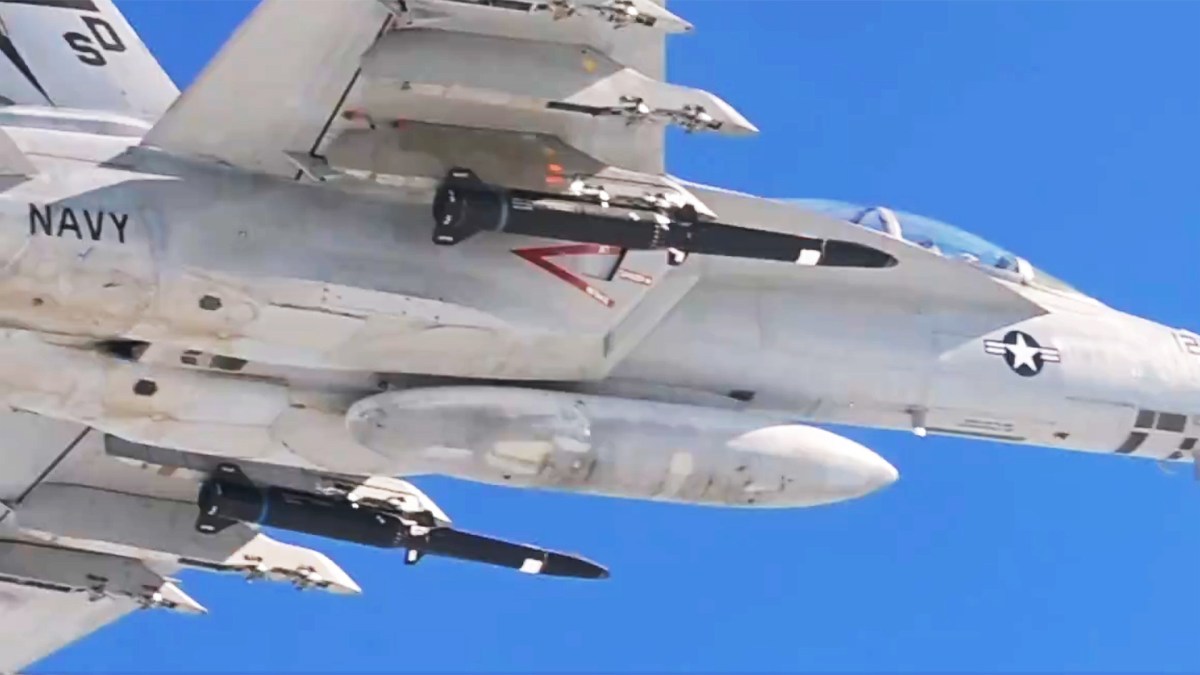
The U.S. Navy has given us the first look at Blackbeard hypersonic strike missiles under the wings of F/A-18E/F Super Hornets during actual flight testing. The Navy is hoping to have Blackbeard in at least limited service no later than 2028, giving its carrier air wings an all-new fast-flying standoff weapon, particularly for engaging enemy ships. The missile is also being designed to be relatively cheap and quick to manufacture.
The Navy’s Office of the Portfolio Acquisition Executive for Aviation (PAE-A) has released a video montage of Blackbeard undergoing flight testing, seen in the social media post below. The service confirmed that it had at least begun test-loading the missiles onto F/A-18E/F Super Hornets in a presentation at the Tailhook Association’s annual convention last month. Now we know the program has moved ahead substantially from that point.
Coming soon to a theater near you…BLACKBEARD! @USPACOM @CENTCOM @PAEAviation pic.twitter.com/KgBtIqdf8I — NAVAIR (@NAVAIRNews) September 25, 2026
Coming soon to a theater near you…BLACKBEARD! @USPACOM @CENTCOM @PAEAviation pic.twitter.com/KgBtIqdf8I
The company behind Blackbeard, defense start-up Castelion, has received several multi-million-dollar contracts from the Navy just this year explicitly to support integration of the weapon onto the Super Hornet, as well as otherwise accelerating its development. In its daily contracting on September 14, the Pentagon announced the Navy had struck yet another deal with Castelion, valued at $43.65 million, “for the manufacturing, assembly, testing, and delivery of the first production lot of 444 All-Up Rounds (AURs), defined as fully functional tactical missiles packaged within specialized shipping and storage containers.”
A screen capture from the Blackbeard flight testing video montage the Navy released today. USN capture
In terms of what we know today about Blackbeard’s design and capabilities, as we have previously written :
“A profile photo [seen below] at the company’s headquarters reveals a weapon with a ballistic missile-like booster, on top of which is mounted what could be an unpowered hypersonic glide vehicle (HGV). A booster brings an HGV to the desired velocity and altitude before releasing it toward its target. The concept is in contrast to air-breathing cruise missiles capable of traveling at hypersonic speeds. Hypersonic speed is generally defined as anything above Mach 5, which larger ballistic missiles also reach in the course of their flights. More precise performance figures for Blackbeard are lacking, but Castelion has previously hinted it could hit targets out to just under 500 miles. Alternatively, the second stage may also have its own motor, allowing it to continue accelerating or sustain high-speed flight. A similar arrangement has been suggested as the propulsion system for the Russian Zircon missile.”
“Both stages of the weapon have cruciform fins, while the upper one features a prominent ‘chine’ line along the length of its body, and a slightly beaklike nose. The trolley on which the weapon is mounted provides some idea of its overall size. The blue stripes seen on each stage normally signify that a munition is an inert, non-explosive round utilized for training or tracking purposes. This would indicate a real (unarmed) missile rather than a dummy or mockup.”
A picture shown at Tailhook had also offered a new look at the front of the missile, exposing what looked to be an aperture on one side of the design’s wedge-shaped nose. As we wrote after that image emerged:
“The apparent apertures are also seen pointed up, but many air-launched munitions do flip down after release.”
“How exactly Blackbeard is guided remains unknown, but a downward-angled aperture at the nose end for a seeker system would make sense for this weapon, which the Navy is pursuing primarily as a new way to target enemy ships. In particular, a wide array of existing anti-ship and land attack missiles , as well as certain anti-air types , have variously shaped apertures in their noses for imaging infrared seekers. Imaging infrared has the benefit of being immune to radio frequency electronic warfare jamming. In addition, it is a passive capability that does not send out signals that can give an opponent advance notice of an incoming attack. Blackbeard’s full guidance package very likely also includes some means of navigating to a target area first, and it could have multiple modes of operation.”
MACE is Project Alpha https://t.co/YatJzd7NDR https://t.co/EjrgMhEdsB pic.twitter.com/IOzpmwsTJ2 — 笑脸男人 (@lfx160219) August 26, 2026
MACE is Project Alpha https://t.co/YatJzd7NDR https://t.co/EjrgMhEdsB pic.twitter.com/IOzpmwsTJ2
The new flight testing footage released today also underscores the relatively small size of Blackbeard overall. While the Super Hornet is set to be the first operational launch platform, it is very likely to be integrated on other aircraft quickly thereafter. The Navy is acquiring Blackbeard under a program called the Multi-mission Affordable Capacity Effector (MACE).
Another screen capture from the new Navy video offering a different of Blackbeards under the wings of a Super Hornet, underscoring their relatively small size. USN capture
Requirements for MACE that the Navy put out previously explicitly called for a design compact enough for carrier-based F-35C (and land-based F-35A) Joint Strike Fighters to carry four of them internally. Whether that remains a goal in any way is unclear. Still, being able to carry some number of Blackbeards internally would not only give those jets a hypersonic strike weapon, but one that they could carry in the most stealthy configuration. The Navy also notably does operate the F-35A outside of the test and evaluation community , which might point to air-launched Blackbeards entering service elsewhere in the future. As an aside, the U.S. Army is pursuing a ground-launched version of this missile , as well.
Another critical aspect of Blackbeard is the emphasis on lower cost and the ability to produce the missiles readily at scale. The conflict with Iran has fully driven home long-standing concerns about the depth of U.S. stockpiles of various critical munitions, as well as its ability to replenish them quickly. Blackbeard reflects a larger push across America’s armed forces to add more cost-effective weapons that can be acquired on faster timetables to their arsenals. Bringing in new, smaller companies like Castelion to develop and build these munitions has also been a major point of focus . To put this all in immediate context, in May, the Pentagon announced a framework agreement to buy 12,000 Blackbeards over the next five years.
As mentioned, the Navy’s stated goal now is to reach an early operational capability with Blackbeard by 2028, if not sooner. What the exact fielding plan for those missiles might be is unclear. PAE-A did write “Coming soon to a theater near you” in its post on X containing the video montage, and tagged the official accounts for U.S. Central Command (CENTCOM) and U.S. Pacific Command (PACOM). CENTCOM oversees U.S. military activities in and around the Middle East, including ongoing operations against Iran. U.S. military officials have also long touted hypersonic weapons, in general, as key to success in any future conflict in the Pacific, especially a high-end fight against China.
It’s also worth noting here that U.S. military hypersonic missile programs across the services have faced repeated setbacks and delays over the years. This, in turn, has prompted discussion about a worrisome gap emerging in this arena between the United States and its chief global competitors, especially China . It is very possible now that Blackbeard could be the first operational air-launched type in American inventory, depending on how the U.S. Air Force does or does not proceed with its Hypersonic Attack Cruise Missile (HACM) program . The Air Force has said previously that it is aiming for HACM to be operational, at least on a limited level, before the end of Fiscal Year 2027 , which begins next month.
If nothing else, we have clear evidence that the air-launched version of Blackbeard is now deep in flight testing for the U.S. Navy.
Contact the author: joe@twz.com
Comments couldn’t be loaded. Please refresh the page.
作者:约瑟夫·特雷维西克
发布于美国东部时间2026年9月25日下午4:37
美国海军首次展示了“黑胡子”高超音速打击导弹在F/A-18E/F“超级大黄蜂”战斗机机翼下进行实际飞行测试的画面。海军希望“黑胡子”导弹最迟于2028年投入有限使用,为其航母舰载机联队提供一种全新的高速远程打击武器,尤其适用于攻击敌方舰艇。该导弹的设计目标是相对低廉且制造速度快。
美国海军航空项目采购执行办公室 (PAE-A) 发布了一段“黑胡子”导弹飞行测试的视频集锦,如下方社交媒体帖子所示。海军上个月在尾钩协会年会上证实,他们至少已经开始在 F/A-18E/F 超级大黄蜂战斗机上进行导弹装载测试。现在我们知道,该项目已经取得了实质性进展。
即将登陆您附近的影院……《黑胡子》!@USPACOM @CENTCOM @PAEAviation pic.twitter.com/KgBtIqdf8I — NAVAIR (@NAVAIRNews) 2026年9月25日
即将登陆您附近的影院……《黑胡子》!@USPACOM @CENTCOM @PAEAviation pic.twitter.com/KgBtIqdf8I
“黑胡子”导弹的研发公司——国防初创公司卡斯特利昂(Castelion)——今年已从海军获得数份价值数百万美元的合同,这些合同明确用于支持该武器与超级大黄蜂战斗机的集成,并加速其研发进程。9月14日,五角大楼在其每日合同公告中宣布,海军与卡斯特利昂达成了一项价值4365万美元的新协议,“用于制造、组装、测试和交付首批444枚全功能导弹(AUR),这些导弹是指包装在专用运输和存储容器内的全功能战术导弹。”
这是海军今天发布的“黑胡子”飞行测试视频集锦中的屏幕截图。美国海军截图
就我们目前对黑胡子的设计和能力所了解的情况而言,正如我们之前所写:
该公司总部的一张照片(见下图)显示,一种武器配备了类似弹道导弹的助推器,其顶部可能安装了一个无动力高超音速滑翔飞行器(HGV)。助推器将HGV加速到所需速度和高度,然后将其释放飞向目标。这一概念与能够以高超音速飞行的吸气式巡航导弹截然不同。高超音速通常定义为超过5马赫的速度,大型弹道导弹在飞行过程中也能达到这一速度。目前尚缺乏“黑胡子”导弹更精确的性能数据,但卡斯特利翁公司此前曾暗示,其射程可能接近500英里。此外,第二级可能也配备了独立的发动机,使其能够继续加速或维持高速飞行。类似的结构也被认为是俄罗斯“锆石”导弹的推进系统。
“该武器的两级都带有十字形尾翼,其中上级弹体有一条明显的‘棱线’贯穿弹体,弹头略呈喙状。武器所安装的推车可以大致反映其整体尺寸。每级弹体上的蓝色条纹通常表示该弹药为惰性、非爆炸性弹药,用于训练或追踪目的。这表明这是一枚真正的(未装药的)导弹,而不是模型或模拟弹。”
在Tailhook展会上展示的一张照片也让我们得以一窥导弹前端的新面貌,照片显示,在楔形弹头的一侧似乎有一个开口。正如我们在那张照片出现后所写的那样:
“可以看到,弹孔似乎朝上,但许多空射弹药在释放后都会向下翻转。”
“黑胡子”导弹的具体制导方式尚不清楚,但其弹头前端向下倾斜的导引头开口对于这种武器来说是合理的,海军研发该导弹的主要目的是将其作为一种新的敌舰目标打击方式。事实上,现有的多种反舰导弹、对陆攻击导弹以及某些防空导弹,其弹头前端都设有不同形状的开口,用于安装成像红外导引头。成像红外导引头的优势在于不受射频电子战干扰。此外,它是一种被动式探测能力,不会发出任何可能提前暴露攻击的信号。黑胡子导弹的完整制导系统很可能也包含某种先导航至目标区域的机制,并且它可能具备多种作战模式。
MACE 是 Alpha 项目 https://t.co/YatJzd7NDR https://t.co/EjrgMhEdsB pic.twitter.com/IOzpmwsTJ2 — 笑脸男人 (@lfx160219) 2026 年 8 月 26 日
MACE 就是 Project Alpha https://t.co/YatJzd7NDR https://t.co/EjrgMhEdsB pic.twitter.com/IOzpmwsTJ2
今天公布的最新飞行测试视频也突显了“黑胡子”导弹整体尺寸相对较小。虽然“超级大黄蜂”战斗机将成为首个投入使用的发射平台,但很可能之后会很快将其集成到其他飞机上。海军正在通过一项名为“多任务经济型运载能力执行器”(MACE)的项目采购“黑胡子”导弹。
海军最新视频中的另一张截图展示了黑胡子战机在超级大黄蜂战斗机机翼下的另一种姿态,突显了它们相对较小的尺寸。美国海军截图
海军此前发布的MACE导弹需求明确要求其设计足够紧凑,以便舰载F-35C(以及陆基F-35A)联合攻击战斗机能够内部携带四枚。目前尚不清楚这一目标是否仍然存在。不过,如果能够内部携带一定数量的“黑胡子”导弹,不仅能为这些战机提供一种高超音速打击武器,还能使其以最佳隐身配置携带。值得注意的是,海军在测试和评估之外也使用F-35A战机,这或许预示着未来空射型“黑胡子”导弹将在其他领域服役。此外,美国陆军也在研发该导弹的陆基版本。
“黑胡子”导弹的另一个关键特点是强调降低成本并能够大规模快速生产。与伊朗的冲突充分凸显了长期以来人们对美国各种关键弹药储备深度及其快速补充能力的担忧。“黑胡子”导弹反映了美国武装部队正在大力推进一项战略,即在其武器库中增加更具成本效益且采购速度更快的武器。引入像卡斯特利翁这样的小型新兴公司来研发和生产这些弹药也是一项重点工作。为了更好地理解这一切,我们不妨回顾一下,今年5月,五角大楼宣布了一项框架协议,将在未来五年内购买12000枚“黑胡子”导弹。
如前所述,海军目前的目标是在2028年之前,甚至更早,使“黑胡子”导弹具备早期作战能力。这些导弹的具体部署计划尚不明确。PAE-A在其X网站上发布的包含视频剪辑的帖子中写道“即将登陆您附近的战场”,并标记了美国中央司令部(CENTCOM)和美国太平洋司令部(PACOM)的官方账号。中央司令部负责监督美国在中东及其周边地区的军事活动,包括正在进行的针对伊朗的军事行动。长期以来,美国军方官员一直将高超音速武器视为未来在太平洋地区任何冲突中取得胜利的关键,尤其是在与中国的高端对抗中。
值得注意的是,多年来,美国各军种的高超音速导弹项目屡遭挫折和延误。这反过来又引发了人们对美国与其主要全球竞争对手(尤其是中国)在这一领域出现令人担忧的差距的讨论。目前来看,“黑胡子”导弹很可能成为美国现役首个投入使用的空射型高超音速导弹,这取决于美国空军高超音速攻击巡航导弹(HACM)项目的进展情况。空军此前曾表示,其目标是在2027财年结束前(下个月开始)使HACM至少在有限范围内投入使用。
至少我们有确凿的证据表明,黑胡子导弹的空射版本目前正在为美国海军进行深入的飞行测试。
联系作者:joe@twz.com
评论加载失败,请刷新页面。