Low on code, high on miles: S’porean uses AI to create tool to maximise credit card rewards代码量少,里程数高:新加坡人利用人工智能开发工具,最大化信用卡奖励
So far, it tracks around 50 credit cards and over 3,300 merchants across Singapore. Read more at straitstimes.com.
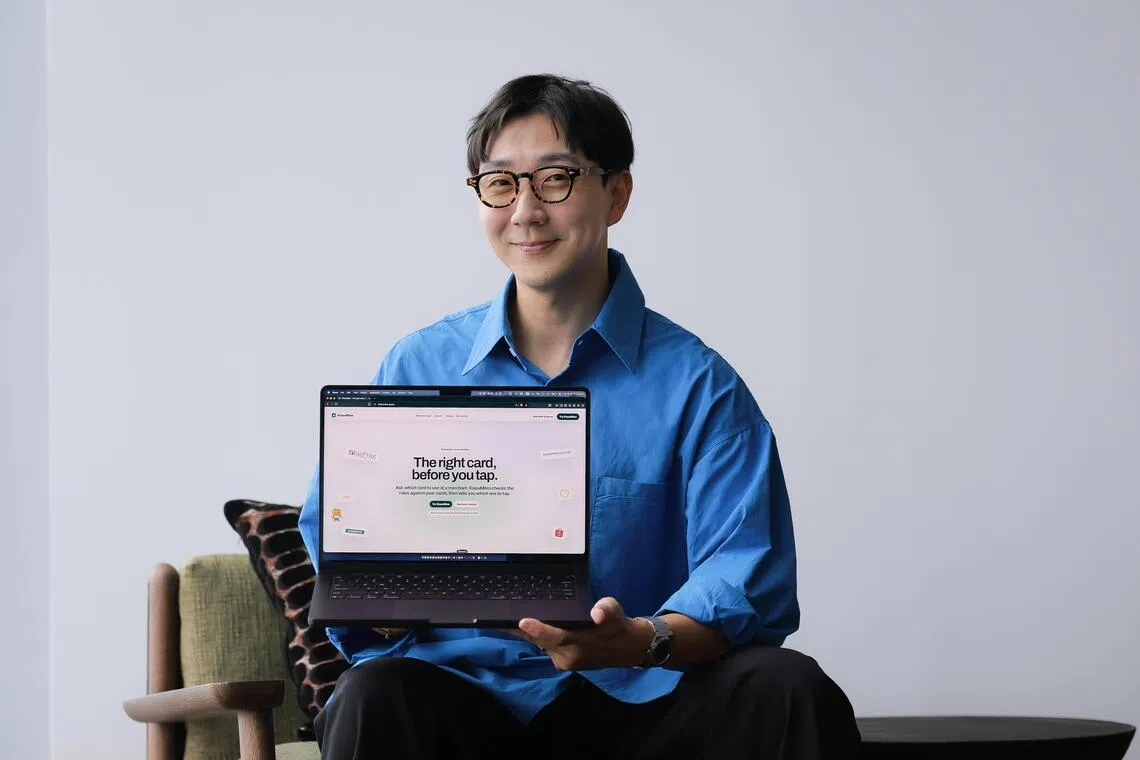
Hosan Swee, creator of KiasuMiles, used artificial intelligence to build the tool which recommends the best credit cards to use at different merchants to maximise airline miles.
Published Sep 26, 2026, 05:00 AM
Updated Sep 26, 2026, 05:00 AM
SINGAPORE – Managing a dozen shared credit cards to maximise frequent flier miles became a frustrating routine for Hosan Swee and his wife.
With every card offering different rewards for different spending categories, picking the right one at various merchants required laborious mental calculations.
“It’s not life or death, but choosing the wrong one leaves a lot of holiday dollars on the table,” said the 37-year-old founder of AI community and workshop provider The AI Burrow.
To eliminate this manual guesswork, Swee tapped artificial intelligence tools to build KiasuMiles – a digital tool that quickly identifies the best credit card from a user’s wallet for a purchase.
Typical queries for KiasuMiles include “I’m paying for GrabFood in-app, which card is best?” or “Which card should I use at Cold Storage with Apple Pay?”
KiasuMiles churns out its recommendation by matching these questions against an internal database containing credit card minimum spending thresholds , monthly miles caps and spending categories eligible to earn rewards.
The database is compiled by instructing AI tools to scan the websites of banks and merchants operating in Singapore. So far, it tracks around 50 credit cards and over 3,300 merchants across Singapore, with credit card reward rules updated regularly.
To the question on the best card to use at Cold Storage, KiasuMiles may suggest the DBS yuu card as users can earn up to 10 miles a dollar spent at Cold Storage. It will also surface corresponding conditions, such as having to spend at least $800 a calendar month , and make transactions in at least four different participating yuu merchants.
To use KiasuMiles, users have to log in to their chatbot accounts – ChatGPT, Claude or Codex – to perform a one-time set-up to connect KiasuMiles to the chatbots. Once the initial set-up is done, users can start asking KiasuMiles questions through their preferred AI chatbots.
An engineer by training and a long-time real estate agent on the side, Swee had always envisioned a tool like KiasuMiles. But his lack of coding skills stood in the way – until now, that is.
The breakthrough came with AI coding tools, which turn plain English prompts into functional code. Swee could finally experiment without any programming expertise.
“The latest AI models are super good at reading your intentions,” said Swee, who used a combination of Codex and ChatGPT Work to create the final version of KiasuMiles.
Even though the latest AI coding tools are good at predicting user intents, Swee said prompts must still be specific.
For instance, his prompt was: “Build a structured knowledge base of Singapore credit cards with accompanying rules, including minimum spend thresholds, miles rewards per dollar spend, eligible spending categories, monthly miles caps and exclusions.”
Codex then scoured the web, including bank and merchant websites, to consolidate the information. The job is done in minutes compared with the hours required if done manually.
KiasuMiles’ knowledge base also includes the spending category that each merchant falls under. This is because major mile-earning credit cards in Singapore categorise the bulk of their bonus rewards into dining, groceries, retail shopping, travel and transport (including ride-hailing). Miles earned on each category vary with each card and payment method.
“Such information is available online, but it’s not very straightforward since it spreads across multiple bank websites and forums such as Reddit,” said Swee.
“AI was able to cobble information from these sources and turn it into a structured database to reduce the guesswork for users.”
Someone directly asking an AI chatbot the same questions may be given incomplete or outdated card information, said Swee.
Swee made an effort to build KiasuMiles iteratively with specific prompts for each feature rather than build it with a single, long prompt. He also tested the tool’s recommendation logic using a few credit cards, merchants and realistic test questions before expanding the parameters.
“Being too ambitious and trying to build in many features at the start would be difficult, and would cause more bugs that require fixes down the line,” said Swee.
He also discovered that learning basic software development terms allowed him to write better prompts and communicate more effectively with Codex. “I would ask the chatbot to explain technical jargon like it was teaching a 12-year-old,” said Swee.
Saying there is no perfect first prompt, he urged all potential AI coders to just type or record whatever comes to mind. “ Thrash it out with AI to refine suggestions that surface,” said Swee.
He added that while free versions of AI tools are sufficient to experiment, paid subscriptions usually give access to smarter and faster models, which can reduce the amount of time used to build tools.
The free versions of AI tools such as ChatGPT and Claude come with basic coding features, but heavier workloads with more data analysis would require a paid subscription.
“Try a small weekend project. Everyone has ideas and creativity,” said Swee, urging people to put aside their apprehensions. “There is joy in seeing something come to life, and AI can help you get there.”
AI/artificial intelligence
KiasuMiles 的创始人 Hosan Swee 利用人工智能技术开发了一款工具,该工具会推荐在不同商家使用的最佳信用卡,以最大限度地赚取航空里程。
发布于 2026 年 9 月 26 日上午 5:00
更新于2026年9月26日上午5:00
新加坡——为了最大限度地积累飞行常客里程,管理十几张共用信用卡成了 Hosan Swee 和他的妻子的一件令人沮丧的事情。
由于每张卡针对不同的消费类别提供不同的奖励,因此在不同的商家选择合适的卡需要费力地进行心算。
“这虽然不是生死攸关的大事,但选错了就会白白浪费很多假期预算,”人工智能社区和研讨会提供商 The AI Burrow 的 37 岁创始人说道。
为了消除这种人工猜测,Swee 利用人工智能工具开发了 KiasuMiles——一款能够快速识别用户钱包中最适合购物的信用卡的数字工具。
KiasuMiles 的典型查询包括“我在 GrabFood 应用内付款,哪张卡最好?”或“在 Cold Storage 使用 Apple Pay 时,我应该使用哪张卡?”
KiasuMiles 通过将这些问题与包含信用卡最低消费门槛、每月里程上限和可赚取奖励的消费类别的内部数据库进行匹配,来生成其推荐。
该数据库通过人工智能工具扫描新加坡银行和商户的网站而建立。目前,它追踪了新加坡约50种信用卡和超过3300家商户,并定期更新信用卡奖励规则。
关于在Cold Storage超市使用哪张信用卡最划算,KiasuMiles可能会推荐DBS yuu卡,因为用户在Cold Storage每消费1美元即可赚取高达10英里的里程。同时,它还会列出相应的条件,例如每月至少消费800美元,并且在至少四家不同的yuu合作商户进行交易。
要使用 KiasuMiles,用户需要登录他们的聊天机器人账号——ChatGPT、Claude 或 Codex——进行一次性设置,将 KiasuMiles 连接到这些聊天机器人。初始设置完成后,用户即可通过他们选择的 AI 聊天机器人向 KiasuMiles 提问。
Swee 是一名受过专业训练的工程师,业余时间也从事房地产经纪工作多年,他一直梦想着开发一款像 KiasuMiles 这样的工具。但由于缺乏编程技能,他一直未能实现这个梦想——直到现在。
人工智能编码工具的出现带来了突破,它可以将简单的英语提示转化为可运行的代码。Swee 终于可以在没有任何编程经验的情况下进行实验了。
“最新的 AI 模型非常擅长读取你的意图,”Swee 说,他结合了 Codex 和 ChatGPT Work 创建了 KiasuMiles 的最终版本。
尽管最新的 AI 编码工具能够很好地预测用户意图,但 Swee 表示,提示仍然必须具体明确。
例如,他的提示是:“建立一个新加坡信用卡及其相关规则的结构化知识库,包括最低消费门槛、每消费一美元的里程奖励、符合条件的消费类别、每月里程上限和例外情况。”
Codex随后搜索了包括银行和商家网站在内的全网信息,以整合这些数据。这项工作只需几分钟即可完成,而手动操作则需要数小时。
KiasuMiles的知识库还包含每家商户所属的消费类别。这是因为新加坡主要的里程累积信用卡将其大部分奖励里程分为餐饮、食品杂货、零售购物、旅行和交通(包括网约车)等类别。每张卡和每种支付方式在每个类别中获得的里程数各不相同。
“这类信息虽然可以在网上找到,但并不直接,因为它分散在多个银行网站和Reddit等论坛上,”Swee说。
“人工智能能够从这些来源收集信息,并将其转化为结构化数据库,从而减少用户的猜测。”
Swee表示,如果有人直接向人工智能聊天机器人询问同样的问题,可能会得到不完整或过时的卡片信息。
Swee并没有一开始就使用冗长的提示,而是尝试以迭代的方式构建KiasuMiles,为每个功能都设计了具体的提示。在扩展参数之前,他还使用少量信用卡、商家和实际测试问题对工具的推荐逻辑进行了测试。
Swee表示:“一开始就过于雄心勃勃,试图加入很多功能,这将会很困难,而且会导致更多错误,需要在以后进行修复。”
他还发现,学习一些基本的软件开发术语能让他写出更好的提示语,也能更有效地与 Codex 沟通。“我会让聊天机器人解释一些技术术语,就像它在教一个 12 岁的孩子一样,”Swee 说。
他表示,没有完美的初始提示,并敦促所有潜在的AI程序员直接输入或录制任何想到的内容。“与AI反复讨论,以完善出现的建议,”Swee说道。
他还补充说,虽然免费版的 AI 工具足以进行实验,但付费订阅通常可以提供更智能、更快速的模型,从而减少构建工具所需的时间。
ChatGPT 和 Claude 等 AI 工具的免费版本具备基本的编码功能,但更繁重的工作负载和更多的数据分析则需要付费订阅。
“不妨尝试一下周末小项目。每个人都有想法和创造力,”Swee说道,并鼓励大家放下顾虑。“看着作品最终成型,那种感觉非常美妙,而人工智能可以帮助你实现这一点。”
人工智能