The Navy’s public shipyards will take more decades to repair, GAO says美国政府问责局(GAO)表示,海军的公共造船厂需要数十年才能修复完毕。
A new report calls for more Congressional oversight of the massive construction projects.
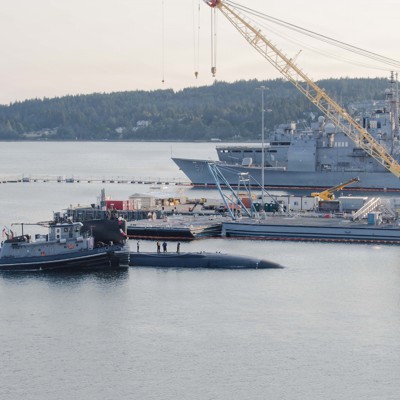
The Los Angeles-class fast-attack submarine USS Alexandria (SSN 757) arrives at Naval Base Kitsap-Bremerton, Washington, July 13, 2026 U.S. Navy / Mass Communication Specialist 3rd Class Kimberli Ibarra Ruiz
A new report calls for more Congressional oversight of the massive construction projects.
The Navy's effort to fix and improve its shipyards will take decades longer and cost billions more than initially planned—and Congress has not been systematically kept apprised of the growing complexity of the Shipyard Infrastructure Optimization Program , the Government Accountability Office has found.
“Without a full picture of how much has been spent, what remains to be funded, and what risks may affect SIOP progress, Congress could make consequential decisions for SIOP based on incomplete information, thus risking billions in taxpayer dollars and a lack of program oversight for the decades to come,” the GAO wrote in a report released Friday.
The Navy must already submit reports related to its shipyard construction efforts to comply with nearly a dozen legislative provisions. But the watchdog agency suggested that Congress should require the service to “annually report consolidated, standardized status updates,” including revised cost and schedule estimates for the entire plan.
The Navy’s public shipyards—Norfolk Naval Shipyard, Pearl Harbor Naval Shipyard, Portsmouth Naval Shipyard, and Puget Sound Naval Shipyard— maintain and update the service’s nuclear-powered submarines and aircraft carriers. The service has struggled for years with maintenance backlogs that have, in at least one case , led a submarine to be retired early rather than fixed up.
Planning for the shipyard upgrades started in 2018 and has taken several years longer than anticipated because the Navy “underestimated the time needed” and “did not fully account for the many challenges, uncertainties, and complex analyses needed to sufficiently plan for an endeavor of SIOP’s magnitude,” the report states.
New projects and costs were also discovered during design and planning.
For example, the Navy found at least $1 billion would be needed for “facility retrofits and new construction to mitigate newly assessed seismic risks at Puget Sound Naval Shipyard” since 2023, the report states. “In 2023, the Navy completed emergency drydock retrofits and repairs. The Navy also requested $830 million to conduct seismic upgrades for Dry Dock 4…in its fiscal year 2026 budget request.”
The GAO’s analysis ran from September 2024 through September 2026.
Earthquake risks were included in SIOP’s original 2018 assessment, the GAO noted.
Many shipyards and their facilities were built close to a century ago, with problems seen today compounded on top of “long-deferred maintenance and worsening decrepitude during that time. As a result, unexpected facility and construction site conditions led to new projects being identified or additional work added to projects during construction,” the report states.
Navy leaders are expected to consider the SIOP plan and cost estimate by this month.
The GAO made three other recommendations , including reviewing future program needs in the oversight framework and documenting the SIOP’s role and duties to improve project risk management.
The Navy hasn’t “fully documented” SIOP’s roles and responsibilities despite creating multiple organizations to manage the program’s projects.
“Doing so would formalize their new SIOP roles and help to ensure not only their ability to effectively implement SIOP’s essential projects but also the continuity of the critical shipyard operations to maintain and modernize the U.S. naval fleet now and throughout SIOP’s extended timeline,” the GAO wrote.
NEXT STORY: Trump floats ‘AI Force’ to boost industry
2026年7月13日,洛杉矶级快速攻击潜艇“亚历山大”号(SSN 757)抵达华盛顿州基萨普-布雷默顿海军基地。(美国海军/三级大众传播专家金伯利·伊瓦拉·鲁伊斯摄)
一份新的报告呼吁国会加强对大型建设项目监管。
美国政府问责局发现,海军修复和改进其造船厂的努力将比最初计划多花费数十年时间和数十亿美元,而且国会没有被系统地告知造船厂基础设施优化计划日益增长的复杂性。
“如果无法全面了解已经花费了多少资金、还剩下多少资金需要资助,以及哪些风险可能会影响SIOP的进展,国会可能会根据不完整的信息对SIOP做出重大决定,从而导致数十亿美元的纳税人资金被浪费,并在未来几十年内缺乏对该计划的监督,”美国政府问责局(GAO)在周五发布的一份报告中写道。
海军目前已须提交与其造船厂建设工作相关的报告,以遵守近十项法律规定。但监督机构建议国会应要求海军“每年提交综合、标准化的进度报告”,包括整个计划的修订成本和进度估算。
美国海军的公共造船厂——诺福克海军造船厂、珍珠港海军造船厂、朴茨茅斯海军造船厂和普吉特海湾海军造船厂——负责维护和升级海军的核动力潜艇和航空母舰。多年来,海军一直饱受维护积压问题的困扰,至少有一艘潜艇因此提前退役,而不是进行维修。
报告指出,造船厂升级计划于 2018 年开始实施,但比预期的时间要长几年,因为海军“低估了所需的时间”,并且“没有充分考虑到 SIOP 这样规模的项目所需的诸多挑战、不确定性和复杂分析”。
在设计和规划过程中,还发现了新的项目和成本。
例如,报告指出,海军发现自2023年以来,至少需要10亿美元用于“普吉特海湾海军造船厂的设施改造和新建工程,以降低新评估的地震风险”。“2023年,海军完成了干船坞的紧急改造和维修。海军还在其2026财年预算申请中申请了8.3亿美元,用于对4号干船坞进行抗震升级。”
美国政府问责局的分析时间从 2024 年 9 月持续到 2026 年 9 月。
美国政府问责局指出,地震风险已包含在SIOP 2018年的原始评估中。
报告指出,许多造船厂及其设施建于近一个世纪前,如今出现的问题是由于“长期维护滞后和日益老化”造成的。因此,意想不到的设施和施工现场状况导致在施工过程中需要启动新的项目或增加额外工作。
预计海军领导层将在本月审议SIOP计划和成本估算。
美国政府问责局提出了另外三项建议,包括审查监督框架中未来的项目需求,以及记录SIOP的角色和职责,以改进项目风险管理。
尽管海军创建了多个组织来管理该计划的项目,但海军尚未“完全记录”SIOP 的角色和职责。
“这样做将正式确立他们在SIOP中的新角色,不仅有助于确保他们能够有效地实施SIOP的重要项目,还能确保关键造船厂运营的持续性,从而在SIOP的整个延长周期内维护和现代化美国海军舰队,”美国政府问责局写道。
下一篇报道:特朗普提出组建“人工智能部队”以促进产业发展