Ignoring the noise: What it’s like competing at the ‘vocational skills Olympics’ in Shanghai忽略喧嚣:在上海参加“职业技能奥林匹克”比赛是怎样的体验
I have never seen anything like it. Read more at straitstimes.com.
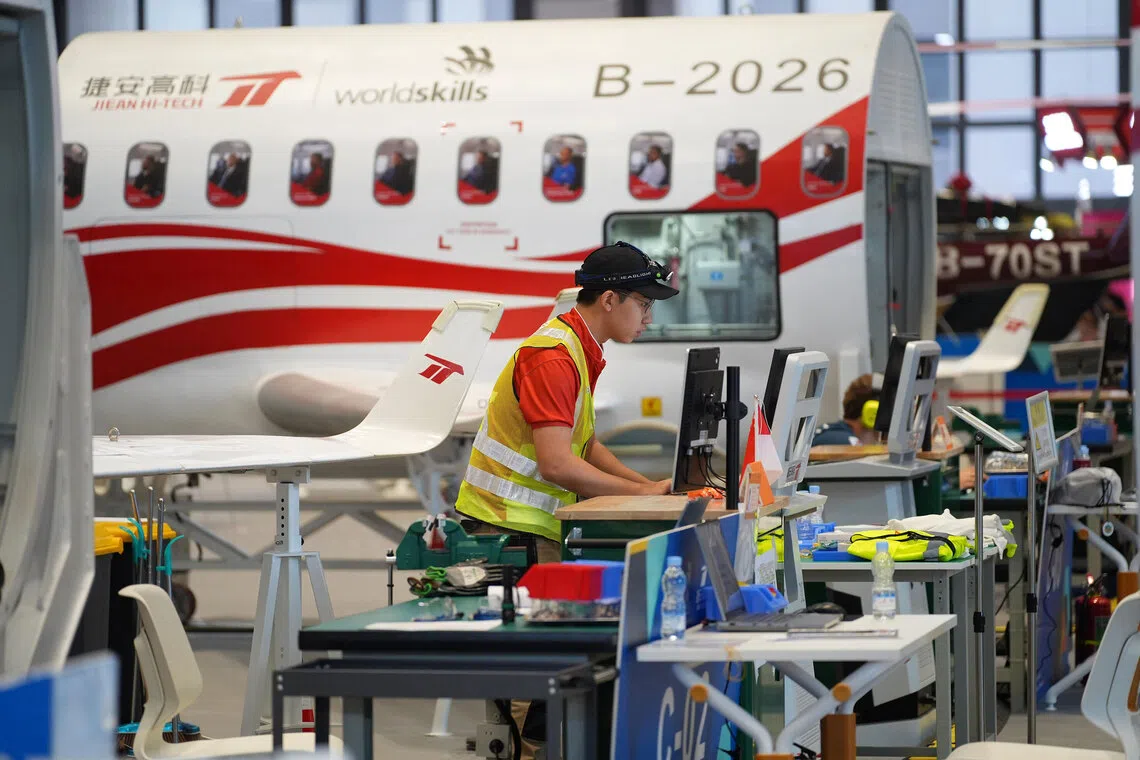
For aircraft maintenance competitor Aidan Wong, 21, there is no time during the contest for toilet or water breaks.
PHOTO: WORLDSKILLS SINGAPORE
Published Sep 26, 2026, 03:00 PM
Updated Sep 26, 2026, 03:00 PM
SHANGHAI – There are hasty glances over at their opponents beside them. Frantic flipping of test papers, youth bent almost double over work stations. Drills clattering to the floor. Futile attempts to lift machine parts.
A hundred curious eyes and phone cameras trained on them, some no more than an arm’s length away. And all the while, a big digital clock counting down on the wall as they race to complete a series of tasks. No pressure.
I am at the biggest skills competition in the world, called WorldSkills. This 48th run of the event, held every two years, is taking place in Shanghai.
Some 1,400 youth representing more than 70 countries and regions are competing across 64 different skills, in sectors ranging from transport and logistics to personal services.
They qualify by beating the competition in their state, nation and regional WorldSkills competitions.
Over four days in a still-warm September, these young men and women are welding and baking, cutting hair and repairing machinery, making clothes and testing software.
I have never seen anything like it.
There are realistic sets of restaurants, hotel receptions and clinic rooms. Nails are painted, food consumed and competitors assessed on their skills and service.
Cars, helicopters and huge machines sat in the space for people to paint, repair and operate.
Some halls smell of baking bread and flowers, while others ring with drilling and whizzing drones.
Work in construction sites, offices, factories and workshops is suddenly brought to the world stage, and everyone wants a glimpse.
Walking into the National Exhibition and Convention Center in Shanghai, I was first struck by its sheer scale – with eight halls forming the shape of a four-leaf clover, it is about the size of 15 football fields.
The sprawling venue is normally used to hold massive trade fairs.
Somewhere, a horn sounds to signal time’s up for an event. The audience claps.
Competing seven hours a day
At the end of the first day, cybersecurity competitor Shum Hoe Yeong, 19, rose dejected from his chair. Later, he told me the questions were difficult.
It is as much a test as a competition. Contestants are expected to compete for as long as seven hours a day.
“I feel like I’m taking O levels again,” said Hoe Yeong.
He and his teammate Eugene Yang, 20, also have to tune out countless comments from tens of thousands of visitors passing through each day.
“I heard a lot of people say, ‘This is Singapore’,” laughed Hoe Yeong. “We cannot listen.”
Headphones are not allowed for cybersecurity.
“Yesterday’s seat was better – it was in the corner, there was not a lot of people,” said Eugene. Cybersecurity competitors draw lots every day to decide the seating arrangement.
The paper was tough, with concepts they had not trained as hard on – cryptography, configuring systems.
But they achieved a mini breakthrough.
Hoe Yeong, stronger in defence, was trying his best to crack a hard question, while Eugene, better at attacks, tackled the subsequent questions.
It was a triumph when Hoe Yeong solved the defence question, and the duo were able to submit their answers in one shot, with all of them marked correct.
Yi Jiaxin, 21, from software testing – a form of quality inspection in the digital world – said he felt pressure from the Chinese competitor sitting behind him.
This is a new category, which means “more chance to win”, Jiaxin said, as competitors are less experienced. He is facing off with 10 competitors.
New skills reflect changing industries
Senior Parliamentary Secretary for Education Syed Harun Alhabsyi, who visited Team Singapore at the event, said the new skills Singapore is participating in reflect the changing industries and how our institutions are adapting.
Among the new areas Singapore joined are rail vehicle technology and unmanned aerial systems.
Fashion technology competitor Lim Jia Zhen, 21, was nervous about only finding out what tasks she had to do only on the day itself. PHOTO: WORLDSKILLS SINGAPORE
Fashion technology competitor Lim Jia Zhen, 21, was nervous about only finding out what tasks she had to do only on the day itself.
Fashion technology competitor Lim Jia Zhen, 21, sweat beading above a furrowed brow on day three, moved from the steamer to the sewing machine. Hair up in a claw clip, pin cushion around her wrist, she stitched away, a slight tremor in her hands.
Watching from the side, her coach Eve Tan said surprise elements in the test threw off competitors.
Jia Zhen had the challenge of creating a rare design of three “darts” on her top – folded and stitched folds of fabric used to shape the material – a process that required high precision.
Eve said Jia Zhen was about 20 minutes behind time, based on usual checkpoints during her training.
But the girl adapted to the changes. And she can go fast and precisely, said Eve. “I’m hopeful.”
Jia Zhen said after the day’s close: “I was really nervous as I would find out what tasks I’m doing only on the day itself. But after the first two days, I’ve decided that I shouldn’t fear the unknown and embrace it like I’m opening a blind box.”
Hungry, but hyper-focused
For aircraft maintenance competitor Aidan Wong, there is no time for toilet or water breaks. The seven hours he is given is barely enough to finish his tasks, he said.
To stay alert, Aidan eats smaller meals, opting for protein over carbohydrates.
“I was basically starving the whole morning,” he said at the end of day two.
To stay alert, Aidan eats smaller meals, opting for protein over carbohydrates. PHOTO: WORLDSKILLS SINGAPORE
But he said the hunger helps him concentrate.
He needed it. Self-doubt crept in when Aidan saw how quickly his opponents finished tasks he was struggling with.
The trickiest questions tested him on repairs, where he had to precisely mend a dent in the plane, rather than create a part from scratch.
“I thought I was an all-rounder. It was humbling,” Aidan said.
More than anything, having got up at 5am each day to get ready, he was “super shag” by the end of day two.
So were Eugene and Hoe Yeong – “exhausted”. Some of the Singapore contingent fell sick two days in.
Aidan, who is bound for national service after WorldSkills, knows medals are not everything. “The point of this is to learn from the best of each nation,” he said.
Fashion tech competitor Jia Zhen also said it has been fulfilling. “Looking back at my training, I think I’ve done a really great job, regardless of the result.”
Harun said Singapore’s competitors, through participating over many hours each day under high pressure, “will develop a sense of confidence in their own skills (and) a sense of resilience against any adversity”.
Those who do not perform as well as they hoped also learn to bounce back, he said.
I left the venue spent but deeply impressed by the contestants, who are usually no older than 23. I have much to learn from their discipline in training, their willingness to solve difficult problems under immense pressure. And no less from their daring to put themselves up against the best in the world, to dream of the gold and go for it.
The next time I am fighting my own battles in work and life that seem insurmountable, I will think of these WorldSkills youth and draw strength from them.
Shermaine Ang is a journalist at The Straits Times, covering social issues in Singapore.
对于 21 岁的飞机维修比赛选手 Aidan Wong 来说,比赛期间没有时间上厕所或喝水。
图片:新加坡世界技能大赛
发布于2026年9月26日下午3:00
更新于2026年9月26日下午3:00
上海——他们匆匆瞥向身旁的对手。考卷飞快地翻动着,年轻人几乎弯腰驼背地伏在工作台上。钻头哐啷哐啷地掉落在地。徒劳地试图捡起机器零件。
上百双好奇的眼睛和手机摄像头对准了他们,有的甚至近在咫尺。与此同时,墙上一个巨大的电子钟正在倒计时,他们争分夺秒地完成一系列任务。压力山大。
我正在参加全球规模最大的技能竞赛——世界技能大赛。这项每两年举办一次的赛事,今年是第48届,在上海举行。
来自 70 多个国家和地区的约 1400 名青年正在参加 64 项不同技能的比赛,涉及从运输和物流到个人服务等各个领域。
他们通过在州级、国家级和地区级世界技能大赛中击败对手而获得参赛资格。
在九月依然温暖的四天里,这些年轻男女进行了焊接、烘焙、理发、修理机器、制作衣服和测试软件等工作。
我从未见过这样的景象。
这里有逼真的餐厅、酒店前台和诊所房间场景。参赛者会涂指甲油、用餐,并根据他们的技能和服务水平接受评估。
汽车、直升机和巨型机械停放在这个空间里,供人们喷漆、修理和操作。
有些大厅里弥漫着面包和鲜花的香味,而有些大厅里则回荡着钻孔声和嗡嗡作响的无人机声。
建筑工地、办公室、工厂和车间的工作突然被带到了世界舞台上,每个人都想一睹为快。
走进上海国家会展中心,我首先被它庞大的规模所震撼——八个展馆组成了一个四叶草的形状,大约相当于 15 个足球场的大小。
这个占地广阔的场地通常用于举办大型贸易展览会。
某处响起喇叭声,提示活动结束。观众鼓掌。
每天比赛七小时
第一天结束时,19岁的网络安全选手沈浩英(音译)沮丧地从椅子上站了起来。后来,他告诉我,题目很难。
这既是一场考验,也是一场比赛。参赛者每天需要比赛长达七个小时。
“我感觉自己好像又在参加O水准考试了,”何英说道。
他和队友杨谨伦(20岁)还不得不屏蔽每天数万名游客的无数评论。
“我听到很多人说,‘这就是新加坡’,”何永笑着说。“我们不能听他们的。”
出于网络安全考虑,不允许使用耳机。
尤金说:“昨天的座位更好——在角落里,人不多。”网络安全竞赛的参赛选手每天都要抽签决定座位安排。
这篇试卷很难,涉及一些他们之前没有系统学习过的概念——密码学、系统配置。
但他们取得了一项小小的突破。
防守能力较强的何永正在努力破解一个难题,而进攻能力更强的尤金则应对了随后的问题。
当何永解答了防御问题时,两人取得了胜利,他们一次性提交了答案,而且所有答案都被判为正确。
21岁的易嘉欣(音译)从事软件测试工作——软件测试是数字世界的一种质量检验形式——他说,他感到来自坐在他身后的中国竞争对手的压力。
嘉欣表示,这是一个新设立的组别,这意味着“获胜机会更大”,因为参赛选手经验较少。他将与10位选手同台竞技。
新技能反映了不断变化的行业
教育部高级政务次长赛义德·哈伦·阿尔哈布西在活动中参观了新加坡队,他表示,新加坡参与的新技能培训反映了不断变化的行业以及我们的机构如何适应变化。
新加坡加入的新领域包括轨道车辆技术和无人机系统。
21岁的时尚科技选手林嘉珍(Lim Jia Zhen)直到比赛当天才知道自己要完成哪些任务,这让她感到紧张。(图片:新加坡世界技能大赛)
21岁的时尚科技类参赛选手林嘉珍(音译)很紧张,因为她直到比赛当天才知道自己要完成哪些任务。
21岁的服装科技参赛选手林嘉珍,在比赛的第三天,额头上渗出汗珠,从蒸笼移到缝纫机旁。她用发夹把头发盘起来,手腕上缠着针垫,埋头缝纫,双手微微颤抖。
她的教练伊芙·谭在一旁观看,她说考试中的一些出人意料的元素让参赛选手措手不及。
贾真面临的挑战是,要在她设计的上衣上做出罕见的三“褶裥”——折叠缝合的布料褶皱,用来塑造面料的形状——这个过程需要很高的精度。
根据训练期间的通常检查点,伊芙说贾真大约迟到了20分钟。
但女孩适应了这些变化。伊芙说,她跑得又快又准。“我很有信心。”
贾震在当天结束后说:“我真的很紧张,因为我只有当天才知道自己要做什么任务。但经过前两天的体验,我已经决定不应该害怕未知,而应该像打开一个盲盒一样欣然接受它。”
饥饿,但高度专注
对于飞机维修专业的参赛选手艾丹·王来说,他根本没有时间上厕所或喝水。他说,分配给他的七个小时几乎不够他完成任务。
为了保持清醒,艾丹少食多餐,选择蛋白质而非碳水化合物。
“我基本上整个上午都饿得不行,”他在第二天结束时说道。
为了保持清醒,艾丹少食多餐,并选择蛋白质而非碳水化合物。图片:新加坡世界技能大赛
但他表示,饥饿感有助于他集中注意力。
他确实需要它。当艾丹看到对手们轻而易举地完成他苦苦挣扎的任务时,自我怀疑开始滋生。
最棘手的问题考验的是他的维修能力,他必须精确地修补飞机上的凹痕,而不是从零开始制造零件。
“我一直以为自己是个全能选手。这让我感到惭愧,”艾丹说道。
最重要的是,他每天早上 5 点起床准备,到第二天结束时已经“筋疲力尽”了。
尤金和何永也是如此——“筋疲力尽”。新加坡代表团中有些人在两天后就病倒了。
艾丹在世界技能大赛结束后即将服兵役,他深知奖牌并非一切。“参加这项赛事的意义在于向各国最优秀的选手学习,”他说。
时尚科技选手贾震也表示,这段经历很有成就感。“回顾我的训练,我觉得无论结果如何,我都做得非常出色。”
哈伦表示,新加坡的参赛选手每天在高压下参加数小时的比赛,“将培养出对自己技能的信心和面对任何逆境的韧性”。
他说,那些表现不如预期的人也能学会重新振作。
离开赛场时,我虽然筋疲力尽,但参赛选手们给我留下了深刻的印象,他们通常都不超过23岁。他们的训练纪律、在巨大压力下解决难题的决心,以及敢于与世界顶尖高手同台竞技、追逐金牌并为之奋斗的勇气,都让我受益匪浅。
下次当我在工作和生活中遇到看似无法克服的困难时,我会想起这些世界技能大赛的年轻人,并从中汲取力量。
Shermaine Ang是《海峡时报》的记者,负责报道新加坡的社会问题。