Helping the bereaved find closure: Singapore officers deployed to Nepal floods return home帮助丧亲者走出悲痛:新加坡派往尼泊尔洪灾现场的官员返回家园
A total of 35 police and forensic officers were deployed to Nepal to provide specialist support in disaster victim identification and aerial surveillance.
新闻视频
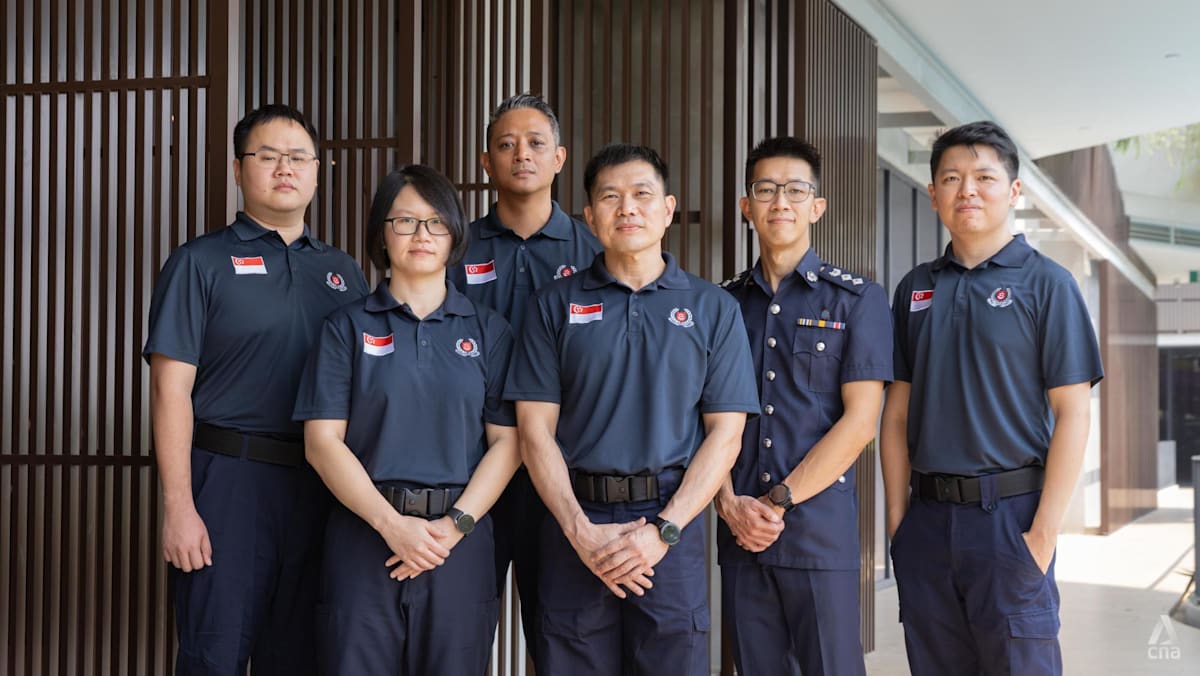
A total of 35 police and forensic officers were deployed to Nepal to provide specialist support in disaster victim identification and aerial surveillance.
Nepal disaster relief operations team (from left to right) HSA's forensic pathologist, Dr Benjamin Kuek, SPF’s assistant superintendent Corelle Tan Pei Shan, senior staff sergeant Hasrin Hasmoon, assistant commissioner Patrick Tan and superintendent Lionel Chee Zhen Liang, and HTX's fingerprint specialist Yong Heng Wei, at HomeTeamNS Bedok Reservoir, on Sep 26, 2026. (Photo: CNA/Ili Mansor)
This audio is generated by an AI tool.
SINGAPORE: When Assistant Superintendent Corelle Tan and her team arrived in Nepal about a week after the devastating floods, the disaster's scale overloaded her senses.
Many human remains were soaked in water and mud and in an advanced stage of decomposition.
“The sight, the smell, the touch, everything, and then operating in an unfamiliar environment. So that required constant self-regulation and focus on the work at hand,” said the disaster victim identification officer from the Singapore Police Force (SPF).
ASP Tan spent days working closely with Nepali authorities to support victim identification efforts through post-mortem procedures, including fingerprint lifting.
CNA Games Guess Word Crack the word, one row at a time Buzzword Create words using the given letters Mini Sudoku Tiny puzzle, mighty brain teaser Mini Crossword Small grid, big challenge Word Search Spot as many words as you can Show More Show Less She was among 35 Singapore police and forensic officers who departed for Nepal to support disaster relief efforts after the deadly flash floods along the Nepal-China border on Aug 26. The floods have killed at least 1,400 people. More than 5,700 people remain missing, including at least 600 foreign nationals. Nine Singaporeans are among those who are still unaccounted for. CNA has contacted the Ministry of Foreign Affairs for updates on the Singaporeans. At the request of the Nepali authorities, the Singapore contingent was deployed from Sep 1 to 18 to provide specialist support in disaster victim identification and aerial surveillance. Called Operation Vanguard, the contingent comprised 31 SPF officers, two officers from the Home Team Science and Technology Agency’s (HTX) integrated forensic services, and two officers from the Health Sciences Authority’s (HSA) forensic medicine division. The police held a welcome home reception for Operation Vanguard officers at HomeTeamNS Bedok Reservoir on Saturday (Sep 26). Speaking at the event, Minister for Law and Second Minister for Home Affairs Edwin Tong said Operation Vanguard was “more than just a humanitarian mission”. “It’s a demonstration of Singapore’s commitment to helping others in their times of need, and a reflection of the professionalism, compassion and really the operational excellence of our officers,” he said. “The experience and operational knowledge gained, and partnerships strengthened through this deployment will benefit the SPF as well as Singapore long after the mission has ended.”
She was among 35 Singapore police and forensic officers who departed for Nepal to support disaster relief efforts after the deadly flash floods along the Nepal-China border on Aug 26.
The floods have killed at least 1,400 people. More than 5,700 people remain missing, including at least 600 foreign nationals. Nine Singaporeans are among those who are still unaccounted for. CNA has contacted the Ministry of Foreign Affairs for updates on the Singaporeans.
At the request of the Nepali authorities, the Singapore contingent was deployed from Sep 1 to 18 to provide specialist support in disaster victim identification and aerial surveillance.
Called Operation Vanguard, the contingent comprised 31 SPF officers, two officers from the Home Team Science and Technology Agency’s (HTX) integrated forensic services, and two officers from the Health Sciences Authority’s (HSA) forensic medicine division.
The police held a welcome home reception for Operation Vanguard officers at HomeTeamNS Bedok Reservoir on Saturday (Sep 26).
Speaking at the event, Minister for Law and Second Minister for Home Affairs Edwin Tong said Operation Vanguard was “more than just a humanitarian mission”.
“It’s a demonstration of Singapore’s commitment to helping others in their times of need, and a reflection of the professionalism, compassion and really the operational excellence of our officers,” he said.
“The experience and operational knowledge gained, and partnerships strengthened through this deployment will benefit the SPF as well as Singapore long after the mission has ended.”
Minister for Law and Second Minister for Home Affairs Edwin Tong meeting the Nepal disaster relief operation officers and their family, at HomeTeamNS Bedok Reservoir on Sep 26, 2026. (Photo: CNA/Ili Mansor)
COORDINATING EFFORTS
When the disaster struck on Aug 26, Superintendent of Police Lionel Chee had his guard up, and the police began putting officers on standby for potential activation.
Four days later, the news came in the early hours of the morning: Nepali authorities had opened up requests for assistance.
Supt Chee got to work. As the operation planner, he coordinated closely with various SPF units, the Ministry of Home Affairs (MHA) and the Ministry of Foreign Affairs (MFA).
Within days, the first officers were sent to Nepal. Working alongside Nepali counterparts, the officers conducted post-mortem examinations, fingerprint recording and identification. They also trained Nepali officers in drone operation capabilities. Assistant Commissioner of Police Patrick Tan, who served as the contingent commander, said one of the biggest challenges was the difficult environment, which put physical and emotional stress on officers.
Reflecting on the magnitude of the disaster, AC Tan said the floods inundated entire river dams and affected five or six major areas. Bodies were swept up to 200 km to the south, with some even reaching India.
“However, I'm glad and very pleased that none of my officers actually said that they were tired; despite the prolonged and tough working conditions, they only continued to work. We improvised our training. We went back to basics,” he said.
People look at photographs of those reported missing following the Aug 26, 2026 flood, displayed outside Tribhuvan University Teaching Hospital in Kathmandu, Nepal. (Photo: CNA/Jack Board)
VICTIM IDENTIFICATION
A key part of the contingent’s work was providing specialist support in victim identification.
When bodies are brought in, they are registered with an identity case number. From there, forensic pathologists document and examine bodies for distinguishing features such as tattoos, moles and scars.
Their teeth are then examined and DNA is collected before the police take their fingerprint data. This information is compared against antemortem data, which comes from local authorities or next-of-kin.
“We need all this information together as a complete package before the Nepali authorities can perform this reconciliation process,” said HSA’s forensic pathologist Benjamin Kuek.
Although preparing for identification during disaster is part of his department’s work, going on the ground for the first time was challenging, he said.
One thing that struck him was the photographs of missing people on hospital walls, showing victims from young to old.
“It's a sobering reminder that the work that we do is not just routine, it's not just technical, it's not just a collection of scientific evidence. But really we are just trying to help the families find some measure of closure,” he said.
Members of the Singapore Police Force contingent prepare equipment in Kathmandu, Nepal, as they support local authorities with disaster victim identification efforts following the Aug 26, 2026 flood. (Photo: CNA/Jack Board)
In disaster identification, fingerprint data is among the primary identifiers. Officers lift fingerprints from human remains, which are used to compare and match against fingerprint records from databases.
HTX’s fingerprint specialist Yong Heng Wei recalled being called to a scene to expedite a fingerprint recording one night.
Two families had claimed that a body belonged to someone they knew because of certain characteristics and where the body was found.
The team compared the fingerprints to the documents that the families brought, but the body did not belong to either family.
In other cases, matching fingerprint data was less straightforward due to poor fingerprint quality.
“Not all bodies come with a usable set of fingerprints because of the damage caused by the disaster itself,” said Mr Yong.
Apart from victim identification, the contingent trained their Nepali counterparts in unmanned aerial vehicle capabilities.
Due to the scale of the disaster, rescuers were unable to access certain areas on foot. Drones allowed officers to search for victims in these disaster zones.
Together with three other trainers, Senior Staff Sergeant Hasrin Hasmoon trained a team of about 20 Nepali officers.
Flying drones in Nepal came with certain challenges, such as strong winds when flying the drone 1,300 metres above sea level, he said.
The drones they brought – and eventually donated – had better zoom functions and thermal technology.
Despite the language barriers, the Nepali officers were determined to learn and there were no issues with communication, he said.
“After the training, they are able to fly the drone with proficiency, and they understand how to use the drone in difficult situations in their search and rescue operation,” he added.
ASP Tan said the deployment in Nepal was a “valuable experience”, which gave them a chance to sharpen their expertise in a specialised field.
“All these experiences are brought back to Singapore to share with our colleagues here, enhance our training and competency, so that in any unfortunate event if it does occur in Singapore, we are always ready to respond,” she said. One thing that stuck with Dr Kuek was when staff members from their base location wrote them notes of encouragement.
One message read: “Grateful for the heart and skill that you carry so far from home. You are truly valued.”
He said: “It's such a small thing, but it really meant a great deal to us. We also were shown such tremendous warmth from the Nepali whom we worked with, who were just so appreciative as well.
“All those are just little reminders of what we are doing.”
Get our pick of top stories and thought-provoking articles in your inbox
Stay updated with notifications for breaking news and our best stories
Join our channel for the top reads for the day on your preferred chat app
总共向尼泊尔部署了 35 名警察和法医人员,为灾难受害者身份识别和空中监视提供专业支持。
2026年9月26日,尼泊尔灾害救援行动小组(从左至右)包括新加坡卫生科学局法医病理学家郭本杰医生、新加坡警察部队助理警司陈佩珊、高级警士哈斯林·哈斯蒙、助理警监陈柏昌和警司谢振良,以及HTX指纹专家杨恒伟,在勿洛蓄水池(HomeTeamNS Bedok Reservoir)合影。(图片:CNA/Ili Mansor)
这段音频由人工智能工具生成。
新加坡:助理警司科雷尔·谭和她的团队在毁灭性洪水发生约一周后抵达尼泊尔,这场灾难的规模令她震惊不已。
许多人类遗骸浸泡在水和泥中,已经高度腐烂。
“视觉、嗅觉、触觉,所有的一切,再加上在陌生的环境中工作。因此,这需要不断地自我调节,并专注于手头的工作,”新加坡警察部队(SPF)的灾难遇难者身份识别官员说道。
警官谭某花了数天时间与尼泊尔当局密切合作,通过尸检程序(包括提取指纹)协助受害者身份识别工作。
CNA游戏 猜词游戏 逐行破解单词 流行词游戏 用给定的字母组成单词 迷你数独 小谜题,脑力挑战 迷你填字游戏 小方格,大挑战 单词搜索 尽可能多地找出单词 显示更多 显示更少 她是8月26日尼泊尔-中国边境发生致命山洪后,前往尼泊尔支援救灾工作的35名新加坡警察和法医人员之一。这场洪水已造成至少1400人死亡,超过5700人失踪,其中包括至少600名外国公民。9名新加坡人仍在失踪人员之列。CNA已联系外交部,了解这些新加坡人的最新消息。应尼泊尔当局的请求,新加坡特遣队于9月1日至18日部署到尼泊尔,提供灾民身份识别和空中监视方面的专业支持。这项名为“先锋行动”(Operation Vanguard)的行动由31名新加坡警察部队(SPF)警员、两名来自内政团队科技局(HTX)综合法医服务部门的警员以及两名来自卫生科学局(HSA)法医部门的警员组成。警方于周六(9月26日)在勿洛蓄水池(Bedok Reservoir)的内政团队国民服务队(HomeTeamNS)为“先锋行动”的警员举行了欢迎仪式。律政部长兼内政部第二部长唐振辉在仪式上表示,“先锋行动”不仅仅是一项人道主义任务。“它展现了新加坡在他人需要帮助时伸出援手的承诺,也体现了我们警员的专业精神、同情心和卓越的行动能力,”他说道。“通过此次部署获得的经验和行动知识,以及加强的伙伴关系,将在任务结束后长期惠及新加坡警察部队和整个新加坡。”
8 月 26 日,尼泊尔与中国边境发生致命的突发洪水后,她与其他 35 名新加坡警察和法医人员一起前往尼泊尔支援救灾工作。
洪水已造成至少1400人死亡,超过5700人失踪,其中包括至少600名外国公民。9名新加坡公民也下落不明。亚洲新闻台已联系外交部,询问有关新加坡公民的最新情况。
应尼泊尔当局的要求,新加坡特遣队于9月1日至18日部署到尼泊尔,为灾害受害者身份识别和空中监视提供专业支持。
该行动代号为“先锋行动”,由 31 名新加坡警察部队警员、2 名内政科技局 (HTX) 综合法医服务部门警员和 2 名卫生科学局 (HSA) 法医部门警员组成。
周六(9月26日),警方在勿洛蓄水池为“先锋行动”警员举行了欢迎回家招待会。
在活动上,律政部长兼内政部第二部长唐振辉表示,“先锋行动”不仅仅是一项人道主义任务。
他说:“这体现了新加坡在他人需要帮助时伸出援手的承诺,也反映了我们官员的专业精神、同情心和卓越的行动能力。”
“此次部署所获得的经验和作战知识,以及加强的伙伴关系,将在任务结束后很长一段时间内使新加坡警察部队和新加坡受益。”
2026年9月26日,律政部长兼内政部第二部长唐振辉在勿洛蓄水池会见了尼泊尔救灾行动人员及其家属。(图片:CNA/Ili Mansor)
协调努力
8 月 26 日灾难发生时,警司 Lionel Chee 提高了警惕,警方开始安排警员待命,以备不时之需。
四天后,清晨传来消息:尼泊尔当局已开始请求援助。
Chee警司立即投入工作。作为行动策划者,他与新加坡警察部队各部门、内政部和外交部密切协调。
几天之内,首批警员便被派往尼泊尔。他们与尼泊尔同行并肩工作,开展尸检、指纹采集和身份识别工作。他们还对尼泊尔警员进行了无人机操作方面的培训。担任此次行动指挥官的助理警务处长帕特里克·谭表示,最大的挑战之一是艰苦的环境,这给警员们带来了身心双重压力。
谈及这场灾难的严重程度,陈先生表示,洪水淹没了整座河坝,并影响了五六个主要地区。遇难者遗体被冲到南方200公里远的地方,有些甚至到达了印度。
“不过,我很高兴也很欣慰,我的警员们没有一个人说他们累了;尽管工作时间长、条件艰苦,他们仍然坚持工作。我们调整了训练方式,回归了基本功,”他说。
在尼泊尔加德满都特里布万大学教学医院外,人们正在观看2026年8月26日洪灾后失踪人员的照片。(图片:CNA/Jack Board)
受害者身份识别
该特遣队的主要工作之一是为受害者身份识别提供专业支持。
尸体运抵后,会登记一个身份案件编号。之后,法医病理学家会根据编号记录和检查尸体,寻找诸如纹身、痣和疤痕等显著特征。
随后,警方会检查他们的牙齿并采集DNA样本,之后再采集指纹信息。这些信息会与当地政府或近亲提供的生前数据进行比对。
“我们需要将所有这些信息作为一个完整的资料包放在一起,尼泊尔当局才能进行和解程序,”HSA 的法医病理学家 Benjamin Kuek 说。
他说,虽然做好灾难中的身份识别准备是他所在部门的工作之一,但第一次亲临现场却充满挑战。
令他印象深刻的一件事是医院墙上贴着的失踪人员照片,照片中的受害者年龄跨度很大,从年轻人到老年人都有。
他说:“这令人警醒地提醒我们,我们所做的工作不仅仅是例行公事,不仅仅是技术性的,也不仅仅是科学证据的收集。实际上,我们只是想帮助家属们找到某种程度的慰藉。”
2026年8月26日尼泊尔发生洪灾后,新加坡警察部队成员在加德满都准备设备,协助当地政府进行灾民身份识别工作。(图片:CNA/Jack Board)
在灾害身份识别中,指纹数据是主要识别手段之一。工作人员会从遗骸上提取指纹,并将其与数据库中的指纹记录进行比对匹配。
HTX 的指纹专家 Yong Heng Wei 回忆起一天晚上被叫到现场加快指纹采集的情景。
两家人声称,根据尸体的某些特征和发现地点,他们认识的人就是尸体的主人。
调查小组将指纹与家属带来的文件进行了比对,但确认尸体不属于任何一个家庭。
在其他情况下,由于指纹质量差,指纹数据的匹配就没那么容易了。
“由于灾难本身造成的破坏,并非所有遗体都能提取到可用的指纹,”杨先生说。
除了受害者身份识别外,该特遣队还训练了尼泊尔同行使用无人机的能力。
由于灾难规模巨大,救援人员无法徒步进入某些区域。无人机使救援人员能够在这些灾区搜寻遇难者。
高级士官哈斯林·哈斯蒙与另外三名教官一起,培训了一支由大约 20 名尼泊尔军官组成的队伍。
他说,在尼泊尔操控无人机飞行会面临一些挑战,例如在海拔 1300 米的高空飞行时会遇到强风。
他们带来的无人机(最终捐赠的无人机)具有更好的变焦功能和热成像技术。
他说,尽管存在语言障碍,但尼泊尔官员决心学习,沟通方面没有任何问题。
“经过培训,他们能够熟练地操控无人机,并且了解如何在搜救行动的困难情况下使用无人机,”他补充道。
警司谭表示,在尼泊尔的部署是一次“宝贵的经历”,让他们有机会在专业领域磨练自己的技能。
“所有这些经验都会带回新加坡,与这里的同事分享,以提升我们的培训和能力,这样,如果新加坡真的发生任何不幸事件,我们都能随时应对,”她说道。令郭医生印象深刻的是,驻地工作人员给她写的鼓励信。
其中一条留言写道:“感谢你远道而来,依然保持着这份热情和技能。你真的很有价值。”
他说:“这虽然是件小事,但对我们意义重大。与我们一起工作的尼泊尔人也对我们表现出了极大的热情,他们也非常感激。”
“所有这些都只是对我们正在做的事情的小小提醒。”
订阅我们的邮件,即可获取精选热点新闻和引人深思的文章。
订阅通知,第一时间获取突发新闻和精彩报道。
加入我们的频道,即可在您常用的聊天应用上获取当日热门文章。