When two families claimed the same body: Singapore officers help identify Nepal flood victims两家人认领同一具遗体:新加坡官员协助辨认尼泊尔洪灾遇难者身份
The highly decomposed state of the bodies made them hard to identify. Read more at straitstimes.com.
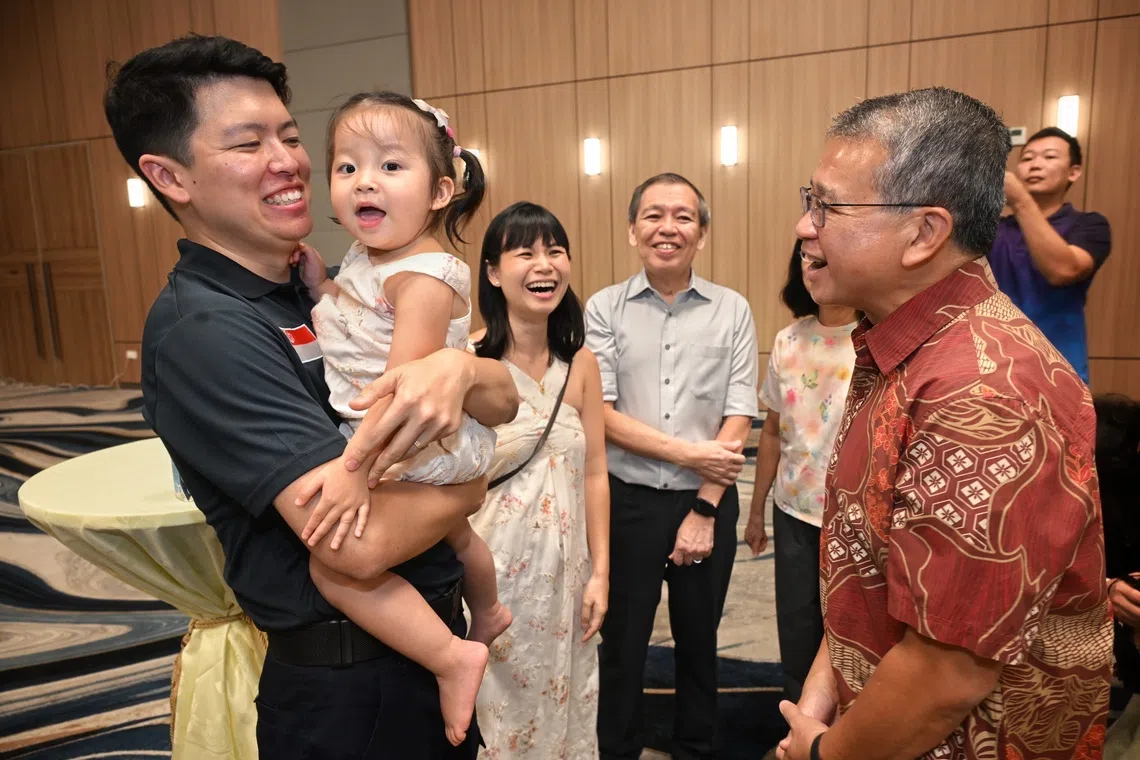
Law Minister Edwin Tong (right) mingling with fingerprint specialist, HTX Integrated Forensics Service Yong Heng Wei (left), and his family at the Welcome Home Reception for the Operation Vanguard Contingent on Sept 26.
ST PHOTO: CHONG JUN LIANG
Published Sep 26, 2026, 04:05 PM
Updated Sep 26, 2026, 04:05 PM
Singapore's Operation Vanguard contingent helped identify Nepal flood victims using fingerprint comparisons, post-mortem examinations.
The team trained Nepalese officers in drone operations for search and rescue, donating six drones to aid in inaccessible flood-affected areas.
Minister Edwin Tong praised the 35 officers for their professionalism and resilience during the deployment in difficult and unfamiliar conditions following the Aug 26 flood.
SINGAPORE - When two Nepalese families tried to claim the same body after the Aug 26 flood, Singaporean fingerprint specialist Yong Heng Wei was called to resolve the situation by conducting a fingerprint comparison.
Both families had said the body belonged to their next-of-kin based on the identifiable characteristics of the corpse, such as clothing and bodily features.
However, a fingerprint comparison done by Yong and his colleagues showed that the body belonged to neither family.
Yong, a fingerprint specialist at the Home Team Science and Technology Agency (HTX), was part of the 35-member Operation Vanguard contingent that was deployed to Nepal from Sept 1 to 18 to support Nepal’s disaster relief efforts.
The contingent, deployed at the request of the Nepali authorities , was made up of officers from the police, the Health Sciences Authority (HSA) and HTX.
The efforts of the contingent, as well as that of the more than 100 personnel involved, were recognised at a welcome home reception at HomeTeamNS Bedok Reservoir on Sept 26. Minister for Law Edwin Tong attended the event as the guest of honour.
The floods, which swept through parts of Tibet and Nepal, have claimed more than 1,450 lives . Over 5,700 are still missing, including nine Singaporeans .
The Singaporean contingent was involved in post-mortem examinations and fingerprint recording and identification. They also helped to train officers from the Nepal Police and Armed Police Force in drone operations.
Recounting the experience in Nepal, Yong, who is the officer-in-charge of HTX’s fingerprint examination team, said he and his colleagues had already returned to base, but were called back due to the urgency of the situation.
He said: “We compared (the deceased’s fingerprints) to the documents both families brought along, but unfortunately the body didn’t belong to either family.”
Yong said he had to use fingerprints that were recovered from the bodies, and match them with available records such as passports and missing persons records.
“It was quite challenging because not all bodies come with a usable set of fingerprints due to the damage done by the flood. Some bodies might also not have all fingers intact.”
Assistant Superintendent of Police Corelle Tan, who is a senior investigation officer in the criminal investigation department, was part of the team in volved in lifting fingerprints from the bodies found.
“When we arrived, it had already been about a week since the disaster. So a lot of the bodies and remains were in an advanced state of decomposition, as some of them were soaked in water and mud.”
As a result, Tan said they had to adapt, as some of the methods they learnt during their training could not be used .
It was also her first time being deployed overseas for a mission, and her first time encountering decomposed bodies on a large scale.
“There was definitely a lot of sensory overload, and I was operating in an unfamiliar environment. So that required constant self-regulation and focus.”
Another member of the contingent, forensic pathologist Benjamin Kuek from HSA , was involved in doing post-mortem examinations of the bodies.
This process involves documenting and examining the bodies for any distinguishing features which could help identify the deceased. This includes traits such a s gender, estimated age, tattoos moles and scars.
“One of the challenges was the scale and the condition of the bodies, which had differing degrees of decomposition and trauma, which can make the identification process difficult ,” Kuek said.
Besides identifying unique characteristics of each body, DNA samples are also collected, and the deceased’s teeth are also examined by a forensic dentist.
“The reconciliation process happens after we have the full complete postmortem data, and information from the family. There’s also additional information from the DNA analysis team and the fingerprint team.
“We need all this information together before the Nepali authorities can perform the reconciliation process,” he said.
The reconciliation process is where the deceased’s fingerprints or DNA is matched with their next-of-kin.
Senior Staff Sergeant Hasrin Hasmoon from the police, was one of the trainers who taught the Nepalese how to operate drones for search and rescue operations.
Hasrin and three other trainers conducted training lessons for 20 Nepalese officers, teaching them how to use the drones, and how to make use of its capabilities to locate flood victims.
The police also donated six drones to the Nepal police.
Hasrin said the drones are used in areas where rescue personnel cannot reach by foot.
He said that one of the challenges was navigating drone operations in a different environment compared to Singapore, as they were flying the drones 1,300 meters above the sea level, which resulted in stronger winds.
In Singapore, drones typically cannot be flown more than 60m above sea level.
He also had to navigate the language barrier when sharing his expertise on the drones.
“(The Nepalese officers) were very determined to learn, and we managed to communicate eventually,” he said.
At the reception, Minister for Law Edwin Tong thanked the officers for their service.
He said: “To all our 35 deployed officers — you’ve really represented Singapore with tremendous distinction. You left home at short notice and worked tirelessly in very unfamiliar and very challenging conditions, but carried out your duties with professionalism, with resilience, and with compassion.”
Claudia Tan is a journalist at The Straits Times covering the crime and court desk.
9月26日,律政部长唐振辉(右)在欢迎先锋行动特遣队凯旋招待会上与指纹专家HTX综合法证服务公司杨恒伟(左)及其家人亲切交谈。
《海峡时报》照片:梁崇俊
发布于 2026 年 9 月 26 日下午 4:05
更新于2026年9月26日下午4:05
新加坡“先锋行动”特遣队利用指纹比对和尸检帮助识别尼泊尔洪灾遇难者。
该团队培训了尼泊尔官员使用无人机进行搜救行动,并捐赠了六架无人机,以帮助进入难以到达的洪水灾区。
唐振辉部长赞扬了35名警员在8月26日洪水过后,在困难和陌生的环境下部署时所展现出的专业精神和韧性。
新加坡——8月26日尼泊尔洪灾后,两户尼泊尔家庭试图认领同一具遗体,新加坡指纹专家杨恒伟受邀进行指纹比对,以解决这一问题。
两家人都表示,根据尸体的可识别特征(如衣着和身体特征),尸体属于他们的近亲。
然而,Yong 和他的同事进行的指纹比对表明,这具尸体不属于这两个家族中的任何一个。
Yong是内政科技局(HTX)的一名指纹专家,他所在的35人“先锋行动”特遣队于9月1日至18日被部署到尼泊尔,以支持尼泊尔的救灾工作。
应尼泊尔当局的要求部署的这支队伍由警察、卫生科学局 (HSA) 和 HTX 的官员组成。
9月26日,在勿洛蓄水池举行的欢迎凯旋招待会上,该特遣队以及参与的100多名人员的努力得到了表彰。律政部长唐振辉作为主宾出席了此次活动。
席卷西藏和尼泊尔部分地区的洪水已造成超过1450人死亡,另有5700多人失踪,其中包括9名新加坡人。
新加坡代表团参与了尸检、指纹采集和身份识别工作。他们还协助培训了尼泊尔警察和武装警察部队的警员进行无人机操作。
HTX指纹鉴定小组负责人永在回忆起在尼泊尔的经历时说,他和同事们已经返回基地,但由于情况紧急,又被召回了。
他说:“我们将(死者的指纹)与两家人带来的文件进行了比对,但不幸的是,这具尸体不属于任何一方。”
Yong表示,他必须使用从尸体上提取的指纹,并将其与护照和失踪人员记录等现有记录进行比对。
“这相当具有挑战性,因为洪水造成的破坏导致并非所有遗体都能提取到可用的指纹。有些遗体甚至可能手指都不完整。”
刑事调查部门高级调查员、警司科雷尔·谭是参与从尸体上提取指纹的团队成员之一。
“我们到达时,灾难已经发生大约一周了。因此,很多尸体和遗骸都已高度腐烂,因为其中一些浸泡在水和泥浆中。”
因此,谭表示,他们不得不做出调整,因为他们在培训期间学到的一些方法无法使用。
这也是她第一次被派往海外执行任务,也是她第一次大规模接触腐烂的尸体。
“当时感官刺激非常强烈,而且我身处一个陌生的环境。所以,我需要不断地进行自我调节和集中注意力。”
另一名队员,来自 HSA 的法医病理学家 Benjamin Kuek,参与了尸体的尸检工作。
这个过程包括记录和检查尸体,寻找任何有助于识别死者身份的特征。这些特征包括性别、估计年龄、纹身、痣和疤痕等。
“其中一个挑战是尸体的数量和状况,尸体的腐烂程度和创伤程度各不相同,这会使身份识别过程变得困难,”郭说。
除了识别每具尸体的独特特征外,还会采集 DNA 样本,并由法医牙医检查死者的牙齿。
“在获得完整的尸检数据和家属提供的信息后,才会进行和解程序。此外,DNA分析团队和指纹鉴定团队也会提供补充信息。”
他说:“我们需要所有这些信息,尼泊尔当局才能开展和解进程。”
和解过程是指将死者的指纹或 DNA 与其近亲的指纹或 DNA 进行比对。
来自警察部队的高级警长哈斯林·哈斯蒙是教尼泊尔人如何操作无人机进行搜救行动的教官之一。
哈斯林和其他三名培训员为 20 名尼泊尔官员进行了培训课程,教他们如何使用无人机,以及如何利用无人机的功能来定位洪水受害者。
警方还向尼泊尔警方捐赠了六架无人机。
哈斯林表示,无人机用于救援人员步行无法到达的地区。
他表示,其中一个挑战是在与新加坡不同的环境下进行无人机操作,因为他们是在海平面以上 1300 米的高度飞行无人机,这导致风力更大。
在新加坡,无人机的飞行高度通常不能超过海平面以上 60 米。
在分享他在无人机方面的专业知识时,他也必须克服语言障碍。
他说:“(尼泊尔军官)学习的决心非常大,我们最终成功地进行了沟通。”
在招待会上,律政部长唐振辉感谢警员们的服务。
他说:“致我们所有35名部署人员——你们以卓越的表现代表了新加坡。你们在接到通知后迅速离开家乡,在非常陌生和充满挑战的环境中不知疲倦地工作,但始终以专业精神、韧性和同情心履行职责。”
Claudia Tan 是《海峡时报》的一名记者,负责报道犯罪和法庭新闻。